Auto Accident Lead Generation: Build a Verified Case Pipeline in 2026
October 4, 2026 by Mohr Marketing
What if more auto accident inquiries are making your case pipeline less reliable, not more? Lead volume can look strong while masking incomplete information, limited intent, or gaps in follow-up. Effective auto accident lead generation connects qualified demand with an intake process prepared to act on it.
Firms need more than a steady stream of names. They need a way to assess lead quality, understand how inquiries are sourced and delivered, and measure whether acquisition supports signed cases. Slow or inconsistent intake can undermine viable opportunities, so marketing and follow-up need to work as one system.
This guide explains how to evaluate verification and delivery models, match incoming opportunities to your team’s intake capacity, and track performance beyond raw lead counts. Mohr Marketing, LLC provides motor vehicle accident leads, verified inquiries, signed retainers, and legal intake services. With more than 30 years of industry experience, the company helps firms build a more transparent, measurable path from acquisition to case pipeline.
Key Takeaways
- Distinguish an initial inquiry from a verified contact, a qualified opportunity, and a signed retainer so each stage is measured clearly.
- Map the path from audience intent through validation, delivery, intake, and outcome tracking to identify where opportunities may be lost.
- Assess auto accident lead generation by contact validity, information completeness, stated intent, case fit, and delivery timing, not volume alone.
- Match the lead type and expected inquiry flow to your intake team’s capacity, ownership, and documented follow-up process.
- Compare inquiry-based leads, live transfers, and signed retainers by what each delivers and how it fits your firm’s acquisition workflow.
What Auto Accident Lead Generation Means for a Law Firm
Auto accident lead generation is the process of attracting and assessing inquiries from people who may be seeking help after a vehicle collision. It involves more than collecting a form or answering a call. As the broader concept of lead generation suggests, an inquiry enters a pipeline where its information and fit can be assessed before the firm decides what action to take.
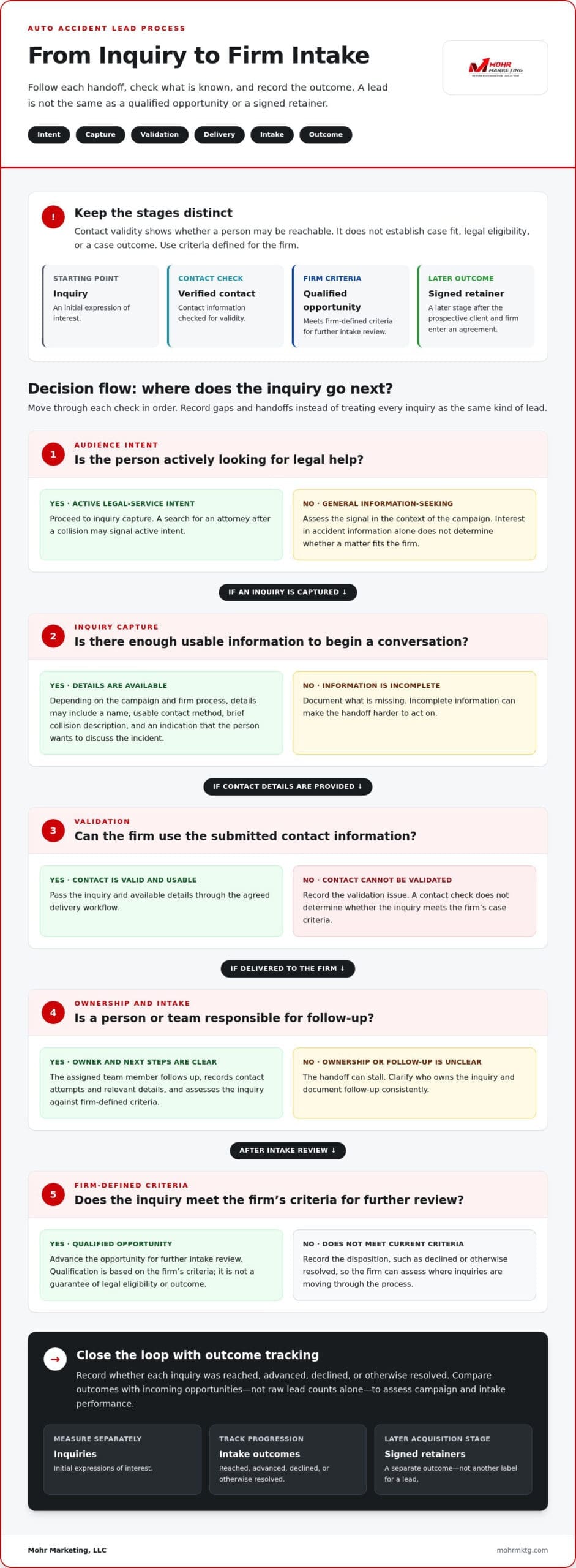
Keep the stages distinct. An inquiry is an initial expression of interest. A verified contact has contact information checked for validity. A qualified opportunity meets criteria the firm has defined for further intake review. A signed retainer represents a later stage: the prospective client has signed an agreement with the firm. These are different levels of progress, not interchangeable labels.
This distinction makes lead generation a pipeline function. Marketing attracts and captures interest; verification helps establish whether the firm can reach the person; intake gathers context and assesses fit under the firm’s criteria. Follow-up then determines whether the opportunity advances. Strong lead quality can support this process, but it cannot establish legal eligibility or guarantee a case outcome.
What counts as an auto accident lead?
An actionable inquiry needs enough information for the firm to identify the prospective claimant and begin a conversation. Depending on the campaign and the firm’s process, that may include a name, a usable contact method, a brief description of the collision, and an indication that the person wants to discuss the incident. These details help intake decide what to do next, but they do not establish whether the matter fits the firm.
Separate contact validity from case fit. A working phone number or email address indicates that contact may be possible. It does not show that the person meets the firm’s criteria, has a matter the firm handles, or is eligible to pursue a claim. Define screening criteria for your practice instead of treating any checklist as a universal standard.
How lead generation differs from case acquisition
Marketing creates an opportunity to engage. Intake assesses the inquiry, gathers relevant information, and moves it forward for the firm’s review. A lead may be valid but incomplete, or complete but outside the firm’s case criteria. Clear handoffs and consistent follow-up help keep these situations distinct.
A signed retainer is not simply a more detailed lead. It is a later acquisition outcome, after the prospective client and firm have taken steps to enter an agreement. Measuring inquiries and signed retainers separately gives firms a clearer view of pipeline movement, intake performance, and where follow-up may need attention. Auto accident lead generation works best when its criteria and measures reflect the firm’s process.
How Auto Accident Leads Move from Intent to Firm Intake
Auto accident lead generation works through a sequence of handoffs. A gap at any stage can leave an inquiry incomplete, misrouted, or waiting for a response. The channel mix and screening approach should reflect the campaign’s purpose and the firm’s criteria, not a one-size-fits-all checklist.
- Audience intent: A person may be actively looking for legal help after a collision or seeking general information about an accident. These actions signal different levels of intent.
- Inquiry capture: A search, paid media campaign, referral, or other channel prompts the person to call or submit information. The campaign should make the next step clear and collect information in a form the firm can use.
- Validation: Lead validation means checking submitted information for accuracy and usability.
- Delivery: The inquiry and available details are passed to the firm through the agreed workflow. Missing contact information or context can make the handoff harder to act on.
- Intake: An assigned team member reviews the information, follows up, records relevant details, and assesses the inquiry against firm-defined criteria.
- Outcome tracking: The firm records whether the inquiry was reached, advanced, declined, or otherwise resolved, then uses those outcomes to assess campaign and intake performance.
Where do auto accident inquiries originate?
Search, paid media, referrals, and other campaign channels can all generate inquiries. A search for an attorney after a collision may indicate active legal-service intent; a visit to a page about accident causes may reflect general information-seeking instead. Neither signal alone determines whether the matter fits a firm’s practice. Campaign strategy should shape how intent is assessed, while the firm defines what makes an opportunity appropriate for intake review. For broader context, firms can consult NHTSA traffic safety statistics.
What happens between lead delivery and intake review?
Delivery only creates value when ownership is clear. Assign each inquiry to a person or team, establish who is responsible for follow-up, and record contact attempts, qualification details, and the final disposition consistently. If information is incomplete, document what is missing. If follow-up is delayed or no one owns the handoff, a potentially useful inquiry can stall before the firm assesses it.
This record also connects acquisition to the return on legal intake services: firms can compare incoming opportunities with the outcomes their intake process advances, rather than judging performance by inquiry volume alone. Mohr Marketing’s acquisition and intake services are outlined on its contact page.
How to Assess Auto Accident Lead Quality and Acquisition Models
Lead quality is not a single score. A usable contact may still lack key details, show limited intent, or fall outside a firm’s case criteria. Assess each dimension separately, then compare delivery and intake outcomes. This gives firms a clearer basis for evaluating auto accident lead generation than raw volume alone.
Which quality signals matter beyond lead volume?
Set clear definitions for the measures that can be reviewed at delivery:
- Contact validity: Can the firm reach the person using the information provided?
- Completeness: Are the details needed for an initial conversation present, or is important context missing?
- Stated intent: Does the person appear to be seeking legal help, or gathering general accident information?
- Case fit: Does the inquiry meet the firm’s own criteria for further review?
- Timing and duplication: When was the inquiry submitted, and has the same person or inquiry already been received?
Where available, review source information, timestamps, and disposition data alongside these signals. This record can help identify whether an issue stems from campaign targeting, information capture, delivery, or intake follow-up. Keep delivery standards separate from eventual case outcomes. A provider can be assessed against agreed delivery terms and the information supplied, while the firm’s case-fit decisions and subsequent outcomes depend on factors beyond the initial inquiry.
How do lead and signed-case models differ?
In a pay-per-lead arrangement, payment is tied to inquiries delivered under defined terms. The firm’s intake team then determines whether each inquiry is reachable, complete, and suitable for further review. A live transfer is different: it connects the firm with a person by phone, so its value depends on the transfer experience and the firm’s ability to take over the conversation. Neither format is equivalent to a signed retainer.
A pay-per-signed-case model is tied to delivery of an executed retainer agreement. It supports a different workflow because the firm receives an opportunity at a later acquisition stage than an initial inquiry. Review what is delivered, which responsibilities remain with the firm, and how outcomes are documented.
Managed marketing can suit firms seeking a coordinated approach to acquisition and intake, while lead-based models may fit teams with established internal processes. The right structure depends on where the firm needs support and how it allocates responsibility and risk. For an example of documented motor vehicle accident opportunities, see police report-backed MVA cases.
How to Build an Auto Accident Lead Process Your Intake Team Can Handle
A reliable acquisition process starts with operational limits, not an arbitrary lead target. Before increasing campaign volume, determine how many inquiries your team can manage given its staffing and coverage hours. Then define the information intake needs, who owns each new inquiry, and how the firm will review results. This keeps auto accident lead generation aligned with the team’s capacity to respond and assess opportunities.
Set case criteria and response ownership
Document the firm’s relevant accident, claimant, and matter criteria before a campaign begins. Make them clear enough for intake staff to apply consistently, while leaving legal judgments to the appropriate firm personnel. Review the criteria as practice priorities or available capacity change, so incoming inquiries remain aligned with what the firm can handle.
Next, assign ownership. Identify who receives new inquiries, who follows up during each coverage period, and how an inquiry is reassigned or escalated if the owner is unavailable or the matter needs additional review. Match expected inquiry flow to staffing rather than assuming the team can absorb every increase. Each handoff should have a clear owner and a documented next step.
Use reporting to improve the acquisition process
Use a consistent record for each inquiry. Track when it was delivered, contact attempts, whether the person was reached, qualification details, signed-retainer status, and the reason it did not progress when applicable. These fields help distinguish a delivery issue from an intake bottleneck. For example, repeated difficulty reaching people may point to a need to review contact details or follow-up ownership; frequent disqualification for the same reason may signal a mismatch between campaign targeting and firm criteria.
Review the data regularly with both acquisition and intake in view. Compare delivered inquiries with contacts, qualified opportunities, and signed retainers. Look for patterns by source or delivery time where that information is available, then adjust criteria, assignments, or workflow as appropriate. Measurement helps locate process friction. It does not guarantee case results, which depend on factors beyond lead handling.
Keep the process practical: set criteria, assign ownership, document activity, and use outcomes to refine the handoff. Mohr Marketing’s acquisition goals and intake needs can be discussed through its contact page.
How Mohr Marketing Supports Auto Accident Case Acquisition
A dependable acquisition strategy connects the opportunities a firm seeks with the intake process it can support. Mohr Marketing brings more than 30 years of industry experience to that work, combining motor vehicle accident leads, verified inquiries, signed retainers, and legal intake services within a turnkey marketing and intake ecosystem. Its data-driven approach focuses on aligning acquisition activity with intake operations rather than treating lead volume as the only measure of progress.
Connect acquisition with verified opportunities
Verified inquiries give firms a structured starting point for intake review. They represent an opportunity to engage, not an automatic determination of case fit or a promise of a signed matter. The firm’s criteria and follow-up process remain essential to moving an inquiry forward.
Signed-retainer delivery is a distinct offering for firms seeking opportunities at a later stage of acquisition. It is different from an outcome guaranteed by every lead. Firms can assess which model aligns with their internal workflow, from handling initial inquiries through intake to receiving signed cases. For an example of a specialized acquisition option, review truck accident signed cases and verified call-transfer leads.
Choose the next step for your firm
Before evaluating a campaign, define your practice priorities, case criteria, and intake capacity. Then consider how delivery expectations, follow-up ownership, and outcome measurement fit together. These details help clarify whether your firm needs verified inquiries, signed retainers, legal intake support, or a coordinated combination of acquisition and intake services.
Founded in 1994, Mohr Marketing brings more than 30 years of industry experience to conversations about how auto accident lead generation can align with your firm’s goals, workflow, and capacity. Its approach focuses on a measurable acquisition process, not promises of case volume, conversions, or legal outcomes.
Build a Case Pipeline Your Team Can Manage
Reliable auto accident lead generation depends on more than attracting inquiries. Define what makes an opportunity relevant, assess each stage clearly, and align delivery with your intake team’s capacity. Then track contact, qualification, and signed-retainer outcomes to see where the process is working and where it needs attention.
Mohr Marketing connects motor vehicle accident leads, verified inquiries, signed-case offerings, and legal intake through a turnkey, data-driven approach. The company brings more than 30 years of industry experience to law firms working to strengthen acquisition and intake coordination. The focus is a clearer, more measurable pipeline, not a promise of case volume or results.
With defined criteria and a process built around your team’s capacity, you can make acquisition decisions with greater clarity and confidence.
Frequently Asked Questions
What is auto accident lead generation for law firms?
Auto accident lead generation is the process of attracting and assessing inquiries from people seeking legal help after a vehicle collision. It includes more than capturing a phone call or form submission: firms also need to consider contact validity, information provided, case fit, and intake follow-up. Mohr Marketing provides motor vehicle accident leads, verified inquiries, signed retainers, and legal intake services to support different stages of case acquisition.
How do law firms generate auto accident leads?
Law firms generate auto accident leads through campaigns that encourage people to request information or speak with the firm. Channels may include online search, paid media, referrals, and other marketing activity. The right mix depends on the campaign strategy and the firm’s priorities. Firms should distinguish active interest in legal help from general accident-related information seeking, then align inquiry capture and intake follow-up with their defined criteria.
What makes an auto accident lead qualified?
A qualified lead meets criteria the law firm has established for further review. Those criteria may address the incident, the prospective claimant, the type of matter, and whether the inquiry aligns with the firm’s practice. Valid contact details and complete information help intake take action, but they do not establish legal eligibility or guarantee that the firm will accept a case. Qualification standards should reflect each firm’s practice and capacity.
Are auto accident leads exclusive or shared?
Auto accident leads may be delivered exclusively to one firm or shared with multiple firms, depending on the arrangement. Exclusivity describes who receives an inquiry; it does not establish case fit or assure a signed retainer. Before evaluating performance, firms should understand the delivery terms and track whether inquiries are valid, timely, and aligned with their criteria. Consistent follow-up matters in either model.
What is the difference between an auto accident lead and a signed case?
An auto accident lead is an inquiry from a prospective claimant. A signed case refers to a later stage, after an agreement has been executed with the firm. The two represent different deliverables and points in the acquisition process. Mohr Marketing provides both motor vehicle accident leads and signed retainers, allowing firms to consider an option that fits their intake workflow without treating every inquiry as a signed matter.
How can a law firm measure auto accident lead quality?
Measure lead quality across separate indicators, including contact validity, information completeness, stated intent, fit with firm criteria, and delivery timing. Then compare delivered inquiries with contact attempts, qualified opportunities, signed retainers, and documented reasons for disqualification. Reviewing source and timestamp data where available can help identify process friction. Track these measures consistently to assess campaign performance and intake outcomes without relying on lead volume alone.
How quickly should a firm follow up with an auto accident inquiry?
A firm should establish a prompt follow-up standard that matches its staffing, coverage hours, and inquiry flow. Assign clear ownership for new inquiries, document contact attempts, and define how an inquiry is reassigned if the responsible team member is unavailable. Delays can make handoffs harder to manage, but a specific response-time target should reflect the firm’s operating capacity. Review follow-up records to identify missed or stalled inquiries.
Recent Posts
- Auto Accident Lead Generation: Build a Verified Case Pipeline in 2026
- Car Accident Case Acquisition: Strategic Law Firm Guide
- In-House vs. Outsourced Law Firm Marketing in 2026
Categories
- AI and Lead Generation
- Business Financing
- Call Verified MVA Leads
- Car Accident Help
- Car Accident Settlements
- Claimant Funding
- Compliance Program
- EMS-EMT Reports
- Geotargeting
- Google Maps Ranking
- Healthcare Practice Growth
- Law Firm Growth
- Law Office Operations
- Lead Generation
- Lead Generation For Attorneys
- Lead Generation For Chiropractors
- Lead Generation For Criminal Attorneys
- Lead Generation For D&A Treatment Centers
- Lead Generation For DUI Attorneys
- Lead Generation For Eye Doctors
- Lead Generation For Family Law Practices
- Lead Generation For PI Law Firms
- Lead Generation For Plastic Surgeons
- Leads For Healthcare Professionals
- Leads For Insurance Industry
- Legal Leads
- Legal Marketing
- Legal Updates
- Mass Tort Leads
- Medicare and Medicaid Leads
- Merchant Funding Leads
- Mold Leads
- Online Marketing Strategies
- Pre-Settlement Funding
- Signed MVA Cases
- Tort Updates
- Truck Accident Leads and Signed Cases
- Truck Accident Settlements
- Web Design