Tampon Lawsuit Client Acquisition: The 2026 Strategy for Mass Tort Firms
August 21, 2026 by Mohr Marketing
The dismissal of major PFAS class actions in 2025 didn’t end the opportunity for growth; it merely shifted the battlefield to heavy metal contamination. As of August 2026, firms are pivoting toward Otkina v. Procter & Gamble Co. and similar lead-related claims, yet many are burning through capital on unverified leads. You likely recognize the frustration of paying for high-cost leads only to find claimants who don’t meet the rigorous standards of medical causation. Mastering tampon lawsuit client acquisition in this climate requires more than just high volume. It demands a surgical approach to intake that filters out the noise before it hits your desk.
Mohr Marketing, LLC provides the blueprint to master the mechanics of acquiring high-value tampon litigation cases through a verified, results-driven intake ecosystem. We’ll show you how to move past the traditional lead vendor model and adopt a strategic partnership focused on speed-to-lead and rigorous verification. You’ll learn the exact protocols to lower your cost-per-acquisition while securing a predictable flow of signed retainers. We’re breaking down the shift from economic loss claims to high-stakes litigation; this ensures your firm stays ahead of the July 2026 FDA findings and state-level PFAS bans.
Key Takeaways
- Understand the 2026 regulatory shift from PFAS to heavy metal contamination and the scientific role of vaginal absorption in establishing liability.
- Differentiate between failure to warn and deceptive advertising legal theories to build stronger, more defensible case files.
- Master a streamlined tampon lawsuit client acquisition strategy by implementing a structured checklist that prioritizes claimants with documented reproductive health complications.
- Implement the Speed-to-Lead principle to contact potential claimants within five minutes, significantly increasing conversion rates through a turnkey intake ecosystem.
- Transition your firm to a Pay-Per-Signed-Case framework to eliminate financial risk and ensure a consistent flow of high-quality mass tort retainers.
The Landscape of Tampon Litigation in 2026
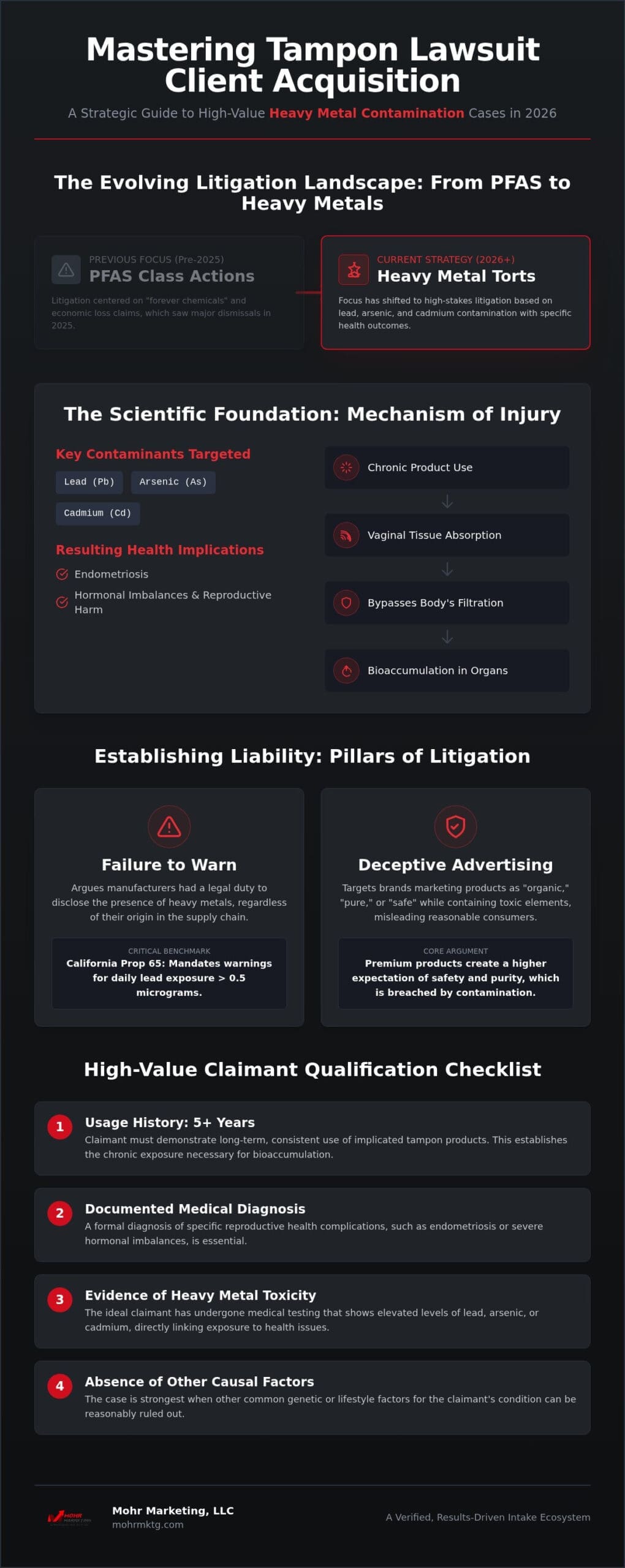
The legal environment surrounding menstrual products underwent a fundamental transformation following the July 2026 FDA report on trace metals. While previous years focused on PFAS and “forever chemicals,” the current litigation landscape centers on heavy metal contamination. The scientific foundation for these claims rests on the 2024 UC Berkeley study. This research proved that tampons from multiple brands contain measurable levels of toxic metals. Tampon litigation stands as a high-growth mass tort for 2026 because it combines a massive consumer base with a unique biological delivery system. Firms are shifting their focus from deceptive “clean” marketing to the concrete presence of lead, arsenic, and cadmium.
The 2026 FDA Report and Market Shift
The FDA’s July 2026 report confirmed the presence of metals but concluded that release levels were too low to cause immediate harm. This finding raised the threshold for medical causation significantly. For successful tampon lawsuit client acquisition, you can’t rely on simple product purchase history. You must now identify claimants with specific, documented health outcomes that contradict the FDA’s “low-risk” assessment. Regulatory oversight has tightened, making claimant eligibility dependent on long-term usage data. Liability has also expanded. Both organic and non-organic products are now implicated, as soil-based metal uptake affects all cotton-based manufacturing processes.
Key Contaminants and Health Implications
Litigation currently targets three primary contaminants: lead, arsenic, and cadmium. These aren’t just surface-level impurities. The mechanism of injury involves direct bloodstream absorption through highly permeable vaginal tissue. Unlike other routes of exposure, this bypasses the body’s natural filtration systems. Chronic exposure through monthly use leads to bioaccumulation in reproductive organs. This process is linked to serious complications, including endometriosis and hormonal imbalances. While the industry previously focused on acute conditions like Toxic Shock Syndrome (TSS), the 2026 strategy prioritizes the systemic impact of heavy metal toxicity. Successful firms will target cases where these specific health markers are present and documented by medical professionals.
Establishing Liability and Medical Causation
Success in tampon lawsuit client acquisition hinges on the ability to translate scientific data into actionable legal theories. While the 2026 FDA report confirmed metal presence, the burden of proof remains with the firm to establish that manufacturers were aware of these contaminants and chose not to act. Independent lab analysis is the only reliable way to demonstrate defendant liability. Many manufacturers operate with minimal oversight in their internal contaminant testing, often failing to screen for trace levels of lead, arsenic, or cadmium. Because the FDA regulates tampons as medical devices, firms must prove that these products deviated from the safety expectations of a reasonable consumer.
Failure to Warn vs. Deceptive Marketing
Litigation generally follows two distinct paths. Failure to warn claims argue that manufacturers had a duty to disclose the presence of heavy metals, regardless of how they entered the supply chain. In contrast, deceptive advertising claims target brands that marketed themselves as “organic,” “pure,” or “safe” while containing toxic elements. Reasonable consumers are led to believe these premium products are free from contaminants. California’s Proposition 65 standards, which mandate warnings for daily lead exposure exceeding 0.5 micrograms, now serve as a critical benchmark for national litigation strategies. These standards provide a concrete framework for arguing that the omission of such warnings constitutes a legal breach.
Establishing the Nexus of Causation
Firms must teach their intake teams to look for a specific nexus of causation. You cannot build a viable case on product usage alone. You need to link long-term usage, typically five years or more, to specific reproductive health outcomes. Diagnostic markers are essential. Look for claimants who have undergone medical testing for heavy metal toxicity or have documented conditions like endometriosis where no other genetic or lifestyle factors are present. Optimizing your tampon lawsuit client acquisition funnel means filtering for these specific medical markers early. Strategic partners can help you refine your criteria to ensure every signed retainer meets the high threshold of medical causation required for 2026 litigation.
Qualifying High-Value Claimants: Criteria and Checklist
Effective tampon lawsuit client acquisition requires a shift from broad marketing to clinical qualification. A general inquiry merely indicates interest; a qualified claimant possesses the specific medical and product-use profile necessary to survive discovery. Consistent brand loyalty is the most significant high-value marker. It proves long-term, chronic exposure to heavy metals like lead and arsenic. If a claimant switched brands frequently, establishing which manufacturer’s product caused the bioaccumulation becomes a complex legal hurdle. Firms must prioritize those who used a single implicated brand for a decade or more to simplify the path to liability.
Primary Health Complications in Litigation
High-priority litigation focuses on three core conditions: endometriosis, infertility, and ovarian cancer. These diagnoses provide the strongest link to the heavy metal contaminants identified in the 2024 and 2026 studies. Secondary complications, such as neurological function reduction and organ damage, are also viable but require more extensive expert testimony. You must ensure your intake team understands that a self-reported diagnosis isn’t enough. Every file needs medical records that pre-date the litigation’s public announcement to avoid “litigation-driven” diagnostic claims. Referencing the FDA Tampon Safety Guidelines provides a baseline for consumer expectations, but your case will rest on the manufacturer’s failure to disclose contaminants that these guidelines don’t explicitly test for.
Case Qualification Checklist
Intake teams often waste time on leads that lack the necessary exposure duration. In 2026, the standard for a viable case requires a clear history of use. Verification of brand purchase history for products like Tampax Pearl or L Brand is essential. Use this staccato list to audit your tampon lawsuit client acquisition files:
- Must-Have: Minimum 5 to 10 years of consistent brand usage.
- Must-Have: Documented diagnosis of primary reproductive health complications.
- Must-Have: Usage occurring within the applicable statute of limitations (typically 3 to 6 years from discovery).
- Nice-to-Have: Digital receipts or Amazon/Target purchase history.
- Nice-to-Have: Laboratory results showing elevated heavy metal levels in the bloodstream.
- Nice-to-Have: No prior history of the specific health condition in the claimant’s family.
Filtering for these data points at the first point of contact ensures your firm only invests in high-intent opportunities. This precision is what separates high-performing firms from those struggling with low conversion rates and unverified leads.
Optimizing the Intake Ecosystem for Conversion
The Mohr Marketing, LLC Method treats legal intake as a high-precision manufacturing process. It eliminates the friction between initial interest and a signed retainer. Success in tampon lawsuit client acquisition depends on the “Speed-to-Lead” principle. You must contact claimants within five minutes of their inquiry. Data shows conversion rates drop significantly after this window. A 24/7 intake ecosystem is mandatory for national campaigns. Claimants don’t follow a 9-to-5 schedule. Your firm shouldn’t either. If you aren’t available when they are, your competitors will be. Every missed call is a lost opportunity for a high-value retainer.
The Mechanics of Mass Tort Intake
Structure the first call to move from qualification to execution immediately. Use the “One-Call Close” strategy for signed retainers. This involves verifying medical history and product usage while the claimant is still engaged. Don’t let them hang up without a digital signature. Every minute that passes between the call and the retainer execution increases the risk of claimant drop-off. The verification process must be rigorous. Cross-reference claimant data against known brand contamination dates and the specific reproductive health markers identified in the qualification checklist. This prevents your legal team from wasting time on unviable files. High-performing intake teams use a script that balances empathy with clinical precision to ensure data integrity at the point of entry.
Bypassing Inefficient Intermediaries
Shared lead aggregators are a liability in high-stakes litigation. They often sell the same inquiry to multiple firms. This creates a race to the bottom that destroys your margins and frustrates potential claimants. Exclusive, high-intent inquiries are the only way to maintain case quality. You need a partner who controls the entire funnel from the first advertisement to the final signature. This direct-to-retainer model eliminates the “middleman tax” and ensures higher case integrity. Performance-based marketing models ensure that your capital is invested in results, not promises. For firms seeking turnkey solutions, Mass Tort Signed Cases offer a direct path to growth without the mess of bulk lead purchases.
Scaling Your Practice with Verified Signed Retainers
In 2026, the Pay-Per-Signed-Case model is the definitive industry standard for high-stakes mass torts. Relying on unverified lead volume is a legacy strategy that no longer works. It’s too slow. It’s too expensive. Success in tampon lawsuit client acquisition requires a shift toward performance-based partnerships. This model transfers the financial risk from your firm to the marketing partner. You don’t pay for “potential” or “interest.” You pay for fully executed retainers. This ensures every dollar in your marketing budget produces a tangible asset for your litigation portfolio. Data-driven growth is no longer optional; it’s the baseline for national firm expansion.
The Performance Model: Risk Mitigation for Firms
The ROI of Pay-Per-Lead (PPL) is notoriously inconsistent. You spend capital on contact information that often fails to convert into a viable case. Pay-Per-Signed-Case (PPSC) eliminates this uncertainty. You only pay for claimants who’ve passed the rigorous medical and brand-usage verification protocols we’ve established. This includes documented long-term usage and specific reproductive health complications. It’s a surgical approach to growth. By only paying for fully executed retainer agreements, you protect your firm’s cash flow. You’re buying verified, high-intent opportunities that are ready for discovery. This is the only way to build a high-quality case inventory in a hyper-competitive market.
Turnkey Acquisition and National Scaling
Growth shouldn’t be a slow process. Our infrastructure allows you to launch or scale a national campaign in under 48 hours. We use pre-vetted digital channels and an established intake ecosystem to capture high-intent inquiries immediately. This isn’t a “test and see” approach. It’s a proven mechanism for rapid expansion. Transparent, data-driven reporting provides total visibility into your campaign’s performance. You track every signature in real-time. This level of precision allows for aggressive scaling across all 50 states without the risk of overextension. Scale your tampon litigation practice with Mohr Marketing, LLC to secure your market share before the window for these claims narrows.
The Mohr Marketing, LLC Advantage is built on 30 years of industry experience. We provide a turnkey solution that eliminates the friction of traditional intake. We handle the speed-to-lead, the medical screening, and the signature execution. Your firm receives high-quality cases that meet the 2026 heavy metal litigation standards. This is a strategic partnership designed for professionals who value efficiency and tangible outcomes. We aren’t just a vendor; we’re the engine for your firm’s expansion into the tampon litigation space. You focus on the law; we’ll deliver the cases.
Dominating the 2026 Tampon Litigation Market
Success in this evolving mass tort requires a departure from outdated lead-buying habits. The 2026 landscape is defined by the rigorous verification of heavy metal exposure and documented medical causation. Firms that prioritize high-intent inquiries and rapid intake protocols will secure the most viable cases before the market saturates. Strategic tampon lawsuit client acquisition isn’t just about volume; it’s about the precision of your intake ecosystem and the reliability of your data. By focusing on long-term brand loyalty and specific reproductive health markers, your firm builds a portfolio that can withstand the scrutiny of discovery.
Mohr Marketing, LLC provides the infrastructure needed to scale. With 30+ years of legal marketing expertise and a turnkey intake and signing ecosystem, we eliminate the friction of claimant conversion. Our performance-based acquisition model ensures you only invest in results, not promises. It’s time to move past inefficient intermediaries and adopt a risk-mitigation strategy that works.
Position your firm at the forefront of this high-growth litigation and start building your case inventory now.
Frequently Asked Questions
What are the current eligibility requirements for a tampon lawsuit?
Eligibility currently requires documented use of implicated tampon brands for 5 to 10 years and a clinical diagnosis of a related reproductive condition. Primary conditions include endometriosis, infertility, and ovarian cancer. Claimants must have used the products within the applicable state-specific statute of limitations. Verification of purchase history through digital receipts or Amazon records significantly strengthens the case file during the discovery phase of litigation.
Which tampon brands are currently being targeted in class action litigation?
Litigation currently targets major manufacturers of both organic and non-organic cotton products. Specifically, brands like Tampax Pearl and L Brand are central to consumer class actions following the 2024 and 2026 studies on lead and arsenic. These lawsuits allege that manufacturers failed to disclose heavy metal contaminants. Any firm entering this space should focus on products with a documented history of contamination to ensure defendant liability is clearly established.
How much does it cost to acquire a signed retainer for tampon litigation?
In 2026, the estimated cost to acquire a signed personal injury case is between $700 and $1,600. Mass tort campaigns currently see a cost per qualified lead between $150 and $275. These costs vary based on exclusivity and the specific criteria required for qualification. Effective tampon lawsuit client acquisition strategies focus on the total cost-per-signed-case rather than raw lead volume to ensure a sustainable return on investment.
What is the difference between a raw lead and a verified signed case?
A raw lead is merely the contact information of an interested party; whereas, a verified signed case is a fully executed retainer. Raw leads often suffer from low conversion rates and unverified medical histories. Verified signed cases have passed through a rigorous screening ecosystem to confirm product usage and specific health complications. This model eliminates the financial risk for your firm, as you only pay for cases that meet established criteria.
How long is the statute of limitations for tampon heavy metal claims?
The statute of limitations for heavy metal claims generally ranges from 3 to 6 years from the date the harm was discovered. This timeframe varies by state jurisdiction. Because heavy metal toxicity involves bioaccumulation over time, the discovery rule is often a central point of legal contention. Firms must act quickly to secure retainers before these windows close, as delays in intake can result in high-value cases becoming barred by time.
Can my firm scale acquisition nationally without a local presence?
Firms can scale their tampon lawsuit client acquisition nationally without maintaining a physical local presence. Digital marketing and turnkey intake ecosystems allow for centralized management of national campaigns across all 50 states. This approach utilizes 24/7 intake services to capture inquiries across all time zones immediately. By partnering with a veteran marketing strategic partner, firms can launch national operations in under 48 hours to capture market share before regional competitors react.
What health complications carry the highest settlement value in these cases?
Ovarian cancer and infertility diagnoses currently carry the highest potential settlement values due to the severity of the harm and associated medical costs. Endometriosis is another high-value complication, particularly when it leads to documented surgical intervention. These conditions provide a clear link to the systemic impact of heavy metal absorption through vaginal tissue. Cases involving these diagnoses are prioritized because they represent the most significant medical damages and carry the strongest scientific foundation.
How does Mohr Marketing, LLC verify the medical causation of claimants?
Our verification protocol involves a multi-step screening process within our proprietary intake ecosystem. We cross-reference the claimant’s product usage history with established contamination windows for specific brands identified in the 2026 reports. Our team then verifies that the health complications align with the diagnostic markers for heavy metal toxicity. Mohr Marketing, LLC uses this rigorous protocol to ensure every signed retainer delivered to your firm meets the necessary legal standards for medical causation.

Recent Posts
- Bar-Compliant Legal Marketing: 2026 Guide for Law Firms
- Auto Accident Lead Generation: Build a Verified Case Pipeline in 2026
- Car Accident Case Acquisition: Strategic Law Firm Guide
Categories
- AI and Lead Generation
- Business Financing
- Call Verified MVA Leads
- Car Accident Help
- Car Accident Settlements
- Claimant Funding
- Compliance Program
- EMS-EMT Reports
- Geotargeting
- Google Maps Ranking
- Healthcare Practice Growth
- Law Firm Growth
- Law Office Operations
- Lead Generation
- Lead Generation For Attorneys
- Lead Generation For Chiropractors
- Lead Generation For Criminal Attorneys
- Lead Generation For D&A Treatment Centers
- Lead Generation For DUI Attorneys
- Lead Generation For Eye Doctors
- Lead Generation For Family Law Practices
- Lead Generation For PI Law Firms
- Lead Generation For Plastic Surgeons
- Leads For Healthcare Professionals
- Leads For Insurance Industry
- Legal Leads
- Legal Marketing
- Legal Updates
- Mass Tort Leads
- Medicare and Medicaid Leads
- Merchant Funding Leads
- Mold Leads
- Online Marketing Strategies
- Pre-Settlement Funding
- Signed MVA Cases
- Tort Updates
- Truck Accident Leads and Signed Cases
- Truck Accident Settlements
- Web Design