Car Accident Case Acquisition: Strategic Law Firm Guide
October 3, 2026 by Mohr Marketing
What if more car accident inquiries are adding workload without producing more signed cases? Car accident case acquisition is not simply a volume target. It is a connected process: when lead quality, qualification, and intake do not align, promising inquiries can fall through before a retainer is signed.
Law firms need consistent criteria for assessing inquiries and a reliable way to measure what happens after a campaign generates interest. More leads alone do not show whether acquisition is working. A more useful measure is how effectively qualified opportunities move through intake to signed retainers.
This guide explains how to build a measurable process that connects campaign intent, inquiry qualification, and follow-up. You will learn how to define quality, track performance through signed cases, compare acquisition models by outcomes rather than volume, and make compliance part of a scalable approach. The goal is a process your firm can assess and refine around its priorities.
Key Takeaways
- Map the path from initial inquiry to signed retainer, and define each stage so your team can assess progress consistently.
- Set acquisition priorities around your firm’s case criteria, capacity, and intended client profile before shaping campaign messaging.
- Compare pay-per-lead, pay-per-signed-case, and managed marketing by the outcome each model delivers, not just by inquiry volume.
- Make car accident case acquisition measurable by tracking the source and defined funnel stages through to signed-case reporting.
- Evaluate delivery definitions, verification, reporting, and model fit when selecting an acquisition partner.
What Car Accident Case Acquisition Means for a Law Firm
Car accident case acquisition is the process of attracting prospective clients, assessing whether their inquiries fit a firm’s criteria, and moving suitable opportunities through intake toward a signed retainer. It is a full-funnel business process, not a count of names or calls. As part of the broader discipline of legal marketing, it connects campaign intent to the outcome a firm values: an appropriate prospective client choosing to retain the firm.
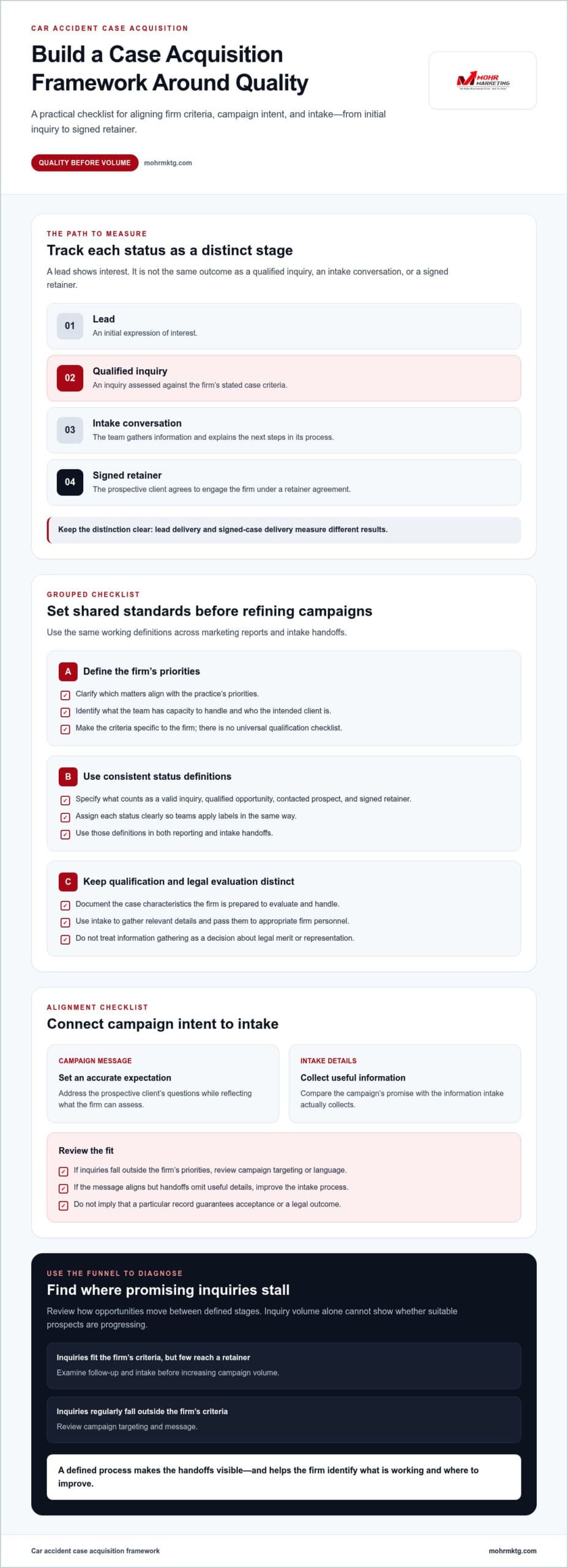
Each stage has a distinct status. A lead is an initial expression of interest. A qualified inquiry has been assessed against the firm’s stated case criteria. An intake conversation is when the team gathers information and explains the next steps in its process. A signed retainer is a separate outcome: the prospective client has agreed to engage the firm under a retainer agreement.
How is a car accident lead different from an acquired case?
A lead indicates interest, not representation or a retained client. Qualification helps the firm determine whether an inquiry aligns with its priorities. Intake advances the conversation and supports a decision about next steps. For example, a person may ask about a collision but not meet the firm’s criteria or proceed to sign. Lead delivery and signed-case delivery therefore measure different results.
That distinction matters when comparing acquisition approaches. A model that delivers inquiries should be evaluated on the inquiries it provides. A signed-case model is tied to a later outcome. The same distinction between inquiry and case acquisition applies in other practice areas, including high-value mold case acquisition.
Why do firms need an acquisition system rather than more leads?
Inquiry volume alone cannot show whether campaigns are producing suitable opportunities or whether intake is moving them forward. A system connects campaign intent, qualification, and intake in sequence. If those stages use inconsistent definitions or lack clear handoffs, a firm may see inquiries arrive without knowing where promising prospects stall.
Make the handoffs visible. Define what counts as an inquiry, who assesses fit, when intake begins, and how the team records a signed retainer. Then review how opportunities move between stages. If inquiries fit the firm’s criteria but few progress to a retainer, examine follow-up and intake before increasing campaign volume. If inquiries regularly fall outside the criteria, review the campaign’s targeting and message. No lead source guarantees a signed case. A defined process helps the firm identify what is working and where to improve.
Build a Car Accident Case Acquisition Framework Around Quality
Quality starts with the firm, not a universal checklist. Before refining campaigns, clarify which matters align with the practice’s priorities, what the team has capacity to handle, and who the intended client is. These decisions shape a useful car accident case acquisition framework: one that attracts relevant inquiries and gives intake staff a consistent basis for routing and assessment.
Turn those priorities into shared working definitions. Specify what your team means by a valid inquiry, a qualified opportunity, a contacted prospect, and a signed retainer. Use the same labels in marketing reports and intake handoffs. If one team marks an inquiry “qualified” based on initial information while another uses the label only after a fuller review, performance comparisons become unreliable.
Which qualification criteria should a firm define first?
Document the case characteristics the firm is prepared to evaluate and handle. Also distinguish information gathering from legal evaluation. Intake can capture relevant details and pass them to the appropriate firm personnel. It should not be confused with deciding legal merit or whether to provide representation. Define criteria in plain language, assign each status clearly, and use the same definitions in reporting and handoffs.
Criteria should reflect the firm’s actual priorities and capacity. Details such as the collision circumstances, reported injuries, available documentation, or timing may be relevant for a firm to assess, but they are not universal qualification rules. Avoid adopting a checklist without determining whether it fits your practice. A consistent, firm-specific standard is more useful than a rigid formula applied to every inquiry.
How should campaign intent align with case criteria?
Campaign messaging should address the questions a prospective client is trying to resolve while accurately reflecting what the firm can assess. For example, a message focused on documentation should not imply that a particular record guarantees acceptance or a legal outcome. Documentation can be one consideration in a firm’s assessment, alongside its other stated criteria.
Compare the promise in each campaign with the information intake collects. If a message attracts inquiries about situations the firm does not prioritize, refine the targeting or language. If the message aligns but handoffs omit useful details, improve the intake process. This feedback loop helps distinguish a campaign-fit issue from a qualification or operational issue, without treating any lead source as a guarantee of signed cases.
For firms refining this framework, discussing your acquisition priorities can help connect campaign objectives with lead or signed-retainer outcomes.
Compare Car Accident Case Acquisition Models by Delivered Outcome
Acquisition models differ in what they define as delivery. Mohr Marketing offers pay-per-lead, pay-per-signed-case, and managed digital marketing models. Compare them by the result delivered, the definitions used to classify that result, and how performance is reported. The right fit depends on your firm’s priorities, intake capacity, and whether you want to purchase inquiries, signed retainers, or marketing management.
What does a pay-per-lead model measure?
A pay-per-lead model ties payment to verified inquiries delivered for a specific legal practice area. Before reviewing results, define what counts as a valid inquiry and what verification means in your process. Then assess whether the records meet those definitions. Lead delivery is an acquisition input, not a signed case. Your team’s contact, qualification, and legal evaluation processes remain important downstream stages, and their results should be tracked separately.
This model can suit firms that want to receive inquiries and manage the next steps through their own intake process. Assess performance using consistent definitions and reporting periods. For example, compare valid inquiries delivered over a defined period with the number contacted, qualified, and advanced through the firm’s process. Without shared definitions, a reported lead total may not support a meaningful comparison.
How does pay-per-signed-case acquisition differ?
Pay-per-signed-case ties delivery to an executed retainer agreement rather than an inquiry. That places the measured outcome further along the acquisition process, but lead delivery and signed-case delivery are not interchangeable. Firms should define what qualifies as a completed retainer, how delivery is documented, and which reporting period applies. Signed retainers are also relevant to other legal matters, including truck accident cases.
Managed marketing is different again. Rather than defining delivery solely as an individual lead or signed retainer, this model focuses on managing digital marketing activity. Compare it by the work and reporting included in the arrangement, and by how clearly campaign activity connects to inquiry and case outcomes. The model itself does not determine the number or quality of cases.
For a fair comparison, align the evaluation:
- Outcome: Compare inquiries with inquiries, or signed retainers with signed retainers.
- Definitions: Establish shared criteria for validity, qualification, and completed delivery.
- Reporting period: Use the same timeframe when reviewing sources and downstream results.
- Firm contribution: Account for intake and evaluation processes that occur after an inquiry arrives.
This makes car accident case acquisition easier to assess without treating one model as the universal winner. Choose based on the outcome your firm wants to purchase and the internal process available to act on it.
Measure and Improve the Case Acquisition Funnel
A useful dashboard follows each opportunity from its source to its final status. For car accident case acquisition, consistent stage definitions matter as much as the totals. Teams need to know what each record represents before comparing campaign performance or intake results.
Use a sequence that makes movement and drop-off visible:
- Source: Record the campaign or channel associated with each inquiry so results can be traced to their origin.
- Inquiry: Log each initial expression of interest using a consistent counting method.
- Verification: Apply the agreed validity criteria and record whether the inquiry meets them.
- Contact: Track whether the team reached the prospective client, and document the status of follow-up.
- Qualification: Record whether the inquiry fits the firm’s stated criteria after assessment.
- Retainer: Report whether the opportunity advanced to a signed retainer, using a clear definition of completed delivery.
Which acquisition metrics should a firm review?
Review delivered inquiries against the validity and qualification definitions agreed for the campaign. Then measure how opportunities progress through contact, evaluation, and signed retainer. Compare costs and outcomes over consistent reporting periods, and measure each model against the outcome it delivers. A lead count and a signed-retainer count answer different questions.
Keep stage definitions stable during comparisons. If “contacted” means a call attempt in one report and a completed conversation in another, the figures cannot be interpreted on equal terms. Record missing statuses as missing rather than treating them as successful progression. Reliable reporting depends on consistent data, not optimistic assumptions.
How can firms identify funnel friction?
Find where opportunities stop advancing or where usable status information disappears. A high volume of unverified inquiries may call for a closer review of campaign intent and validity criteria. Qualified inquiries without a recorded contact outcome may point to a handoff or intake-tracking gap. If contact is documented but few prospects progress, examine intake handling and the firm’s evaluation process before changing campaign strategy.
Review the full sequence before assigning a cause. Campaign messaging, inquiry quality, handoff clarity, and intake operations can all affect what the final report shows. Where practical, change one relevant process at a time, then compare results using the same definitions and reporting period. This supports informed decisions without relying on unsupported benchmarks or assuming that a specific change will improve conversion.
Choose a Car Accident Case Acquisition Partner for Scalable Growth
A partner should fit the firm’s acquisition priorities and operating capacity, not simply deliver activity. Evaluate how clearly it defines an inquiry, verification, qualification, and completed delivery. Then assess whether its model matches your goal: receiving motor vehicle accident leads, acquiring signed retainers, or managing digital marketing as part of a broader growth process.
What should an acquisition partnership make clear?
Set expectations before evaluating results. The partnership should clearly define what counts as a delivered lead or signed retainer, how qualification terms are applied, what reporting covers, and how opportunities move into the firm’s intake process. Require enough visibility to understand what was delivered and how it aligns with your case priorities. Clear definitions reduce disagreements over status and make performance easier to assess.
Operational fit matters just as much. A firm with capacity to manage its own inquiry follow-up may prefer lead delivery. A firm prioritizing executed retainers may prefer a signed-case model. Managed digital marketing offers another approach for firms seeking support across marketing activity. Each model has a different delivery focus, so compare it with your team’s intake capacity and reporting needs rather than assuming one option suits every firm.
Make compliance an ongoing operational consideration. Review how campaign execution, messaging, and verification processes are handled, and keep the firm’s priorities and communication expectations clear. The goal is a transparent working relationship with shared definitions, usable reporting, and a clear handoff, not an unsupported promise about case outcomes.
How can a firm take the next step?
Start with a focused discussion about your acquisition goals, case criteria, intake capacity, and preferred delivery outcome. Mohr Marketing serves law firms nationally with motor vehicle accident leads, signed retainers, legal intake services, and managed digital marketing. Founded in 1994, the company brings more than 30 years of industry experience to an integrated marketing and intake ecosystem. These services can support firms evaluating how to structure car accident case acquisition around their priorities.
Build a More Predictable Acquisition Process
Strong car accident case acquisition connects firm priorities to the path from inquiry to signed retainer. Define what makes an opportunity a fit, align campaign messaging with those criteria, and measure each stage using consistent terms. This gives your team a clearer view of whether performance depends on campaign alignment, intake handling, or both.
Choose a delivery model that fits your capacity and goals. Pay-per-lead, pay-per-signed-case, and managed digital marketing serve different needs. Compare outcomes using consistent definitions rather than volume alone.
Mohr Marketing serves law firms nationally and brings more than 30 years of industry experience. Its offerings include motor vehicle accident leads, signed retainers, legal intake, and managed marketing models to support different acquisition priorities.
A disciplined system makes growth easier to assess and refine. Set clear priorities, track what matters, and improve the process using what the results show.
Frequently Asked Questions
What is car accident case acquisition?
Car accident case acquisition is the process of attracting prospective clients, assessing inquiries against a firm’s criteria, and moving suitable opportunities through intake toward a signed retainer. It includes more than generating leads. Campaign intent, inquiry validity, qualification, follow-up, and retainer outcomes all affect how firms evaluate performance. Defining these stages clearly helps teams understand what a marketing effort delivered and where opportunities progress or stall.
How can a law firm acquire more car accident cases?
A firm can strengthen acquisition by aligning campaign messaging with its case priorities and capacity, then moving inquiries through a consistent intake process. Define the intended client profile and qualification criteria before assessing campaign fit. Track inquiries from source through contact, evaluation, and retainer, then review where progression slows. More volume alone may not address a mismatch between campaign intent, inquiry quality, and the firm’s ability to follow up.
What is the difference between car accident leads and signed cases?
A car accident lead is an initial expression of interest, while a signed case is a later delivery outcome tied to an executed retainer agreement. Lead delivery gives the firm an inquiry to assess and handle through its intake process. Signed-case delivery is measured at the retainer stage. Report these outcomes separately because receiving an inquiry does not mean the prospective client has retained the firm.
How should law firms measure car accident case acquisition?
Track each opportunity from its source through inquiry, verification, contact, qualification, and signed retainer. Use consistent definitions for every stage and compare results over the same reporting period. Review delivered inquiries and their progression, including whether records have usable status information. This allows a firm to distinguish campaign performance from intake handling and evaluate cost in relation to the outcome being measured, rather than relying on inquiry counts alone.
Is pay-per-signed-case better than pay-per-lead for car accident firms?
Neither model is universally better. Pay-per-lead ties delivery to inquiries that meet agreed criteria, while pay-per-signed-case ties delivery to executed retainer agreements. The relevant choice depends on the firm’s preferred outcome, intake capacity, and ability to assess opportunities after delivery. Compare models using clear definitions and like-for-like reporting. A signed-case model measures a later stage, but the firm still needs to assess fit and operational alignment.
How can firms support compliance in car accident case acquisition?
Firms can support compliance by treating campaign messaging, verification processes, and partner coordination as ongoing operational considerations. Establish internal review procedures for marketing materials and make expectations clear to the teams and partners involved. Keep records and reporting definitions transparent so the firm can understand how inquiries are generated and handled. Because requirements and review practices can vary, align acquisition activity with the firm’s own compliance processes.
Recent Posts
- Car Accident Case Acquisition: Strategic Law Firm Guide
- In-House vs. Outsourced Law Firm Marketing in 2026
- Signs You Need a New Lead Generation Partner: A Law Firm Guide
Categories
- AI and Lead Generation
- Business Financing
- Call Verified MVA Leads
- Car Accident Help
- Car Accident Settlements
- Claimant Funding
- Compliance Program
- EMS-EMT Reports
- Geotargeting
- Google Maps Ranking
- Healthcare Practice Growth
- Law Firm Growth
- Law Office Operations
- Lead Generation
- Lead Generation For Attorneys
- Lead Generation For Chiropractors
- Lead Generation For Criminal Attorneys
- Lead Generation For D&A Treatment Centers
- Lead Generation For DUI Attorneys
- Lead Generation For Eye Doctors
- Lead Generation For Family Law Practices
- Lead Generation For PI Law Firms
- Lead Generation For Plastic Surgeons
- Leads For Healthcare Professionals
- Leads For Insurance Industry
- Legal Leads
- Legal Marketing
- Legal Updates
- Mass Tort Leads
- Medicare and Medicaid Leads
- Merchant Funding Leads
- Mold Leads
- Online Marketing Strategies
- Pre-Settlement Funding
- Signed MVA Cases
- Tort Updates
- Truck Accident Leads and Signed Cases
- Truck Accident Settlements
- Web Design