Personal Injury Client Intake Best Practices 2026: The Ultimate Efficiency Checklist
July 26, 2026 by Mohr Marketing
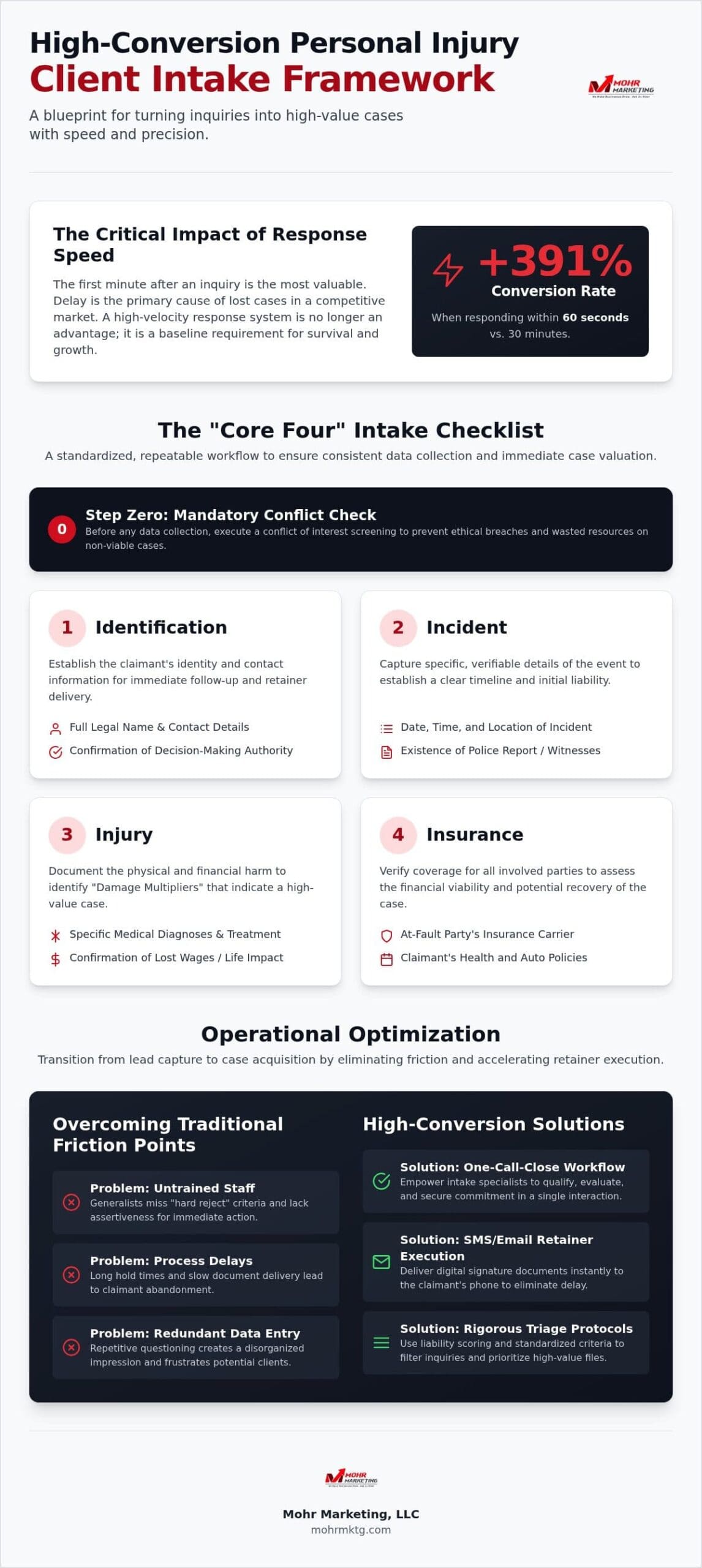
Responding to a lead within sixty seconds increases your conversion rate by 391 percent compared to waiting just thirty minutes. In a 2026 market where competitors are aggressive and lead-to-case drop-off rates are climbing, your personal injury client intake process is no longer an administrative task; it is a critical revenue-generating system. You likely feel the drain of wasted time on unqualified inquiries and the sting of losing high-value cases to faster firms. It’s frustrating to see marketing spend yield inconsistent data instead of signed retainers.
This article provides the high-conversion intake frameworks used by top-tier firms to stop the bleed and start scaling with precision. You’ll learn how to implement a standardized, repeatable workflow that ensures every inquiry is verified and every retainer is executed with speed. We will examine the specific mechanics of data collection and the technological shifts, such as AI-driven scoring, that allow elite practices to maintain a dominant market position. This is your blueprint for turning raw leads into high-value assets without the friction of traditional, manual methods.
Key Takeaways
- Transition from passive intake to a high-speed conversion funnel to capture high-intent claimants before competitors can intervene.
- Standardize your personal injury client intake process by utilizing the “Core Four” framework to ensure consistent data collection and immediate case valuation.
- Apply rigorous triage protocols and liability scoring at the front door to filter out unqualified inquiries and prioritize high-value files.
- Accelerate case acquisition through one-call-close workflows and SMS-based digital retainer execution to secure clients instantly.
- Leverage verified lead ecosystems and pay-per-signed-case models to bypass internal screening friction and scale firm operations efficiently.
Rethinking Personal Injury Client Intake for the 2026 Market
The modern intake ecosystem is no longer a static repository for contact details; it is a high-velocity conversion funnel. In the 2026 legal market, the personal injury client intake process serves as the primary filter for firm profitability. If your intake system is “leaky,” you aren’t just losing names. You are losing five and six-figure settlements to firms that treat every inquiry with mechanical precision. This process is the first case evaluation decision that dictates your firm’s economics for years to come. You must stop viewing intake as a clerical burden and start seeing it as a strategic triage point.
Speed-to-lead has evolved from a competitive advantage into a non-negotiable baseline. Industry data confirms that responding within one minute can increase conversion by up to 391 percent. Waiting even thirty minutes effectively forfeits the case. For a personal injury lawyer, every second of delay is a direct subsidy to the competition. You must view intake as a high-stakes triage system where speed and accuracy determine the survival of your marketing ROI. Firms that fail to adapt to this “instant-on” expectation will see their cost-per-acquisition skyrocket while their competitors thrive.
The Shift from Lead Capture to Case Acquisition
A lead is merely an inquiry, while a signed case is a litigation-ready asset. Firms often fail because they prioritize the volume of inquiries over the velocity of retainers. The first sixty seconds of a call determine the outcome. Your intake staff must balance professional empathy with clinical efficiency. They must validate the claimant’s trauma while simultaneously extracting the specific data points required for a viability assessment. This isn’t a casual conversation. It is a rigorous verification process designed to secure a commitment before the claimant moves to the next search result. A lead that isn’t signed within the first interaction is a lead that is likely lost.
Why Traditional Intake Models Fail in 2026
Relying on generalist receptionists or overworked paralegals is a recipe for stagnation. These staff members often lack the specialized training to identify “hard reject” criteria or the assertive mindset needed to push for a digital signature immediately. Common friction points, such as redundant questioning, long hold times, or slow document delivery, lead to immediate claimant abandonment. If the initial experience is clunky, the claimant assumes the legal representation will be equally disorganized. Friction is the silent killer of conversion.
The financial impact of these failures is significant. You can analyze the specific data behind these losses in our guide on The ROI of Legal Intake Services. In a contingency-fee practice, every intake decision is a financial investment. You are deciding where to allocate your firm’s limited time, capital, and labor. Treating intake as a clerical task rather than a strategic triage point is the most expensive mistake a firm can make in the current landscape. Success requires a shift toward verified, high-intent data and immediate retainer execution.
The 2026 Essential Intake Checklist: Data Points That Determine Case Value
High-performing firms don’t treat intake as a data entry task; they treat it as an underwriting process. To maximize case value, you must standardize the “Core Four” of every inquiry: Identification, Incident, Injury, and Insurance. Before any data is collected, your staff must execute a mandatory Conflict of Interest screening as step zero. This prevents ethical breaches and immediate resource drain on cases you cannot legally or ethically accept. You can use professional frameworks to refine your firm’s client intake process based on established professional standards. Once cleared, the focus shifts to capturing liability indicators that withstand defense scrutiny, such as witness availability and the existence of contemporaneous police reports.
Early identification of “Damage Multipliers” is equally critical. Your intake team must screen for surgery recommendations, significant lost wages, and permanent life impact within the first call. These factors distinguish a routine file from a high-value asset. Capturing this data early allows for strategic triage, ensuring your best investigators and attorneys are assigned to the most promising cases immediately. If you need to streamline this verification, you can consult with our intake specialists to audit your current workflow.
Incident and Injury Verification
Precision is the enemy of the defense. Your personal injury client intake process must require specific dates, exact times, and precise GPS locations. This allows your team to cross-reference weather patterns, traffic light cycles, and surveillance camera proximity. You must also document the mechanism of injury with clinical detail to establish immediate causation. Verify the claimant’s medical treatment status immediately. An ER visit within hours of an incident is a high-value indicator, whereas delayed primary care requires more rigorous vetting to overcome “gap in treatment” defenses.
Insurance and Collectability Pathways
A high-value injury is worthless without a viable recovery pathway. Identify defendant insurance carriers and policy limits at the earliest possible stage. In commercial vehicle accidents, your staff should proactively screen for umbrella policies or corporate assets that exceed standard automotive limits. For motor vehicle incidents, securing Police Report-Backed MVA Cases ensures that liability and insurance information are documented by an objective third party from the start. This reduces the risk of “he-said, she-said” disputes that stall settlement throughput. Collectability is the foundation of firm liquidity; verify it before you commit significant billable hours.
Strategic Triage: Evaluating Liability and Viability at the Front Door
Successful firms treat their personal injury client intake process as a high-stakes financial filter. You cannot afford to let low-value or meritless cases clog your system. Establishing “Hard Reject” criteria is the first step in protecting your firm’s resources. If a lead involves property damage only with no medical treatment, or if the statute of limitations has already expired, the inquiry must be terminated immediately. The applicable statute of limitations varies significantly by jurisdiction, often ranging from one to several years for personal injury claims. Additionally, specific types of claims, such as those against government entities, frequently have much shorter reporting deadlines. Missing these windows renders a lead worthless, regardless of the injury’s severity. Your staff must be trained to verify these dates with clinical precision before proceeding.
Liability scoring allows your team to prioritize high-intent claimants who possess objective proof. A lead with a police report and available witnesses scores higher than a “slip and fall” with no incident report. You must also assess comparative fault risks immediately. Jurisdictions employ various comparative fault rules, such as pure or modified comparative negligence, which can reduce a claimant’s recovery based on their assigned percentage of fault. If the intake data suggests the claimant is primarily responsible, the projected case value may not justify the contingency investment. Triage is about identifying these risks at the front door, not three months into discovery.
Screening for High-Value Mass Tort Potential
Your intake team should cross-reference every personal injury inquiry for mass tort potential. A routine medical malpractice inquiry might actually be a high-value pharmaceutical claim. Train your staff to recognize trigger words involving specific medications, surgical implants, or toxic exposures. Identifying these complex litigation opportunities early can significantly shift the ROI of your lead spend. For a deeper analysis of this strategy, read our guide on Mass Tort Lead Generation: A Roadmap to Scalable Growth in 2026.
The Economics of the Contingency Investment
Every case you sign carries a hidden “intake overhead” that must be balanced against the projected settlement. Smaller matters with disputed liability often cost more in labor than they yield in fees. Collectability is the final gatekeeper in this economic equation. You must verify that a defendant has sufficient insurance coverage or seizable assets to satisfy a judgment. In the context of 45 CFR §164.524 compliance, collectability refers to the strategic verification of a defendant’s financial solvency and insurance limits, often substantiated through the authorized retrieval of medical and financial evidence while respecting the claimant’s right to access their protected health information. Without a clear pathway to collection, the most compelling injury remains a bad investment.
Operational Optimization: Reducing Friction in Retainer Execution
Friction in the personal injury client intake process is a direct tax on your firm’s profitability. Every minute that passes between a verbal “yes” and a signed retainer increases the risk of claimant abandonment. In the 2026 market, you must transition from traditional follow-up methods to a “One-Call-Close” workflow. This strategy requires your intake staff to have digital retainer agreements ready for immediate dispatch while the claimant is still engaged on the phone. Waiting to send an email is an invitation for the claimant to continue their search or succumb to a competitor’s targeted ads.
Execution requires technical precision. You must automate the HIPAA Authorization process to initiate medical retrieval the moment the retainer is signed. This eliminates the weeks of delay often associated with manual document requests and sets the stage for faster case-to-settlement throughput. For high-value inquiries that meet your premium criteria, establish a “Warm Transfer” protocol. This ensures that the most promising cases are moved directly from intake to a senior investigator or attorney without a break in communication. Momentum is your greatest asset in securing high-stakes retainers.
Accelerating the Signing Process
The “Moment of Highest Intent” occurs during the initial intake call. This is when the claimant’s frustration is peak and their desire for a solution is strongest. Capturing this intent requires mobile-first signing solutions. Email retainers are often buried in spam or require a desktop computer to navigate, creating unnecessary hurdles. SMS-based signing allows the claimant to execute the agreement on their smartphone in seconds. To maximize this workflow, your team must be prepared for verified call transfers. This readiness checklist includes having pre-populated digital packets and a dedicated “closer” available to handle the final execution steps for high-priority leads.
Post-Sign Onboarding and Expectations
Securing the signature is only the first half of the battle. You must standardize a “Welcome Sequence” to reduce client anxiety and prevent immediate churn. This sequence should be automated and delivered via SMS or email, providing the client with immediate confirmation of their case status and the names of their legal team. Setting clear communication expectations at this stage is vital. By defining how and when the firm will provide updates, you proactively reduce the volume of “status check” calls that drain your staff’s time. This level of professional organization is especially critical for complex matters, such as those found in Truck Accident Signed Cases, where the stakes are high and the litigation process is intensive. Professionalism at the start builds the trust necessary for a long-term litigation partnership.
Scaling Your Firm with a Turnkey Intake and Lead Ecosystem
Scaling a personal injury practice is a math problem, not a management problem. If your current personal injury client intake process relies on internal staff to filter raw inquiries, you’re likely overpaying for labor and losing high-value cases to inefficiency. Top-tier firms in 2026 have moved beyond the “lead generation” model. They’ve embraced a turnkey ecosystem where the risk of conversion is shifted to the provider. By utilizing a “Pay-Per-Signed-Case” model, you eliminate the financial drain of unqualified inquiries and focus your firm’s capital on litigation-ready assets. This approach ensures that every dollar spent results in a verified, fully executed retainer.
A “Verified Lead” ecosystem bypasses the friction of internal screening entirely. Instead of your paralegals chasing unvetted names, you receive high-intent opportunities that have already passed rigorous triage protocols. Mohr Marketing, LLC serves as the strategic partner for national-scale acquisition, leveraging thirty years of industry experience to deliver high-intent inquiries. We prioritize strict compliance with state laws and bar mandates, ensuring that your expansion is both aggressive and ethically sound. This level of procedural precision is what separates market leaders from those struggling with high lead-to-case drop-off rates.
Eliminating Waste in the Marketing Funnel
Performance-based models are the most effective way to stabilize your marketing ROI. When you pay for results rather than raw data, the burden of verification falls on the ecosystem provider. This rigor involves multi-step validation of incident details, injury severity, and insurance collectability before a case ever reaches your desk. This shift allows your firm to maintain a lean administrative footprint while scaling case volume. You can compare different acquisition strategies in our 2026 guide to Personal Injury Lead Generation Companies. Moving to a performance-based model is the fastest path to predictable growth.
Next Steps: Auditing Your Intake for 2026
To ensure your firm is positioned for dominance, execute this five-point audit today:
- Is your response time to new inquiries consistently under sixty seconds?
- Do you have “Hard Reject” criteria that prevent low-value cases from entering your workflow?
- Are you utilizing mobile-first, SMS-based signing to capture retainers instantly?
- Is your intake process fully compliant with 2026 state bar mandates and privacy regulations?
- Are you tracking your marketing success by cost-per-signed-case rather than cost-per-lead?
Signed retainers are the only metric that matters for immediate litigation readiness. If your current system isn’t delivering verified results, it’s time to transition to a more efficient ecosystem.
Dominate the 2026 Personal Injury Market
Efficiency is no longer optional. You must implement a standardized triage framework and shift toward mobile-first retainer execution. This approach eliminates the friction that costs your firm high-value cases. Treating the personal injury client intake process as a strategic financial filter ensures your team focuses on litigation-ready assets rather than unvetted inquiries. This is how elite firms protect their resources and maximize settlement throughput.
Mohr Marketing provides the infrastructure for precise, national-scale expansion. We bring 30 plus years of legal marketing expertise to every partnership. Our compliance-first approach delivers verified inquiries and fully executed retainers directly to your workflow. We manage the verification rigor so you can focus on trial performance and firm growth.
Taking control of your intake funnel is the first step toward predictable growth. Your firm has the legal expertise. We provide the verified cases to match it. Start building your more efficient future today.
Frequently Asked Questions
What is the most important field in a personal injury intake form?
The date of the incident is the most critical field because it determines the statute of limitations. If the legal window for filing has closed, the inquiry has zero financial value regardless of the injury’s severity. Your intake team must verify this date immediately to prevent wasting firm resources on dead files. This step serves as the primary “hard reject” point in any efficient personal injury client intake process.
How long should a personal injury intake call take?
A high-efficiency intake call should take between 10 and 15 minutes. This timeframe provides enough room to extract the “Core Four” data points and execute a digital retainer while the claimant is still engaged. If a call exceeds 20 minutes without a signature, the conversion probability drops as the claimant loses momentum. The objective is to move from validation to a signed agreement while intent is at its peak.
Should I use an in-house team or an outsourced legal intake service?
Outsourced legal intake services are generally superior for firms looking to scale without increasing fixed overhead. Professional services provide 24/7 coverage and specialized “closers” who are trained specifically in conversion rather than general administrative tasks. While an in-house team offers more direct control, it often lacks the technological infrastructure and around-the-clock availability required to capture high-value opportunities in a competitive 2026 market.
How does automated retainer execution improve conversion rates?
Automated retainer execution improves conversion by eliminating the “gap of doubt” that occurs after a call ends. By sending an SMS-based agreement while the claimant is still on the phone, you secure the case before they can contact a competitor. This immediate action transforms the personal injury client intake process from a data collection exercise into a high-speed acquisition funnel that prevents claimants from continuing their search.
What is the difference between a lead and a signed retainer?
A lead is merely a raw inquiry that requires vetting, whereas a signed retainer is a verified, litigation-ready asset. Leads represent potential, but they also carry the risk of being unqualified or uncollectible. A signed retainer represents a committed client who has passed your firm’s triage criteria. Shifting your focus to signed retainers allows you to measure marketing success by actual case volume rather than deceptive inquiry numbers.
How can I verify insurance coverage during the initial intake call?
You can verify insurance coverage by requesting the defendant’s carrier name and policy number during the initial triage. If the claimant doesn’t have this information, your team should ask for the exchange of information form or the police report number. Identifying the carrier early allows you to estimate policy limits and determine if the case meets your firm’s minimum collectability threshold before you commit significant billable hours.
What are the ethical considerations for outsourced legal intake?
The primary ethical consideration is ensuring that non-attorney staff don’t provide legal advice or create unauthorized attorney-client relationships. All scripts must be approved for compliance with state bar mandates and privacy regulations. It’s also vital to ensure the service follows strict data protocols to protect claimant information. A professional intake partner maintains these boundaries while still driving the claimant toward an authorized retainer agreement.
How does a “pay-per-signed-case” model work for law firms?
The pay-per-signed-case model works by charging the law firm only when a fully executed retainer is delivered. Unlike traditional lead generation where you pay for every phone call or form submission, this model shifts the financial risk to the provider. You only pay for cases that meet your pre-defined criteria, such as specific injury types or liability standards. This ensures a predictable ROI and eliminates waste in your marketing budget.

Recent Posts
- Personal Injury Signed Retainers: The Strategic Guide to Scalable Case Acquisition in 2026
- Motor Vehicle Accident Leads: A 2026 Guide to High-Intent Case Acquisition
- Legal Intake Solutions: The 2026 Guide to Maximizing Law Firm ROI
Categories
- AI and Lead Generation
- Business Financing
- Call Verified MVA Leads
- Car Accident Help
- Car Accident Settlements
- Claimant Funding
- Compliance Program
- EMS-EMT Reports
- Geotargeting
- Google Maps Ranking
- Healthcare Practice Growth
- Law Firm Growth
- Law Office Operations
- Lead Generation
- Lead Generation For Attorneys
- Lead Generation For Chiropractors
- Lead Generation For Criminal Attorneys
- Lead Generation For D&A Treatment Centers
- Lead Generation For DUI Attorneys
- Lead Generation For Eye Doctors
- Lead Generation For Family Law Practices
- Lead Generation For PI Law Firms
- Lead Generation For Plastic Surgeons
- Leads For Healthcare Professionals
- Leads For Insurance Industry
- Legal Leads
- Legal Marketing
- Legal Updates
- Mass Tort Leads
- Medicare and Medicaid Leads
- Merchant Funding Leads
- Online Marketing Strategies
- Pre-Settlement Funding
- Signed MVA Cases
- Tort Updates
- Truck Accident Leads and Signed Cases
- Truck Accident Settlements
- Web Design