Mass Tort Lead Generation: A Roadmap to Scalable Growth in 2026
June 9, 2026 by Mohr Marketing
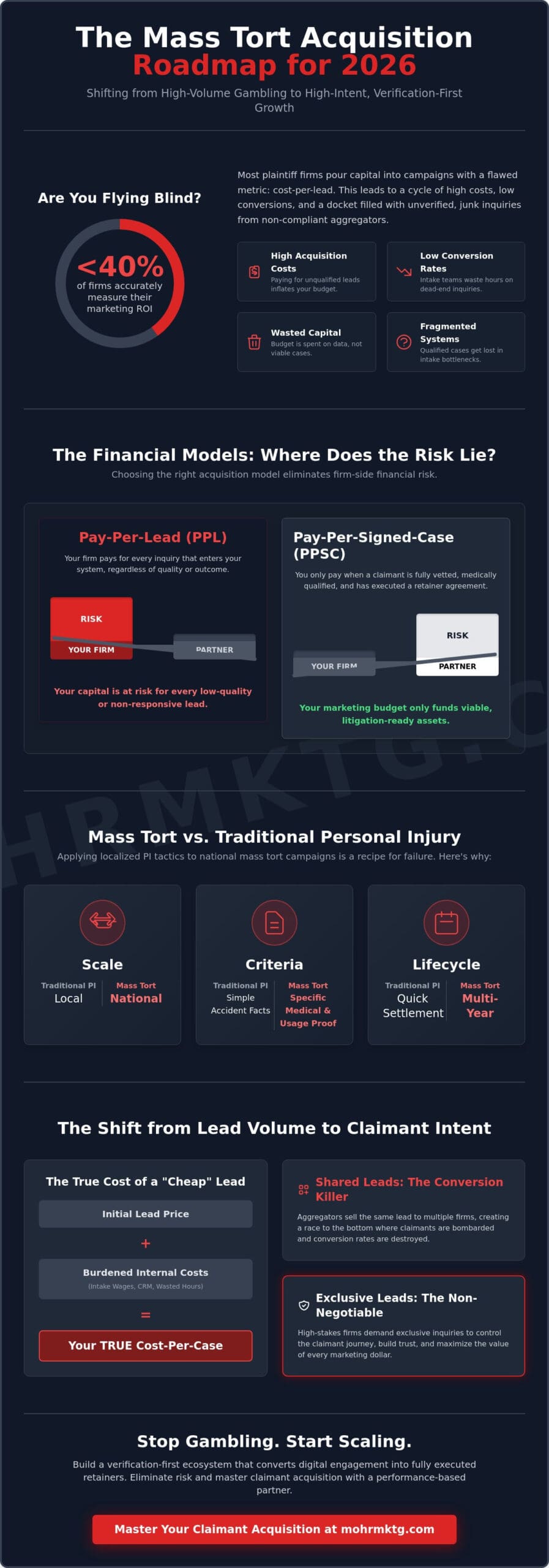
Fewer than 40% of plaintiff firms accurately measure their ROI beyond the basic cost-per-lead metric. Most are flying blind. They pour capital into mass tort lead generation campaigns that look good on paper but fail at the intake desk. You’ve likely felt the frustration of high acquisition costs and low conversion rates. It’s a cycle driven by non-compliant aggregators and fragmented systems that let qualified cases disappear. You need verified inquiries, not a list of junk numbers.
It’s time to stop gambling with your budget. You can master the mechanics of high-intent claimant acquisition and scale your docket without the risk of unverified leads. This roadmap breaks down the 2026 landscape, including stringent industry compliance requirements. We’ll show you how to build a verification-first ecosystem that delivers fully executed retainer agreements ready for litigation. From analyzing the current costs of emerging torts like PFAS to fixing your intake bottlenecks, we’re providing the direct path to growth.
Key Takeaways
- Understand why the 2026 legal landscape requires a shift from broad-net advertising to precision-targeted, high-intent claimant acquisition.
- Evaluate the financial mechanics of Pay-Per-Lead versus Pay-Per-Signed-Case models to effectively eliminate firm-side financial risk.
- Master the evolving national compliance standards for mass tort lead generation to protect your firm from strict liability and advertising penalties.
- Learn to optimize your intake ecosystem using modern “Speed to Lead” benchmarks and specialized medical claim qualification.
- Discover how a turnkey ecosystem converts initial digital engagement into fully executed signed retainers ready for litigation.
Defining Mass Tort Lead Generation in the 2026 Legal Landscape
Mass tort lead generation is the strategic engine behind Multi-District Litigation (MDL) growth. It isn’t just about buying names or filling a database. It’s the precision-engineered acquisition of claimants who meet specific medical and exposure criteria. To understand the scale of these operations, you first need to know What is a Mass Tort? and how it differs from standard litigation. In 2026, the industry has shifted. The “wide-net” approach that worked five years ago is now a recipe for financial loss. Firms now prioritize high-intent targeting over raw volume. Digital funnels for litigations like Ozempic or PFAS must act as filters, not just magnets. They need to disqualify the thousands of people who don’t fit the criteria before they ever reach your intake team.
Traditional personal injury cycles move fast. A motor vehicle accident happens, and the case is often settled within a year. Mass torts are different. They require a national reach and a massive upfront investment. You aren’t just looking for someone who was hurt. You’re looking for someone whose life was altered by a specific product or chemical over a specific timeframe. This requires a level of data precision that localized marketing simply cannot provide. Firms that rely on legacy personal injury lead generation companies often find that the shared acquisition models underpinning those services fail to deliver the verified, high-intent claimants that complex mass tort dockets demand.
Mass tort acquisition differs from traditional PI in three distinct ways:
- Scale: It requires a national rather than local presence to find enough qualified claimants.
- Criteria: It demands specific medical proof and usage history rather than simple accident facts.
- Lifecycle: It involves a multi-year commitment and a different financial model than a quick settlement.
The Shift from Lead Volume to Claimant Intent
Raw lead counts are a trap. In 2026, high-intent signals are the only metrics that matter. This means identifying search behaviors that indicate a claimant is ready to sign, not just browsing. With new privacy regulations, you can’t rely on broad third-party tracking. You need first-party data and rigorous verification to ensure every inquiry represents a viable case. Volume without intent is just a drain on your internal resources.
Why Traditional PI Tactics Fail in Mass Tort Campaigns
Most PI firms fail because they treat medical claims like car accidents. Mass torts require deep medical criteria and long-term nurturing. You aren’t just signing a lead; you’re managing a relationship for years. Localized efforts lack the scale needed for a profitable docket. Success requires a national reach and an intake cadence that accounts for the complexity of litigations like Ozempic or PFAS. If your intake team treats a Paraquat lead like a fender-bender, you’ll lose the case before it starts.
The Performance Model: Exclusive Leads vs. Pay-Per-Signed-Case
Mass tort lead generation operates on two primary financial tracks: Pay-Per-Lead (PPL) and Pay-Per-Signed-Case (PPSC). Choosing the wrong one can bankrupt a campaign before it gains momentum. In the PPL model, you pay for every inquiry that hits your system. This shifts the entire conversion risk onto your firm. If your intake team is slow or the lead quality is poor, your cost-per-acquisition skyrockets. Conversely, the PPSC model eliminates this uncertainty. You only pay when a claimant meets all criteria and executes a retainer. This model forces the marketing partner to absorb the risk of non-responsive or unqualified inquiries, ensuring your capital only funds viable litigation assets.
Exclusivity is the non-negotiable variable in either model. Shared leads are a race to the bottom. When a lead aggregator sells the same claimant data to five different firms, the claimant is bombarded with calls. This creates a high-friction experience and destroys conversion rates. High-stakes firms prioritize exclusive mass tort leads to maintain control over the claimant journey. When managing these campaigns, you must also adhere to ethical mandates for legal advertising to ensure that every acquisition method remains compliant with state bar standards. Transparency in how these leads are generated is as important as the leads themselves.
The Hidden Costs of Raw Lead Data
Low-cost leads are often the most expensive assets on your books. You must calculate the “burdened cost” of your internal intake team. This includes hourly wages, CRM licensing, and the opportunity cost of chasing unverified data. If your team spends 40 hours a week calling raw inquiries only to sign three cases, your effective cost-per-case is far higher than the initial lead price. Non-exclusive leads in competitive torts like Ozempic see massive attrition rates. Most firms find that paying a premium for verified data yields a significantly higher ROI than managing a high-volume, low-intent funnel.
Signed Retainers: The Gold Standard for Scalability
The PPSC model allows you to forecast growth with surgical precision. Instead of guessing how many leads will convert, you buy the outcome. A signed retainer is a fully executed agreement between claimant and counsel. By utilizing Signed Retainers, firms can bypass the intake bottleneck entirely. This turnkey approach delivers litigation-ready files that have already passed through rigorous medical and exposure screening. It’s the most direct path to scaling a docket without increasing your administrative overhead or financial exposure.
Navigating Compliance and Ethical Mandates Nationally
Compliance in 2026 isn’t just about fine print. It’s about survival. New regulations, such as California’s SB 37, have fundamentally changed the liability landscape. Attorneys are now strictly liable for the content of advertisements created by third-party agencies. A single violation can cost between $5,000 and $100,000. You can’t hide behind a vendor anymore. If your mass tort lead generation partner uses deceptive “hype marketing” or outcome guarantees, you’re the one on the hook. This shift demands a partner who understands the mechanical accuracy of compliant acquisition. Reviewing a comprehensive mass tort advertising compliance checklist is now an essential step for any firm running national campaigns in 2026.
Transparency is the only way to mitigate this risk. You must vet every provider for Bar compliance and TCPA adherence. “Black box” aggregators who hide their traffic sources are a threat to your firm’s reputation and license. You need to know exactly where every claimant comes from. This isn’t a luxury; it’s a professional requirement. All marketing must align with the Federal Trade Commission’s advertising rules, which mandate that all commercial speech be truthful and non-deceptive. If a lead provider can’t provide a clear audit trail of the claimant’s journey, they’re a liability you can’t afford.
Bar Rules and Multi-State Advertising Standards
Managing a national docket means juggling 50 different sets of ethics rules. Video ads are a particular minefield. Many states have strict regulations regarding non-attorney spokespeople and dramatizations. If you use an actor, you must disclose it. Every digital funnel needs state-specific disclaimers. The “Attorney Advertising” label isn’t optional. It must be clear and conspicuous on every claimant-facing asset. Failing to include a physical office location or a licensed attorney’s name can trigger immediate disciplinary action. We ensure every asset meets these rigorous standards before a single dollar is spent on media.
Transparency and the Elimination of Middlemen
Knowing the origin of a lead is critical for compliance. Middlemen often use co-registration or incentivized traffic to pad their numbers. This traffic is often non-compliant and low-intent. It pollutes your intake system and puts you at risk of TCPA violations. You shouldn’t settle for “black box” data. Mohr Marketing, LLC focuses on a direct path from the initial inquiry to the signed retainer. By eliminating inefficient intermediaries, we ensure that every claimant is acquired through verified, transparent channels. This protects your firm’s resources and your standing with the Bar. We don’t just deliver data; we deliver verifiable litigation assets.
Optimizing the Intake Ecosystem for Maximum Conversion
Mass tort lead generation is only as effective as the intake system that supports it. A lead is a raw asset; a signed case is a realized one. In 2026, the friction between an initial inquiry and a signed retainer must be eliminated through a rigorous, multi-channel approach. High-stakes firms don’t leave conversion to chance. They build ecosystems that prioritize immediate response and clinical-level qualification. If your intake desk isn’t operational 24/7, you’re forfeiting the highest-intent claimants to competitors who are. The bridge between marketing spend and a profitable docket is built on the precision of your intake process.
Speed to Lead: The 5-Minute Conversion Window
The first five minutes after an inquiry are the most critical in the claimant’s journey. Conversion rates drop by over 80% if the initial contact occurs after this window. You need a system that triggers an automated SMS and email touchpoint within seconds. However, automation isn’t a substitute for authority. A human intake specialist must follow up immediately to establish trust and begin the screening process. National campaigns require 24/7/365 availability. Claimants don’t wait for business hours to seek justice. If you aren’t there when they click, you’ve already lost the case.
Qualifying Claimants with Rigorous Medical Criteria
Generic call centers fail in mass torts because they lack the technical depth to screen complex medical claims. You need specialized Legal Intake Services that use custom scripts mirrored after MDL census requirements. This “Deep Screen” method moves beyond basic contact information to establish actual case viability. It involves verifying specific drug usage, exposure dates, and diagnosed injuries. A lead is only ‘verified’ once it meets specific medical and exposure criteria. This level of precision ensures your firm only spends time on claimants who will survive the eventual motion to dismiss. Quality markers must be established early to prevent intake bottlenecks.
Structuring a multi-touch follow-up sequence is the final piece of the puzzle. This includes a strategic mix of SMS, email, and voice calls over a 14-day period. Every touchpoint should reinforce your firm’s authority and keep the claimant engaged through the complexity of the litigation. Integrating this intake data directly into your CRM ensures a seamless onboarding process. There’s no room for manual data entry or lost files in a scalable operation. Your growth depends on a streamlined flow from the initial click to the fully executed retainer, ensuring no qualified cases slip through the cracks.
Partnering for Growth: The Mohr Marketing, LLC Turnkey Approach
Scaling a mass tort docket requires more than just capital. It requires a partner who understands the mechanical accuracy of the 2026 legal landscape. Mohr Marketing, LLC brings over 30 years of industry-specific expertise to your firm. We’ve seen the industry evolve from basic television spots to the complex, high-intent digital funnels required today. Our turnkey ecosystem handles every stage of the acquisition process. We manage the initial click, the medical screening, and the final execution of the retainer. This end-to-end management allows your firm to focus on litigation while we focus on the mechanics of growth.
Efficiency is the core of our operation. We eliminate the inefficient intermediaries that drive up costs and introduce compliance risks. By removing these “middlemen,” we ensure a transparent and direct path from the claimant to your firm. This isn’t just about mass tort lead generation; it’s about building a predictable, scalable pipeline of verified assets. You don’t need to hire a massive internal intake team to manage raw data. Our system delivers litigation-ready files that integrate seamlessly into your existing workflow. We provide the data-driven strategy you need to maintain a competitive advantage in a high-stakes environment.
A Strategic Partner, Not a Lead Vendor
Most vendors sell data. We sell outcomes. Mohr Marketing, LLC provides consultative growth strategies tailored to your firm’s specific practice areas. We don’t provide “one-size-fits-all” solutions. If a specific tort is over-saturated or the cost-per-case is no longer viable, we’ll tell you. This straight-talker approach is why high-stakes professionals trust us with their resources. We prioritize high-intent opportunities over raw volume. We know that a single verified inquiry is worth more than a hundred unverified names. We stay ahead of market shifts and technological trends to keep your firm in a leadership position.
Verified Inquiries and Fully Executed Retainers
Our verification process is rigorous. We don’t consider an inquiry complete until it meets every medical and exposure criteria required by the MDL. This ensures that every file we deliver is ready for immediate litigation. You bypass the intake bottlenecks and the high attrition rates of non-exclusive leads discussed earlier. To understand how exclusivity benchmarks compare across acquisition models in 2026, reviewing a detailed exclusive mass tort leads comparison guide can help your firm make more informed investment decisions. This model protects your capital and ensures a high ROI on your marketing spend. You get the benefits of a massive national campaign without the administrative burden of managing one. Our focus is on transparency and the elimination of friction in your business processes.
The goal is simple: a predictable flow of high-intent claimants. Mohr Marketing, LLC provides the reliability you need to build a successful mass tort practice. Stop gambling with unverified data and start investing in verified results. Our procedural precision ensures that your firm remains protected while aggressively pursuing expansion.
Scale your firm’s docket with verified mass tort leads from Mohr Marketing, LLC.
Scale Your Docket with Surgical Precision
The legal market in 2026 doesn’t reward firms that chase raw data. Success belongs to those who prioritize verified claimant intent and mechanical accuracy. You’ve seen how the shift toward high-intent targeting and the adoption of a performance-based Pay-Per-Signed-Case model can eliminate financial risk. By integrating strict Bar and TCPA compliance protocols, you protect your firm’s reputation while aggressively expanding your docket. Effective mass tort lead generation is no longer a volume game; it’s a verification game.
Mohr Marketing, LLC provides the transparency and industry-specific expertise needed to navigate these complexities. With over 30 years of experience, we offer a turnkey ecosystem that delivers litigation-ready files directly to your CRM. We handle the friction of acquisition so you can focus on the litigation. It’s time to move beyond inefficient intermediaries and secure a predictable flow of high-value cases. Your firm’s growth is within reach when you partner with a strategic expert dedicated to your success.
Secure your firm’s next high-value cases with Mohr Marketing, LLC
Frequently Asked Questions
What is the difference between a mass tort lead and a signed retainer?
A mass tort lead is a raw inquiry from a potential claimant who has expressed interest via a digital funnel or advertisement. It requires your firm or an intake partner to perform outreach, qualification, and medical screening. A signed retainer is a fully executed legal agreement between the claimant and your firm. It represents a litigation-ready asset where the claimant has already passed all eligibility criteria and committed to legal representation.
How do you ensure mass tort advertising compliance across different states?
Compliance requires a multi-layered review process that aligns with both the Federal Trade Commission’s advertising rules and individual state bar standards. In 2026, this includes mandatory disclosures of physical office locations and the identification of at least one licensed attorney in the jurisdiction. We avoid “hype marketing” and outcome guarantees to mitigate the risk of strict liability and penalties under new regulations like California’s SB 37.
What is the typical cost-per-lead for current mass torts like Ozempic or PFAS?
Industry costs for mass tort lead generation fluctuate based on tort maturity, geographic targeting, and claimant intent. Emerging torts like PFAS typically command a higher premium due to the complexity of exposure verification and lower audience saturation. Mature torts often see more stable pricing, but the true metric of success is the cost-per-signed-case rather than the initial lead price. We focus on high-intent inquiries to ensure your capital is not wasted on unverified data.
Why is ‘Speed to Lead’ so critical in mass tort lead generation?
High-intent claimants often contact multiple firms or continue searching until they speak with a professional. Conversion rates drop by over 80% if the initial contact occurs after the first five minutes. Immediate response via SMS, email, or voice is essential to capture the claimant’s attention before a competitor does. A delayed response effectively turns a high-value inquiry into a lost opportunity.
Can your intake services handle complex medical screening for claimants?
Yes, specialized legal intake services are designed to move beyond basic contact information to establish case viability. This involves using custom scripts that mirror MDL census requirements to verify specific drug usage, exposure dates, and diagnosed injuries. A lead is only considered verified once it meets these rigorous medical and exposure criteria, ensuring your firm only receives viable cases.
What makes an ‘exclusive’ mass tort lead better than a shared lead?
Exclusive leads are sold to only one firm, ensuring you have total control over the claimant journey. Shared leads are sold to multiple firms simultaneously, creating a high-friction experience where the claimant is bombarded with calls. This “race to the bottom” destroys conversion rates and often leads to TCPA complaints. Exclusivity protects your firm’s reputation and ensures a higher ROI on your acquisition spend.
How does Mohr Marketing, LLC verify the intent of a potential claimant?
We verify intent through a combination of precision-targeted digital funnels and a “Deep Screen” intake process. By analyzing search behavior and social engagement, we identify individuals actively seeking legal remedies. Our intake specialists then perform a secondary verification to ensure the claimant understands the litigation process and is ready to execute a retainer. This eliminates low-intent inquiries and “black box” data from your pipeline.
Is there a minimum volume requirement for starting a mass tort campaign?
Campaign structures vary based on your firm’s specific growth goals and the maturity of the target tort. While we recommend a baseline volume to achieve statistical significance in conversion data, we take a consultative approach to determine the right starting point. This ensures you can scale your docket predictably without overextending your administrative overhead or intake capacity.

Recent Posts
- Attorney Search Engine Marketing: Do It Yourself or Hire Help
- Improving Law Firm Marketing ROI: A Practical Measurement Framework
- 4 Ways to Assess Unqualified Legal Leads and Their Costs
Categories
- AI and Lead Generation
- Business Financing
- Call Verified MVA Leads
- Car Accident Help
- Car Accident Settlements
- Claimant Funding
- Compliance Program
- EMS-EMT Reports
- Geotargeting
- Google Maps Ranking
- Healthcare Practice Growth
- Law Firm Growth
- Law Office Operations
- Lead Generation
- Lead Generation For Attorneys
- Lead Generation For Chiropractors
- Lead Generation For Criminal Attorneys
- Lead Generation For D&A Treatment Centers
- Lead Generation For DUI Attorneys
- Lead Generation For Eye Doctors
- Lead Generation For Family Law Practices
- Lead Generation For PI Law Firms
- Lead Generation For Plastic Surgeons
- Leads For Healthcare Professionals
- Leads For Insurance Industry
- Legal Leads
- Legal Marketing
- Legal Updates
- Mass Tort Leads
- Medicare and Medicaid Leads
- Merchant Funding Leads
- Mold Leads
- Online Marketing Strategies
- Pre-Settlement Funding
- Signed MVA Cases
- Tort Updates
- Truck Accident Leads and Signed Cases
- Truck Accident Settlements
- Web Design