The 2026 Mass Tort Advertising Compliance Checklist: Protecting Your Firm and Your ROI
June 21, 2026 by Mohr Marketing
TCPA lawsuit filings have surged by 28.2 percent in the first four months of 2026. This spike confirms that mass tort advertising compliance is no longer a legal formality. It is the core operating system for any firm that intends to remain profitable. You likely recognize the growing difficulty of maintaining campaign stability while Google and Meta aggressively update their enforcement protocols. A single oversight in an AI-generated ad or a missing disclosure can now trigger fines of up to $50,120 per call under the latest TSR guidelines.
You can master this complex regulatory landscape to secure high-intent claimants without risking State Bar sanctions or account suspensions. We will provide the exact framework needed to protect your firm and your marketing spend. This checklist breaks down the critical requirements of the 2026 ABA Model Rules and the June 2026 Google Ads Terms of Service updates. You will learn how to implement a repeatable compliance process that ensures your intake team handles every inquiry according to the latest FCC consent revocation rules. Stop worrying about regulatory traps and start focusing on high-quality verified inquiries.
Key Takeaways
- Align your campaigns with the intersection of ABA Model Rules and platform policies to reduce marketing friction and lower your cost per case.
- Execute a rigorous audit of lead providers to ensure every campaign adheres to 2026 mass tort advertising compliance standards.
- Deploy mandatory one-to-one consent protocols to shield your firm from escalating TCPA penalties and potential account suspensions.
- Secure mobile landing pages by placing required legal disclosures above the fold to satisfy updated June 2026 Google Ads requirements.
- Integrate marketing and intake processes into a single, transparent ecosystem to guarantee compliance from the initial click to the signed retainer.
The Financial Stakes: Why Compliance is Your Primary ROI Driver
In 2026, mass tort advertising compliance is the critical intersection of State Bar ethics rules, federal statutes like the TCPA, and digital platform policies. It’s not a secondary administrative task. It is the primary engine of your campaign’s profitability. To understand the necessity of these rules, one must first understand the legal foundation of the cases themselves. What is a Mass Tort? This definition guides how you must communicate with potential claimants. When you ignore these boundaries, you introduce marketing friction. This friction manifests as higher Cost Per Case (CPC) because platforms penalize ads that trigger user complaints or automated flags.
Non-compliance is an expensive gamble. When an account is flagged, the immediate loss of momentum halts your intake pipeline. Your staff sits idle while you scramble to rebuild. This downtime, combined with the loss of historical conversion data, can increase your acquisition costs by 40 percent or more during the recovery phase. By treating compliance as a strategic asset, you secure a lower cost of capital and more stable lead flow.
Strict compliance acts as a barrier to entry. It prevents low-quality lead generators, often migrating from the solar or insurance industries, from flooding the market with deceptive “get paid now” hooks. These entities often ignore the nuance of legal solicitation, leading to account suspensions that you can avoid by following a rigorous mass tort advertising compliance framework. Professionals who invest in verified protocols effectively price out these amateur competitors.
Account Longevity and the “Trust Score”
Google and Meta utilize internal Trust Scores for every legal advertiser. High scores grant you lower CPMs and faster ad approvals. Conversely, a single compliance strike can permanently degrade this score. This forces you to pay a risk premium on every impression. Recovering from a ban is not just about a new account. You lose months of pixel data and machine learning progress. Retraining an algorithm to find high-intent claimants from scratch is a massive sunk cost that most firms can’t afford.
Protecting the Firm’s Reputation and License
State Bars are increasingly conducting spot audits on high-volume advertisers. In 2026, deceptive imagery or unsubstantiated settlement claims aren’t just ad policy violations. They are evidence in ethics hearings. If your lead provider uses “medical-looking” logos to trick seniors, your firm carries the liability. In 2026 digital solicitation, your duty of truthfulness requires that every ad clearly identifies the sponsoring law firm without creating unjustified expectations of success. Protect your license by demanding total transparency from your marketing partners.
The Regulatory Pillars: ABA, TCPA, and Platform Policies
The regulatory landscape for mass torts is a tripartite structure. You must manage the American Bar Association (ABA) Model Rules, Federal Communications Commission (FCC) statutes, and the internal policies of tech giants like Google and Meta. Failure in any single area compromises the entire operation. In 2026, mass tort advertising compliance requires a granular understanding of how these layers overlap. The Model Rules of Professional Conduct, 2026 Edition, published on April 20, 2026, remains the gold standard for ethics, but it is often the federal statutes that carry the heaviest financial penalties.
ABA Model Rules 7.1 through 7.3 dictate the ethics of digital solicitation. Rule 7.1 prohibits any communication that is false or misleading. This includes omitting a fact necessary to make the statement as a whole not materially misleading. Rule 7.2 governs the actual advertising process, while Rule 7.3 restricts direct contact with people who need legal services. These rules prevent firms from creating “unjustified expectations” regarding potential settlements.
The FCC has tightened TCPA compliance rules significantly. As of 2026, lead transfers require documented, one-to-one consent. You can no longer rely on a general list of “marketing partners” buried in a hyperlink. Each claimant must specifically authorize your firm to contact them. With TCPA litigation filings up 28.2 percent through April 2026, the cost of a mistake starts at $500 per violation and scales rapidly.
Meta and Google have added their own hurdles. Meta often flags mass tort ads under the “Social Issues, Elections or Politics” category because they involve public policy or high-profile litigation. Misclassifying these ads leads to immediate account flags. Additionally, the California Information Privacy Act (CIPA) now targets tracking pixels. If your landing page records a user’s keystrokes or health data without explicit 2026-compliant disclosures, you face statutory damages. These digital “wires” are now a primary target for class action plaintiffs’ attorneys.
State Bar Nuances in National Campaigns
National campaigns require a “lowest common denominator” approach. You must adhere to the most restrictive state rules to avoid local sanctions. Every digital asset must identify at least one “responsible attorney” by name. Avoid prohibited language. Words like “Expert” or “Specialist” are restricted unless you hold specific certifications. Never use “Guaranteed Compensation.” These terms trigger automatic audits. If you are unsure about your current ad copy, you can consult with our team to review your assets against 2026 standards.
TCPA and Consent Capture in 2026
Consent must be clear and conspicuous. Pre-checked boxes are now a multi-million dollar liability. If a claimant doesn’t manually check the box, the consent is void. You must store TrustedForm or Jornaya certificates for every lead to prove the moment of intent. This documentation is your only defense against $1,500 “willful” TCPA violations. Effective mass tort advertising compliance starts with the technical configuration of your lead forms.
Transparency vs. The “Black Box”: Evaluating Lead Providers
Purchasing leads through a “black box” provider is the fastest way to invite a State Bar audit. Many agencies operate as aggregators. They buy traffic from anonymous third-party affiliates and resell it to your firm. Because you never see the original ad creative or the landing page, you cannot verify mass tort advertising compliance. If an affiliate uses deceptive imagery or promises specific dollar amounts to drive clicks, your firm is legally responsible for that solicitation. In 2026, you must treat every lead provider as a direct extension of your firm’s ethics department.
The “Pay-Per-Signed-Case” model often exacerbates this transparency problem. While it seems to de-risk your upfront investment, it frequently hides aggressive “bait-and-switch” tactics. Providers might use ads that look like government notices or medical alerts to trick vulnerable populations. These deceptive hooks create high volume but low intent. When these claimants realize they are speaking to a law firm rather than a medical board, conversion rates plummet. Our approach focuses on high-intent inquiries generated through real search behavior. This eliminates the need for deceptive hooks and ensures every claimant understands the legal nature of the communication.
To verify if a provider is using bait-and-switch tactics, demand a live link to the active ad sets. Cross-reference the branding on the ad with the branding on the landing page. If the ad promises “instant checks” or “guaranteed payouts,” the lead is non-compliant. High-quality providers welcome these audits as proof of their procedural precision. Firms that want to eliminate the risk of shared, recycled inquiries entirely should consider transitioning to exclusive mass tort leads that belong solely to your firm, a model that removes the aggregator layer and its associated compliance liabilities.
The Audit Trail: From Ad Click to Retainer
You need full visibility into every digital asset. This includes the exact ad copy, the imagery used, and the mobile landing page. Compliant landing pages must never promise a specific settlement. They should focus on qualification criteria and the legal process. For example, you can Learn how Mohr Marketing handles Mesothelioma leads with strict case criteria to see how transparency drives better outcomes. If a provider refuses to show you their landing pages, terminate the relationship immediately.
Performance-Based Compliance
High-quality agencies don’t hide their methods. They welcome compliance audits. A major red flag is the use of “incentivized leads” where claimants are offered gift cards or prizes to complete a form. These leads have zero intent and high disqualification rates. Review your vendor contracts for indemnification clauses. If the provider refuses to indemnify your firm for TCPA violations or deceptive advertising claims, they are likely cutting corners. True mass tort advertising compliance requires a partner that stands behind their verification process and their data sources.
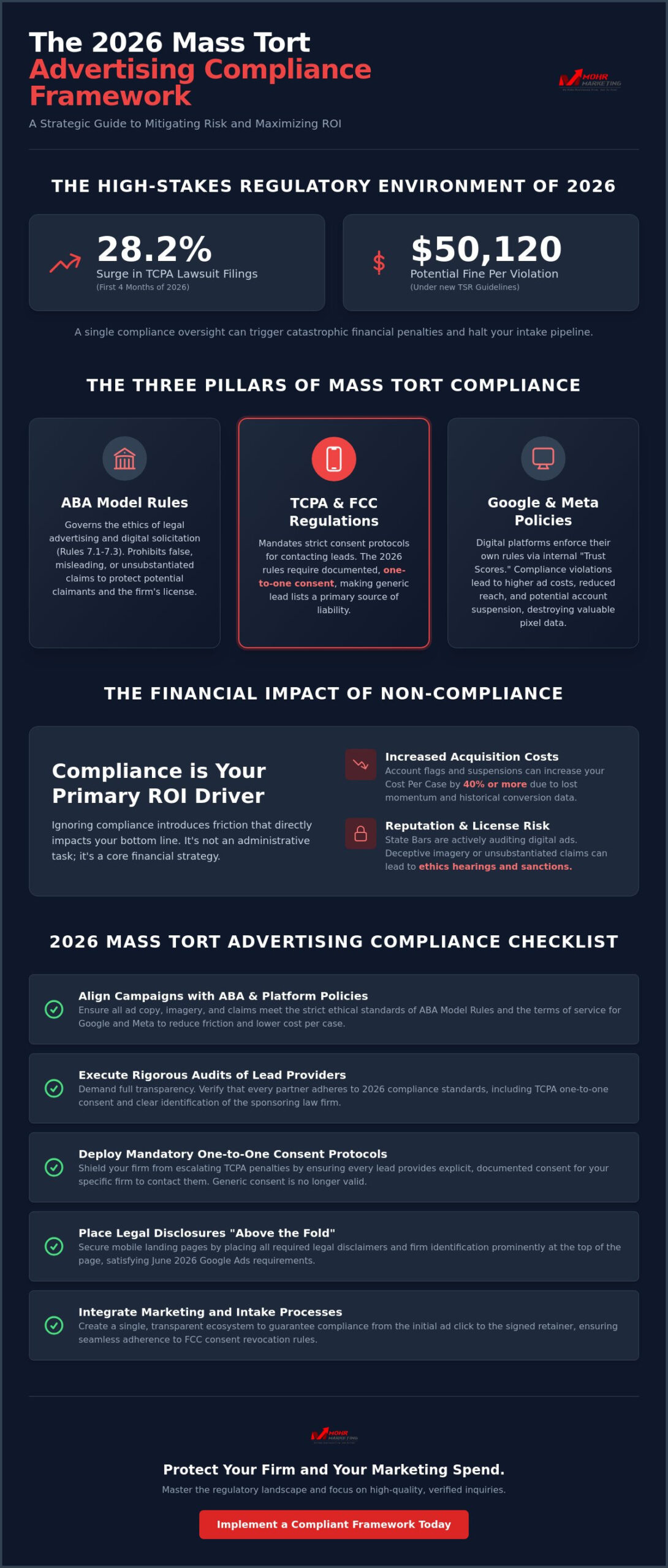
The 2026 Mass Tort Advertising Compliance Checklist
Execution is the only safeguard against regulatory scrutiny. You must move beyond general awareness and implement a rigorous verification sequence for every campaign asset. This checklist serves as your operational manual for maintaining mass tort advertising compliance across all digital channels. Use these five steps to audit your current workflow and eliminate high-risk vulnerabilities before they trigger a platform ban or a State Bar inquiry.
- Step 1: Creative Review. Audit all imagery for “medical-looking” logos, caduceus symbols, or deceptive branding. Your creative must clearly represent a legal service, not a government health alert or an official medical board notice.
- Step 2: Disclosure Placement. Verify that all required legal disclaimers appear “above the fold” on mobile landing pages. Regulators prioritize visibility on small screens where users are most likely to overlook fine print.
- Step 3: Consent Verification. Confirm that every lead form utilizes an active, manual opt-in for SMS and automated calls. Pre-checked boxes are non-compliant and create significant TCPA liability.
- Step 4: AI Audit. Deploy automated scanning tools to review ad copy for prohibited terminology. Specifically, flag and remove words like “Expert,” “Specialist,” or “Guaranteed Compensation” to stay aligned with 2026 ABA standards.
- Step 5: Data Security. Verify that your lead storage and transfer protocols are HIPAA-compliant. This is mandatory when your intake process involves collecting detailed medical history or pharmaceutical usage data.
Landing Page and Lead Form Essentials
Your landing page is the primary target for compliance audits. Every page must feature a prominent “Attorney Advertising” header. This header should be static and visible regardless of scrolling position. You must also provide direct, conspicuous links to your Privacy Policy and Terms of Service. Before a claimant hits the “Submit” button, the form must clearly identify your law firm, or the specific sponsoring firm, as the entity that will receive their data. Transparency at this stage prevents “consumer confusion” claims and improves lead quality.
Creative and Messaging Prohibitions
Eliminate any headlines that mimic government agencies. Phrases like “Medical Alert,” “Official Notice,” or “Public Health Warning” are deceptive and will lead to immediate ad rejection. If you use “No-Fee-Unless-You-Win” messaging, you must include the required disclosure explaining that clients may still be responsible for certain costs or expenses. Ad platforms reject “scare tactics” in pharmaceutical torts because they often present unverified medical risks that cause unnecessary patient panic or interfere with doctor-prescribed treatments. Precision in messaging is your best defense. If you need a professional review of your current assets, contact our compliance team to ensure your campaigns meet these 2026 standards.
Effective mass tort advertising compliance requires constant vigilance. By following this structured checklist, you protect your firm’s reputation while ensuring your marketing spend generates a sustainable return. Do not leave your ROI to chance; verify every asset against these criteria before going live.
Building a Compliant Intake Ecosystem for Scale
Mass tort advertising compliance is a continuous chain. It starts with the first impression on a mobile screen and ends only when the retainer is signed. Many firms mistakenly believe that if the ad is compliant, the risk is mitigated. This is incorrect. If your intake team provides unauthorized legal advice or fails to re-verify TCPA consent during the call, the firm remains exposed. Compliance must permeate every interaction to protect your ROI and your license.
We solve this through a turnkey ecosystem that integrates marketing and intake. This eliminates the compliance gap that typically exists when external lead providers hand off data to internal firm staff. We utilize Verified Call Transfers to ensure claimants meet your specific criteria before engagement. This process filters out low-intent inquiries and protects your staff’s time. By the time your firm speaks to a claimant, the initial compliance hurdles have already been cleared and documented.
To scale rapidly in 2026, you must offload compliance risk. Managing internal intake teams is capital-intensive and fraught with management overhead. Firms seeking aggressive growth often utilize mass tort signed cases to bypass the initial qualification hurdles. This allows you to acquire verified retainers that have already passed through a rigorous compliance and verification filter. You receive a ready-to-litigate asset rather than a raw inquiry that requires heavy lifting. For firms evaluating their acquisition strategy, understanding the cost and quality differences between shared and exclusive mass tort leads in 2026 is an essential step before committing to any lead provider relationship.
The Role of Professional Intake
Professional intake is an exercise in restraint. Specialists must follow neutral scripts that qualify the claimant without straying into the unauthorized practice of law. Providing legal advice during a qualification call is a fast path to a Bar grievance. Every call must be recorded and archived. These recordings serve as your primary defense during a State Bar audit or a TCPA dispute. Our police report-backed MVA cases demonstrate the value of high-verification standards. We apply this same methodology to mass torts to ensure every case in your inventory is built on a foundation of verifiable fact.
Conclusion: Compliance as a Competitive Advantage
The era of the “cowboy” marketer is over. As platform enforcement becomes more automated and Bar sanctions more frequent, compliance becomes the ultimate barrier to entry. Firms that invest in transparent, performance-based acquisition models will outlast those chasing cheap, unverified leads. Compliance isn’t a cost of doing business; it’s the strategy that protects your license and your ROI. Contact Mohr Marketing to scale your mass tort practice with compliant, high-intent leads and secure your firm’s position in the 2026 market.
Secure Your Firm’s Future with a Compliance-First Strategy
Success in the 2026 mass tort market requires more than a large budget. It demands a rigorous commitment to mass tort advertising compliance that spans from the initial ad click to the final signed retainer. You’ve seen how procedural precision eliminates marketing friction and protects your internal trust scores. Firms that prioritize transparency and audit their lead providers will inevitably outpace those still operating in the “black box” model. By integrating your marketing and intake into a single, verified ecosystem, you turn regulatory requirements into a significant competitive advantage.
Mohr Marketing brings over 30 years of industry experience to your expansion strategy. We eliminate the guesswork by maintaining strict adherence to all state bar and TCPA mandates. Our performance-based signed retainer models ensure you only pay for high-intent, verified cases that meet your specific criteria. It’s time to stop worrying about account bans and start focusing on sustainable growth. Secure your next mass tort case with Mohr Marketing’s compliant acquisition system. You’re now equipped to dominate the landscape with confidence and mechanical accuracy.
Frequently Asked Questions
Is mass tort advertising considered solicitation under Bar rules?
Yes, mass tort advertising is classified as a form of public solicitation under ABA Model Rule 7.3 and corresponding state ethics codes. While it is not a direct, in-person contact, it remains subject to strict rules regarding truthfulness and disclosure. You must ensure every ad clearly identifies the sponsoring firm and avoids coercive language that pressures vulnerable individuals into immediate action without a full understanding of their rights.
Do I need a separate disclaimer for every state I target in a national campaign?
You must adhere to the most restrictive state regulations when running a national campaign to avoid local sanctions. While some states accept a general “Attorney Advertising” disclaimer, others have specific font size and phrasing requirements that are mandatory. A “lowest common denominator” approach is safest. This involves including the name of at least one attorney responsible for the ad and identifying the specific jurisdiction where the firm is licensed.
Can I use the word “Expert” if I have handled hundreds of similar mass tort cases?
No, you cannot use the word “Expert” or “Specialist” unless you hold a formal certification recognized by your state bar. ABA Model Rule 7.2 prohibits claiming expertise even if your experience is extensive. Instead, focus on factual descriptions of your firm’s history. Use phrases like “extensive experience in mass tort litigation” to communicate your qualifications without violating ethics rules regarding self-laudatory claims.
What is the “clear and conspicuous” standard for TCPA consent in 2026?
The “clear and conspicuous” standard requires that consent language is easily noticed and understood by the average consumer. In 2026, this means the disclosure must be in a contrasting color and a font size similar to the surrounding text. It cannot be buried in a hyperlink or fine print. Proper mass tort advertising compliance requires that the user understands they are authorizing automated calls or texts to the specific number provided.
How do I handle compliance when using a third-party lead provider?
You must demand full transparency into the provider’s lead generation funnel before purchasing any inquiries. This includes reviewing the original ad creative, landing pages, and the specific consent language used. Your firm carries the ultimate liability for any non-compliant solicitation. Implement a contract that requires the provider to indemnify you for TCPA violations and provide TrustedForm or Jornaya certificates for every lead delivered to your intake team.
What happens if my ad account is banned for a compliance violation?
An ad account ban results in immediate data loss and a total halt in claimant acquisition. Google and Meta utilize internal trust scores; a permanent ban often prevents you from using the same domain or payment method for future campaigns. Rebuilding requires retraining new algorithms from scratch, which significantly inflates your acquisition costs. Maintaining rigorous mass tort advertising compliance is the only way to protect your account longevity and historical pixel data.
Are “medical alert” style ads still allowed in mass tort marketing?
No, “medical alert” or “official notice” headlines are strictly prohibited by both platform policies and state bar rules. These tactics are considered deceptive because they mimic government communications to trigger a fear-based response. Modern ad platforms use AI to flag these hooks instantly. Your creative must clearly state that it is a legal advertisement to avoid immediate account suspension and potential ethics investigations by state authorities.
How long should I keep records of my mass tort advertising compliance audits?
You should maintain records for at least four years to align with the federal statute of limitations for TCPA violations. This archive must include dated screenshots of ad creative, landing page versions, and lead certificates. In the event of a State Bar audit or a private right of action, these records serve as your primary defense. Consistent documentation proves you maintained a high procedural standard of care across all digital campaigns.

Recent Posts
- Mass Tort Digital Marketing Agency
- Personal Injury Signed Retainers: The Strategic Guide to Scalable Case Acquisition in 2026
- Motor Vehicle Accident Leads: A 2026 Guide to High-Intent Case Acquisition
Categories
- AI and Lead Generation
- Business Financing
- Call Verified MVA Leads
- Car Accident Help
- Car Accident Settlements
- Claimant Funding
- Compliance Program
- EMS-EMT Reports
- Geotargeting
- Google Maps Ranking
- Healthcare Practice Growth
- Law Firm Growth
- Law Office Operations
- Lead Generation
- Lead Generation For Attorneys
- Lead Generation For Chiropractors
- Lead Generation For Criminal Attorneys
- Lead Generation For D&A Treatment Centers
- Lead Generation For DUI Attorneys
- Lead Generation For Eye Doctors
- Lead Generation For Family Law Practices
- Lead Generation For PI Law Firms
- Lead Generation For Plastic Surgeons
- Leads For Healthcare Professionals
- Leads For Insurance Industry
- Legal Leads
- Legal Marketing
- Legal Updates
- Mass Tort Leads
- Medicare and Medicaid Leads
- Merchant Funding Leads
- Online Marketing Strategies
- Pre-Settlement Funding
- Signed MVA Cases
- Tort Updates
- Truck Accident Leads and Signed Cases
- Truck Accident Settlements
- Web Design