In-House vs. Outsourced Legal Intake: A Strategic Comparison for 2026
August 5, 2026 by Mohr Marketing
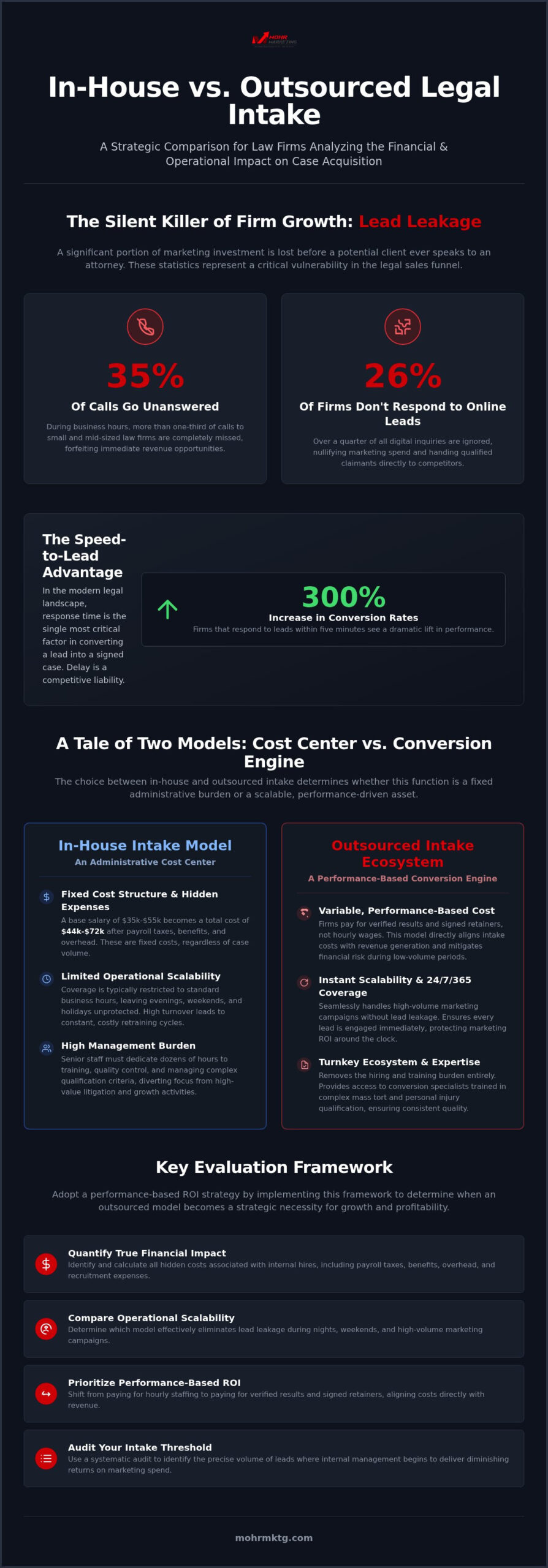
Thirty-five percent of calls to small and mid-sized law firms go completely unanswered during business hours. This statistic represents a massive leak in your firm’s profitability and marketing ROI. When you consider that 26% of firms fail to respond to online leads at all, the decision between in-house vs outsourced legal intake becomes a critical strategic choice for 2026. You’re likely tired of the high cost of internal turnover and the endless cycle of training staff who struggle with complex mass tort qualifications. It’s an inefficient use of resources that limits your ability to scale.
This guide compares the financial and operational impacts of both models to determine the most scalable path for your firm’s case acquisition. We’ll show you how to lower your cost-per-acquisition and drive a higher volume of signed retainers by eliminating administrative hiring burdens. You’ll gain a clear understanding of the 300% conversion lift possible with five-minute response times. We’ll also explore why shifting from a fixed-cost internal team to a variable-cost conversion engine is the most effective risk-mitigation strategy for modern legal practices.
Key Takeaways
- Quantify the true financial impact of internal hires by identifying hidden costs such as payroll taxes, benefits, and administrative overhead.
- Compare the operational scalability of in-house vs outsourced legal intake to determine which model effectively eliminates lead leakage during high-volume campaigns.
- Implement a performance-based ROI strategy that prioritizes paying for verified results and signed retainers over traditional hourly staffing models.
- Utilize a 5-step audit framework to identify the precise volume threshold where internal intake management begins to diminish your marketing ROI.
- Adopt a turnkey intake ecosystem to remove the hiring and training burden while ensuring consistent qualification for complex mass tort and personal injury cases.
The Strategic Conflict: Administrative Cost Center vs. Conversion Engine
Legal intake serves as the high-precision bridge between marketing expenditure and litigation revenue. It represents the single most vulnerable point in the legal sales funnel. Treatment of intake as a back-office administrative burden, often assigned to staff with a basic secretary mindset, is a strategic liability in 2026. Success now requires a conversion specialist approach. When evaluating in-house vs outsourced legal intake, you are deciding whether to maintain an administrative cost center or build a high-performance conversion engine designed for mechanical accuracy.
The phenomenon of lead leakage acts as a silent killer of firm growth, occurring whenever qualified claimants fall through the cracks due to slow responses or missed calls. Research from May 2026 indicates that 35% of calls to small and mid-sized law firms go unanswered during business hours, while 26% of firms fail to respond to online lead forms entirely. This failure to capture intent destroys your ROI and hands an immediate advantage to your competitors. Choosing between in-house vs outsourced legal intake requires an objective assessment of your current team’s ability to protect revenue at the point of entry.
The Financial Impact of Lead Leakage
Quantifying the damage reveals that even a 10% drop in intake efficiency can effectively double your cost-per-signed-case. In the current digital landscape, speed-to-lead is the ultimate competitive advantage. Firms that respond to leads within five minutes see conversion rates increase by up to 300%. If internal teams are restricted by standard business hours or administrative distractions, you’re hemorrhaging high-value opportunities. Common friction points include inconsistent lead qualification in complex mass torts, which turns expensive marketing campaigns into wasted capital.
Modern Intake: Beyond Answering the Phone
Modern intake has evolved into a data-driven, multi-channel operation requiring seamless integration across SMS, web chat, and phone lines. Real-time lead verification and qualification are now baseline requirements for competitive firms. You don’t have the luxury of waiting 24 hours to determine if a claimant meets the criteria for a motor vehicle accident or medical malpractice case. In this high-stakes ecosystem, legal intake functions as a revenue-protection officer for law firms; it stands at the gate to ensure only high-value, qualified opportunities enter the firm’s workflow.
The In-House Intake Model: Control, Culture, and Hidden Complexity
The primary appeal of maintaining an in-house team is the illusion of total control. You can walk down the hall, monitor conversations, and ensure staff align with your firm’s specific culture. This direct oversight feels secure, but it comes at a steep price. When comparing in-house vs outsourced legal intake, many partners overlook the massive financial burden beneath the surface. A single intake specialist doesn’t just cost their base salary. Between payroll taxes, health benefits, workers’ compensation, and office overhead, a $35,000 to $55,000 salary balloons into a total annual cost of $44,000 to $72,000 per employee.
Operational gaps are equally taxing. Maintaining true 24/7/365 coverage with an internal team is nearly impossible for most firms. Most internal departments operate on a standard schedule, leaving your marketing investment unprotected during evenings, holidays, and weekends. If you want to capture every lead, you must also manage the high turnover rates inherent in entry-level intake roles. Every time a staff member leaves, your firm loses institutional knowledge and incurs the immediate cost of recruitment. The cycle of constant retraining is a drain on both capital and focus.
The Management Tax: Training and Quality Control
Training staff to handle complex mass tort criteria requires dozens of hours from senior partners or high-level managers. This is time better spent on litigation or firm growth. When call volumes spike, internal staff often become overwhelmed, leading to inconsistent screening and missed details. You also inherit the technical burden of managing telephony systems and CRM integrations. If your internal tech stack fails, your intake stops entirely. You can evaluate your current intake overhead to see if these management costs are eroding your profit margins.
The Scalability Wall
In-house intake functions as a fixed-cost anchor. When you launch a high-volume marketing campaign, your internal team hits a ceiling. They cannot process 500 leads with the same precision as 50. Conversely, during slow periods, you’re forced to pay for idle capacity. Hiring ahead of the curve creates wasted overhead that drains capital. An internal model lacks the elasticity required to respond to market shifts or sudden surges in case volume. This rigidity prevents your firm from being aggressive when new opportunities arise in the competitive legal landscape.
The Outsourced Intake Ecosystem: Scalability and Performance-Based ROI
Moving beyond the fixed-cost anchor of internal staff requires a fundamental shift in perspective. An outsourced intake ecosystem is not a simple answering service. It is a high-performance conversion engine built to handle the complexities of modern litigation. When you analyze in-house vs outsourced legal intake, the primary advantage of outsourcing is the transition from paying for “hours worked” to paying for “verified results.” This model provides the elastic capacity needed for national mass tort campaigns. You no longer need to worry about staffing up for a surge or paying for idle time during a lull. Specialized providers offer a turnkey solution that integrates directly with your firm’s growth objectives.
Scalability is the engine of firm expansion. In an internal model, your capacity is limited by the number of chairs in your office. In an outsourced ecosystem, capacity is virtually limitless. This allows you to scale your marketing spend aggressively without the fear of overwhelming your staff. You gain access to a professional workforce that is already trained in legal business operations. These specialists understand that every call is a potential high-value asset that must be secured with speed and precision. This approach removes the friction from your business processes and ensures a direct path to success.
Specialized Qualification for High-Stakes Litigation
High-stakes litigation demands surgical precision at the first point of contact. Generalist receptionists often fail to identify the specific markers of a high-value claim. For instance, mesothelioma leads require rigorous verification of asbestos exposure and medical diagnosis. Specialized intake specialists use advanced decision trees to ensure every inquiry meets your firm’s strict criteria. This level of detail is also essential for police report-backed MVA cases. By utilizing specialists who already understand complex legal terminology and qualification standards, your firm ensures that only the most viable cases reach your desk. This process maintains strict compliance with state laws and bar mandates, protecting your firm’s reputation.
The Pay-Per-Signed-Case Advantage
The ultimate risk-mitigation strategy for law firms is the performance-based model. In the traditional debate of in-house vs outsourced legal intake, firms frequently struggle with the “pay-per-lead” trap. This model often forces you to pay for unqualified inquiries that waste your time and resources. A professional ecosystem focuses on the end goal: mass tort signed cases. Under a pay-per-signed-case arrangement, your firm only pays for fully executed retainers. This approach aligns the provider’s incentives directly with your firm’s revenue goals. It eliminates the financial burden of hiring, training, and managing a team that may not deliver results.
Key Evaluation Criteria: When to Shift Your Intake Strategy
Deciding between in-house vs outsourced legal intake shouldn’t be based on intuition. It requires a rigorous, data-driven audit of your current operations. If your firm is growing, you’ll eventually hit a volume threshold where internal management becomes a liability rather than an asset. This shift usually occurs when the time spent on recruitment, training, and quality control begins to detract from high-level litigation and strategic planning. To determine if you’ve reached this tipping point, follow this five-step audit framework:
- Measure your average “Time to First Contact” across all lead sources.
- Calculate your true Inquiry-to-Retainer ratio.
- Identify the percentage of leads lost during after-hours or weekends.
- Quantify the total cost-per-signed-case, including staff benefits and management time.
- Review qualification accuracy to ensure no high-value cases are being rejected in error.
Data doesn’t lie. If your audit reveals response times exceeding five minutes or a high volume of missed calls, your current model is failing. Transitioning from an administrative model to a conversion-focused ecosystem is the only way to protect your marketing ROI. This shift moves the financial burden from a fixed overhead to a variable, performance-based cost. It ensures your firm remains agile and ready to capitalize on market shifts without the friction of hiring cycles.
Auditing Your Current Conversion Efficiency
Your “Time to First Contact” is the most critical metric in a competitive digital environment. A delay of even ten minutes can slash your conversion rate by half. You must also define your Inquiry-to-Retainer ratio as the ultimate benchmark for success. If this number is stagnant while your marketing spend increases, your intake process is the bottleneck. For specific financial benchmarks and a deeper dive into these metrics, review The ROI of Legal Intake Services. This analysis will help you identify exactly where capital is leaking from your funnel.
Evaluating Outsourced Partners for 2026
Not all providers are equal. You need a partner that offers more than simple call answering. Verify that any potential partner maintains strict compliance with state laws and bar mandates to protect your license. Test their specialized knowledge by asking how they handle complex truck accident signed cases, which require immediate action and specific evidence gathering. A high-tier provider will offer seamless CRM integration and real-time data transparency. This ensures you maintain visibility into your lead pipeline without the burden of day-to-day management.
The Mohr Marketing Method: A Turnkey Intake Ecosystem
Mohr Marketing operates as a strategic partner rather than a simple vendor. We’ve spent 30 years refining a turnkey marketing and intake ecosystem that bridges the gap between digital intent and litigation revenue. When you compare in-house vs outsourced legal intake, our method stands out by removing the firm’s administrative burden entirely. We don’t just deliver inquiries. We deliver fully executed retainers ready for your legal team. This approach eliminates the friction points that typically slow down firm expansion.
Our ecosystem combines high-intent lead generation with a rigorous, verified intake process. This ensures that your firm’s resources are never wasted on unqualified leads or administrative hiring cycles. We take full responsibility for the speed-to-lead and qualification standards. You don’t have to manage a call center or worry about after-hours coverage. We provide the infrastructure, the specialists, and the technology to secure high-value cases around the clock. The traditional debate over in-house vs outsourced legal intake often focuses on cost, but our method focuses on yield and mechanical accuracy.
Eliminating Waste with Verified Signed Retainers
The core of our method is the delivery of fully executed retainer agreements. We handle the complex screening required for specialized litigation, such as high-value mold case acquisition. This process involves verifying medical documentation and exposure history before the case ever reaches your desk. Our intake specialists are trained to identify specific criteria that define a viable case. By adopting this model, your firm only pays for converted opportunities ready for litigation. It’s the ultimate risk-mitigation strategy for firms looking to scale without the overhead of an internal department. We remove the uncertainty from your case acquisition pipeline.
Scaling Your Firm with Confidence
Our national reach allows you to expand into new jurisdictions without hiring a single new employee. You gain the benefits of a massive intake infrastructure without the management tax or the high cost of internal turnover. We provide complete transparency through our data-driven process. You’ll have real-time visibility into your case acquisition pipeline, ensuring that every marketing dollar is accounted for. This level of precision ensures that your growth is both predictable and sustainable. We act as your revenue-protection officer, standing at the gate to ensure only high-quality litigation assets enter your firm.
Secure Your Firm’s Strategic Advantage for 2026
The strategic decision between in-house vs outsourced legal intake defines your firm’s financial trajectory. Internal departments often struggle with the hidden management tax of constant training and the 35% missed call rate that plagues many mid-sized firms. Transitioning to a performance-based conversion engine removes these friction points and transforms your intake from a fixed-cost burden into a revenue protector. By shifting to an external ecosystem, you ensure that every marketing dollar is backed by a professional response team focused on the final retainer.
Mohr Marketing, LLC provides a reliable turnkey ecosystem backed by over 30 years of specialized industry experience. We ensure strict compliance with state laws and bar mandates while delivering fully executed retainers directly to your workflow. This approach allows your firm to scale aggressively without the administrative weight of internal hiring or the risk of lead leakage. It’s time to replace administrative complexity with mechanical accuracy and strategic value.
Focus your energy on high-stakes litigation and firm growth while we secure your case acquisition pipeline. Sustainable expansion is achievable when you choose a partner dedicated to your tangible outcomes and long-term stability.
Frequently Asked Questions
What is the primary difference between a legal answering service and a legal intake ecosystem?
Answering services are passive systems that simply capture contact information and take messages. In contrast, a legal intake ecosystem is a proactive conversion engine that qualifies leads and executes retainers in real-time. Traditional answering services often contribute to lead leakage because they lack the specialized training to identify high-value case markers. An ecosystem integrates directly with your marketing intent to ensure every inquiry is moved toward litigation readiness.
How do I ensure an outsourced intake service maintains my law firm’s professional standards?
You maintain standards by implementing custom qualification scripts and decision trees that mirror your firm’s internal protocols. Professional providers conduct rigorous training and regular quality audits to ensure every interaction reflects your firm’s authority. This systematic approach eliminates the inconsistency often found in the in-house vs outsourced legal intake debate. It ensures that specialists act as a seamless extension of your professional brand.
Is outsourced legal intake compliant with state bar ethics rules?
Outsourced intake is compliant with ethics rules when the provider adheres to strict non-solicitation and unauthorized practice of law mandates. You must verify that your partner follows state-specific regulations regarding third-party lead generation and fee-sharing prohibitions. Reliable partners prioritize transparency and maintain rigorous verification processes to protect your firm’s license. This compliance-first approach ensures that your case acquisition remains ethically sound across all jurisdictions.
What is the typical cost structure for a performance-based legal intake model?
Performance-based models typically utilize a Pay-Per-Lead or Pay-Per-Signed-Case structure. This model shifts your financial burden from a fixed-cost administrative model to a variable-cost conversion model. You only pay for tangible outcomes, such as verified inquiries or fully executed retainers. This cost structure aligns the provider’s incentives with your firm’s growth and eliminates the overhead costs associated with hiring and training internal staff.
Can an outsourced intake service integrate with my firm’s existing CRM?
Yes, a professional intake ecosystem integrates directly with your existing CRM via secure API connections. This ensures real-time data transparency and removes the friction of manual data entry. Your team receives verified inquiries and signed retainers instantly, allowing for immediate litigation follow-up. This technical integration is a critical component of a modern, scalable intake strategy that minimizes administrative delays and protects your ROI.
How quickly can a firm transition from in-house to an outsourced intake model?
Most firms can transition from an internal model to an outsourced ecosystem within two to four weeks. This period involves technical CRM integration, script customization, and specialist training on your specific case criteria. Rapid deployment is essential to minimize lead leakage and maintain momentum during high-volume marketing campaigns. A structured onboarding process ensures that the transition doesn’t interrupt your firm’s current lead flow or litigation schedule.
What specific metrics should I use to compare in-house vs. outsourced performance?
You should compare “Time to First Contact” and the “Inquiry-to-Retainer” ratio to evaluate performance accurately. Firms that respond within five minutes see conversion rates increase by up to 300%. These metrics provide a clear financial benchmark to determine the ROI of in-house vs outsourced legal intake for your practice. Tracking the cost-per-signed-case is also vital to understand the true impact on your bottom line.
Do outsourced intake specialists handle complex mass tort criteria effectively?
Specialized intake specialists are trained to handle complex mass tort criteria with high precision. They use detailed decision trees to verify specific medical diagnoses or exposure history for litigations like mesothelioma or high-value mold cases. This ensures that only high-value, qualified opportunities enter your firm’s sales funnel. Using specialists who understand complex legal terminology protects your firm’s resources from being wasted on unqualified or low-value inquiries.

Recent Posts
- Personal Injury Signed Retainers: The Strategic Guide to Scalable Case Acquisition in 2026
- Motor Vehicle Accident Leads: A 2026 Guide to High-Intent Case Acquisition
- Legal Intake Solutions: The 2026 Guide to Maximizing Law Firm ROI
Categories
- AI and Lead Generation
- Business Financing
- Call Verified MVA Leads
- Car Accident Help
- Car Accident Settlements
- Claimant Funding
- Compliance Program
- EMS-EMT Reports
- Geotargeting
- Google Maps Ranking
- Healthcare Practice Growth
- Law Firm Growth
- Law Office Operations
- Lead Generation
- Lead Generation For Attorneys
- Lead Generation For Chiropractors
- Lead Generation For Criminal Attorneys
- Lead Generation For D&A Treatment Centers
- Lead Generation For DUI Attorneys
- Lead Generation For Eye Doctors
- Lead Generation For Family Law Practices
- Lead Generation For PI Law Firms
- Lead Generation For Plastic Surgeons
- Leads For Healthcare Professionals
- Leads For Insurance Industry
- Legal Leads
- Legal Marketing
- Legal Updates
- Mass Tort Leads
- Medicare and Medicaid Leads
- Merchant Funding Leads
- Online Marketing Strategies
- Pre-Settlement Funding
- Signed MVA Cases
- Tort Updates
- Truck Accident Leads and Signed Cases
- Truck Accident Settlements
- Web Design