Law Firm Intake Process Optimization: The 2026 Technology Guide
August 6, 2026 by Mohr Marketing
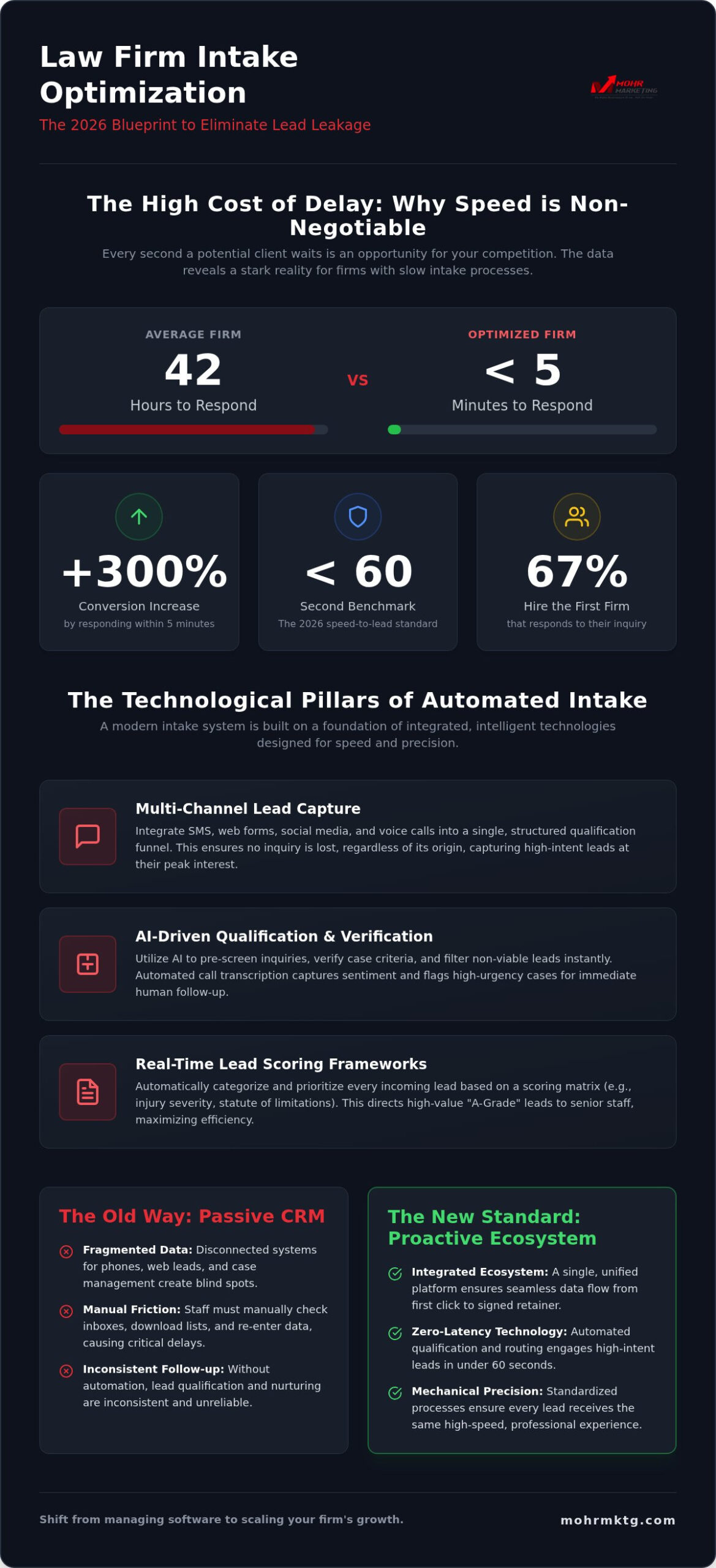
Responding to a new inquiry within five minutes can increase your conversion rate by up to 300% compared to waiting just half an hour. Yet, the average firm still takes 42 hours to respond to a web lead. This massive gap is where law firm intake process optimization becomes a competitive weapon rather than a back-office chore. You’re likely already aware that every second a lead sits untouched is a second they’re searching for your competitor. It’s frustrating to watch high-value cases slip through the cracks because of fragmented data or inconsistent staff follow-up.
You need a system that operates with mechanical precision. This guide provides the blueprint to master the 2026 technological framework required to eliminate lead leakage and convert high-intent inquiries into signed retainers. We’ll examine how to build a turnkey intake ecosystem that uses automated qualification and seamless integration to bridge the gap between your marketing spend and your case management software. You’ll learn how to deploy zero-latency technology that ensures you never lose another high-value case to a faster firm simply because they answered the phone first.
Key Takeaways
- Define the 2026 speed-to-lead benchmark and learn why manual steps create fatal friction in your conversion funnel.
- Identify the core technological pillars required for law firm intake process optimization, including AI-powered pre-screening and multi-channel integration.
- Recognize the critical difference between a passive CRM and a proactive intake ecosystem to avoid the hidden costs of fragmented tech stacks.
- Follow a structured roadmap to audit your current lead-to-retainer timeline and standardize qualification questions across all practice areas.
- Shift your focus from managing complex software to scaling your firm through a turnkey system designed specifically for signed case growth.
The Cost of Friction: Why Traditional Intake Methods Fail in 2026
Friction is the primary obstacle to your firm’s growth. It’s defined as any manual step that delays the connection between a high-intent claimant and your legal team. In 2026, these delays are no longer acceptable. Consumers expect instant gratification. If your process requires a staff member to manually download a CSV or check an inbox to find a lead, you’ve already lost the case. This friction creates a barrier that prevents high-value inquiries from ever reaching your attorneys.
The current speed-to-lead benchmark is sub-60 seconds. Data shows that responding to an inquiry within five minutes can increase conversion rates by up to 300%. Conversely, the average law firm takes 42 hours to respond to a web form submission. This discrepancy is where law firm intake process optimization becomes your greatest competitive advantage. When a claimant is in distress, they equate speed with reliability. A delayed response doesn’t just lose a lead; it damages your brand’s perceived authority. You’re not just fighting for a case; you’re fighting against the “next” button on a search results page.
The Latency Tax on Personal Injury Firms
Every minute of delay functions as a tax on your marketing budget. Conversion probability drops by double digits for every sixty seconds of silence. In a landscape where 67% of clients hire the first firm that responds, being second is the same as being last. You shouldn’t just measure marketing spend. You must measure Intake ROI. This involves calculating the cost of every lead that leaked out of your funnel due to slow human intervention. Effective Law Practice Optimization requires viewing intake as a high-speed mechanical process rather than a casual administrative task.
Fragmented Data: The Silent Case Killer
Disconnected systems create operational blind spots. When your phone system doesn’t sync with your lead tracker, you miss conflict checks and create duplicate entries. This fragmentation leads to inconsistent lead qualification and wasted staff hours. To identify your bottlenecks, perform a simple intake audit as part of your law firm intake process optimization strategy. Map every touchpoint from the initial click to the signed retainer. If you find more than two manual data entries, your system is broken. Integrated ecosystems are the only way to ensure data security and compliance with modern standards like the NIST Cybersecurity Framework 2.0. Manual spreadsheets are no longer just inefficient; they’re a liability.
Essential Technology Pillars for Automated Client Intake
Achieving law firm intake process optimization requires a shift from passive data collection to active technological engagement. You cannot rely on a single web form. A robust 2026 infrastructure integrates multi-channel lead capture across SMS, web, social media, and voice. This ensures that no matter where a claimant starts their journey, they’re immediately pulled into a structured qualification funnel. The goal is to move from initial inquiry to an automated retainer delivery in a single, frictionless session. By removing manual data entry, you ensure that high-intent leads are captured while their interest is at its peak.
AI-Driven Qualification and Verification
AI-powered pre-screening uses natural language processing to verify case criteria instantly. This technology filters out ‘tire-kickers’ by identifying inconsistencies in their narrative before a human ever picks up the phone. For high-stakes litigation like mass tort signed cases, you can set strict parameters such as specific medical proof requirements or exposure dates. Automated call transcription further enhances this by capturing claimant sentiment and urgency, allowing your system to flag high-emotion, high-intent inquiries for immediate action. This level of verification ensures your team only spends time on viable, high-value matters.
Real-Time Lead Scoring Frameworks
Lead scoring is the mathematical prioritization of litigation potential. By building a scoring matrix based on injury severity and the statute of limitations, your system can automatically categorize every incoming inquiry. ‘A-Grade’ leads are routed directly to your most senior intake specialists, while lower-scoring inquiries receive automated nurturing sequences. This algorithmic approach prevents your staff from wasting hours on low-probability cases. If your current setup lacks this level of precision, it’s time to consult with an intake specialist to modernize your workflow and implement law firm intake process optimization at scale.
The final pillar of this ecosystem is the automated retainer delivery. Once a lead passes your AI pre-screening and meets your scoring threshold, the system should instantly generate and send an e-signature document. Moving from qualification to a signed retainer in one session is the only way to guarantee a competitive advantage in a high-volume market. This turnkey approach eliminates the “thinking time” that often leads to lead leakage. You aren’t just managing data; you’re securing assets with mechanical precision.
Comparing Standalone CRM Software vs. Integrated Intake Ecosystems
A Customer Relationship Management (CRM) tool is a system of record. It’s a digital filing cabinet that stores information after it’s been collected. In contrast, an integrated intake ecosystem is a system of action. It actively drives the conversion process from the moment a lead is generated. Relying solely on a CRM for law firm intake process optimization is a strategic error. You need a platform that doesn’t just hold data but moves it toward a signed retainer with zero latency.
DIY tech stacks come with heavy hidden costs. Integrating disparate tools for SMS, email, and e-signatures requires constant maintenance and specialized training. These administrative hurdles drain your resources. Subscription software models charge you every month regardless of your conversion rate. A performance-based ecosystem aligns with your firm’s financial goals by focusing on the delivery of signed cases rather than just providing a platform to store them. For firms scaling national mass tort campaigns, the efficiency of a pre-built ecosystem is the only way to maintain a competitive edge.
The Limitations of Standalone CRM Tools
Standard CRMs are passive. They require your staff to manually input data, set reminders, and initiate follow-ups. In high-velocity environments like mass tort litigation, these manual steps lead to fatal delays. If your software isn’t built to handle thousands of concurrent inquiries, data will fragment. “Cheap” standalone tools often result in expensive case loss because they lack the automated speed-to-lead capabilities required in 2026. If a lead isn’t qualified and signed within minutes, they’re gone.
The Performance Advantage of Integrated Ecosystems
An integrated ecosystem combines marketing, screening, and signing into a single, fluid workflow. This structure allows you to leverage verified call transfer leads directly within your intake stack. There’s no data transfer delay. The system qualifies the claimant, verifies the criteria, and presents the retainer for signature immediately. This level of law firm intake process optimization removes the administrative burden from your attorneys. It allows your legal team to stop managing technology and start focusing on high-stakes litigation. You’re buying outcomes, not just access to software.
A Step-by-Step Roadmap to Implementing Intake Automation
Implementing law firm intake process optimization starts with a rigorous audit of your current “Lead to Retainer” timeline. You must map every touchpoint to identify where claimants drop off. If your data shows a significant lag between the initial inquiry and the first human contact, that’s your primary leakage point. Once you’ve identified these bottlenecks, you must integrate your marketing funnels directly with your intake software via API. This ensures that lead data flows into your system in real time without manual entry errors or delays.
Standardize your qualification questions across every practice area to maintain data consistency. This allows your automated systems to process inquiries with the same level of scrutiny as your best intake specialist. For leads that meet your criteria but don’t sign immediately, deploy automated nurture sequences. These multi-channel follow-ups via SMS and email keep your firm top-of-mind during the decision-making process. Monitor your conversion metrics weekly. Use this data to refine your AI screening prompts and adjust your qualification logic to improve the quality of your signed cases.
Standardizing the Discovery Process
Effective automation requires “Hard-Stop” questions. These are binary filters designed to disqualify non-viable cases instantly. For example, if a claimant lacks a specific medical diagnosis required for a mass tort, the system should end the inquiry and provide a polite rejection. This methodology ensures strict compliance with mass tort lead generation standards. Your staff must be trained to handle AI-augmented workflows, focusing their energy on high-value conversations while the software manages the routine data collection.
Closing the Loop with E-Signatures
The transition from qualification to signature must be instantaneous. Your system should trigger an e-signature document automatically the moment a lead meets your “A-Grade” criteria. This enables “One-Call” closes where the claimant signs the retainer while still on the phone or in the initial chat session. Eliminating the gap between “yes” and the signed document is the ultimate goal of law firm intake process optimization. Remember that signed retainers are the only KPI that directly impacts your firm’s revenue and growth. Any technology that doesn’t drive this specific outcome is secondary.
Beyond the Software: Leveraging Turnkey Intake for Signed Case Growth
The ultimate goal of law firm intake process optimization isn’t to become a software expert. It’s to acquire signed cases with maximum efficiency and zero technical friction. Many firms stall because they get bogged down in the mechanics of their tech stack. They spend valuable hours configuring APIs and troubleshooting synchronization issues. This is a misallocation of resources. Time spent on IT support is time taken away from high-stakes litigation and trial strategy. A turnkey ecosystem removes this burden entirely. It allows you to scale your mass tort and personal injury volume without the massive overhead of an internal intake department.
Mohr Marketing, LLC provides a pre-built legal intake ecosystem that bridges the gap between raw marketing spend and a signed retainer. This performance-based model shifts your focus from managing technology to achieving tangible business outcomes. You don’t pay for seats in a database or monthly software access. You invest in the results that drive your firm’s revenue. By leveraging a system that’s already optimized for 2026 standards, you bypass the trial-and-error phase that costs your competitors thousands in lost leads.
Eliminating the Technology Learning Curve
Outsourcing your intake ecosystem to specialized partners eliminates the steep learning curve associated with modern automation. You should focus your resources on the ROI of legal intake services rather than maintaining internal IT infrastructure. When selecting a partner, prioritize those who deliver fully executed retainer agreements. This ensures that your firm’s only responsibility is to begin the legal work. It’s the most direct path to scaling. You gain the benefits of law firm intake process optimization without the headache of building it from scratch. This approach turns your intake process into a predictable, mechanical engine for growth.
Scaling with Confidence
Data-driven insights allow you to expand into high-value litigation areas like mesothelioma with total confidence. The future of legal intake relies on predictive analytics and proactive claimant engagement. These tools identify the most promising cases before they even enter your competitor’s funnel. By leveraging a turnkey solution, you stay ahead of market shifts and technological trends. You’re no longer reacting to lead leakage; you’re preventing it. Stop managing fragmented processes and start scaling your firm with precision. Secure your firm’s growth with a turnkey intake solution. The path to market leadership is built on conversion efficiency and zero-latency action.
Master Your Intake Ecosystem for 2026
The transition to a zero-latency intake model is not a luxury; it’s a survival requirement. Implementing law firm intake process optimization transforms your front office from a cost center into a high-performance engine for growth. You now have the roadmap to eliminate friction, score leads mathematically, and automate the journey from initial inquiry to signed retainer. By moving beyond the limitations of passive software, you position your firm to capture market share that competitors are losing to delay and data fragmentation.
Mohr Marketing, LLC leverages over 30 years of industry expertise to deliver a zero-leakage intake ecosystem. This model prioritizes fully executed retainers over raw data, ensuring your marketing investment translates directly into active litigation. We provide the technical framework and procedural precision necessary to dominate high-volume case acquisition. We bridge the gap between software and signed retainers with mechanical accuracy.
Stop managing inefficient intermediaries and start acquiring signed cases with confidence. Focus your professional energy on winning in the courtroom while your intake infrastructure handles the mechanics of growth. The future of your practice depends on the speed and accuracy of your first connection.
Frequently Asked Questions
What is the best technology for law firm client intake in 2026?
The most effective technology in 2026 is an integrated intake ecosystem that utilizes AI-driven conversational interfaces. These systems replace static web forms with dynamic, real-time interactions that engage claimants immediately. This approach ensures you maintain a sub-sixty-second response time, which is the current industry benchmark for high-velocity case acquisition. You need a platform that combines multi-channel lead capture with automated verification logic.
How does AI improve the legal intake process?
AI improves the process by automating the pre-screening and qualification of leads through natural language processing. It analyzes claimant responses against specific case criteria instantly, filtering out non-viable inquiries without human intervention. This allows your team to focus exclusively on high-value matters while the AI handles the routine data collection. It also uses sentiment analysis to flag high-emotion, high-intent leads for immediate follow-up.
Can intake software integrate with my existing case management system?
Yes, professional intake technology integrates with leading case management systems through robust API connections. This integration allows for the seamless transfer of data once a claimant signs a retainer. It eliminates the need for manual data entry and ensures your system of record is updated in real time. This connectivity is essential for maintaining data integrity and reducing the administrative burden on your legal staff.
What is the difference between a legal CRM and an intake ecosystem?
A CRM is a passive system of record used for storing data, while an intake ecosystem is an active system of action designed to convert leads. Ecosystems manage the entire journey from the initial inquiry to the signed retainer. This distinction is vital for law firm intake process optimization because an ecosystem focuses on revenue generation and conversion efficiency rather than just administrative data storage.
How do I ensure my automated intake process is bar-compliant?
Ensure your technology partner strictly adheres to state bar mandates and modern data security standards like the NIST Cybersecurity Framework 2.0. The system should maintain transparent records of all interactions and follow established rules regarding attorney-client communications. Professional ecosystems are built with these compliance requirements as a foundational layer, ensuring your firm remains protected while scaling its operations.
What are the most important features to look for in intake technology?
Prioritize features like multi-channel integration, real-time lead scoring, and automated e-signature delivery. These tools allow you to capture leads across SMS, voice, and web while prioritizing them based on litigation potential. High-velocity firms also require automated call transcription and sentiment analysis to identify high-intent inquiries quickly. The goal is to move from qualification to signature in a single, frictionless session.
How much does it cost to implement automated legal intake?
Implementation costs vary depending on your firm’s volume and the complexity of your practice areas. Performance-based models often provide a superior ROI compared to subscription-only software because they align costs with the delivery of signed cases. You should evaluate the total cost of ownership, including integration and maintenance. Avoid DIY stacks that require constant IT support, as these often carry high hidden costs.
How does automated intake help with mass tort case acquisition?
Automated intake is critical for managing the high volume and strict qualification criteria typical of mass tort litigation. It allows you to process thousands of inquiries simultaneously and verify specific medical proof requirements instantly. This level of law firm intake process optimization ensures you capture significant market share without increasing your staff. It provides the mechanical precision needed to secure signed retainers at scale.

Recent Posts
- Mass Tort Digital Marketing Agency
- Personal Injury Signed Retainers: The Strategic Guide to Scalable Case Acquisition in 2026
- Motor Vehicle Accident Leads: A 2026 Guide to High-Intent Case Acquisition
Categories
- AI and Lead Generation
- Business Financing
- Call Verified MVA Leads
- Car Accident Help
- Car Accident Settlements
- Claimant Funding
- Compliance Program
- EMS-EMT Reports
- Geotargeting
- Google Maps Ranking
- Healthcare Practice Growth
- Law Firm Growth
- Law Office Operations
- Lead Generation
- Lead Generation For Attorneys
- Lead Generation For Chiropractors
- Lead Generation For Criminal Attorneys
- Lead Generation For D&A Treatment Centers
- Lead Generation For DUI Attorneys
- Lead Generation For Eye Doctors
- Lead Generation For Family Law Practices
- Lead Generation For PI Law Firms
- Lead Generation For Plastic Surgeons
- Leads For Healthcare Professionals
- Leads For Insurance Industry
- Legal Leads
- Legal Marketing
- Legal Updates
- Mass Tort Leads
- Medicare and Medicaid Leads
- Merchant Funding Leads
- Online Marketing Strategies
- Pre-Settlement Funding
- Signed MVA Cases
- Tort Updates
- Truck Accident Leads and Signed Cases
- Truck Accident Settlements
- Web Design