Outsourced Legal Intake Services: How Calls, Conflicts and Roles Work
October 31, 2026 by Mohr Marketing
Outsourcing intake shifts the first conversation, not legal judgment. Outsourced legal intake services can answer inquiries, collect case information, apply the firm’s qualification criteria, and schedule consultations. Attorneys and firm staff remain responsible for deciding whether to accept a matter, clearing conflicts, and providing legal advice.
A message-taking service differs from an intake team that speaks with prospective clients and guides the conversation toward a consultation. Both can help manage calls, but the right fit depends on what your firm needs covered and how much guidance callers need.
This guide explains what outsourced intake typically covers, when live call coverage can help, and how to manage calls from existing clients. It also clarifies the boundaries between intake work and attorney responsibilities, including conflict checks and consultation scheduling, so you can assess how outsourcing fits your firm’s process.
Key Takeaways
- Distinguish message-taking from full intake, then match coverage to the conversations your firm needs handled.
- Use clear qualification criteria so intake staff can collect relevant details and route promising inquiries consistently.
- Set separate procedures for existing-client calls to preserve familiarity and direct requests to the right team member.
- Keep legal judgment with attorneys: define who reviews conflicts, decides whether to accept a matter, and advises callers.
- Track response quality and lead outcomes to identify bottlenecks and refine the intake process over time.
1. What Is Legal Intake Outsourcing?
Outsourced legal intake services assign the first stage of prospective-client contact to an external team. That team can answer inquiries, capture information, screen leads against firm-defined criteria, and direct qualified prospects toward a consultation. The firm sets the process; intake staff apply it consistently and record callers’ responses.
In-house staff can develop familiarity with the firm’s attorneys, clients, and matter workflows. An answering service typically takes messages, while an intake call center can conduct the initial conversation and schedule consultations. The practical distinction is scope: message-taking records contact, while intake gathers details and moves a prospective client through the firm’s process.
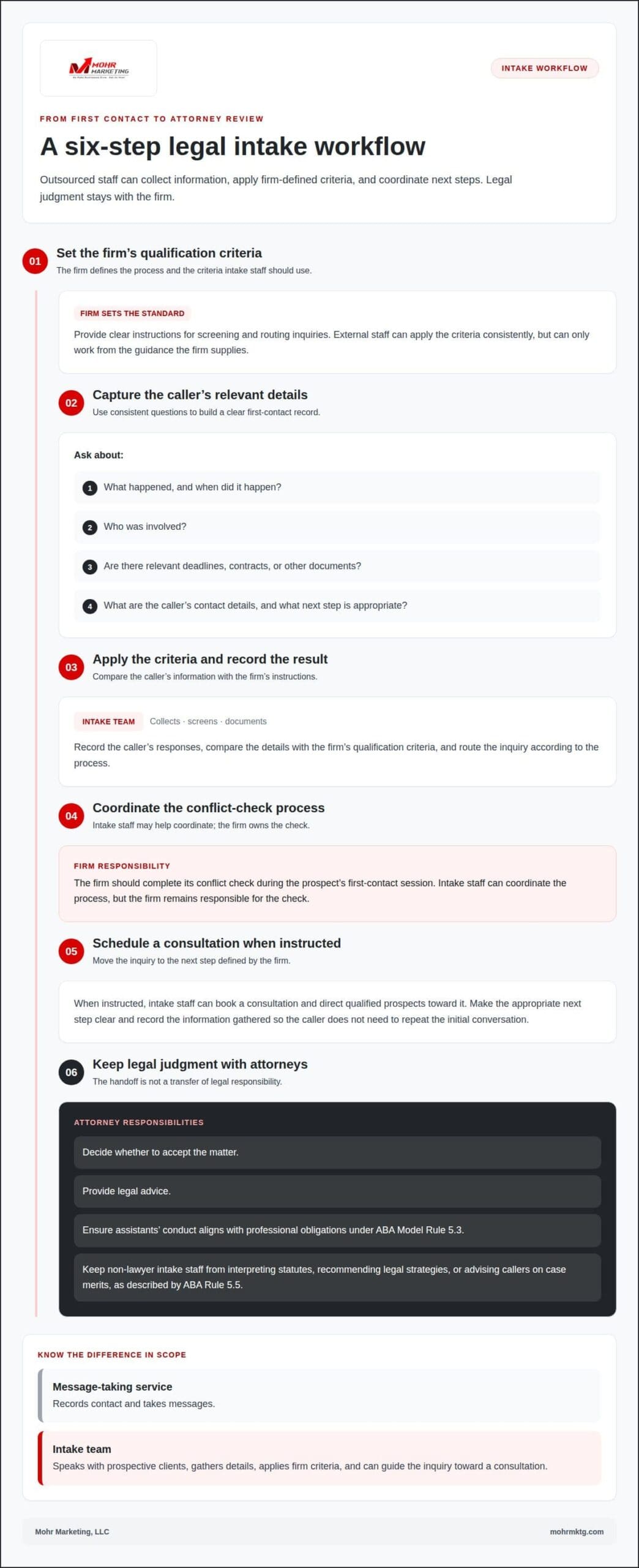
Lead qualification starts with consistent questions. Intake staff can identify the legal issue, the parties involved, relevant deadlines, and any contracts or documents the caller mentions. They then compare those details with the firm’s criteria, record the result, and route the inquiry. Clear criteria matter because outsourced staff can apply only the instructions the firm provides.
What should intake specialists ask prospective clients? They should ask what happened, when it happened, who was involved, and whether there are deadlines or relevant documents. They can also confirm contact details and the appropriate next step. For example, a motor vehicle accident inquiry may require the incident date, the parties involved, and whether the caller has records to share.
Which providers serve U.S. law firms, and what features do they offer? Options include legal answering services and intake call centers; some handle screening, information capture, lead routing, or consultation scheduling. Because services vary in scope, compare their actual intake steps with your firm’s workflow rather than assuming every call-answering option provides full intake.
How can a firm evaluate and choose a provider? Review recent inquiry volume and complexity, then map how calls move from first contact to attorney review. Assess staff training in legal terminology, call control, empathy, and qualification. Define who updates scripts, reviews records, and monitors calls. A practical quality check is to sample at least 10% of intake calls.
Intake specialists need clear communication, accurate recordkeeping, and familiarity with the firm’s scripts and systems. They can collect details, coordinate a conflict-check process, and book a consultation when instructed. The firm should complete its conflict check during the prospect’s first-contact session and decide whether to accept the matter.
They cannot replace attorney judgment. ABA Model Rule 5.3 requires lawyers to make reasonable efforts to ensure assistants’ conduct aligns with professional obligations. ABA Rule 5.5 bars non-lawyer intake staff from interpreting statutes, recommending legal strategies, or advising callers on case merits. Keep qualification and scheduling separate from legal advice.
2. Live-response coverage for overflow and after-hours calls
Call volume rarely follows a firm’s staffing schedule. New inquiries can arrive during hearings, lunch breaks, holidays, or temporary campaigns. Live-response coverage gives callers someone to speak with when internal staff cannot answer. Depending on the arrangement, coverage can extend beyond office hours or provide 24/7 availability. The firm defines what responders capture, which matters need escalation, and how callers receive follow-up.
After-hours coverage handles calls that arrive while the office is closed. Callers can share basic information and receive a clear next step instead of reaching voicemail. Weekend and holiday coverage can maintain an intake path when regular staff are unavailable. Specify how agents should record inquiries, flag urgent matters, and notify the appropriate team when a prompt response is needed.
Extended coverage may fit firms whose calls arrive outside 8 AM to 8 PM. Consider it alongside call records: identify when inquiries arrive, which sources generate them, and how often callers leave messages. Compare those patterns with staff availability. That review helps distinguish an after-hours gap from daytime overflow or delayed follow-up.
Overflow coverage handles a temporary rise in inquiries during business hours. A campaign launch or widely reported event, for example, can generate more requests than the intake team can manage. Set a trigger for overflow, such as unanswered calls or a growing queue. Define how responders capture caller details, route qualified inquiries, and hand unresolved matters back to firm staff.
Temporary surges also need a clear end point. Decide who can activate additional coverage, what information the temporary team needs, and who handles outstanding callbacks once volume returns to normal. A shared queue or handoff record can show staff which callers received a response and which still need follow-up.
Set measurable expectations before coverage begins. Define response-time targets, required call records, escalation rules, and callback ownership. Review missed-call patterns alongside consultation bookings and lead outcomes. Capturing contact details without clarifying the next step still creates friction. A complete handoff gives staff enough context to act without making the caller repeat the initial conversation.
Map your call sources, peak periods, and handoff process before changing coverage. For a practical discussion of your firm’s intake needs, review your coverage options.
3. Limitations of outsourced agents’ familiarity with existing clients
An outside intake agent may know the firm’s procedures without knowing each client’s history. That matters when a caller says, “I already spoke with my attorney,” or asks about a recent filing. A new-lead script can frustrate an existing client if it repeats screening questions or treats the call as a potential conversion. The law firm needs a separate path for current-client calls.
Start by defining how agents identify existing clients. Ask for the caller’s name and a safe identifier approved by the firm, then have staff locate the matter record. Do not ask an outside agent to infer identity from a familiar voice or partial case description. If identity remains unclear, route the call to firm staff instead of sharing matter details.
Client inquiries also need triage rules. A scheduling update differs from a report of a missed deadline, a new incident, or an urgent document. Create categories that specify the destination, urgency, and information to capture. For example, route a routine appointment request to the assigned team, but flag a stated deadline for prompt review under the firm’s procedure.
These boundaries shape the client experience. A caller who has to explain a matter repeatedly may lose confidence, while a caller routed correctly can continue with the appropriate team. Give agents concise routing notes, escalation names or roles, and instructions for calls involving sensitive details. Review misrouted inquiries and repeat-contact complaints, then use those examples to improve scripts and handoffs.
Confidentiality remains central, even before a formal engagement. According to the American Bar Association, Model Rule 1.6 mandates confidentiality of client information. The rule also applies when a prospective client shares case details before a formal relationship exists. Limit collection to information needed for routing, restrict access to records, and train agents to avoid discussing a caller’s matter where others can hear.
A practical workflow separates information capture from case discussion. The agent records the caller’s identity, whether the person is an existing client, the reason for contact, and any stated urgency. The agent then routes the record to the assigned team without interpreting the facts or promising an outcome. Attorneys and firm staff review the matter, provide context-specific responses, and decide what happens next.
Before launch, test the process with scenarios involving a current client, an uncertain identity, and a time-sensitive request. Confirm that each scenario reaches the right team and that the record contains enough context for follow-up. Review the test results with the agent team, then update routing instructions whenever the firm changes its workflows.
4. Outsourced intake tasks and attorney responsibilities
Outsourced teams can handle first-contact work while attorneys retain legal judgment. Typical tasks include answering calls, responding to web inquiries, recording facts, applying firm-approved screening criteria, routing requests, and arranging consultations. For example, an intake team can capture a caller’s account of an accident and send the record to the firm’s designated reviewer.
Intake specialists support workflows; they do not decide whether a legal claim will succeed. They can collect names, contact details, dates, involved parties, and documents mentioned by a prospective client. They can also flag missing information and follow up on outstanding items. Attorneys assess legal merits, decide whether to accept matters, and determine what advice to provide.
How do outsourced intake companies serve law firms? Their services can include phone intake, web-lead response, information capture, lead screening, routing, and consultation scheduling. Some providers also handle after-hours inquiries or support communication in multiple languages. The firm defines the channels, qualification rules, and escalation process its intake team must follow.
Response time matters across channels. Firms can set a target for calls and web leads, assign an owner to each inquiry, and measure actual response times. A web form without a named follow-up owner can sit unanswered, even when the intake script is well designed.
Attorneys also retain responsibility for oversight. ABA Model Rule 5.3 requires lawyers to make reasonable efforts to ensure assistants’ conduct is compatible with professional obligations. ABA Model Rule 1.1 addresses competency through adequate instruction and supervision when delegating work. In practice, firm leaders should approve scripts, explain prohibited responses, train staff on escalation, and review intake records for accuracy.
How should a law firm transition to outsourced intake? First, document the existing process, including call routes, web-form ownership, screening criteria, and conflict-check handoffs. Next, standardize scripts and train the intake team using realistic examples. Then establish clear responsibilities and communication routines between the provider and the firm. Regularly review response times, lead outcomes, client feedback, and incomplete records.
For calls, web leads, and after-hours inquiries, the team should capture the same core details and route each record through the firm’s workflow. Multilingual support can help callers communicate in a language they understand, while attorneys remain responsible for legal advice. Set escalation paths for urgent matters, uncertain conflicts, and existing-client requests.
Clear boundaries protect the client experience and attorney time. An intake team can acknowledge a concern, explain the next procedural step, and transfer the inquiry. It must not interpret statutes, recommend legal strategies, or promise a result. Firm review helps keep delegated intake work aligned with attorneys’ responsibilities.
5. Conflict checks and consultation scheduling
A conflict check needs usable information from the first conversation. The intake team should collect the prospective client’s name, the names of other parties, and a concise description of the matter. According to the American Bar Association, Model Rule 1.18 requires lawyers to protect prospective-client information, even when no formal relationship exists. Keep intake records limited to authorized staff.
Run the firm’s conflict-check process during the same session as first contact. An outsourced team can gather and enter the required details, then flag possible matches for firm review. The firm remains responsible for clearing conflicts and deciding whether to accept the matter. A match prompts attorney review; it does not authorize intake staff to accept or reject a case independently.
Prioritization should follow written escalation rules. For example, route a possible conflict, an urgent caller, or an unclear party relationship to the designated firm contact. Record the reason for escalation and when it was sent. This creates a clear handoff and helps the firm distinguish a routine consultation request from an inquiry needing prompt attorney attention.
Deadlines require careful information capture, not legal interpretation. Ask whether the caller knows of a court date, filing deadline, or other time-sensitive event, and record the date as the caller provides it. Do not calculate a limitation period or tell the caller how much time remains. Route the information to an attorney, who can assess its significance and set the appropriate priority.
Consultation scheduling should follow the firm’s decision process. Once the required conflict review is complete and the firm authorizes the next step, intake staff can offer an available appointment, confirm the caller’s contact details, and record the consultation time. If review is still pending, staff should explain that the firm will follow its established process without implying that representation has begun.
Consistent call handling also depends on clear scripts and reliable records. Use fields for party names, matter type, stated deadlines, conflict-review status, and consultation outcome. A supervisor can compare the intake record with the calendar entry to catch missing details or routing errors. Review sampled calls and records, then update instructions when the firm changes its conflict workflow.
Align your intake process with clear conflict and scheduling workflows.
Mohr Marketing: Personal Injury Leads
Mohr Marketing, LLC provides Personal Injury Leads and Motor Vehicle Accident (MVA) Leads for law firms seeking new case opportunities. Its Legal Intake Services can support firms handling incoming inquiries. Firms seeking signed cases can also consider Signed Retainers.
The right fit depends on the firm’s needs: lead generation, intake support, or signed retainers. Keep attorney review, conflict decisions, and legal advice within the firm’s responsibilities. Align lead criteria and intake workflows before integrating outside support, so prospective-client inquiries have a clear path from initial contact to firm review.
Contact Mohr Marketing, LLC to discuss your firm’s needs.
Set Your Intake Strategy Up for Growth
The next step is to align your intake capacity with the matters your firm wants to pursue. Decide which case types deserve focused attention, where new inquiries should go, and how your team will assess outcomes. This operating plan gives outsourced legal intake services a defined role in your broader growth strategy instead of treating them as a disconnected call-handling function.
Mohr Marketing, LLC offers Mass Tort Leads, Personal Injury Leads, and Motor Vehicle Accident (MVA) Leads. These options can support firms developing pipelines in those practice areas. Choose the opportunity that fits your case priorities, then connect it to a clear intake and review process within your firm.
A clear next step can help your team turn its intake strategy into a focused growth plan.
Frequently Asked Questions
What Is Legal Intake Outsourcing?
Legal intake outsourcing assigns initial inquiry handling to an outside team working from the firm’s procedures. These outsourced legal intake services may gather caller details, categorize the inquiry, and direct it to the appropriate staff member. For example, a firm could route a new injury inquiry to intake while sending a billing question to its administrative team. The firm retains control of its criteria, review process, and legal decisions.
Can I monitor call quality?
Yes. Use a written review rubric and listen to recorded calls where recording and handling comply with applicable requirements. Assess whether the agent identifies the caller’s purpose, follows approved prompts, captures required details, and explains the next step accurately. Compare call notes with recordings to find gaps. If an agent misroutes a current client, use that example to clarify the routing script and coach the team.
What Is Poor Intake Actually Costing Your Firm?
Poor intake can cost a firm opportunities, staff time, and client confidence. To estimate its impact, compare inquiries received with consultations attended and matters accepted, then identify where prospects drop out. Review examples such as an unreturned web inquiry or a caller asked to repeat information. Track staff time spent correcting incomplete records. This internal review helps pinpoint whether the main loss comes from delayed follow-up, weak qualification, or handoff errors.
What about attorney-client privilege?
Outsourcing an initial conversation does not itself establish an attorney-client relationship or remove confidentiality concerns. A prospective caller may share sensitive facts before the firm accepts the matter. Limit intake questions to information needed for screening and routing, restrict record access to authorized personnel, and train agents not to discuss case details outside approved channels. Have firm counsel set instructions for handling sensitive disclosures and requests for legal advice.
What are the real risks, and how do you mitigate them?
Key risks include inaccurate records, misrouted inquiries, inconsistent scripts, and unauthorized access to sensitive information. Reduce them by documenting responsibilities, restricting access, and testing sample scenarios before launch. For instance, test how the workflow handles a returning client, an unclear party name, and an urgent deadline. Assign a firm contact to resolve exceptions, then review errors and update instructions when the process changes.
How does outsourced legal intake software integrate with law firm CRM and case management systems?
Integration depends on the systems and permissions the firm uses. Map intake fields, such as contact details, matter category, and referral source, to the corresponding CRM or case record. Decide whether staff will transfer records manually or use an available system connection. Before launch, test duplicate contacts, missing fields, and routing permissions. Assign ownership for correcting records so incomplete information does not disappear between platforms.
What ethical, confidentiality, and data security rules apply to outsourced legal intake in the United States?
Relevant guidance includes ABA Model Rules 1.6, 1.18, and 5.3, alongside applicable state professional rules. The rules address confidentiality, prospective-client information, and supervision of nonlawyer assistance; Rule 5.5 also limits nonlawyer legal activity. Firms should set access controls, approved communication methods, retention procedures, and incident escalation steps. Attorneys remain responsible for supervision and should tailor procedures to the rules governing their practice.
What are the risks and drawbacks of outsourcing legal client intake?
An outside agent may lack context about a long-standing client, the firm’s internal preferences, or a matter’s history. That can lead to repetitive questions or a poor handoff. Outsourcing also takes time to document workflows, train agents, and review performance. Maintain a clear route for exceptions, provide current instructions, and gather client feedback. A low-volume firm that mainly needs messages taken may find a simpler answering arrangement better suited to its needs.

Recent Posts
- Outsourced Legal Intake Services: How Calls, Conflicts and Roles Work
- Streamlining the Legal Retainer Process Through Clear Communication
- TCPA Rules for Legal Lead Generation, Lead Quality, and Compliance
Categories
- AI and Lead Generation
- Business Financing
- Call Verified MVA Leads
- Car Accident Help
- Car Accident Settlements
- Claimant Funding
- Compliance Program
- EMS-EMT Reports
- Geotargeting
- Google Maps Ranking
- Healthcare Practice Growth
- Law Firm Growth
- Law Office Operations
- Lead Generation
- Lead Generation For Attorneys
- Lead Generation For Chiropractors
- Lead Generation For Criminal Attorneys
- Lead Generation For D&A Treatment Centers
- Lead Generation For DUI Attorneys
- Lead Generation For Eye Doctors
- Lead Generation For Family Law Practices
- Lead Generation For PI Law Firms
- Lead Generation For Plastic Surgeons
- Leads For Healthcare Professionals
- Leads For Insurance Industry
- Legal Leads
- Legal Marketing
- Legal Updates
- Mass Tort Leads
- Medicare and Medicaid Leads
- Merchant Funding Leads
- Mold Leads
- Online Marketing Strategies
- Pre-Settlement Funding
- Signed MVA Cases
- Tort Updates
- Truck Accident Leads and Signed Cases
- Truck Accident Settlements
- Web Design