Streamlining the Legal Retainer Process Through Clear Communication
October 29, 2026 by Mohr Marketing
A retainer agreement should leave no room for guesswork. Streamlining the legal retainer process starts with clearly explaining what the payment covers, how fees and costs are handled, when more funds may be needed, and what happens to unearned funds. Put those terms in writing and communicate them consistently.
Clients should understand the financial arrangement before work begins, not have to decipher it from an invoice later. Clear explanations set expectations, reduce avoidable confusion, and give both sides a shared reference throughout the engagement.
This guide covers the terms to discuss, the key components of a retainer agreement, and how to explain advance payments and trust-account handling. It also explores how jurisdiction can affect a retainer’s meaning and the handling of funds, and how clear records support an orderly client intake process.
Key Takeaways
- Explain what the retainer covers, how billing works, and when additional funds may be needed before work begins.
- Set out the services, agreement duration, rates, billable costs, and payment schedule in clear written terms.
- Distinguish advance payments for legal services from entry fees, and explain how funds are handled and unearned amounts returned.
- Account for jurisdictional differences when describing retainers and trust-account practices.
- Build a more orderly intake and signing process with clear communication, complete documentation, and consistent follow-through.
Client communication about retainer terms
Clear communication makes a retainer easier to understand before representation begins. Explain the payment, the work it covers, billing practices, and how client funds are handled.
Explaining Terms and Setting Expectations
A retainer explanation translates the agreement’s financial and service terms into clear expectations. Describe the work included, what falls outside the scope, how fees and costs are billed, and when another deposit may be needed. Explain how unearned funds are returned. This helps clients understand what the initial payment covers and what future invoices may include.
Use consistent language in the agreement and intake conversation. If the matter’s scope changes, explain how that affects the services and billing before proceeding.
Invoicing and Client Approval
Retainer invoices document work performed, charges applied, and the remaining balance. Itemized invoices should link each charge to the agreed services, list costs separately, and explain any amount due or replenishment request. Consistent records show clients how funds were applied.
Explain how clients can review invoices and raise questions. A clear process identifies who reviews the bill, how questions are submitted, and how the firm records its response. Cover these steps at intake and follow them for every invoice.
Intake Checks Before Signing
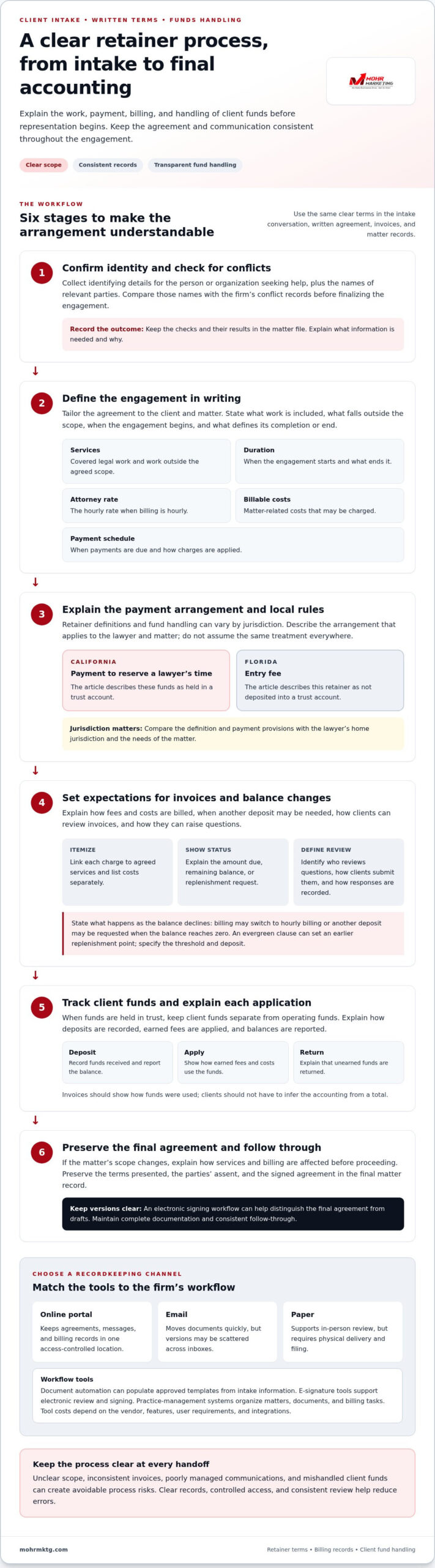
Pre-signing intake checks confirm a prospective client’s identity and screen the matter for conflicts. Collect identifying details for the person or organization seeking help, along with the names of relevant parties. Compare those names with the firm’s conflict records before finalizing the engagement.
Record the checks and their outcomes in the matter file. This helps prevent an agreement from proceeding while identity questions or potential conflicts remain unresolved. Explain what information the client must provide and why it is needed.
Digital Channels and Signing Tools
Online portals keep agreements, messages, and billing records in one access-controlled location. Email can move documents quickly but may scatter versions across inboxes. Paper supports in-person review but requires physical delivery and filing. Choose a channel that gives clients clear access and helps the firm maintain an orderly record.
Document automation can populate approved agreement templates using intake information. E-signature tools support electronic review and signing, while practice-management systems organize matters, documents, and billing tasks. Tool costs depend on the vendor, features, user requirements, and integrations, so compare these factors with the firm’s workflow.
Client funds must remain separate from operating funds in a trust account, and unearned funds must be returned. Explain how the firm records deposits, applies earned fees, and reports balances. Invoices should show how funds were used, rather than leaving clients to infer the accounting from a total.
Common risks include an unclear scope, inconsistent invoices, unauthorized disclosure through poorly managed communications, and mishandled client funds. Because jurisdiction can affect retainer definitions and fund handling, describe the applicable arrangement accurately. Clear records, controlled access, and consistent review help reduce avoidable process errors.
Retainer agreement terms and components
A written retainer agreement defines the legal work, payment arrangement, and duration of the engagement. Tailor its terms to the client’s matter rather than relying on a generic template alone.
Requirements can vary by state and matter because jurisdictions may define retainers differently. California treats a retainer as payment to reserve a lawyer’s time, with funds held in a trust account. Florida treats a retainer as an entry fee that isn’t deposited into a trust account. The type of work also shapes the services, costs, and payment schedule to include.
Use the agreement to describe the arrangement in specific, reviewable terms. Include these core components:
- Services: Identify the legal work covered and distinguish work outside the agreed scope.
- Duration: State when the engagement begins and what defines its completion or end.
- Attorney rate: Set out the hourly rate when billing is hourly.
- Billable costs: Explain which matter-related costs may be charged.
- Payment schedule: Specify when payments are due and how charges are applied.
These details make the agreement a practical reference if the matter changes. For example, compare a new service request with the stated scope before proceeding with additional work. Tailoring the document to the client and matter helps prevent broad wording from obscuring what the lawyer agreed to do.
Also define what happens as the retainer balance declines. An attorney may switch to hourly billing or request another deposit when the balance reaches zero. An evergreen clause can set an earlier replenishment point. The agreement should state the threshold and deposit clearly.
Electronic signing can complete the agreement workflow in the United States. Preserve the terms presented, the parties’ assent, and the signed document in the final record. This gives both sides a stable reference and helps distinguish the final version from drafts.
Before using a template, compare its retainer definition and payment provisions with the lawyer’s home jurisdiction and the matter’s needs. For example, a personal injury engagement may need different service descriptions and cost terms from an hourly advisory matter. Clear, tailored clauses make the agreement easier to interpret as work progresses.
The agreement should show how its terms fit together: describe the services, contract duration, attorney hourly rate, billable costs, and payment schedule so the client understands what the fee covers and when charges arise. A lawyer retainer agreement should address each item, noting when it does not apply rather than leaving uncertainty. An evergreen retainer clause in the original fee agreement can help prevent the account balance from reaching zero. Explain how replenishment works and when another payment is due, so the client knows what to expect as work continues.
“Retainer” can describe different fee arrangements. An entry fee is typically a flat fee that secures a law firm’s availability to handle a client’s legal needs, but it does not cover the actual cost of legal services. Distinguish that fee from charges for the work itself, explaining which services are included and how additional fees or costs will be addressed. Clear distinctions help clients understand their financial commitment before the engagement proceeds.
Advance payments and trust-account handling
Advance payments require a clear separation between client funds and fees already earned. Explain in the agreement where the payment is held, how charges are applied, and what happens to any remaining balance when the work ends.
California defines an advance for fees as a client payment intended to cover some or all expected legal services. The invoice and trust ledger should clearly show each transaction.
The American Bar Association advises lawyers to keep client funds in trust accounts separate from other funds and return unearned funds. Money received for future services is not automatically earned upon receipt. Record the deposit, document each authorized transfer, and reconcile the trust ledger with account activity. These records help explain the balance to the client and support accurate accounting.
The label “retainer” alone does not determine how money is handled. The treatment of a retainer can depend on the agreement and jurisdiction, so clarify how the funds will be handled. Florida treats a retainer as an entry fee that isn’t deposited into trust. An entry fee typically belongs to the firm upon receipt, while an advance for services covers work expected later. Explain which arrangement applies to the matter and jurisdiction.
Firms can automate payment records and replenishment reminders by connecting billing workflows to matter balances and the agreement’s stated threshold. Set alerts to notify staff and clients when funds approach that threshold, then review the balance before requesting a deposit. Process only authorized payments, and ensure each trust transfer matches work performed and appears in the client ledger.
Automation supports administration but doesn’t replace review. Assign a staff member to reconcile deposits, withdrawals, invoices, and refunds. For each matter, compare the trust ledger with the operating account and billing record. Resolve discrepancies before sending a balance update. A documented review can catch duplicate entries, transfers posted to the wrong matter, or reminders sent after replenishment.
Close the matter with a final accounting showing payments received, fees earned, transfers made, and any unearned balance returned. The American Bar Association’s guidance on returning unearned client funds underscores why the final record should distinguish earned charges from money still held for future work.
An entry fee is typically nonrefundable and should not be deposited into a trust account because it belongs to the law firm upon receipt. State its purpose and treatment plainly in the agreement, and keep the corresponding billing entry separate from deposits held for future services. Before posting a payment, confirm that its description matches the arrangement documented for the matter.
Use consistent language with clients to distinguish an entry fee from a payment for future work. If the agreement or payment record is unclear, pause processing and clarify the arrangement before recording or applying the funds. Clear descriptions help prevent an entry fee from being confused with money held for later services.
What is a legal retainer and how does the retainer process work?
A legal retainer is a payment or fee arrangement connected to legal services. Its meaning depends on the agreement and the lawyer’s jurisdiction. An advance payment may cover expected work, while an entry fee may secure the firm’s availability without paying for specific legal services. The agreement should clearly state which arrangement applies.
The process connects a client’s request for legal help with a defined working relationship. A consultation identifies the matter, the lawyer assesses whether the work is a fit, and both sides establish the engagement’s scope and financial terms. Signing the agreement records that arrangement. Payment and work then proceed according to its terms.
- Assess the matter. The lawyer gathers details about the client’s legal issue, relevant parties, and requested outcome. For example, a personal injury matter may require different work from a contract review.
- Define the engagement. The agreement identifies the services, the responsible lawyer, and the expected duration. If a client asks for work beyond the original scope, the parties can address that change before proceeding.
- Explain the payment model. The lawyer clarifies whether the payment is an advance for services, an entry fee, or another arrangement. The explanation should distinguish legal fees from costs and describe how charges affect the balance.
- Sign and begin work. Once the client understands and signs the agreement, the firm records the engagement and follows its stated billing and communication process. The signed document becomes a reference if questions arise later.
A retainer doesn’t necessarily represent the total cost of a matter. In an hourly arrangement, the initial payment may be applied to work as it is performed. A flat-fee agreement instead ties payment to defined services. The client should understand what the agreed amount covers and which work may require a separate arrangement.
For example, a client hires a lawyer to review a business contract. The agreement defines that review as the initial service. If the client later requests negotiation support, the additional work can be discussed and documented separately. Clear boundaries help both parties understand which task the existing engagement covers.
The process continues after signing. The firm tracks work against the agreement, communicates material changes, and issues invoices that link charges to the engagement. At completion, the lawyer closes the matter and accounts for any remaining advance balance. A clear sequence shows clients what to expect from initial contact through the end of representation.
What steps can law firms take to streamline client intake and retainer signing?
A defined intake workflow moves each prospective matter from first contact to a documented decision. A consistent sequence supports streamlining the legal retainer process from inquiry through signed agreement. Assign an owner to each stage, record the outcome, and make the next action clear.
Start with a consistent intake form. Capture the prospective client’s name, contact details, matter type, relevant parties, and a concise description of the issue. For a motor vehicle accident inquiry, record incident details and the names of other parties. Collect the information needed for initial review, then route the inquiry to the appropriate staff member.
Use a clear sequence so no inquiry stalls between teams:
- Log and assign the inquiry. Enter its arrival and matter category in the firm’s intake system. Give a designated person responsibility for the next review.
- Review basic fit and conflicts. Gather names connected to the matter and compare them with conflict records. Note unresolved questions and pause progression until staff address them.
- Arrange attorney review. Provide the reviewing attorney with the intake summary and relevant documents. Record the decision, such as decline, request more information, or proceed to discuss engagement terms.
- Prepare the agreement. Use an approved template that populates client and matter details. Have staff review the completed document for accuracy before sending it.
- Track signature and next action. Record when the agreement is sent, signed, or still outstanding. Route the completed record to the person responsible for opening the matter.
Standardized handoffs reduce duplicate entry. For example, entering a client’s contact information once and reusing it in the agreement can prevent mismatched names or email addresses. Clearly distinguish an inquiry from an active matter. Record the decision authorizing the next stage rather than treating document delivery as an engagement.
Set client expectations at each transition. An intake confirmation can identify the assigned contact and explain what information is outstanding. Before sending the agreement, summarize the proposed scope and payment arrangement in plain language. If the client requests a change, revise the document and retain the final version with the signed record. These steps make streamlining the legal retainer process part of daily intake, not a separate project.
Review operational records to assess how the process is working. Track where inquiries pause, which documents often need correction, and whether unsigned agreements receive follow-up. If intake forms repeatedly omit a key detail, update the form or staff prompt. If agreement errors cluster around one field, add a review step for it. These checks help keep the workflow clear as caseloads shift.
Mohr Marketing: Personal Injury Leads
Mohr Marketing provides Personal Injury Leads for law firms looking to build their intake pipeline. Firms handling motor vehicle accident cases can also consider Motor Vehicle Accident (MVA) Leads. Mohr Marketing also offers Legal Intake Services and Signed Retainers to support intake and case conversion.
These offerings can suit firms with clear retainer terms that need a consistent process for handling prospective matters. Legal Intake Services can support the intake stage, while Signed Retainers support the transition from prospective inquiry to signed engagement. The right fit depends on the firm’s practice focus and intake needs.
Contact Mohr Marketing to discuss its personal injury lead and intake services.
Build a Stronger Intake Foundation
Use your next intake review to identify a point where prospective clients encounter delays or unclear handoffs. A disciplined approach to streamlining the legal retainer process can support a more consistent experience and help your team see where inquiries progress or stall. Set a practical improvement, assign responsibility, and assess whether the revised workflow is easier to follow.
For firms seeking additional opportunities in relevant practice areas, Mohr Marketing offers Mass Tort Leads, Personal Injury Leads, and Motor Vehicle Accident (MVA) Leads. These offerings can complement an intake process designed to move suitable inquiries toward a clear next step.
Keep the process focused, measurable, and responsive to your firm’s needs. Each refinement can help your team create a more deliberate path from initial inquiry to engagement.
Frequently Asked Questions
What should a legal retainer agreement include under U.S. state bar rules?
There is no universal retainer definition or checklist for every U.S. jurisdiction, so the agreement should reflect the lawyer’s home jurisdiction and the matter. Clearly identify the services, engagement duration, applicable attorney rate, billable costs, and payment schedule. Explain how the payment will be treated, when another deposit may be requested, and how any unearned balance will be handled. For example, distinguish an advance for future work from an entry fee.
How much do legal practice management and e-signature tools cost for retainer processing?
Tool costs depend on the vendor, features, user requirements, and integrations.

Recent Posts
- Streamlining the Legal Retainer Process Through Clear Communication
- TCPA Rules for Legal Lead Generation, Lead Quality, and Compliance
- HIPAA compliant marketing for law firms and penalty risks
Categories
- AI and Lead Generation
- Business Financing
- Call Verified MVA Leads
- Car Accident Help
- Car Accident Settlements
- Claimant Funding
- Compliance Program
- EMS-EMT Reports
- Geotargeting
- Google Maps Ranking
- Healthcare Practice Growth
- Law Firm Growth
- Law Office Operations
- Lead Generation
- Lead Generation For Attorneys
- Lead Generation For Chiropractors
- Lead Generation For Criminal Attorneys
- Lead Generation For D&A Treatment Centers
- Lead Generation For DUI Attorneys
- Lead Generation For Eye Doctors
- Lead Generation For Family Law Practices
- Lead Generation For PI Law Firms
- Lead Generation For Plastic Surgeons
- Leads For Healthcare Professionals
- Leads For Insurance Industry
- Legal Leads
- Legal Marketing
- Legal Updates
- Mass Tort Leads
- Medicare and Medicaid Leads
- Merchant Funding Leads
- Mold Leads
- Online Marketing Strategies
- Pre-Settlement Funding
- Signed MVA Cases
- Tort Updates
- Truck Accident Leads and Signed Cases
- Truck Accident Settlements
- Web Design