Bar-Compliant Legal Marketing: 2026 Guide for Law Firms
October 5, 2026 by Mohr Marketing
Compliance is not a final ad review. It is an operating process that starts before a campaign goes live and continues through content, lead generation, and intake. Bar compliant legal marketing matters because professional conduct rules and interpretations can differ by jurisdiction, while a single campaign may involve multiple channels and teams.
A practical process begins by identifying which rules apply to the firm and assigning responsibility for reviewing campaign materials. The next step is to apply those requirements consistently to claims, testimonials, outreach, and lead handling. Without clear ownership, an issue can surface at any stage, from an ad draft to an intake handoff.
This 2026 guide explains how to build a repeatable process for reviewing campaigns, content, and communications with prospective clients. You’ll learn how to account for jurisdictional differences, coordinate marketing with intake, and evaluate a marketing partner’s approach to verification and transparency. Mohr Marketing, LLC supports law firms with verified inquiries, signed retainers, and legal intake services, helping connect campaign activity with the operational steps that follow.
Key Takeaways
- Build bar compliant legal marketing around the requirements that apply to your firm’s jurisdictions, not assumptions based on a general framework.
- Review claims, content, and channels for clarity, context, and the potential to mislead before publication.
- Make review part of campaign operations, with defined checkpoints for questions and revisions.
- Assign clear responsibility for jurisdiction mapping, legal review, marketing execution, approval, and ongoing monitoring.
- Evaluate how verified inquiries, signed retainers, and legal intake services fit your firm’s growth process.
What Bar-Compliant Legal Marketing Means for a Law Firm
Bar-compliant legal marketing is the planning, review, and operation of campaigns against the professional conduct requirements that apply to a firm’s lawyers and the jurisdictions they serve. It covers more than the final advertisement. A campaign may attract qualified inquiries and still require ethical review. Performance measures cannot establish whether its claims or methods meet applicable standards.
It is also important to distinguish broad principles from binding rules. The American Bar Association’s Model Rules provide a reference framework, but they do not automatically govern every lawyer. Jurisdictions may adopt, amend, or interpret professional conduct rules differently. Firms should identify the rules that apply to their attorneys and campaigns rather than assume one national standard answers every question.
How ABA Model Rules and State Rules Relate
Model Rules 7.1, 7.2, and 7.3 address lawyer communications, advertising, and solicitation in the ABA framework. Their current text can inform a review, but firms must verify whether and how relevant provisions have been adopted and interpreted in each applicable jurisdiction. The Legal advertising overview offers general context, while jurisdiction-specific analysis requires the governing rules.
This distinction matters for campaigns that reach audiences in multiple jurisdictions. A phrase, format, or outreach method reviewed against one jurisdiction’s rules should not be assumed suitable everywhere else. Use the model framework as a starting reference, then route questions about applicable obligations to the firm’s designated legal reviewer.
What Compliance Should Cover Beyond the Advertisement
Review the campaign as a connected process. Consider its planning, ad copy, website and landing-page content, lead forms, follow-up communications, and intake handoffs. Content review asks what a prospective client sees and whether it could create a misleading impression. Process review asks how an inquiry is captured, routed, and handled. Both matter, and a generic checklist cannot resolve every jurisdiction-specific question.
A campaign landing page and its lead form, for example, may present different information and prompt different interactions. Reviewing only the ad leaves those connected parts outside the review. A page about high-value mold case acquisition illustrates why each campaign asset should be considered in context, rather than cleared solely because another page or ad has already been reviewed.
Make the distinction operational: assess campaign performance separately from professional conduct considerations, document jurisdictional questions that need firm-side review, and define how approved content connects to inquiry handling. This gives marketing and intake teams a controlled process without treating a single approval as universal clearance.
Build Legal Marketing Compliance Into Claims, Content, and Channels
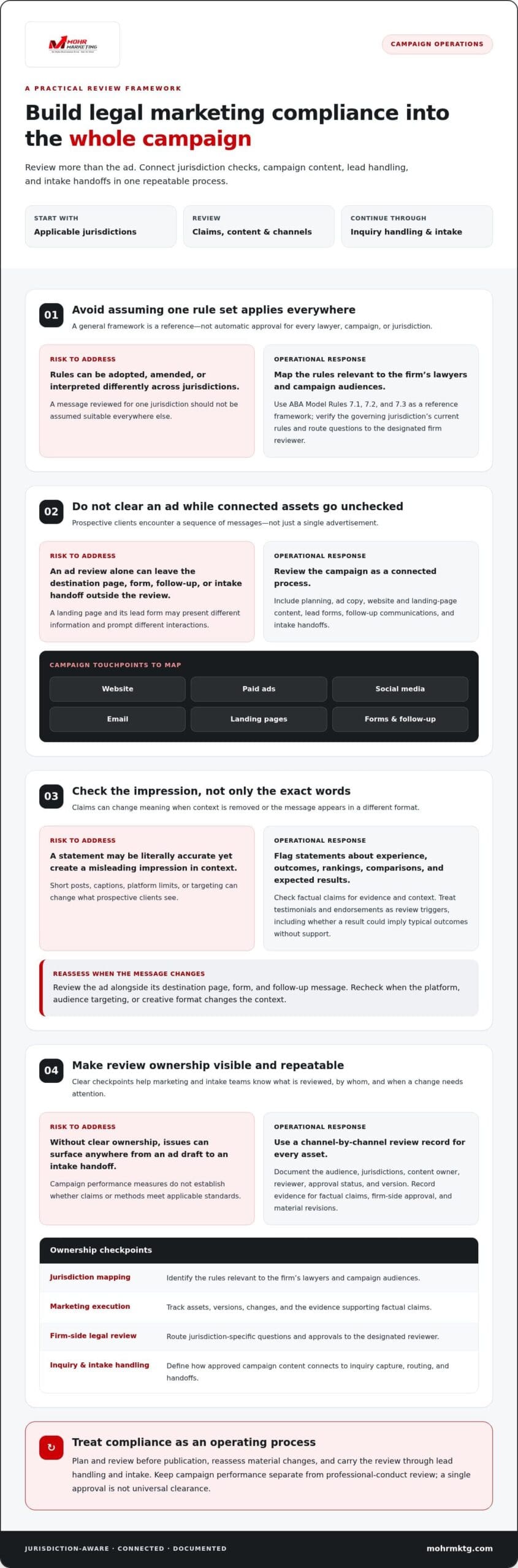
A campaign is more than its ad. The message continues through the destination page, lead form, follow-up communication, and intake handoff. Bar compliant legal marketing requires reviewing these components together and accounting for the rules relevant to the firm and its audience.
Start by mapping every active channel, including the firm’s website, paid ads, social media, email, and landing pages. For each asset, record its intended audience, relevant jurisdictions, content owner, reviewer, approval status, and version. This channel-by-channel matrix makes gaps visible and shows who needs to review a change before publication.
Review Claims, Testimonials, and Results Statements
Flag statements about experience, outcomes, rankings, comparisons, or expected results for review. Consider what a reasonable reader could understand from the full message, not only whether each sentence is literally accurate. Factual claims need evidence and context. A result or testimonial should not imply that similar outcomes are typical without support. Testimonials and endorsements are review triggers, not automatic violations. Assess their use against the requirements that apply in the relevant jurisdiction.
Use official materials as the source for jurisdiction-specific rule text. State bar rules materials, such as this professional conduct rule resource, illustrate why campaign teams should identify the governing jurisdiction and verify current requirements rather than rely on a generic national template.
Apply the Same Review Discipline Across Digital Channels
Review each ad alongside its destination page, form, and follow-up message. A headline may make a claim that the page explains in context, while a short social post or video caption may remove that context. Reassess the message when platform limits, audience targeting, or creative format changes what prospective clients see.
Make the review matrix useful in day-to-day work. For every asset, note the jurisdictions considered, evidence supporting factual claims, required firm-side approval, publication version, and material revisions. Assign marketing staff responsibility for tracking changes and the designated firm reviewer responsibility for legal approval. Keep those roles distinct: efficient execution does not replace professional review.
This approach supports consistent campaign operations without treating one checklist as a universal answer. To discuss how campaign planning, verified inquiries, and intake coordination can fit into your firm’s workflow, learn about Mohr Marketing’s services.
Address the Misconception That Compliance Means Avoiding Effective Marketing
Compliance review does not require a firm to avoid effective marketing. It calls for appropriate review to be built into campaign operations rather than treated as a last-minute launch barrier. With bar compliant legal marketing, teams can plan review while developing campaign messages, creative, landing pages, and inquiry workflows.
The difference is operational. A concern identified near launch may require edits to an ad, its destination page, or related materials, disrupting the schedule. Planned checkpoints give the marketing team a defined route for raising questions and the firm’s designated reviewer a clear point for approval or escalation. This structure can make revisions easier to manage, but it does not eliminate risk or replace jurisdiction-specific legal judgment.
| Review approach | Workflow effect | Key limitation |
|---|---|---|
| Ad hoc review | Questions surface inconsistently and may require late changes across campaign assets. | Responsibility and approval history may be unclear. |
| Documented review | Defined checkpoints clarify who prepares, reviews, approves, and records changes. | Documentation does not guarantee legal approval or campaign results. |
Measure Performance Without Confusing It With Compliance
Marketing and compliance answer different questions. Performance reporting can describe campaign activity and inquiry quality. It cannot determine whether a communication meets professional conduct requirements. Keep the assessments distinct: firm-side legal review addresses compliance questions, while campaign reporting tracks operational and marketing measures.
Use consistent definitions for the measures the firm chooses to track. Distinguish an inquiry received from one that has been verified or progressed through intake. Compare results using the same definitions and reporting period, and note campaign changes so the team can interpret the data in context. Do not present uncertain outcomes as assured results.
Lead verification and intake feedback can provide useful context for campaign assessment. They help teams understand what happened after a response came in, without turning operational information into a legal conclusion or a promise of future performance. Review the evidence, identify where the workflow needs adjustment, and route professional conduct questions to the appropriate firm reviewer.
Create a Repeatable Legal Marketing Compliance Review Process
A repeatable process turns bar compliant legal marketing from an occasional review into a defined campaign workflow. It clarifies who prepares materials, who evaluates legal questions, and what the team records before and after publication. The workflow should account for the firm’s jurisdictions and campaign details. One template cannot resolve every issue.
Set ownership before work begins. The firm identifies a responsible attorney to review legal questions and an escalation path for uncertain interpretations. Marketing owns campaign execution, asset coordination, and version tracking. Record the intended audience, jurisdictions, channels, and material claims so reviewers can assess the campaign in context.
Use this sequence for each campaign:
- 1. Map jurisdictions and audience. Identify where the campaign is directed and which firm attorneys or practices it represents. Route uncertain interpretations to qualified counsel or the relevant authority.
- 2. Document the campaign. List its channels, assets, intended audience, claims, and supporting evidence. Include connected materials such as landing pages, forms, and follow-up communications.
- 3. Assign review roles. Have marketing prepare and coordinate materials. The designated firm reviewer evaluates legal questions and identifies issues requiring further escalation.
- 4. Record approval and publish. Save the approved versions, supporting evidence, reviewer, and review date. Publish the materials that were reviewed, and track later edits rather than treating approval as permanent clearance.
- 5. Monitor and reassess. Schedule a review when claims, targeting, landing pages, or relevant rules change. Use inquiry and intake feedback to identify process gaps, not as proof that a campaign complies.
Keep a clear record. A later reviewer should be able to see which version ran, what evidence supported its claims, which jurisdictions were considered, and when approval occurred. If the campaign changes, preserve the earlier version and record the revision and its review status. This makes it easier to distinguish a production edit from a change that affects the message or audience.
Monitoring should connect marketing and intake without merging their responsibilities. Intake feedback may reveal, for example, that inquiries are unclear about the advertised service or that a handoff needs attention. Share that information with the campaign owner, then route legal questions to the firm’s reviewer. Lead volume alone does not establish compliance, and a documented process cannot guarantee approval or eliminate risk.
Choose a Legal Marketing Partner That Supports a Controlled Growth System
A marketing partner should make campaign responsibilities visible. Before work begins, clarify who plans the campaign, executes it, verifies inquiries, coordinates intake, and routes legal questions to the firm. Defined handoffs help connect marketing activity with the process for receiving prospective clients.
This structure supports bar compliant legal marketing, but it does not transfer the firm’s professional obligations to an agency. The law firm remains responsible for its legal judgments and for determining how professional conduct requirements apply to its lawyers and campaigns. A marketing partner can support transparent execution and operational coordination, but cannot replace legal advice or guarantee compliance.
Connect Campaign Delivery With Lead Verification and Intake
Campaign planning should account for what happens after someone responds. A firm seeking inquiries may prioritize verified inquiries, while a firm seeking completed engagements may consider signed retainers. These are distinct offerings and should be described accurately, without implying that an inquiry has become a client or that a particular result is assured.
For mass tort campaigns, firms can consider how mass tort signed cases fit their acquisition needs. The operational discussion should also establish how incoming inquiries connect to the firm’s intake process, what information is shared, and who owns each handoff. This helps the firm assess the campaign as a complete workflow rather than as an isolated ad or lead source.
Keep Compliance Accountability Clear
Evaluate a partner by the transparency of its process. Are campaign responsibilities defined? Are inquiry verification and intake coordination explained clearly? Can the firm distinguish marketing execution from its own review and legal decisions? These questions help set practical boundaries and surface gaps before launch.
Mohr Marketing, LLC brings more than 30 years of industry experience in legal and healthcare marketing. That experience provides business context, but it does not establish that a campaign satisfies any jurisdiction’s professional conduct rules. A controlled approach still depends on clear coordination between the firm and its marketing partner, with the firm retaining responsibility for legal review.
For firms managing campaigns across jurisdictions, this division of work is especially important. Mohr Marketing provides verified inquiries, signed retainers, and legal intake services to support campaign operations. The firm determines the applicable requirements and makes the legal judgments. Keep both roles explicit as campaigns evolve.
Make Compliance Part of Your Growth Plan
Effective bar compliant legal marketing depends on more than reviewing an ad before it goes live. Map the requirements that apply to each campaign, review claims and connected channels, and assign clear ownership for legal approval, marketing execution, and intake coordination. A repeatable process helps teams manage changes with greater clarity, but it does not replace the firm’s legal judgment or guarantee compliance.
The right marketing partner should make its role clear and support transparent campaign operations. Mohr Marketing provides verified inquiries, signed retainers, and legal intake services. These offerings can support different stages of a firm’s acquisition process while the firm retains responsibility for its professional obligations.
Build a system that supports responsible review and gives your team a clear view of how campaigns and inquiries move forward. To discuss how Mohr Marketing’s services can support your firm’s acquisition and intake workflow, contact Mohr Marketing, LLC.
Frequently Asked Questions
What does bar-compliant legal marketing mean?
Bar-compliant legal marketing is the planning and review of a law firm’s campaigns against the professional conduct requirements applicable to its lawyers and jurisdictions. It covers more than ad copy: claims, websites, landing pages, lead forms, communications, and intake handoffs may all be part of the process. A strong conversion rate does not establish compliance. Firms need a consistent review process and jurisdiction-specific analysis.
Do the ABA Model Rules apply in every state?
No. The ABA Model Rules are a model framework, not automatically binding law in every jurisdiction. Authorities may adopt, amend, or interpret professional conduct rules differently. A firm should identify the jurisdictions relevant to its lawyers and campaigns, then verify the applicable rules and interpretations. Treating the Model Rules as a useful reference is not a substitute for checking the requirements that govern the firm.
Can a law firm use client testimonials in its marketing?
Potentially, but testimonials should be reviewed before publication. Assess whether the statement is truthful, supported, and presented in a context that could mislead or create an unjustified expectation about results. Requirements and interpretations can vary by jurisdiction, including any conditions or disclosures that may apply. Review the testimonial and surrounding ad or page together, then route jurisdiction-specific questions to the firm’s designated legal reviewer.
How should a law firm review digital advertising for compliance?
Review each ad as part of its full campaign, not in isolation. Check the claims, audience, and jurisdictions, then assess the destination page, lead form, and follow-up communications. Confirm that factual statements have support and that context is not lost across formats, such as a short social post. Assign a firm-side reviewer for legal questions, document approvals and revisions, and reassess materials when campaign details change.
Are paid leads or signed retainers automatically compliant?
No. A lead’s source or status as a signed retainer does not, by itself, establish that the marketing and intake process meets applicable requirements. Review how the campaign was presented, how inquiries were generated and handled, and which jurisdictions are involved. Keep marketing performance measures separate from legal review. The firm should assess applicable professional conduct requirements rather than treat lead verification or a completed retainer as proof of compliance.
Who is responsible for reviewing a law firm’s marketing?
The firm should assign a responsible attorney or other designated firm reviewer to evaluate legal questions and make professional judgments. Marketing staff or an external partner can coordinate campaign execution, track versions, and support inquiry verification or intake operations. Make those roles explicit. A marketing partner’s operational support does not replace the firm’s responsibility to determine how applicable professional conduct requirements affect its lawyers and campaigns.

Recent Posts
- Bar-Compliant Legal Marketing: 2026 Guide for Law Firms
- Auto Accident Lead Generation: Build a Verified Case Pipeline in 2026
- Car Accident Case Acquisition: Strategic Law Firm Guide
Categories
- AI and Lead Generation
- Business Financing
- Call Verified MVA Leads
- Car Accident Help
- Car Accident Settlements
- Claimant Funding
- Compliance Program
- EMS-EMT Reports
- Geotargeting
- Google Maps Ranking
- Healthcare Practice Growth
- Law Firm Growth
- Law Office Operations
- Lead Generation
- Lead Generation For Attorneys
- Lead Generation For Chiropractors
- Lead Generation For Criminal Attorneys
- Lead Generation For D&A Treatment Centers
- Lead Generation For DUI Attorneys
- Lead Generation For Eye Doctors
- Lead Generation For Family Law Practices
- Lead Generation For PI Law Firms
- Lead Generation For Plastic Surgeons
- Leads For Healthcare Professionals
- Leads For Insurance Industry
- Legal Leads
- Legal Marketing
- Legal Updates
- Mass Tort Leads
- Medicare and Medicaid Leads
- Merchant Funding Leads
- Mold Leads
- Online Marketing Strategies
- Pre-Settlement Funding
- Signed MVA Cases
- Tort Updates
- Truck Accident Leads and Signed Cases
- Truck Accident Settlements
- Web Design