Improving Law Firm Client Intake Process: The 2026 Strategy for High-Value Case Acquisition
August 24, 2026 by Mohr Marketing
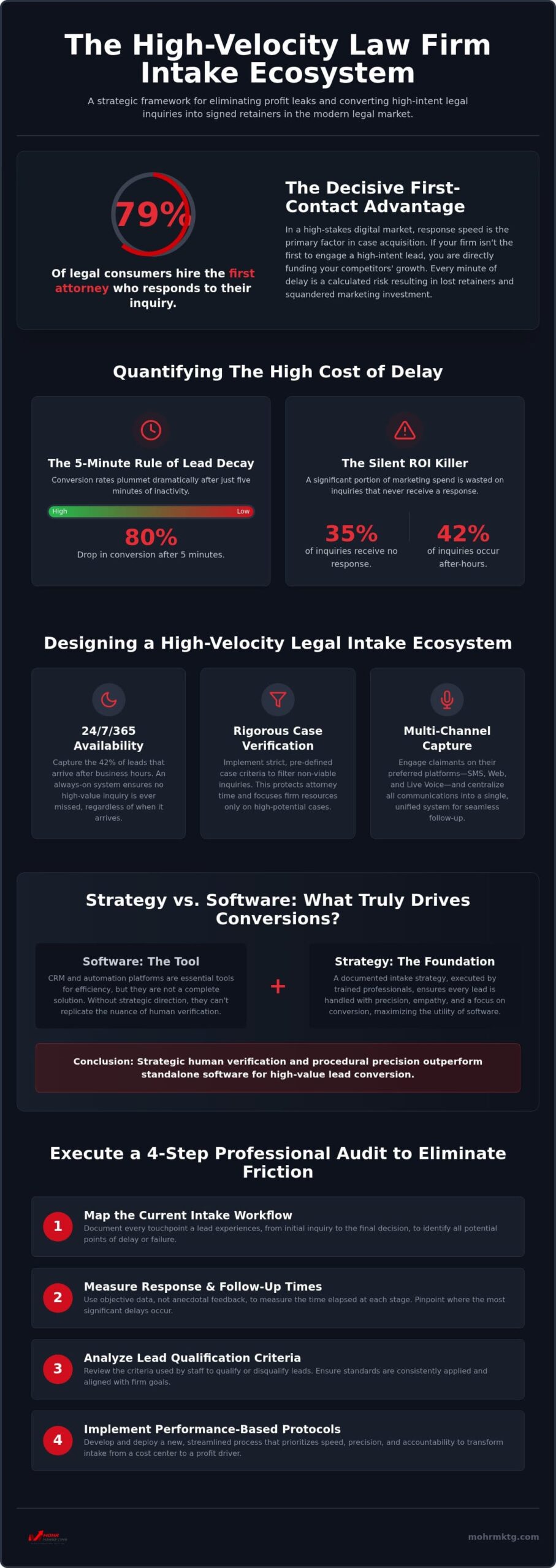
Recent data indicates that 79% of legal consumers hire the first attorney who responds to their inquiry. If your firm isn’t the first to reach a high-intent lead, you’re effectively funding your competitors’ expansion. Improving law firm client intake process isn’t a minor administrative update; it’s a strategic necessity for high-stakes firms in 2026. Every minute of delay is a calculated risk that results in lost retainers and wasted marketing spend.
You’ve likely experienced the frustration of paying for expensive leads only to watch them vanish due to slow response times or poor qualification by staff. It’s a common profit leak that compromises your ROI and limits your firm’s scalability. This article teaches you how to eliminate these friction points by building a 24/7 intake ecosystem that prioritizes speed and precision. We’ll explore the shift toward proactive communication, the integration of verified lead protocols, and why a performance-based retainer model is the ultimate solution for predictable growth.
Key Takeaways
- Identify and seal the profit leaks in your current workflow where high-value cases are lost to faster competitors.
- Implement a high-velocity ecosystem for improving law firm client intake process that captures and qualifies inquiries 24/7.
- Recognize why strategic human verification and procedural precision outperform standalone software for lead conversion.
- Execute a 4-step professional audit to eliminate friction points and move beyond anecdotal staff feedback.
- Leverage a performance-based acquisition model to transition from chasing inquiries to receiving fully executed signed retainers.
Why the Client Intake Process is Your Firm’s Greatest Profit Leak
Legal intake is the critical bridge between your marketing spend and firm revenue. It’s the moment where a prospect’s intent is either captured as an asset or discarded as a loss. In the 2026 high-velocity digital market, traditional intake methods aren’t just inefficient; they’re a liability. Strategic firms recognize that Law Practice Optimization begins with identifying these procedural gaps. A single missed inquiry in high-stakes litigation like mass torts can represent six figures in lost fees. Improving law firm client intake process is the most direct way to stop these leaks and stabilize your firm’s growth.
The 5-Minute Rule: The Science of Lead Decay
Response speed is the primary factor in case acquisition. Research confirms that conversion rates drop by 80% after just five minutes of inactivity. While the median response time for firms was 13 minutes in 2024, the 2026 market demands near-instantaneous engagement. Modern claimants expect immediate, professional responses via their preferred channel. In competitive fields such as personal injury or motor vehicle accidents, the “first-to-contact” advantage is a decisive competitive edge. Data shows that 79% of legal consumers hire the first attorney who responds to them in a helpful manner. If your firm isn’t responding within seconds, you’re effectively paying for your competitors’ leads.
Quantifying the Cost of Inefficient Follow-Up
Inefficient follow-up is a silent killer of firm ROI. Approximately 35% of all law firm inquiries never receive a response, which represents a massive destruction of marketing capital. You can calculate the Cost of Lost Opportunity by multiplying your average case value by the number of qualified inquiries that didn’t sign due to delays. There are also hidden costs in using untrained staff for high-stakes initial calls. Inconsistent lead qualification often results in attorneys wasting time on low-value files while high-value mass tort leads are lost to more agile firms. A professional intake ecosystem eliminates this variability by ensuring every inquiry is handled with mechanical accuracy and strategic intent.
Designing a High-Velocity Legal Intake Ecosystem
Static forms don’t sign cases. Improving law firm client intake process requires a transition from passive data collection to a high-velocity ecosystem. This system must capture, verify, and convert inquiries in real-time. In 2026, successful firms integrate lead generation directly with the intake engine. This removes the friction that occurs when marketing teams hand off leads to disconnected staff. You must ensure 24/7/365 availability. Research shows 42% of legal inquiries occur after hours. If your firm closes at 5 PM, you’re forfeiting nearly half your market share to more responsive competitors.
Implementing Rigorous Case Criteria and Verification
Effective intake is about exclusion as much as inclusion. You shouldn’t waste attorney time on non-viable inquiries. A professional ecosystem uses strict case markers to build a verified inquiry process. This ensures that only claimants who meet specific legal thresholds move forward. For example, focusing on police report-backed MVA cases allows for immediate qualification based on objective data. To Improve Your Client Intake, your team must set clear expectations early and use automated verification tools to filter out noise. This precision protects your firm’s resources and ensures your senior partners only touch cases with high settlement potential.
Multi-Channel Capture: SMS, Web, and Live Voice
Claimants in 2026 demand flexibility. Your intake process must provide seamless transitions between digital ads and live intake agents. SMS has become the primary communication tool for follow-up. It’s faster than email and less intrusive than a cold call. Centralizing this data is mandatory. If an inquiry starts on a web form, continues via SMS, and concludes with a live voice call, your intake team needs a single source of truth. A unified platform ensures that no inquiry slips through the cracks across different channels. If you’re ready to modernize your firm’s acquisition strategy, you can consult with a strategic partner to design a custom, performance-driven workflow.
Strategy vs. Software: What Actually Improves Conversion Rates?
Software is a tool, not a solution. Many firms invest heavily in complex CRM systems only to find their conversion rates stagnant. This occurs because improving law firm client intake process is a strategic challenge that requires human expertise and professional authority. While automation can organize data, it cannot replace the critical first 60 seconds of a call where a claimant decides whether to trust your firm. Strategy determines how you qualify a lead, how you handle objections, and how you project the confidence necessary to secure a high-value case. If your in-house team is distracted by administrative tasks, they won’t have the focus required to convert high-intent inquiries into signed retainers.
The choice between in-house management and professional legal intake services often dictates your firm’s growth trajectory. In-house staff may lack the specialized training needed for high-stakes litigation. Professional services, however, operate with a performance-driven mindset. They understand that the only metric that truly matters is the signed retainer. By prioritizing the strategic handoff over simple data entry, you ensure that your marketing budget translates directly into a predictable case docket. This methodical approach identifies high-value opportunities that automated systems frequently overlook.
The Human Element: Empathy and Authority in Intake
High-stakes claimants require a delicate balance of professional empathy and assertive authority. For example, individuals searching for mesothelioma leads built on real search intent are often dealing with life-altering diagnoses. They don’t want to talk to an AI bot or an untrained clerk. They need to hear from a professional who understands their situation and can articulate your firm’s value proposition before an attorney ever picks up the phone. The intake professional acts as both gatekeeper and closer, ensuring the claimant feels protected and prioritized from the very first interaction.
Performance-Based Marketing: Moving to Signed Cases
Traditional “Pay-Per-Lead” models are inherently flawed because they reward volume over quality. This forces your firm to waste resources chasing low-intent inquiries that never sign. Transitioning to a “Pay-Per-Signed-Case” model shifts the risk of improving law firm client intake process to your marketing partner. This alignment of interests ensures that every inquiry is pursued with maximum intensity. When you evaluate a strategic partner, you should scrutinize their mass tort signed case delivery history. A partner who provides fully executed retainers allows your firm to focus on litigation rather than lead chasing, effectively removing the friction from your expansion strategy.
A 4-Step Audit to Identify Intake Friction Points
Optimizing your firm for high-value case acquisition requires a transition from anecdotal staff reports to rigorous, data-driven analysis. You cannot fix a process that you have not meticulously measured. Improving law firm client intake process begins with a structured audit of every touchpoint in the claimant journey. This instructional framework allows you to identify where revenue is leaking and how to stabilize your conversion rates. By comparing your internal performance against the established ROI of legal intake services, you can establish a professional benchmark for your 2026 growth strategy.
To begin the audit, you must mystery shop your own firm. Submit a web inquiry after hours and call your main intake line during peak litigation windows. Document the response time, the professional tone of the agent, and the clarity of the qualification process. This exercise often reveals significant friction points that are invisible to partners but highly frustrating for potential clients. A professional audit replaces subjective staff feedback with objective observations, ensuring that your marketing spend is supported by a functional conversion engine.
Step 1: Response Time and Contact Rate Analysis
Measure your speed-to-lead across all digital and traditional marketing channels. You need to calculate the exact duration between a lead submission and the first outbound contact attempt. Identify the specific drop-off point where leads stop responding to your follow-up sequence. In 2026, high-priority inquiries, such as toxic mold leads, must be handled with immediate urgency. If your contact rate is below 70%, your team is failing to engage nearly a third of your potential revenue, indicating a need for a more aggressive, 24/7 response protocol.
Step 2: Scripting and Qualification Accuracy
Review a randomized sample of call recordings to ensure your intake professionals are strictly applying case criteria. Listen for consistency in brand voice and the precision of the qualification questions. You must specifically look for “false negatives”; these are qualified cases that were mistakenly rejected because an agent failed to identify a key legal marker. Standardizing your scripts removes individual bias and ensures that every claimant is evaluated with mechanical accuracy. This procedural discipline ensures that your attorneys only receive verified, high-probability files for final review.
Scaling Your Firm with the Mohr Marketing, LLC Intake Solution
Managing an elite intake operation is a full-time endeavor that often distracts from the core practice of law. Improving law firm client intake process isn’t just about better software; it’s about deploying a professional, performance-driven ecosystem that operates with mechanical accuracy. Mohr Marketing, LLC provides this turnkey solution. With over 30 years of industry experience, we eliminate the risk of inefficient intake by managing the entire journey from initial inquiry to fully executed retainer. Our veteran team understands the nuances of state laws and bar mandates, ensuring that every case we deliver is compliant and ready for litigation. You don’t have to manage leads when you can simply receive signed cases.
Turnkey Acquisition for Mass Tort and Personal Injury
Our turnkey ecosystem delivers fully executed retainers directly to your firm, effectively removing the labor-intensive burden of in-house intake. This model is built for firms looking to dominate national litigation without the overhead of a massive administrative team. We apply rigorous verification protocols to every inquiry to ensure viability. For example, our process for truck accident signed cases involves verifying specific liability markers and insurance coverage before the case ever reaches your desk. This level of procedural precision ensures that your attorneys spend their time on high-value litigation rather than qualifying low-intent inquiries.
Risk Mitigation through Performance-Based Fees
The traditional marketing model is broken because it forces law firms to pay for volume rather than results. Our “Pay-Per-Signed-Case” fee structure aligns our interests with yours. You only pay for the outcome that matters: a verified, signed retainer. This performance-based approach provides complete transparency and eliminates the financial risk of improving law firm client intake process on your own. Mohr Marketing, LLC provides data-driven reporting throughout the ecosystem, so you always know the status of your acquisition pipeline. This level of visibility allows your firm to forecast revenue with precision and scale your operations without the uncertainty of traditional lead buying.
Stop wasting resources on inefficient intermediaries and fragmented systems. To scale your firm with a predictable flow of high-value cases, you need a strategic partner who understands the mechanics of growth. Initiate a consultation today to review our available case inventories and design a custom acquisition strategy that prioritizes your firm’s ROI.
Transition to a Performance-Driven Acquisition Strategy
The 2026 legal landscape requires a fundamental shift from reactive handling to proactive acquisition. By auditing your current workflow and identifying friction points, you’ve taken the first step toward improving law firm client intake process. Success now depends on replacing fragmented software with a cohesive, high-velocity system that prioritizes human authority and verification at every touchpoint. These strategic adjustments ensure that your marketing budget translates into tangible firm revenue rather than missed opportunities.
Mohr Marketing, LLC offers a comprehensive solution through our performance-based delivery of signed cases. With over 30 years of specialized experience, we ensure strict compliance with bar mandates while removing the operational burden from your staff. Our ecosystem is designed for firms that demand measurable results and a predictable path to national litigation dominance. We provide the procedural precision required to secure high-intent claimants before they reach your competitors.
You don’t have to navigate the transition to a modern intake model alone. Partner with a strategic expert to stabilize your case pipeline and focus your resources on winning settlements.
Frequently Asked Questions
How quickly should a law firm respond to a new lead?
Instant engagement is the gold standard for 2026. Since 74% of legal consumers visit your website before contact, they’ve already vetted your brand and are ready to commit. A delay of even ten minutes allows them to move to the next search result. Improving law firm client intake process means ensuring that the very first interaction is helpful, professional, and definitive, securing the claimant’s trust before they look elsewhere.
What is the difference between a legal lead and a signed retainer?
A legal lead is merely a data point representing a potential claim, often requiring significant manual follow-up and verification. In contrast, a signed retainer is a fully qualified case ready for litigation. Mohr Marketing, LLC focuses on the latter, delivering fully executed agreements that meet your specific case markers. This transition from raw inquiries to signed retainers removes the administrative burden of qualification and ensures your firm only invests time in high-value, verified opportunities.
Can legal intake be fully automated with AI in 2026?
Automation alone often leads to the “efficiency paradox,” where firms adopt AI but fail to see revenue gains. While AI tools are excellent for routing and initial data collection, they cannot navigate the complex emotional landscape of high-stakes litigation. A strategic intake process uses AI to remove friction in the early stages while relying on human professionals to provide the authoritative, empathetic closing necessary to secure a signed retainer in competitive markets.
What are the most common reasons law firm leads fail to convert?
Conversion failures usually stem from reactive communication rather than proactive engagement. If your intake team only responds to inquiries as they arrive without a structured follow-up sequence, you’ll lose cases. Many firms fail because they lack 24/7 coverage, missing the significant volume of inquiries that occur outside standard business hours. Improving law firm client intake process requires a proactive strategy that sets clear expectations and maintains momentum from the initial contact to the final signature.
How does a pay-per-signed-case model work for mass torts?
This model eliminates the risk of paying for low-quality noise. Instead of buying unverified inquiries, your firm pays a fixed fee for a fully executed retainer that meets every state law and bar mandate. This performance-based approach forces the marketing partner to prioritize verification and speed, as they’re only compensated when a case is successfully secured. It’s the most transparent way to scale a firm’s mass tort docket without wasting capital.
What information should be included in a legal intake script?
A high-performance script must go beyond basic contact information to address specific legal thresholds and claimant expectations. It should include questions that verify real search intent and identify “red flag” issues early. The script must also outline the next steps in the legal process to build trust. Effective scripts are designed to route qualified leads to the appropriate attorney immediately, ensuring the transition from intake to representation is seamless and professional.
Is it better to have an in-house intake team or an outsourced service?
The decision depends on your firm’s ability to maintain a constant, multi-channel presence. Most in-house teams struggle to provide the 24/7 availability that modern legal consumers expect. An outsourced, professional intake ecosystem provides specialized expertise that is difficult to replicate internally. This allows your firm to capture after-hours inquiries and handle high-volume surges without the overhead costs of expanding your permanent staff or compromising on response speed.
How do you verify the quality of a personal injury inquiry?
Quality verification involves a multi-step process that combines digital data with human review. Beyond checking for police reports or medical records, you must verify that the claimant has a clear understanding of the legal process and genuine search intent. This prevents your firm from signing weak cases that’ll ultimately be dropped during discovery. A professional intake system applies these rigorous filters early, ensuring that every inquiry passed to your attorneys has a high probability of settlement.

Recent Posts
- Car Accident Lead Qualification: Guide for Law Firms
- Medical Malpractice Leads: A Strategic Guide for Law Firms
- Pay-Per-Lead Legal Marketing: A Guide for Law Firms
Categories
- AI and Lead Generation
- Business Financing
- Call Verified MVA Leads
- Car Accident Help
- Car Accident Settlements
- Claimant Funding
- Compliance Program
- EMS-EMT Reports
- Geotargeting
- Google Maps Ranking
- Healthcare Practice Growth
- Law Firm Growth
- Law Office Operations
- Lead Generation
- Lead Generation For Attorneys
- Lead Generation For Chiropractors
- Lead Generation For Criminal Attorneys
- Lead Generation For D&A Treatment Centers
- Lead Generation For DUI Attorneys
- Lead Generation For Eye Doctors
- Lead Generation For Family Law Practices
- Lead Generation For PI Law Firms
- Lead Generation For Plastic Surgeons
- Leads For Healthcare Professionals
- Leads For Insurance Industry
- Legal Leads
- Legal Marketing
- Legal Updates
- Mass Tort Leads
- Medicare and Medicaid Leads
- Merchant Funding Leads
- Mold Leads
- Online Marketing Strategies
- Pre-Settlement Funding
- Signed MVA Cases
- Tort Updates
- Truck Accident Leads and Signed Cases
- Truck Accident Settlements
- Web Design