Pay-Per-Lead Legal Marketing: A Guide for Law Firms
October 7, 2026 by Mohr Marketing
What if a lead you pay for does not meet your firm’s case criteria? Pay per lead legal marketing can make acquisition spending easier to track, but a billable inquiry is not automatically a qualified prospect or a signed case. The model works best when you know exactly what triggers a charge and can assess what happens after delivery.
To evaluate a program, compare its payment trigger with other billing models, define what makes an inquiry relevant and verified, and confirm what reporting you will receive. Your intake process also needs clear ownership so inquiries are reviewed, followed up, and categorized consistently.
This guide explains how pay-per-lead arrangements work and what to evaluate before committing. You will learn how to define lead quality around your practice area and case criteria, set delivery and reporting expectations, and measure performance through intake. The goal is to determine whether the model supports your firm’s growth, not just whether it generates inquiries.
Key Takeaways
- Understand what pay per lead legal marketing charges for, and define the criteria that make an inquiry billable.
- Set clear expectations for how leads are generated, verified, delivered, and tracked.
- Compare pay-per-lead and pay-per-signed-case models by payment trigger, firm responsibilities, and intake fit.
- Put lead definitions, billing events, dispute procedures, reporting, and campaign scope in writing.
- Align lead criteria and payment structure with your firm’s goals, case requirements, and intake capacity.
What Is Pay-Per-Lead Legal Marketing, and What Does a Firm Pay For?
Pay-per-lead legal marketing ties a fee to an inquiry delivered to a law firm, rather than to campaign activity such as running ads or publishing content. The key question is what the agreement defines as a billable lead. Without a clear definition and billing trigger, a firm may pay for inquiries outside its practice area or case criteria.
Pay-per-lead means paying for an inquiry that meets agreed delivery criteria, not for a signed client or a legal case. The model uses the Cost per lead (CPL) approach: the fee is associated with acquiring an inquiry. It does not establish whether the person qualifies for representation or whether the firm will accept the matter.
What counts as a legal lead?
A legal lead begins when a prospective claimant expresses interest in getting help with a legal matter. For billing purposes, define the details an inquiry must include. Criteria may cover:
- The relevant practice area and case type.
- Contact details needed for the firm to follow up.
- Any agreed verification or delivery requirements.
These details describe the inquiry, not its legal merit. A lead can meet the agreed criteria and still fall outside the firm’s case-acceptance standards after intake review. A qualified prospect is one the firm determines is a potential fit for further evaluation. A signed retainer means the prospective client has executed an agreement with the firm. Do not treat either status as automatic just because an inquiry was delivered.
How does pay-per-lead billing differ from other marketing fees?
With pay-per-lead billing, the fee is triggered by a delivered inquiry that meets the agreed definition. A monthly managed-marketing retainer pays for ongoing marketing work over a set period, whether or not that work produces a particular number of inquiries. A per-signed-case arrangement ties payment to an executed retainer agreement. Each structure has a different payment event and financial exposure.
Before choosing a model, establish when a lead becomes billable, what records document delivery, and how to raise a billing dispute. Compare those terms with your intake capacity and case criteria. For a closer look at the signed-retainer structure, see The Performance Model: Pay-Per-Signed-Case Explained. The useful comparison is not just the fee trigger, but how clearly each model connects spending to outcomes your firm can track.
How Legal Leads Are Generated, Verified, and Delivered
A reliable lead process starts before a campaign attracts an inquiry. The firm and its marketing partner need shared criteria, a defined verification step, a delivery method, and a way to record what happens during intake. In pay per lead legal marketing, that sequence makes performance easier to assess and billing easier to reconcile.
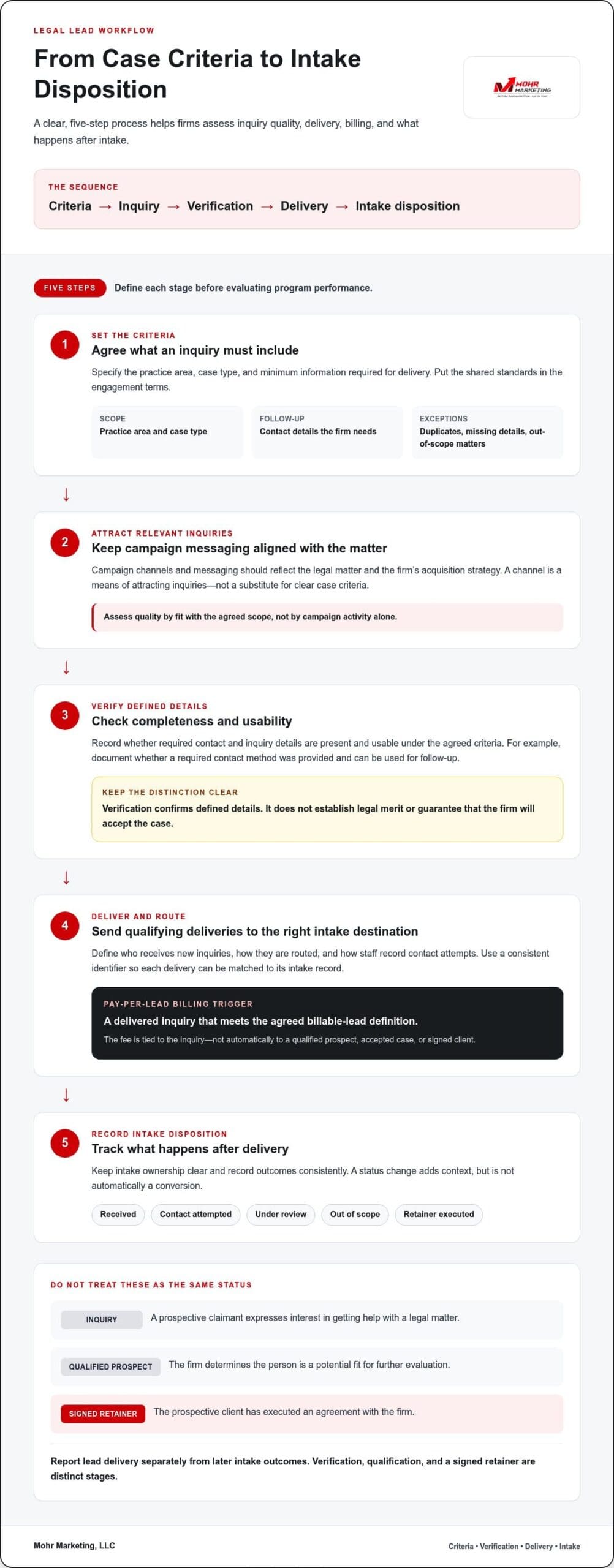
Lead workflow: Criteria → Inquiry → Verification → Delivery → Intake disposition
Set criteria and attract relevant inquiries
Specify the practice area, case type, and minimum information required for delivery. Define how to handle duplicate inquiries, missing contact details, and matters outside the agreed scope. Record these standards in the engagement terms so both parties use the same definitions when reviewing deliveries and reporting results.
Campaign channels and messaging should reflect the matter and the firm’s acquisition strategy. The channel is a means of attracting inquiries, not a substitute for clear case criteria. Assess campaign quality by whether inquiries match the agreed scope, not by activity alone.
Verify details without confusing verification with qualification
A verification process should establish whether required contact and inquiry details are present and usable under the agreed criteria. For example, if a valid contact method is required, the process should record whether it was provided and can be used for follow-up. Documenting the criteria gives both parties a consistent basis for reviewing incomplete or disputed deliveries.
Verification confirms defined details; it does not establish a matter’s legal merit or guarantee that the firm will accept the case. Legal qualification is a separate assessment made through the firm’s intake and review process. Keep these steps distinct so a verified inquiry is not reported as a signed client or accepted case.
Deliver, route, and track the inquiry
Once an inquiry meets the agreed delivery criteria, route it to the right intake destination. Define who receives new leads, how they are routed, and how staff record contact attempts. Clear ownership helps prevent inquiries from sitting unreviewed and creates a consistent intake record. Speed is an operational consideration explored in The Mechanics of Mass Tort Intake: Optimizing for Speed.
Use a consistent identifier for each delivery so intake records can be matched to the original inquiry. Track statuses such as received, contact attempted, under review, out of scope, or retainer executed. A status change adds context, but is not automatically a conversion. Reporting should distinguish lead delivery from later intake outcomes.
Mohr Marketing connects legal lead generation, verification, and intake support in a broader acquisition ecosystem. This helps firms assess the path from inquiry through intake disposition while keeping case criteria and operational capacity central. To discuss your firm’s lead acquisition needs, start a conversation with Mohr Marketing.
Pay-Per-Lead vs. Pay-Per-Signed-Case: Which Model Fits?
These models attach payment to different points in the acquisition process. A lead fee applies at the inquiry stage, while a signed-case fee is associated with an executed retainer. Neither structure guarantees that an inquiry will become a client or that a signed retainer will result in a particular case outcome. Compare how each payment trigger fits your firm’s intake resources, case criteria, and ability to track results.
| Consideration | Pay per lead | Pay per signed case |
|---|---|---|
| Payment trigger | Delivery of an inquiry that meets agreed criteria | Execution of a retainer agreement |
| Firm responsibility | Assess the inquiry and manage follow-up through intake | Review the signed retainer and track the resulting matter |
| Performance visibility | Compare delivered inquiries with intake dispositions | Compare executed retainers with subsequent case tracking |
| Operational fit | Requires capacity to evaluate and follow up on inquiries | Centers measurement on converted opportunities |
Assess a lead-based fee against the criteria for a billable inquiry and records showing what happened next. If the firm cannot distinguish eligible deliveries from out-of-scope inquiries or record intake outcomes consistently, it will lack a reliable basis for evaluating the model. Lead volume alone does not establish signed cases or revenue.
When can a pay-per-lead structure make sense?
Pay per lead legal marketing may suit a firm that wants to review and qualify inquiries through its own intake process before deciding whether to represent someone. It also makes the inquiry stage visible for analysis when the firm has staff and a process to respond, assess fit, and record outcomes. The model is less useful when inquiries cannot be handled or tracked consistently.
When might a signed-case model be a better comparison?
Under a signed-case model, payment is associated with a fully executed retainer, shifting the comparison from delivered inquiries to converted opportunities. This can be relevant when the firm wants to evaluate acquisition costs at a later stage, but intake capacity and the agreed definition of a signed case still matter. Mohr Marketing’s mass tort signed cases illustrate this offering.
Before comparing terms, map each model to your workflow: who receives the inquiry, who assesses fit, how follow-up is recorded, and which event triggers billing. Then compare like with like. A per-lead arrangement and a signed-case arrangement represent different stages, so assess their fees alongside the responsibilities and records required at each stage.
How to Evaluate a Pay-Per-Lead Legal Marketing Agreement
A pay-per-lead legal marketing agreement should make financial and operational terms clear before delivery begins. Review what qualifies as a billable inquiry, what evidence records delivery, how reporting works, and whether your intake team can manage the workflow. The agreement should also define campaign scope so later performance reviews compare like with like.
A useful agreement makes the billable event and its evidence trail explicit. If either is vague, it becomes harder to reconcile invoices, assess disputed deliveries, or understand how inquiry quality affects intake results.
What should the agreement define?
Put the criteria and billing trigger in writing. State which practice area and case types are in scope, what minimum information an inquiry must contain, and what event makes it billable. Clarify how to handle duplicates, invalid contact details, incomplete inquiries, and out-of-scope matters. Define reporting cadence and the process for raising delivery questions.
Use records that allow both parties to review each delivery against those terms. A useful record connects an inquiry identifier to its delivery date, agreed category, and relevant verification details. The agreement should also describe campaign scope and how changes to criteria or targeting are documented, rather than leaving expectations to informal exchanges.
Include a review of applicable state laws and bar mandates when planning the engagement. Requirements can vary, so avoid relying on generic assumptions when assessing how a campaign is structured and communicated. Written terms support operational transparency, but do not replace a review of the rules that apply to the firm and its marketing.
What should a firm measure after delivery?
Track each stage separately: contact attempts, responses, qualification outcomes, and executed retainers. Use consistent categories to compare outcomes by campaign and lead type, not just total inquiry volume. This can help identify whether performance differences relate to lead fit, follow-up, or intake handling. The ROI of Legal Intake Services offers a related perspective on measuring conversion through intake.
- Delivery: Record the inquiry identifier, delivery date, and agreed category.
- Follow-up: Log contact attempts and whether a response was received.
- Disposition: Record whether the inquiry was qualified, out of scope, or unresolved.
- Conversion: Track executed retainers separately from earlier intake stages.
Review the data alongside your team’s capacity. If inquiries are left unprocessed or statuses are recorded inconsistently, reports may not show whether the issue is lead fit or intake execution. A sound assessment connects agreement terms to delivery evidence and distinct downstream outcomes.
Build a Legal Lead Program Around Verified Inquiries and Intake
Design a pay-per-lead program around the firm’s acquisition goals, not as a standalone stream of inquiries. Identify the practice area and case objectives, set criteria for the inquiries you want, choose a payment trigger that fits your operating model, and measure what happens from delivery through intake disposition. This sequence helps you evaluate the program against defined expectations rather than volume alone.
Align acquisition criteria with intake operations
Connect campaign criteria to the selected practice area and case objectives before launch. Then map those criteria to intake: decide how inquiries will be received, routed, categorized, and reviewed. Use consistent reporting categories to distinguish a delivered inquiry from a qualified prospect or executed retainer. Keep applicable state laws and bar mandates in the operating process as campaigns and requirements evolve.
This alignment matters because the campaign and intake team are parts of the same acquisition path. If criteria target matters the firm cannot assess, or intake records do not match the categories in delivery reports, results become difficult to interpret. A coordinated program connects these elements while preserving the distinction between marketing activity, verified inquiries, and the firm’s case decisions.
Connect lead generation, verification, and intake support
Mohr Marketing brings legal lead generation, verification, and legal intake services together in a broader acquisition ecosystem. With more than 30 years of industry experience, the company supports firms seeking a connected process from inquiry acquisition to intake. Clear criteria, consistent follow-up, and performance review remain essential. The process can be structured around the firm’s goals and operational requirements.
For a focused discussion, be prepared to describe your practice area, acquisition priorities, case criteria, and intake capacity. These details help shape an approach suited to the engagement and campaign, including how inquiries are defined and outcomes tracked. The objective is a workable fit between what the campaign delivers and what the firm can evaluate and manage.
- Define the goal: Identify the practice focus and acquisition objective.
- Set the criteria: Specify which inquiries fit the firm’s case requirements.
- Select the trigger: Choose the payment event that aligns with the firm’s model.
- Measure outcomes: Track delivery and intake stages using consistent categories.
Pay-per-lead legal marketing is most useful when its terms, verification process, and intake reporting work together. A clear operating plan helps the firm assess fit, identify friction, and make informed acquisition decisions without assuming that a payment structure guarantees a particular outcome.
Make Your Next Acquisition Decision Deliberate
Use your next planning cycle to define what growth should look like for your firm. Identify which matters deserve attention, how much intake capacity is available, and what evidence would justify continuing or adjusting an acquisition approach. Those decisions give pay per lead legal marketing a practical role in a broader growth plan, rather than making it a commitment based on assumptions.
Set a review point before launching. Compare inquiry and intake patterns with your objectives, then decide whether to maintain the approach, refine its criteria, or reassess the payment structure. A disciplined review keeps investment decisions grounded in your firm’s priorities and operating realities.
Discuss your acquisition goals and intake requirements with Mohr Marketing to plan a focused, measurable approach.
Frequently Asked Questions
What is pay-per-lead legal marketing?
Pay-per-lead legal marketing is an acquisition arrangement where a law firm is charged for inquiries delivered under agreed criteria. Unlike paying for campaign management alone, the charge is connected to an inquiry, not simply the work performed to attract one. The agreement should specify what information and matter type qualify, and whether billing is triggered by delivery or another defined event.
How does pay-per-lead marketing work for law firms?
A firm sets its target matter type and inquiry requirements, then receives inquiries generated through a campaign. For example, a firm focused on a particular type of injury matter might require a prospective claimant’s contact details and a description of the incident. Intake staff review the inquiry, record its status, and determine whether it warrants further evaluation. Reporting should keep delivered inquiries separate from later intake decisions.
Is pay-per-lead legal marketing better than a monthly retainer?
Neither structure is automatically better. A per-lead arrangement ties charges to inquiries that meet agreed conditions, while a monthly retainer pays for ongoing marketing services over a specified period. Consider whether your firm wants to evaluate individual deliveries or fund continuing campaign management, and whether staff can handle the resulting intake work. Compare service scope, billing trigger, reporting, and operational responsibilities before choosing.
Can a law firm pay per signed case instead of per lead?
Yes. In a pay-per-signed-case model, the payment event is tied to an executed retainer agreement rather than a delivered inquiry. This shifts the assessment toward opportunities that have progressed through intake, but does not guarantee a particular legal outcome. The agreement should state what counts as a completed retainer and how execution is documented, so billing and performance reports use the same standard.
What should a law firm count as a qualified lead?
A qualified lead should meet the firm’s stated screening criteria, such as the relevant matter type, required contact details, and any agreed preliminary information. For example, a firm may distinguish an inquiry that fits its practice focus from one that lacks enough information for intake review. Qualification is an operational screening category, not a decision about legal merit or a promise that the firm will accept the matter.
How can a firm measure pay-per-lead marketing performance?
Measure the path from delivery through intake using consistent records. Track inquiries received, successful contact, screening results, follow-up status, and executed retainers as separate outcomes. Review results by campaign or matter category to identify where inquiries are advancing or stalling. Also record intake capacity and follow-up consistency, since delivery data alone cannot show whether weak results stem from inquiry fit or the firm’s handling process.

Recent Posts
- Pay-Per-Lead Legal Marketing: A Guide for Law Firms
- Exclusive Personal Injury Leads: How Law Firms Should Evaluate Quality in 2026
- Bar-Compliant Legal Marketing: 2026 Guide for Law Firms
Categories
- AI and Lead Generation
- Business Financing
- Call Verified MVA Leads
- Car Accident Help
- Car Accident Settlements
- Claimant Funding
- Compliance Program
- EMS-EMT Reports
- Geotargeting
- Google Maps Ranking
- Healthcare Practice Growth
- Law Firm Growth
- Law Office Operations
- Lead Generation
- Lead Generation For Attorneys
- Lead Generation For Chiropractors
- Lead Generation For Criminal Attorneys
- Lead Generation For D&A Treatment Centers
- Lead Generation For DUI Attorneys
- Lead Generation For Eye Doctors
- Lead Generation For Family Law Practices
- Lead Generation For PI Law Firms
- Lead Generation For Plastic Surgeons
- Leads For Healthcare Professionals
- Leads For Insurance Industry
- Legal Leads
- Legal Marketing
- Legal Updates
- Mass Tort Leads
- Medicare and Medicaid Leads
- Merchant Funding Leads
- Mold Leads
- Online Marketing Strategies
- Pre-Settlement Funding
- Signed MVA Cases
- Tort Updates
- Truck Accident Leads and Signed Cases
- Truck Accident Settlements
- Web Design