Exclusive Personal Injury Leads: How Law Firms Should Evaluate Quality in 2026
October 6, 2026 by Mohr Marketing
An “exclusive” label does not prove that an inquiry is being sent to only your firm, that it meets your criteria, or that the person is ready to hire. When evaluating exclusive personal injury leads, focus on what exclusivity means in practice: who receives each inquiry, what information is verified, and what happens after delivery. Without clear terms and outcome tracking, a high lead count can conceal poor fit, low intent, or delays in follow-up.
Exclusive delivery can reduce competition for the opportunity to respond, but it does not guarantee signed cases. This guide explains how to assess distribution terms, verification, lead fit, and intent, then compare programs using consistent measures such as contact rates and cost per signed case. It also shows how to match acquisition with intake capacity so promising inquiries receive timely attention. Mohr Marketing provides verified, high-intent inquiries and legal intake services. Use the framework below to decide whether a program supports your firm’s growth goals.
Key Takeaways
- Define exclusivity through specific delivery terms, including who receives an inquiry and how duplicates are handled.
- Map each stage from inquiry to outcome to identify where verification, delivery, or follow-up affects performance.
- Compare exclusive personal injury leads with shared leads, signed-case programs, and firm-managed marketing by control, intake responsibility, and reporting.
- Assess lead fit and program performance with consistent measures, rather than relying on lead volume alone.
- Align acquisition with intake capacity so incoming inquiries support measurable case-acquisition goals.
What Exclusive Personal Injury Leads Mean for a Law Firm
An exclusive personal injury lead is an inquiry delivered to one law firm under program terms that define who receives it and how it is distributed. The label describes the delivery arrangement. It does not establish the person’s legal eligibility, likelihood of hiring, or potential case value.
This distinction matters because personal injury law covers many types of circumstances. The subject of an inquiry alone does not show whether it fits a firm’s practice or case criteria. Exclusivity can reduce competition for the opportunity to respond, but it does not replace intake, verification, or case review. For an example of a different acquisition pathway, see truck accident signed cases and verified call transfer leads.
Exclusive versus shared personal injury inquiries
With exclusive delivery, the stated terms identify one receiving firm. A shared inquiry may go to multiple firms, while a resold or broadly distributed inquiry may reach additional recipients. Timing matters too: firms that receive the same inquiry at different times may have different opportunities to respond. Since programs can define exclusivity differently, assess the written distribution terms rather than relying on the label.
Separate the delivery promise from the outcome. An exclusive inquiry does not guarantee that the person can be reached, is ready to speak with counsel, meets the firm’s criteria, or signs a retainer. Measure each of these as a separate stage.
What exclusivity does not tell you
Exclusivity does not establish legal merit or eligibility. By itself, it also says nothing about contactability, intent to hire, or fit with the firm’s practice. A person may submit an inquiry and not respond to follow-up, the matter may fall outside the firm’s practice, or the available information may be insufficient for evaluation. Delivery status is only one part of lead quality.
Use a consistent intake and case review process to assess each inquiry. Record whether the person was reached, whether the matter fits the firm’s criteria, and what decision followed. These records provide a more useful basis for evaluating exclusive personal injury leads than the exclusivity label or delivery count alone.
How Exclusive Personal Injury Leads Move from Inquiry to Intake
A lead program is a sequence of steps, not a single handoff. Each stage affects what the firm can learn about an inquiry and how its team can respond. For exclusive personal injury leads, map the process from initial interest through the firm’s recorded outcome:
- Discovery: A person encounters information relevant to a legal problem.
- Inquiry: The person submits contact details or requests information.
- Verification: The inquiry is checked against defined quality-control criteria, such as usable contact information or campaign requirements.
- Delivery: The inquiry and available context are passed to the firm under the program’s delivery terms.
- Firm follow-up: Intake staff attempt contact, gather relevant information, and route the inquiry for review.
- Outcome tracking: The firm records whether the person was reached, whether the matter fit its criteria, and whether it progressed.
This map clarifies responsibility. The lead program handles defined acquisition and delivery steps; the firm’s intake and case review determine what happens next. Recording outcomes makes it easier to distinguish issues with acquisition or delivery from delays or gaps in the firm’s response process.
From search intent to delivered inquiry
Search behavior can signal a need, but it does not establish qualification. A person may search for an attorney or for information about a specific legal problem, such as what to do after a vehicle collision. Relevant campaign messaging can connect that interest with a practice-area inquiry. It cannot establish that every person has the same urgency, intent to hire, or case value.
Clear, accurate messaging matters at this stage. The American Marketing Association’s statement of ethics offers a general framework for ethical marketing practices, including honesty and responsibility. In lead generation, those principles support a clear connection between what an inquiry represents and what the firm receives.
Verification, handoff, and firm response
Verification should have a defined purpose. It may establish whether contact details are usable or whether an inquiry meets stated campaign criteria, but it does not determine legal merit. A verified inquiry is not a signed retainer: verification addresses specified information or criteria, while a retainer follows a separate decision after communication and review by the firm.
Record delivery context, contact attempts, and outcomes consistently. These records help the firm assess inquiry quality alongside intake capacity. For a closer look at the role of follow-up, see The ROI of Legal Intake Services. To discuss how acquisition and intake can work together, review Mohr Marketing’s lead and intake approach.
How to Compare Exclusive Personal Injury Leads with Other Acquisition Models
Compare what each model delivers, who owns the next step, and what performance data the firm can review. A label or payment structure alone does not show whether an approach fits your goals. Apply the same criteria to each option, then weigh the results against campaign objectives, intake capacity, and preferred payment structure.
Compare lead models using the same criteria
The table outlines common structural differences. Terms, verification steps, and reporting vary by program, so use the written delivery terms to define what your firm receives and what it can measure.
| Model | Control and delivery | Verification | Intake responsibility | Reporting to assess |
|---|---|---|---|---|
| Exclusive leads | An inquiry is delivered to one firm under stated terms. | Defined by the program; clarify what is checked. | Typically the firm follows up and reviews the matter. | Delivery, contact attempts, fit, progression, and outcomes where available. |
| Shared leads | An inquiry may be distributed to multiple firms. | Depends on the program’s stated process. | Each receiving firm manages its own follow-up. | Available inquiry details and the firm’s own intake results. |
| Signed-case programs | The firm receives an executed retainer, subject to program terms. | Clarify the documentation and criteria defining a completed case. | Responsibility for later client communication and case handling should be explicit. | Retainer delivery and any defined outcome or quality reporting. |
| Firm-managed marketing | The firm directs its own campaigns and receives resulting inquiries through its selected channels. | The firm defines or coordinates its verification process. | The firm manages follow-up, often with its internal intake resources. | Campaign activity, inquiries, intake progression, and signed cases if tracked. |
Measure quality beyond lead volume
Lead volume is an input, not a case-acquisition result. When evaluating exclusive personal injury leads, compare delivery counts with contactability, practice-area fit, intake progression, and signed-case outcomes where available. Use the same definitions and reporting period across models to make the comparison meaningful.
Payment structure also affects what the firm is buying. Under a pay-per-lead arrangement, the firm pays for an inquiry as defined by the program and manages follow-up to see whether it progresses. Under a pay-per-signed-case arrangement, payment is tied to a retainer milestone defined by the agreement. In either model, clarify what counts as delivery or a completed case.
Keep marketing indicators separate from legal screening and case acceptance. Campaign relevance and verification can inform intake, but the firm’s review determines whether a matter meets its criteria. For broader acquisition context, consult the existing Personal Injury Lead Generation Companies guide, then compare each option with your firm’s capacity and desired outcomes.
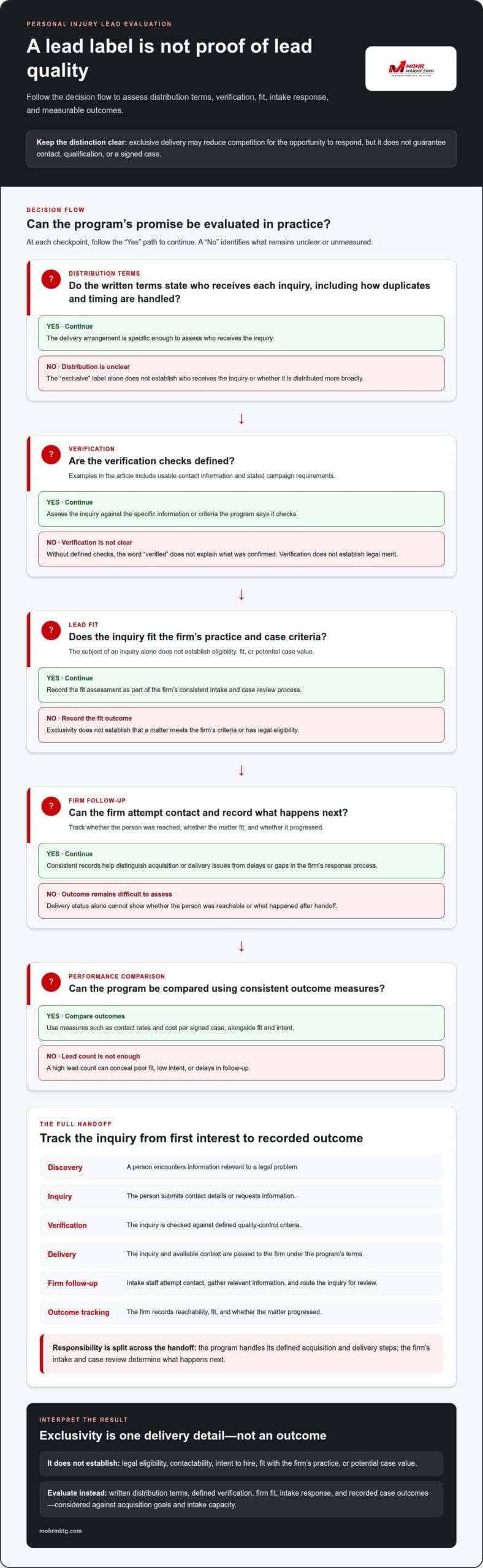
How to Evaluate an Exclusive Personal Injury Lead Program
Exclusivity has limited value without clear delivery terms and a defined process for responding. Evaluate a program as an operating system, not simply as a source of inquiries. The aim is to understand what the firm receives, what the program verifies, and how to connect performance with intake and firm-defined outcomes.
Clarify terms, controls, and reporting
Put core definitions in writing before assessing results. The agreement or program documentation should state what counts as a delivered lead, what “exclusive” means within the program, and how potential duplicates are handled. These details give the firm a consistent basis for evaluating delivery.
- Delivery definition: Identify what information or event constitutes a delivered inquiry.
- Exclusivity scope: Specify who receives the inquiry and any stated limits on its distribution.
- Duplicate handling: Define how repeat submissions or inquiries already in the firm’s records are treated.
- Verification: Document which checks are performed and what they establish. Verification is not a finding of legal merit.
- Reporting: Establish which source, campaign, delivery, and outcome information is available and how it connects to the firm’s intake records.
Review program terms and advertising practices in light of applicable state laws and bar mandates. A documented process supports transparency, but it does not replace the firm’s own compliance review.
Check whether the firm can act on the opportunity
Before increasing acquisition, assess whether the firm has the capacity to handle the expected inquiries. Identify who owns follow-up, whether intake coverage aligns with delivery, and whether the campaign matches the firm’s practice areas and case criteria. Even a well-defined lead process can lose value if ownership is unclear or an inquiry has no recorded next step.
Use a consistent intake record for every inquiry. Track contact attempts, whether the person was reached, practice-area fit, progression through intake, and the final firm-defined disposition. Review performance by source, campaign, and intake stage to distinguish acquisition issues from follow-up bottlenecks and case-review decisions.
For more on the operational role of follow-up, read The ROI of Legal Intake Services. Mohr Marketing connects personal injury leads with legal intake services through a turnkey marketing and intake ecosystem, supporting a measurable view from inquiry to outcome. Judge exclusive personal injury leads by that full process, not by delivery status alone.
Build a Personal Injury Lead Strategy Around Measurable Case Acquisition
Build a personal injury acquisition strategy around the firm’s growth priorities, not a target lead count. Decide whether the immediate need is more relevant inquiries, executed retainers, or stronger intake support. Then match the approach to practice-area focus, intake capacity, and the reporting needed to evaluate progress.
Match the acquisition approach to firm priorities
Firms seeking to expand the intake pipeline may prioritize personal injury leads or motor vehicle accident leads. Firms focused on executed retainers may consider signed-case offerings. Firms with limited intake resources may also use legal intake services to support follow-up. These options address different stages of acquisition, so define the intended outcome before comparing them.
Choose measures that reflect the objective. A firm seeking inquiries can track contactability, practice-area fit, and intake progression. A firm focused on signed retainers can assess retainer outcomes alongside available reporting on the path to signing. In either case, align campaign focus with the team’s capacity to respond and review matters. For broader acquisition context, see the Personal Injury Lead Generation Companies guide.
Take the next step with Mohr Marketing
Before selecting a program, resolve four operational questions: What counts as delivered? What does verification establish? Which reports connect acquisition to intake outcomes? Who owns follow-up at each stage? Clear answers make it easier to assess whether exclusive personal injury leads fit the firm’s goals and operating capacity.
Mohr Marketing provides personal injury leads, motor vehicle accident leads, verified inquiries, signed-case offerings, and legal intake services within a turnkey marketing and intake ecosystem. Its compliance-focused approach recognizes the importance of applicable state laws and bar mandates. With more than 30 years of industry experience, Mohr Marketing helps firms evaluate acquisition as a connected process, from opportunity through follow-up, without treating any lead source as a guaranteed outcome.
Make Your Next Acquisition Decision Measurable
Exclusivity matters only when delivery terms are clear and the firm can track what follows. Evaluate exclusive personal injury leads by more than volume: assess verification, contactability, practice-area fit, intake progression, and signed-case outcomes where available. Compare acquisition models using consistent measures, and make sure follow-up responsibilities match the firm’s capacity.
Mohr Marketing brings more than 30 years of industry experience to personal injury leads, verified inquiries, signed-case offerings, and legal intake services. Its turnkey marketing and intake ecosystem connects acquisition with follow-up, helping firms evaluate opportunities against their growth priorities. No lead label replaces a defined process or the firm’s own case review.
With clear terms and measurable outcomes, your firm can make informed acquisition decisions and build a strategy aligned with its goals.
Frequently Asked Questions
What are exclusive personal injury leads?
Exclusive personal injury leads are inquiries delivered to one law firm under defined program terms. Those terms should explain who receives each inquiry and how distribution works. Exclusivity describes delivery, not whether a person can be reached, intends to hire counsel, or meets the firm’s case criteria. The firm still needs to assess contactability, practice-area fit, and case information through its intake and review processes.
Are exclusive personal injury leads better than shared leads?
Not automatically. Exclusive delivery can give a firm a direct opportunity to follow up without competing with other recipients of the same inquiry, while shared inquiries may go to multiple firms. The better fit depends on the firm’s goals, response capacity, acquisition model, and performance data. Compare contact rates, practice-area fit, intake progression, and signed-case outcomes where available instead of assuming one model will always perform better.
How can a law firm verify whether a personal injury lead is exclusive?
Review the written delivery terms and reporting for a clear definition of exclusivity. They should specify who receives the inquiry, the scope of distribution, and how duplicates or repeat submissions are handled. Compare these terms with delivery records and available campaign reporting. A label alone is insufficient; the firm needs a defined way to understand what was delivered and how the program handles distribution.
What should a firm evaluate before buying personal injury leads?
Define what counts as a delivered lead, what verification covers, how duplicates are handled, and what reporting is available. Assess whether the campaign fits the firm’s practice areas and whether intake staff can manage follow-up. Assign ownership for each step, from first contact through disposition. Review program terms and advertising practices in light of applicable state laws and bar mandates.
Do exclusive personal injury leads guarantee signed cases?
No. Exclusivity describes how an inquiry is distributed; it does not guarantee contact, intent to hire, case eligibility, legal merit, or a signed retainer. A verified inquiry is also different from an executed retainer: verification applies to defined information or criteria, while signing follows the firm’s communication and review. Measure each stage separately to understand how inquiries progress through intake.
How should law firms measure personal injury lead quality?
Track more than the number of inquiries delivered. Use consistent measures for contactability, practice-area fit, intake progression, and signed-case outcomes where available. Break down results by source or campaign, and record contact attempts and dispositions. Keep marketing indicators separate from legal screening and case-acceptance decisions. This helps identify whether performance issues relate to inquiry quality, follow-up, or the firm’s review process.
Can a firm combine personal injury leads with legal intake services?
Yes. A firm can connect lead acquisition with legal intake services to move inquiries into an organized follow-up process. Define who owns initial contact, what information intake records, and how outcomes are reported. Align the volume and type of inquiries with the firm’s capacity and practice-area focus. Mohr Marketing’s turnkey marketing and intake ecosystem connects acquisition and follow-up for evaluation against firm-defined goals.

Recent Posts
- Exclusive Personal Injury Leads: How Law Firms Should Evaluate Quality in 2026
- Bar-Compliant Legal Marketing: 2026 Guide for Law Firms
- Auto Accident Lead Generation: Build a Verified Case Pipeline in 2026
Categories
- AI and Lead Generation
- Business Financing
- Call Verified MVA Leads
- Car Accident Help
- Car Accident Settlements
- Claimant Funding
- Compliance Program
- EMS-EMT Reports
- Geotargeting
- Google Maps Ranking
- Healthcare Practice Growth
- Law Firm Growth
- Law Office Operations
- Lead Generation
- Lead Generation For Attorneys
- Lead Generation For Chiropractors
- Lead Generation For Criminal Attorneys
- Lead Generation For D&A Treatment Centers
- Lead Generation For DUI Attorneys
- Lead Generation For Eye Doctors
- Lead Generation For Family Law Practices
- Lead Generation For PI Law Firms
- Lead Generation For Plastic Surgeons
- Leads For Healthcare Professionals
- Leads For Insurance Industry
- Legal Leads
- Legal Marketing
- Legal Updates
- Mass Tort Leads
- Medicare and Medicaid Leads
- Merchant Funding Leads
- Mold Leads
- Online Marketing Strategies
- Pre-Settlement Funding
- Signed MVA Cases
- Tort Updates
- Truck Accident Leads and Signed Cases
- Truck Accident Settlements
- Web Design