Car Accident Lead Qualification: Guide for Law Firms
October 9, 2026 by Mohr Marketing
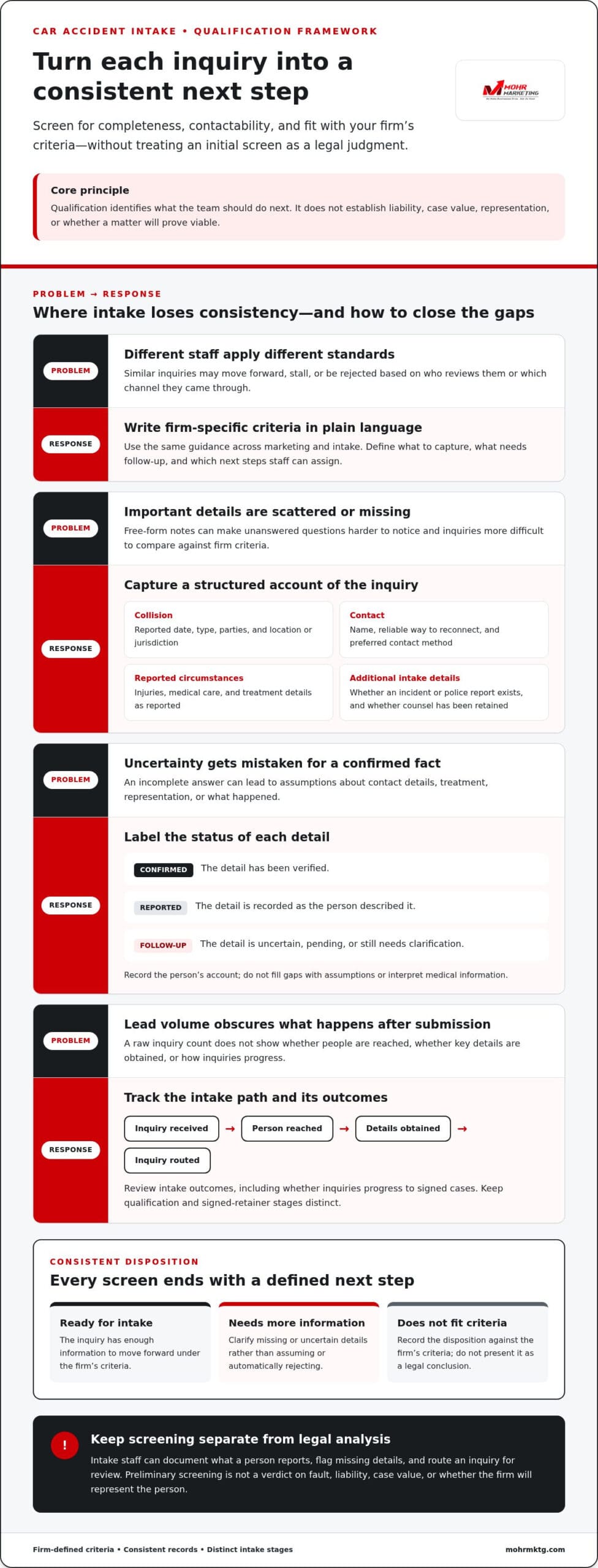
What if the problem is not a shortage of car accident inquiries, but a process that cannot separate viable opportunities from incomplete or unverified information? More leads do not automatically mean more signed clients. When staff apply different standards or follow-up varies, marketing volume can hide gaps in case fit and intake performance. A consistent approach to car accident lead qualification helps firms assess inquiries against their own criteria and use intake capacity more effectively.
This guide shows you how to build that process. Define firm-specific qualification criteria, verify key details, and route inquiries consistently. Then evaluate lead quality through intake outcomes, including whether inquiries progress to signed cases, rather than relying on volume alone. The result is a practical framework that connects lead generation, verification, and follow-through across incoming motor vehicle accident inquiries.
Key Takeaways
- Separate intake screening from legal judgments about liability or case value, and assess inquiries against criteria your firm defines.
- Use a consistent set of questions to capture contact details, collision facts, and what the person is seeking.
- In car accident lead qualification, distinguish verified details from claimant-reported information and items that still need follow-up.
- Match each inquiry to a clear next action, whether it is ready for intake, needs more information, or does not fit your firm’s criteria.
- Connect lead generation, verification, intake, and disposition reporting to understand which inquiries progress toward signed cases.
What Car Accident Lead Qualification Means for a Law Firm
Car accident lead qualification is an intake screening process, not a verdict on a claim. It helps a firm determine whether an inquiry has enough information to assess, whether the person can be reached, and whether the reported matter appears to align with the firm’s criteria. The goal is to identify a consistent next step, not to reach a premature conclusion about the merits of a potential case.
Car accident lead qualification checks an inquiry’s completeness, contactability, and fit with firm-defined criteria so the team can determine what to do next. This definition gives marketing and intake staff a shared starting point without confusing a screening decision with legal analysis.
Keep the distinction clear. Intake staff can record what a person reports, identify missing details, and decide whether the inquiry should move forward for review. They shouldn’t treat that initial screen as a legal opinion about fault, liability, or potential case value. Personal injury law provides broader context for the area of law, but a lead’s fit with a specific firm depends on that firm’s criteria and assessment process.
Lead volume alone cannot show whether an inquiry is useful. A large number of submissions may include unreachable contacts, incomplete accounts, or matters outside the firm’s focus. An inquiry that needs clarification, however, may still warrant follow-up rather than immediate rejection. Track what happens after submission: whether the person is reached, whether key details are obtained, and how the inquiry is routed. Those outcomes reveal more than a raw count.
How a qualified inquiry differs from a signed case
An inquiry is an initial expression of interest. Qualification means the available information has been screened against the firm’s criteria and an appropriate next action has been identified. It does not mean the firm has agreed to represent the person or that the matter will prove viable.
A signed retainer reflects a later point in the firm’s intake journey, after further discussion and the firm’s own decision-making. Track these stages separately. If qualified inquiries and signed cases are grouped together, teams cannot see where follow-up or review may be needed. Keeping the stages distinct also helps staff avoid promising an outcome based on an early screen.
Why firms need written qualification criteria
Written criteria reduce variation between staff members and inquiry channels. Without them, one team member might advance an inquiry with missing information while another rejects a similar one. Document the criteria in plain language for both marketing and intake teams. Specify what information to capture, what requires follow-up, and which next steps are available.
Make the guidance specific to the matters the firm handles, without turning it into an unsupported universal checklist. Each firm defines its own criteria. Review how those criteria perform against actual intake dispositions, then clarify ambiguous instructions so staff can apply them consistently without making legal judgments during preliminary screening.
- Separate screening status from any legal assessment.
- Record whether key details are confirmed, reported, or still missing.
- Use the same written criteria across intake staff and marketing channels.
Which Details Should a Firm Assess in a Car Accident Inquiry?
A useful screening record gives the team enough detail to understand who is making the inquiry, what they report happened, and what help they are seeking. Organize information in consistent fields rather than relying on free-form notes alone. This makes missing answers easier to spot, supports comparison against firm-defined criteria, and clarifies what needs follow-up.
Capture the account as reported. Intake staff should not fill gaps with assumptions or interpret medical information. The firm’s matter criteria determine how each detail affects qualification, so the same fact may lead to different next steps at different firms.
Incident and contact details to capture
Record the reported collision date, collision type, and relevant parties in a consistent format. Capture where the collision occurred, such as the reported location or jurisdiction, so the firm can assess the information under its own criteria. Avoid creating a universal date or location cutoff. Preserve what the person said and flag uncertainty for review.
Confirm the person’s name and a reliable way to reconnect. Note their preferred contact method and the best contact details they provide. Ask whether an incident or police report exists, and record the answer without treating a report as a universal requirement. Some firms may have specific criteria involving reports, as illustrated by police report-backed MVA cases.
Reported injuries, treatment, and representation status
Ask the person to describe any injuries they associate with the collision and whether they have sought medical care. Record treatment information as reported, including details the person says are known or still pending. Intake staff should document the account, not interpret medical records or draw conclusions about diagnosis, severity, causation, or case value. If the person is unsure, mark the detail for follow-up.
Ask whether the person has already retained counsel, following the firm’s intake protocol. Don’t infer representation status from a brief or incomplete answer. If the response is unclear, preserve that uncertainty in the record and route it for the appropriate next step. This keeps staff from treating an unanswered question as a confirmed fact.
A practical intake record can group information into three categories:
- Identity and contact: Name, reliable contact details, and preferred contact method.
- Incident: Reported date, location, collision type, relevant parties, and whether a report exists.
- Injuries and request: Reported injuries, treatment status, representation status, and what assistance the person is seeking.
Use the same fields across channels, and distinguish confirmed details from information supplied by the individual. This gives reviewers a clear basis for follow-up without overstating what is known. Firms refining how they collect and route motor vehicle accident inquiries can discuss their intake needs with Mohr Marketing.
How to Verify and Prioritize Car Accident Leads Consistently
Verification turns an initial inquiry into a record the intake team can act on. Use the same sequence for every channel, and keep the basis for each decision visible. A firm-defined priority framework helps staff determine what needs attention without relying on personal judgment or unsupported scoring rules.
Verification improves the consistency of intake decisions, but it cannot guarantee that an inquiry will become a signed case or produce a particular legal outcome. Treat verification as a way to establish what is known, what remains uncertain, and who should take the next step.
A repeatable verification workflow
Follow a documented sequence so staff don’t skip basic checks or confuse missing information with poor fit. These steps establish a consistent record before the inquiry is routed. Firms can adapt the fields and destinations to their own criteria and procedures.
- Check completeness. Review the required fields and identify missing or unclear responses. Don’t infer an answer from context.
- Verify contactability. Use the firm’s established process to confirm the contact details and record the result, including when confirmation is still pending.
- Compare with firm criteria. Assess the documented facts against the firm’s written criteria. Keep this screening separate from a legal opinion about liability or case value.
- Document the disposition. Select a consistent status and record the specific reason for it.
- Route the inquiry. Send it to the appropriate next step under firm procedure. Direct ambiguous, incomplete, or time-sensitive inquiries according to the documented routing rules.
Documenting decisions and dispositions
Use distinct categories for not qualified, incomplete, and awaiting follow-up. These statuses describe different situations: a mismatch with firm criteria, missing information, or an outstanding action. Add a concise reason so another team member can understand the decision without reconstructing the conversation.
Keep the source and certainty of each detail clear. Mark information as confirmed, claimant-reported, or still requiring follow-up. For example, a person’s account of the collision should remain identified as reported unless the firm’s process establishes otherwise. Clear labels help prevent unverified statements from being treated as established facts.
Prioritization should reflect the firm’s own procedures, not an invented universal score. A team might route a complete inquiry for review, assign an incomplete record for follow-up, and document a matter outside its criteria with the reason. The appropriate action depends on the firm’s defined standards. If an inquiry is unclear, preserve its status and route it for review rather than forcing it into a category that does not fit.
Review dispositions alongside later intake progress and signed-retainer outcomes. If records routinely show “incomplete” but do not identify what was missing, improve the fields or staff guidance. If a status does not help explain what happened next, refine the category. This feedback makes car accident lead qualification a useful operational process, not merely a labeling exercise.
How to Improve Qualification Without Sacrificing Relevant Inquiries
Stricter screening does not automatically produce better results. If criteria are too narrow, poorly explained, or applied inconsistently, a firm may overlook inquiries that need clarification rather than rejection. The objective is disciplined fit: apply the firm’s documented standards consistently, then choose a next step that matches what is actually known.
Use different dispositions for different situations. A complete inquiry can proceed to the next stage under firm procedure. An incomplete inquiry may need follow-up. A poor-fit inquiry does not align with the firm’s documented matter criteria. These distinctions keep uncertainty from being mistaken for disqualification and make later performance reviews more useful.
Distinguishing a poor-fit inquiry from an incomplete one
An inquiry is incomplete when information needed for a decision under the firm’s process is missing or unclear. It is poor fit only when the available information does not align with the firm’s documented criteria. For example, an unanswered question calls for follow-up if the firm’s process allows it. It should not be treated as a disqualifying answer. Record what is missing and assign the appropriate next action.
Review decisions alongside contact rates, follow-up status, and signed-retainer outcomes. This shows whether an inquiry was reached, whether clarification changed its disposition, and whether it progressed through intake. Do not assume that a particular disposition predicts value. Instead, look for patterns supported by the records, and use consistent definitions so comparisons reflect real differences rather than staff labeling habits.
For a clearer view of conversion performance, connect qualification reporting to the firm’s broader intake measures. Track each stage separately, from initial inquiry and successful contact through review and signed retainer. Use measures that match your firm’s goals, and interpret them in context rather than treating any single rate as a complete assessment.
Using intake outcomes to refine criteria
Review recurring reasons for disqualification and follow-up. If staff often record the same missing detail, clarify the question or improve how it is collected. If similar inquiries receive different dispositions, revisit the written criteria and team guidance. Compare outcomes by source and disposition only when records are reliable and categories are applied consistently. Search intent and the case criteria used in marketing can also help the team assess whether incoming inquiries align with the matters the firm handles.
Make car accident lead qualification a feedback loop. Keep the criteria stable enough for consistent handling, but review whether the process creates avoidable friction or leaves useful inquiries unresolved. Update questions and routing instructions when the evidence supports a change. Then monitor whether the revised process produces clearer dispositions and more informative intake outcomes.
Build a Connected Car Accident Lead Qualification Process
Qualification works best as a connected operating process, not a filter applied in isolation. Lead generation brings inquiries into the firm’s intake path. Verification clarifies which details are known, reported, or unresolved. Intake applies the firm’s criteria and routes each inquiry to an appropriate next step. Disposition reporting closes the loop by showing what happened after that decision.
This connection matters because a gap at one stage can distort the next. If marketing and intake use different definitions of a relevant inquiry, teams may disagree about lead quality without identifying the source of the mismatch. Shared criteria, consistent records, and regular review give both teams a common basis for improving the process.
Aligning lead generation with intake criteria
Start by agreeing on what information makes an inquiry relevant to the firm, which details need follow-up, and how outcomes should be recorded. Give marketing and intake teams definitions they can both apply. Then use disposition feedback to identify patterns. An inquiry source may be generating incomplete records, or an intake question may need clearer wording. Let documented outcomes guide adjustments rather than assuming more volume means better fit.
Keep incident documentation as one part of the assessment, not a universal pass-or-fail rule. For example, a firm may track whether a police report is available and apply its own criteria to that detail. Mohr Marketing’s police report-backed MVA cases reflect one incident-documentation context. The broader process still depends on how the firm defines fit and handles the inquiry.
Where truck collisions are handled differently from other motor vehicle matters, specify that distinction in shared criteria and routing guidance. Clear categories help prevent marketing labels from being mistaken for an intake decision, while allowing the firm to assess each matter under its own process.
Choosing the right next step for firm growth
Identify the operational priority. A firm may need more consistent inquiry verification, clearer intake handling, or a model focused on signed-retainer acquisition. These goals are related, but they measure different stages. Lead-generation reporting describes incoming inquiries; intake reporting tracks how they are handled; signed-retainer outcomes show which progressed further. Review them together without treating one stage as proof of the next.
Mohr Marketing connects motor vehicle accident lead generation with legal intake support as part of a broader marketing and intake ecosystem. Firms can use that connection to align acquisition goals with the way inquiries are reviewed and routed, while assessing outcomes through their own criteria. No process can guarantee a signed case, but a connected one makes performance easier to evaluate and operational gaps easier to identify.
Make Qualification a Repeatable Growth Discipline
A dependable intake process is not static. As your firm’s priorities and matter criteria evolve, use recorded outcomes to test whether qualification still directs inquiries to the right next step. Keep the process practical: clear definitions, accountable follow-up, and reporting that connects inquiry sources to intake results. That discipline helps your team make informed adjustments without relying on volume alone.
For firms assessing how to strengthen car accident lead qualification, the next step is to align acquisition goals with the way inquiries are screened and handled. Mohr Marketing brings more than 30 years of industry experience and supports law firms through a connected marketing and intake ecosystem.
With clear priorities and a process your teams can apply consistently, your firm can build a stronger foundation for evaluating future growth opportunities.
Frequently Asked Questions
Can a car accident lead qualify without a police report?
Yes, an inquiry can pass a firm’s initial screening without a police report if the firm’s criteria do not require one. Record whether a report exists, is unavailable, or has not yet been obtained, then follow the firm’s process for that situation. The absence of a report alone does not establish whether a claim has merit or whether the firm should accept representation.
How quickly should a law firm follow up on a car accident inquiry?
Set a clear internal response target and assign responsibility for meeting it. A prompt first attempt can help the team establish contact while the inquiry is active, but the right target depends on the firm’s staffing and intake workflow. Track the time from submission to first attempt, whether contact was made, and any further follow-up needed. Use those records to identify delays the firm can address.
Do all car accident leads need documented medical treatment to qualify?
No universal treatment-documentation rule applies to every firm’s lead screening. Record what the person reports about injuries, care received, and any available records, then apply the firm’s own criteria. For example, distinguish someone who has not yet sought care from someone whose treatment information is simply unknown. Intake staff should capture the reported facts without drawing medical conclusions or treating missing records as proof of no injury.
What should a firm do when an accident inquiry has incomplete information?
Identify the specific missing detail and decide whether the firm’s process calls for a follow-up attempt, additional review, or another disposition. Avoid closing an inquiry solely because a field is blank if the information may be obtained. For instance, if the collision location is unclear, ask a focused clarification question and update the record with the person’s response. Keep unanswered questions visible for the next team member.
Can automation qualify car accident leads without intake staff?
Automation can collect answers, prompt for missing fields, and direct inquiries according to rules the firm defines. It can support consistent initial sorting, but it should not be treated as a substitute for staff review of unclear responses, conflicting details, or exceptions. Keep a human review path for cases that do not fit a defined route, and audit automated dispositions against later intake results to catch misrouting.
How can a law firm measure car accident lead quality?
Measure what happens after an inquiry arrives, not just how many arrive. Track contact attempts and successful connections, completion of follow-up, disposition reasons, progression to intake, and signed retainers. Compare results by source only when records use consistent categories. Reviewing these measures together can show whether a source produces reachable inquiries and whether the firm’s intake process moves them forward.
Recent Posts
- Car Accident Lead Qualification: Guide for Law Firms
- Medical Malpractice Leads: A Strategic Guide for Law Firms
- Pay-Per-Lead Legal Marketing: A Guide for Law Firms
Categories
- AI and Lead Generation
- Business Financing
- Call Verified MVA Leads
- Car Accident Help
- Car Accident Settlements
- Claimant Funding
- Compliance Program
- EMS-EMT Reports
- Geotargeting
- Google Maps Ranking
- Healthcare Practice Growth
- Law Firm Growth
- Law Office Operations
- Lead Generation
- Lead Generation For Attorneys
- Lead Generation For Chiropractors
- Lead Generation For Criminal Attorneys
- Lead Generation For D&A Treatment Centers
- Lead Generation For DUI Attorneys
- Lead Generation For Eye Doctors
- Lead Generation For Family Law Practices
- Lead Generation For PI Law Firms
- Lead Generation For Plastic Surgeons
- Leads For Healthcare Professionals
- Leads For Insurance Industry
- Legal Leads
- Legal Marketing
- Legal Updates
- Mass Tort Leads
- Medicare and Medicaid Leads
- Merchant Funding Leads
- Mold Leads
- Online Marketing Strategies
- Pre-Settlement Funding
- Signed MVA Cases
- Tort Updates
- Truck Accident Leads and Signed Cases
- Truck Accident Settlements
- Web Design