Outsource Legal Intake: A Strategic Resource Guide for Law Firm Scaling
June 17, 2026 by Mohr Marketing
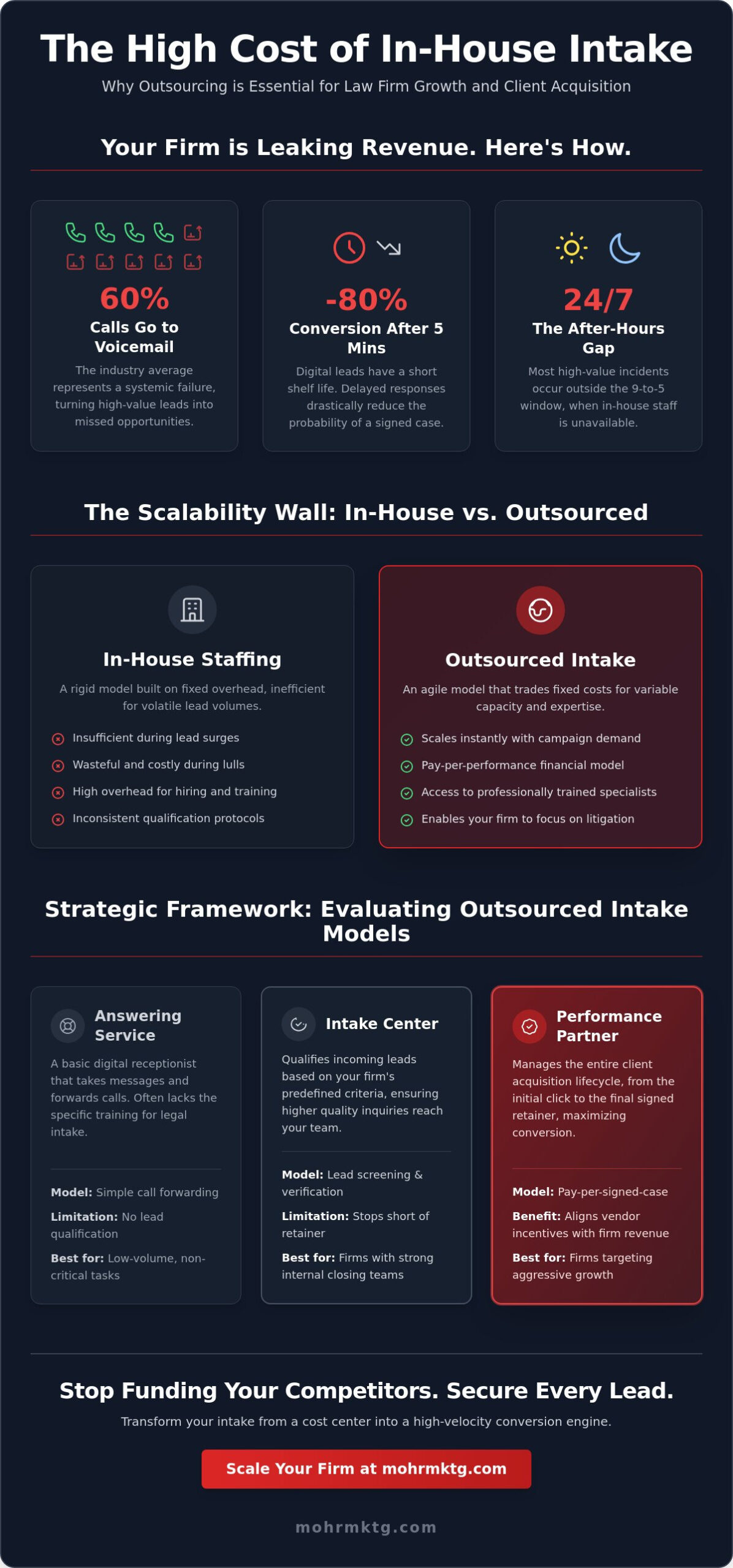
If 60% of your firm’s incoming calls are going to voicemail, you aren’t just losing leads; you’re funding your competitors’ growth. This industry average represents a systemic failure in operational efficiency that drains marketing budgets and stalls scaling efforts. High overhead for in-house staff and inconsistent qualification protocols often turn potential high-value cases into missed opportunities. To scale effectively, you must outsource legal intake and move beyond passive call answering. This shift transforms a reactive cost center into a high-velocity conversion engine that secures signed retainers around the clock.
You likely recognize that your current intake process is the primary bottleneck preventing your firm from reaching its next revenue milestone. This guide provides the strategic framework to fix these leaks and achieve a lower cost-per-signed-case. We’ll outline how to implement 24/7 coverage, leverage the 79% AI adoption rate seen in high-growth firms, and maintain rigorous quality control without the hiring headaches. This transition ensures that every viable inquiry is captured and converted with mechanical precision.
Key Takeaways
- Identify the hidden opportunity costs of in-house bottlenecks and learn how to outsource legal intake to secure every viable lead.
- Evaluate the differences between basic answering services and high-performance intake centers to select the right strategic model for your firm.
- Implement rigorous screening and verification protocols that distinguish high-intent claimants from unqualified inquiries.
- Establish a compliance framework that satisfies state bar mandates and protects client data during third-party processing.
- Leverage a professional intake ecosystem to accelerate the transition from a raw inquiry to a litigation-ready signed retainer.
The High Cost of In-House Bottlenecks: Why Law Firms Outsource Legal Intake
Outsourced legal intake is more than a remote answering service. It is a professionalized extension of your firm’s front office designed to capture high-intent inquiries the moment they occur. This practice falls under the broader umbrella of Legal Process Outsourcing (LPO), where specialized vendors handle critical non-core functions. Many firms treat intake as an administrative task. This is a mistake. Intake is your first and most vital sales touchpoint. If your intake team fails to qualify a lead or secure a signature immediately, your marketing spend is wasted. To scale effectively, you must outsource legal intake and treat it as a conversion-focused ecosystem rather than a cost center.
The industry average of 60% missed calls is a financial hemorrhage. For a personal injury firm, even a single missed MVA lead can represent tens of thousands of dollars in lost contingency fees. When you factor in slow follow-ups and unreturned voicemails, the opportunity cost becomes staggering. Scaling requires a shift away from passive support. You need a high-performance engine that operates with mechanical precision. Modern digital marketing never sleeps; your intake shouldn’t either.
Identifying Leakage in Your Current Intake Process
Audit your response time immediately. Digital leads have a shelf life of approximately five minutes. If you wait longer to respond, your conversion probability drops by 80%. Most in-house teams can’t maintain this pace while managing current case files. There is also the “After-Hours” gap to consider. Most motor vehicle accidents occur outside the standard 9-to-5 window. If you don’t have 24/7 coverage, you’re effectively closing your doors when your services are needed most. Inconsistent qualification is another silent killer. If different staff members ask different questions, your data is compromised and your case quality suffers.
The Scalability Wall: When In-House Hiring Fails
Mass tort campaigns create extreme volatility in lead volume. One day you receive five calls; the next, you receive five hundred. In-house staffing is built on fixed overhead, which is either insufficient during surges or wasteful during lulls. When you outsource legal intake, you trade fixed costs for variable capacity. This financial elasticity allows you to scale up for major mass tort campaigns without the overhead of hiring, training, or managing specialized receptionists. You eliminate the turnover cycle and keep your focus on litigation. Professional partners provide the infrastructure to handle thousands of inquiries without sacrificing the quality of the claimant experience.
Strategic Framework: Evaluating Outsourced Legal Intake Models in 2026
Selecting a partner to outsource legal intake requires a rigorous evaluation of their operational model. Not all providers are equal. In 2026, the market has segmented into three distinct tiers: Answering Services, Intake Centers, and Performance Partners. A basic answering service acts as a digital receptionist. An intake center qualifies leads based on your criteria. A performance partner manages the entire lifecycle from the initial click to the final signature. For firms aiming for aggressive growth, the “Turnkey” approach is the only viable path. It eliminates the friction between lead generation and case acquisition.
Selection criteria must prioritize speed, legal expertise, and seamless technology integration. If your vendor’s system doesn’t push data to your CRM in real time, you’re flying blind. You need full transparency into every inquiry. The financial model you choose determines your firm’s risk profile. While pay-per-lead models are common, they often prioritize volume over quality. A pay-per-signed-case model aligns your vendor’s incentives with your firm’s revenue goals. This shift ensures you only pay for litigation-ready assets rather than raw, unverified data. Understanding the roi of legal intake services is essential to selecting the financial model that maximizes your firm’s return on every marketing dollar spent.
Answering Services vs. Specialized Legal Intake
General call centers often fail when handling complex mass tort signed cases. These agents lack the industry-specific training required to navigate sensitive claimant histories or medical complexities. High-stakes litigation demands a balance of empathy and authority. A specialized intake specialist knows how to build trust quickly while strictly adhering to your screening protocols. Beyond the human element, technical requirements are non-negotiable. Your partner must provide real-time data transparency and direct CRM integration to ensure no lead falls through the cracks. If you’re unsure which model fits your firm, you should evaluate your current intake model with an expert.
The Performance-Based Model: Paying for Results
The performance-based model is the gold standard for modern law firm scaling. It effectively eliminates marketing waste by shifting the risk of lead conversion from the firm to the intake partner. Instead of buying a “chance” at a case, you are acquiring a verified, signed retainer. Firms that outsource legal intake using this model see higher conversion rates and a more stable ROI. This model relies on strict case criteria and multi-layer verification processes. It ensures that every case delivered meets your specific standards for liability and damages. Professional practices are moving away from the uncertainty of traditional lead gen toward this results-oriented framework. It provides the financial predictability needed to plan large-scale litigation campaigns with confidence.
Operational Excellence: The Mechanics of High-Intent Claimant Verification
A “lead” is merely a data point; a “case” is a verified opportunity with clear liability and documented damages. High-performance firms understand that volume is meaningless without intent. When you outsource legal intake, your provider must act as a gatekeeper, not just a receptionist. This requires a mechanical approach to qualification that begins before the phone rings. Data-driven marketing strategies target individuals searching for specific legal remedies, ensuring the inquiries you receive are inherently higher in value. This precision reduces the noise in your pipeline and allows your team to focus on litigation rather than administrative sorting.
Strategic use of police report-backed MVA cases represents the pinnacle of this verification process. By integrating official accident data into the intake workflow, you confirm the facts of the incident, such as fault and vehicle involvement, before the claimant even speaks to an agent. This eliminates the “he-said, she-said” ambiguity that often plagues early-stage personal injury leads. Verification isn’t just about collecting names; it’s about confirming the legal viability of the claim.
Case-Specific Verification Protocols
The requirements for truck accident signed cases are significantly more stringent than standard passenger vehicle claims. Verification must cover commercial liability, insurance minimums, and specific injury thresholds. An effective intake engine establishes these facts during the first contact. Real-time call transfers are critical for high-urgency inquiries. If a claimant has just been involved in a commercial collision, they need an immediate response. Your intake partner must document evidence and establish claim validity instantly, securing the claimant’s commitment before they contact another firm.
The Technology Stack Behind Modern Intake
Operational excellence depends on a robust technology stack. It’s not enough to answer the call; you must manage the follow-up. Automated sequences ensure that non-responsive leads receive consistent touchpoints via SMS and email. These tools bridge the gap between the initial inquiry and the executed retainer, maintaining momentum when the claimant is distracted or hesitant. Transparent reporting provides a direct view of the entire journey. You should be able to track every inquiry from the initial click to the final signature. This level of granular data allows you to optimize your marketing spend and ensure your decision to outsource legal intake delivers a measurable ROI.
Risk Management and Compliance in Outsourced Legal Intake
Attorneys retain ultimate ethical responsibility for the intake process, regardless of whether it happens in-house or through a partner. When you outsource legal intake, you aren’t just hiring a service; you’re appointing a representative of your firm. State bar mandates regarding client confidentiality, data security, and the unauthorized practice of law remain your burden. You must verify that your partner operates with mechanical precision and follows a strict “No Legal Advice” policy. Intake specialists must be trained to collect data and qualify cases without offering legal opinions or making promises about case outcomes. Crossing this line creates significant professional liability.
Data security is your next line of defense. In a modern digital environment, claimant privacy must be protected through enterprise-grade encryption and secure storage protocols. If your firm handles medical-related litigation, ensure your partner adheres to HIPAA standards where applicable. You need a partner who provides documented proof of their security measures and allows for regular audits. Transparency is the only way to confirm that your vendor is protecting your firm’s reputation and your clients’ sensitive information. Scaling without a compliance framework is a recipe for disaster.
Maintaining Quality Control in 2026
Effective risk management requires constant oversight. You must have access to recorded calls and real-time transcripts to verify that agents are following your specific screening protocols. Establish a rigorous feedback loop where your firm reviews a percentage of intake interactions and provides immediate corrections. This ensures that the quality of the claimant experience never wavers. Avoid lead aggregators who sell non-exclusive, low-intent inquiries. These intermediaries often use aggressive or misleading marketing tactics that can tarnish your firm’s brand and lead to ethical complaints. High-quality intake relies on exclusive, high-intent leads that are vetted through your specific criteria.
Transparency as a Safeguard
Demand full visibility into the marketing funnel and the lead source. You should know exactly what a claimant saw and heard before they reached your intake team. Data-driven strategies allow you to maintain a clear audit trail, proving that every interaction was compliant with advertising laws and state bar rules. This transparency is your best safeguard against regulatory scrutiny. Professional, high-standard interactions protect your firm’s reputation while increasing the likelihood of a signed retainer. If you need to secure your intake process while maintaining strict compliance, contact our team for a professional assessment of your current strategy.
Scaling with the Mohr Marketing Intake Ecosystem: From Inquiry to Signed Case
Scaling a law firm requires a departure from traditional, fragmented administrative processes. The Mohr Marketing Turnkey Ecosystem provides a centralized, high-performance solution for firms ready to dominate their market. When you outsource legal intake to a partner with 30 years of experience, you aren’t just buying time. You’re acquiring a refined methodology that’s been stress-tested across thousands of high-stakes campaigns. This ecosystem streamlines the path from the initial digital inquiry to a litigation-ready case, ensuring that every operational component is aligned with your firm’s growth objectives.
Efficiency is the byproduct of precision. Our approach removes the intermediaries and inefficiencies that typically drain marketing budgets. By implementing a legal intake ecosystem, firms can move with the speed necessary for national expansion. This framework is specifically designed to handle the complexities of mass tort and personal injury litigation, where the quality of the claimant is just as important as the volume of inquiries. It’s a strategic shift from managing calls to managing assets.
The Advantage of Signed Retainers
Standard leads are merely a starting point. Signed retainers are the finish line. A fully executed agreement represents a secured asset that’s ready for your legal team to process. This eliminates the friction to litigation that occurs when staff must chase potential claimants for signatures. By securing the retainer during the initial high-intent window, you prevent lead decay and competitor poaching. This allows your internal resources to focus on trial preparation and high-level strategy rather than administrative follow-up. It’s the difference between managing a database and managing a caseload.
Executing a National Growth Strategy
National growth demands a scalable, performance-based model. You can’t reach national scale by relying on fixed-overhead in-house teams that struggle with volume volatility. Leveraging managed digital marketing retainers allows your firm to target high-value opportunities across jurisdictions with surgical precision. This model shifts the focus to results, ensuring your capital is deployed toward case acquisition rather than operational maintenance. To begin your transition toward a high-velocity conversion engine, audit your intake process with Mohr Marketing today. We provide the infrastructure you need to turn inquiries into outcomes.
Transition to a High-Velocity Intake Engine
Scaling your firm requires more than increased marketing spend; it requires a mechanical approach to lead conversion. By choosing to outsource legal intake, you eliminate the operational bottlenecks that drain resources and stall growth. You move from passive call answering to a strategic system that prioritizes high-intent verification and rigorous compliance. This guide has outlined how specialized screening, real-time data integration, and performance-based models transform raw inquiries into litigation-ready assets.
Success in today’s competitive legal landscape depends on speed and precision. Mohr Marketing brings 30+ years of industry experience to help you navigate this transition. Our turnkey marketing and intake ecosystem is built on a foundation of strict compliance with state laws and bar mandates, ensuring your firm’s reputation remains protected while you scale. You don’t have to manage the friction of lead generation alone.
Take the next step in your firm’s expansion. Secure high-intent signed cases with Mohr Marketing and build a more profitable, scalable practice. We look forward to helping you reach your growth milestones.
Frequently Asked Questions
What is the difference between a legal answering service and outsourced legal intake?
Answering services focus on message taking, while you outsource legal intake to prioritize lead qualification and case acquisition. A general service merely documents a caller’s name and number. Specialized intake providers follow rigorous screening protocols to identify high-intent claimants immediately. This professionalized approach moves the lead through the funnel, often resulting in a signed retainer rather than just a recorded message.
How does outsourcing legal intake improve law firm conversion rates?
Outsourcing improves conversion rates by eliminating response delays and ensuring 24/7 coverage. Since digital leads have a shelf life of approximately five minutes, immediate contact is essential. Professional intake engines use automated follow-ups and real-time transfers to capture interest while it is at its peak. This mechanical precision reduces lead waste and ensures every viable inquiry moves toward a signed agreement without friction.
Is outsourced legal intake compliant with state bar ethical rules?
Outsourced intake is compliant as long as the firm maintains ultimate supervision and agents don’t provide legal advice. You must verify that your partner adheres to state bar mandates regarding confidentiality and data security. Professional vendors use scripts that focus on data collection and qualification rather than legal analysis. Attorneys remain responsible for final case acceptance and must establish clear Service Level Agreements with their partners.
Can an outsourced intake team handle complex mass tort case criteria?
Yes, specialized intake teams are specifically trained to manage the multi-layered criteria of complex mass tort litigation. They use targeted screening questions to verify liability, medical history, and injury thresholds. By using a performance-based ecosystem, firms can handle the high call volumes associated with national campaigns. This ensures only claimants who meet specific case criteria move forward, protecting your firm’s internal resources and time.
How much does it cost to outsource legal intake for a law firm?
Pricing structures for legal intake typically follow either a per-minute, per-lead, or per-signed-retainer model. While costs vary based on specialization and volume, many firms find the ROI of a performance-based model is superior. By paying for signed cases rather than raw inquiries, you shift the financial risk to the provider. This ensures your marketing budget is spent on litigation-ready assets rather than administrative overhead.
What should I look for in a legal intake company in 2026?
In 2026, prioritize partners who offer full technology integration and advanced data transparency. You need a vendor that utilizes AI for routine tasks while maintaining a high-touch human element for complex inquiries. Look for a proven track record in high-stakes litigation like mass torts or MVA cases. A provider should offer 24/7 coverage and a turnkey ecosystem that manages the entire lifecycle from initial click to signed retainer.
Can outsourced intake services integrate with my firm’s CRM?
Seamless CRM integration is a standard requirement for modern outsource legal intake operations. Your partner should push lead data, call recordings, and signed documents directly into your practice management software in real time. This eliminates manual data entry and provides your team with immediate access to case files. Real-time integration ensures your pipeline remains accurate and follow-up sequences are triggered without any delay.
How do outsourced services handle Spanish-speaking or bilingual claimants?
Professional intake providers offer 24/7 bilingual support to capture the growing Spanish-speaking market. Having native speakers available ensures language barriers don’t prevent high-value claimants from securing representation. This capability is essential for national mass tort and personal injury campaigns where cultural alignment and clear communication are critical. It expands your firm’s reach and ensures no viable case is lost due to a lack of linguistic resources.

Recent Posts
- Personal Injury Intake Services: A 2026 Guide to High-Conversion Case Acquisition
- Using EMS Reports to Find and Qualify Personal Injury Clients
- The Strategic Value of EMS-EMT Accident Reports in Car Accident Lawsuits
Categories
- AI and Lead Generation
- Business Financing
- Call Verified MVA Leads
- Car Accident Help
- Car Accident Settlements
- Claimant Funding
- Compliance Program
- EMS-EMT Reports
- Geotargeting
- Google Maps Ranking
- Healthcare Practice Growth
- Law Firm Growth
- Law Office Operations
- Lead Generation
- Lead Generation For Attorneys
- Lead Generation For Chiropractors
- Lead Generation For Criminal Attorneys
- Lead Generation For D&A Treatment Centers
- Lead Generation For DUI Attorneys
- Lead Generation For Eye Doctors
- Lead Generation For Family Law Practices
- Lead Generation For PI Law Firms
- Lead Generation For Plastic Surgeons
- Leads For Healthcare Professionals
- Leads For Insurance Industry
- Legal Leads
- Legal Marketing
- Legal Updates
- Mass Tort Leads
- Medicare and Medicaid Leads
- Merchant Funding Leads
- Online Marketing Strategies
- Pre-Settlement Funding
- Signed MVA Cases
- Tort Updates
- Truck Accident Leads and Signed Cases
- Truck Accident Settlements
- Web Design