Law Firm Case Acquisition Cost: The 2026 Strategic Guide to CAC
August 19, 2026 by Mohr Marketing
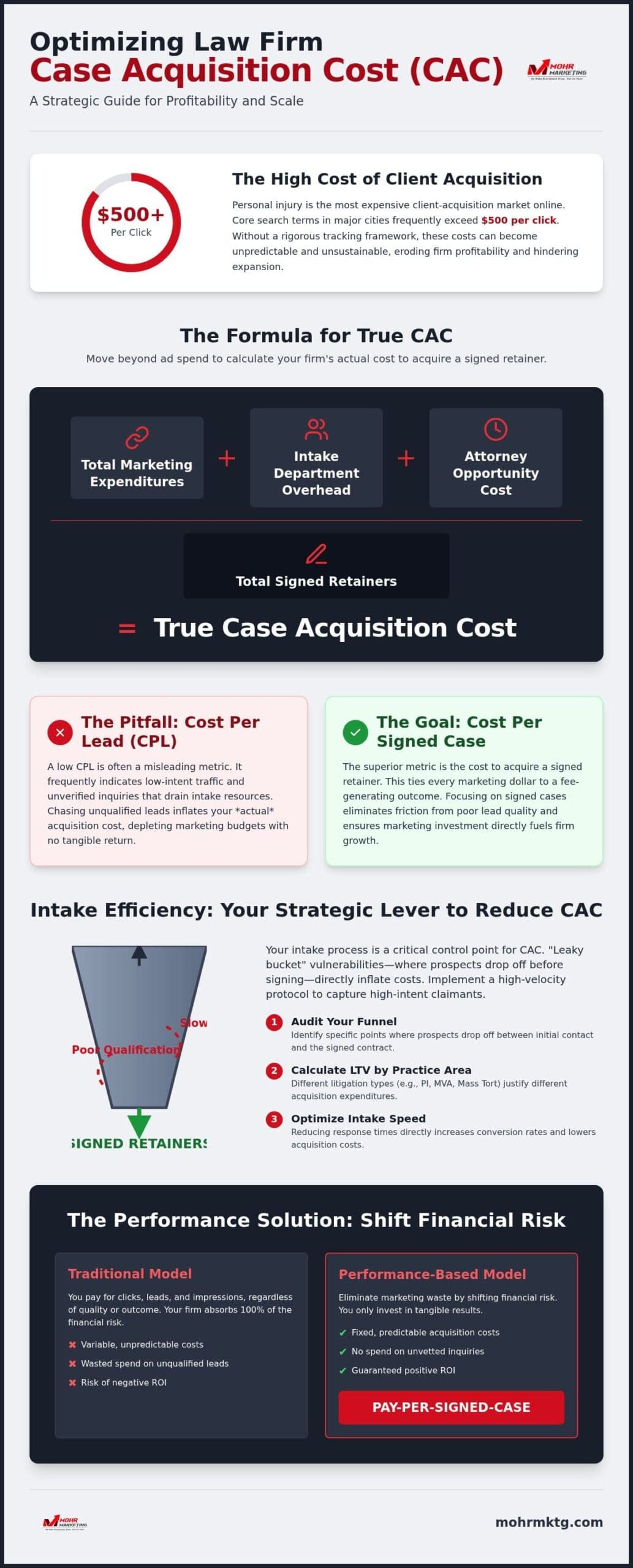
Personal injury remains the most expensive client-acquisition market on the internet. With core search terms like “car accident lawyer” frequently exceeding $500 per click in major metropolitan areas, your law firm case acquisition cost can increase unpredictably without a rigorous tracking framework. You likely already recognize the pressure of rising costs and the inconsistent quality of inquiries provided by traditional marketing agencies. Wasted expenditure on leads that fail to convert into signed retainers is a significant barrier to firm expansion.
This strategic guide provides the professional methodology required to calculate, benchmark, and optimize your acquisition expenses for maximum profitability. You will learn the precise formula for determining true CAC, analyze 2026 industry benchmarks for Personal Injury and Mass Tort, and discover how to utilize intake efficiency to reduce costs. Finally, this guide outlines how to shift financial risk through performance-based acquisition models to ensure your firm maintains a leadership position.
Key Takeaways
- Calculate your true law firm case acquisition cost by aggregating total marketing spend with the operational overhead of your intake department.
- Benchmark your firm’s performance against 2026 industry standards for Personal Injury, MVA, and high-stakes Mass Tort acquisitions.
- Identify and repair leaky bucket vulnerabilities in your intake process by implementing a high-velocity protocol to capture high-intent claimants.
- Eliminate marketing waste by shifting financial risk to lead providers through a performance-based, pay-per-signed-case model.
- Transform variable marketing expenses into fixed, predictable acquisition costs to ensure long-term firm profitability and scale.
Understanding Law Firm Case Acquisition Cost (CAC) in 2026
Strategic growth in the legal sector requires a rigorous analysis of Customer Acquisition Cost (CAC). In the legal industry, CAC represents the total investment required to secure a single signed retainer. It’s the primary metric for assessing firm expansion and operational profitability. Relying on superficial data like impressions or click volume is a liability. Your firm must account for the entire financial journey from the initial search query to a fee-generating file.
A comprehensive law firm case acquisition cost includes two distinct categories of expenditure. Front-end costs encompass marketing investments such as PPC, SEO, and social media advertising. Back-end costs involve the salaries, technology, and overhead of your intake department. Firms that fail to integrate these back-end expenses are operating without sufficient data. This oversight often results in a law firm case acquisition cost that exceeds the revenue potential of the matter, leading to significant margin erosion and unsustainable growth patterns. You must treat intake efficiency as a direct component of your marketing ROI.
Cost Per Lead vs. Cost Per Signed Case
Many marketing agencies prioritize a low Cost Per Lead (CPL) to demonstrate performance. However, a low CPL frequently indicates low-intent traffic or unverified inquiries that require excessive labor to filter. If your intake team spends significant hours chasing leads that don’t meet your case criteria, your actual acquisition cost increases. This “conversion gap” is where substantial marketing resources are depleted. You must transition your measurement from raw leads to signed retainers. This shift ensures that every dollar allocated to marketing is tied to a tangible outcome rather than a speculative inquiry. Focusing on signed cases eliminates the friction caused by poor-quality lead generation.
The Economic Impact of CAC on Firm Scalability
Scalability is dictated by the relationship between CAC and the Lifetime Value (LTV) of a legal matter. High-growth firms utilize this ratio to determine their maximum sustainable marketing budget and outbid competitors in expensive digital channels. For example, when acquiring police-report-backed MVA cases, the LTV calculation must account for the higher settlement potential of verified liability. This data allows for a precise CAC ceiling that maintains profitability while scaling volume. To manage these economics effectively, follow this instructional framework:
- Audit your funnel: Identify specific points where prospects drop off between the initial contact and the signed contract.
- Calculate LTV by practice area: Different litigation types justify different acquisition expenditures.
- Optimize intake speed: Reducing response times directly lowers acquisition costs by increasing conversion rates.
By mastering these mechanics, you create a predictable path for expansion. High-stakes professionals use mechanical accuracy to dominate the market and protect their resources. This instructional approach ensures your firm remains competitive while maintaining strict control over its financial performance.
The Formula: How to Calculate Your Firm’s True CAC
Calculating your true law firm case acquisition cost requires moving beyond simple ad spend. Many firms make the mistake of only looking at their Google Ads invoice. To gain a competitive advantage, you must follow a rigorous four-step protocol that accounts for every dollar spent on the path to a signed retainer. This mechanical accuracy prevents budget leakage and ensures your growth remains profitable.
- Step 1: Aggregate all marketing expenditures. Include gross ad spend, agency management fees, and monthly SEO retainers. Every external dollar allocated to lead generation must be accounted for.
- Step 2: Calculate intake department overhead. Total the costs of staff salaries, dedicated call center fees, and lead management software subscriptions. If a team member spends 50% of their time on intake, include 50% of their compensation.
- Step 3: Factor in attorney opportunity cost. Track the time attorneys spend on non-billable consultations or reviewing files that do not result in a retainer. This time has a direct financial value that inflates your actual acquisition cost.
- Step 4: Divide the total investment by signed retainers. Take the sum of the first three steps and divide it by the number of fully executed retainer agreements within your specific tracking period.
Accounting for Hidden Intake Costs
Intake is often the most significant hidden variable in your law firm case acquisition cost calculation. You must audit your CRM licenses and phone system costs to identify “invisible” drains on your resources. Utilizing professional legal intake services can simplify this process by providing a fixed cost structure, which removes the unpredictability of internal overhead. Your CRM should act as the definitive source of truth, ensuring that every lead is tracked from the initial click to the final signature.
Case-Specific Calculation Models
You cannot manage your firm with a single, broad metric. Calculate CAC separately for Personal Injury, MVA, and Mass Tort departments. High-stakes mass torts require a different capital allocation than standard MVA files due to longer conversion windows and higher settlement values. Use multi-channel attribution to assign leads to the correct case type based on the specific keyword or landing page that triggered the inquiry. Blended CAC represents the total marketing and intake investment divided by the total number of signed cases across all practice areas, providing a high-level view of firm-wide efficiency. If your internal audit reveals a volatile CAC, it may be time to evaluate a more predictable acquisition strategy.
2026 Benchmarks: Average Acquisition Costs by Practice Area
Benchmarks provide the essential baseline for measuring your competitive performance. In 2026, the law firm case acquisition cost varies significantly based on the channel and the intent of the prospect. Data shows that leads generated through SEO average $456, while PPC leads average $784. Paid social channels like Facebook typically produce leads between $500 and $700. These figures represent the cost of an inquiry, but the true metric is the cost per signed case. In personal injury, the cost to acquire a signed retainer through paid online channels generally ranges from $1,500 to $3,500. Well-optimized campaigns in competitive markets can occasionally drive this below $2,000, but these results require surgical precision in both targeting and intake.
Relying on broad averages is a strategic error. A “low” acquisition cost is irrelevant if the resulting case value doesn’t support the firm’s overhead. You must evaluate your spend against the specific economics of the matter type. A general guideline is that your acquisition cost should remain between 15% and 20% of the case’s lifetime value. If an average client is worth $10,000, your total law firm case acquisition cost must stay under $2,000 to maintain healthy margins.
Personal Injury and MVA Case Economics
The market for motor vehicle accidents is exceptionally saturated. High-value police-report-backed MVA cases command a premium because they offer verified liability and higher settlement potential. Firms targeting truck accident signed cases will face even higher benchmarks due to the catastrophic nature of the injuries and the larger insurance policies involved. To manage these rising costs, follow this instructional framework:
- Set a hard ceiling: Determine the maximum you can pay for a signed retainer based on your historical settlement averages.
- Prioritize verified leads: Focus your budget on opportunities where liability is already documented by law enforcement.
- Track by sub-type: Don’t blend standard auto accidents with commercial trucking cases; their economics are fundamentally different.
Mass Tort Acquisition: High Risk, High Reward
Mass tort economics operate on a different scale than single-event personal injury. Successful mass tort lead generation requires a different CAC framework because of the longer litigation windows. For instance, mesothelioma leads built on real search intent are among the most expensive in the industry. The high acquisition price is justified only when strict case criteria and rigorous verification are applied. In the 2026 landscape, the most profitable firms are shifting away from broad awareness ads toward intent-based acquisition models that deliver verified, high-intent claimants ready for retainer.
Intake Efficiency: The Strategic Lever to Reduce CAC
Intake performance is the most significant variable under your firm’s direct control. While digital marketing costs are often dictated by external auction dynamics, the efficiency of your internal funnel determines the final law firm case acquisition cost. A “leaky bucket” conversion process occurs when high-intent traffic fails to convert due to friction in the communication chain. This structural flaw destroys your marketing ROI and forces your firm to spend more to achieve the same volume of signed cases. You must view your intake department not merely as a support function, but as a critical revenue-protection engine.
Maximizing intake efficiency requires a 24/7 operational posture and a rigorous “speed to lead” protocol. Since a majority of legal clients select the firm that responds first, any delay in answering a call or responding to a web form increases your CAC. Professional verification protocols are essential to isolate high-value opportunities from unqualified inquiries. By verifying specific case criteria during the initial contact, your firm ensures that legal resources are allocated only to matters with a high probability of settlement. This systematic removal of non-converting leads prevents your attorneys from wasting billable hours on unviable files.
Optimizing the Conversion Funnel
Auditing your conversion funnel requires a methodical review of every prospective client touchpoint. To maximize your conversion rates and lower your law firm case acquisition cost, follow these instructional steps:
- Audit intake call scripts: Agents must use standardized, qualifying questions to establish liability and damages immediately. This prevents the intake of cases that don’t meet your firm’s minimum settlement thresholds.
- Implement automated follow-up sequences: Use SMS and email automation to maintain engagement with prospects who don’t sign during the initial contact. Persistent, automated follow-up can revive inquiries that would otherwise be lost to competitors.
- Utilize immediate e-signatures: Delivering a retainer via e-signature during the intake call locks in the client while their intent is at its peak. Any delay between the verbal agreement and the signature increases the risk of client attrition.
Outsourcing vs. In-House Intake
Maintaining a 24/7 in-house intake department involves significant fixed overhead, including salaries, benefits, and management costs. These expenses contribute to a volatile acquisition cost that is difficult to forecast accurately. Utilizing a specialized legal intake service provides a more predictable cost structure. This external ecosystem allows your firm to pay for conversion results rather than internal labor, ensuring that your acquisition spend remains aligned with your revenue goals. Prioritize partners who demonstrate strict compliance with state bar mandates and possess the infrastructure to handle high-volume surges during major marketing campaigns.
The Performance Solution: Shifting CAC Risk to Lead Providers
Traditional marketing models leave your firm exposed to market volatility. You pay for clicks, impressions, and unverified leads regardless of the final outcome. This creates an unpredictable law firm case acquisition cost that fluctuates with every algorithm update and competitor bid increase. To stabilize your margins, you must shift the financial risk of lead generation back to the provider. The Pay-Per-Signed-Case model accomplishes this by turning a variable marketing expense into a fixed, predictable acquisition cost.
Adopting a performance-based model provides a definitive hedge against rising costs in paid search. When you pay only for fully executed retainers, you eliminate the financial drain of non-converting inquiries. This approach requires a strategic partner with a turnkey ecosystem capable of handling the entire journey from initial search intent to the signed contract. Evaluate any potential partner’s verification standards using this instructional checklist:
- Verified Exposure: Does the provider confirm the claimant’s presence at the specific site or their use of the defective product?
- Documented Injury: Is there a rigorous process to verify medical diagnoses or physical damages before a retainer is sent?
- Statute Compliance: Does the partner screen for statute of limitations issues to ensure the case is viable for litigation?
Eliminating the “Lead Quality” Variable
Performance models align the incentives of the lead provider with your firm’s growth goals. Because the provider is only compensated for signed retainers, they must target high-intent search queries that demonstrate a clear need for legal representation. This eliminates the “junk” leads common in traditional CPL models. You receive litigation-ready files that integrate directly into your existing workflow. This procedural precision allows your legal team to focus on casework rather than chasing unresponsive prospects, effectively lowering your internal law firm case acquisition cost by maximizing staff efficiency.
Scaling with Predictability
Predictability is the foundation of scalable growth. When your acquisition cost is fixed, forecasting annual revenue becomes a matter of simple arithmetic. You can calculate exactly how many mass tort signed cases your budget will secure, allowing for precise capital allocation. This transparency removes the friction from your expansion plans and protects your resources from market shifts. Your final strategic directive is clear: stop buying “leads” and start acquiring “clients.” Transitioning to a signed retainer model ensures your firm maintains a leadership position in an increasingly competitive landscape.
Dominate the 2026 Legal Market with Predictable Growth
Mastering your law firm case acquisition cost is the difference between erratic growth and market dominance. You’ve learned that true profitability depends on moving beyond vanity lead metrics and focusing strictly on signed retainers. By fixing your acquisition expenses and optimizing your intake ecosystem, you remove the volatility that plagues traditional legal marketing. This strategic shift allows your firm to scale with mechanical accuracy while protecting your most valuable resources. Every dollar you invest must be tied to a verified outcome.
Mohr Marketing, LLC provides the transparency and expertise required to execute this transition. With over 30 years of industry experience, we offer a turnkey intake and verification ecosystem that delivers high-intent opportunities ready for litigation. Our data-driven strategies ensure you only pay for results, providing a secure path to expansion in even the most competitive practice areas. It’s time to stop gambling on unpredictable lead quality and start investing in guaranteed growth.
Take control of your firm’s trajectory and start acquiring clients with total confidence. Your path to a more profitable and scalable practice begins with data-driven precision.
Frequently Asked Questions
What is a good law firm case acquisition cost for personal injury?
A good personal injury acquisition cost typically ranges from $1,500 to $3,500 when using paid online channels. Well-optimized campaigns can drive this figure below $2,000 in competitive markets. You should aim for a cost that represents 15% to 20% of the case’s lifetime value. If your CAC exceeds this threshold, your margins are at risk. Consistency in tracking ensures you maintain profitability as market competition increases.
How do you calculate CAC for a law firm?
You calculate CAC by dividing your total marketing and intake investment by the number of signed retainers secured during a specific period. This formula must include gross ad spend, agency fees, and SEO retainers. It also requires accounting for the operational overhead of your intake department and attorney time spent on non-billable consultations. Totaling these variables provides an accurate reflection of your true law firm case acquisition cost.
Why is my law firm’s CAC so high compared to industry benchmarks?
High acquisition costs often stem from a “leaky funnel” in the intake process or low-quality lead sources. If your firm doesn’t respond to inquiries within minutes, your conversion rate drops and your CAC inflates. Additionally, bidding on broad keywords without strict negative keyword lists can waste budget on non-converting traffic. Improving your speed-to-lead and utilizing professional verification services are the most effective ways to bring your costs back in line.
Does SEO or PPC have a lower case acquisition cost?
SEO generally offers a lower cost per lead, averaging $456 compared to $784 for PPC. However, SEO requires a longer timeline to produce results and involves significant upfront investment. PPC provides immediate volume but comes with higher volatility and rising costs per click. Most high-growth firms utilize a blended strategy to balance the immediate scalability of paid search with the long-term efficiency of organic traffic generated through search engine optimization.
What is the difference between cost per lead and cost per client?
Cost per lead measures the price of an initial inquiry, while cost per client represents the total investment required to secure a signed retainer. A low cost per lead is often a vanity metric that hides a high acquisition cost due to poor lead quality. You must focus on the cost per signed case to ensure your marketing spend produces tangible revenue. This distinction is critical for maintaining accurate financial forecasting and scaling your practice.
How can I lower my CAC without reducing my lead volume?
You can lower your law firm case acquisition cost by increasing your intake conversion rate and implementing rigorous lead verification. Faster response times and better qualifying scripts ensure you sign more cases from your existing lead flow. Utilizing automated follow-up sequences also helps revive cold inquiries that would otherwise be wasted. These efficiency gains allow you to acquire more clients without increasing your front-end marketing budget or sacrificing lead volume.
Is the pay-per-signed-case model better for mass torts?
The pay-per-signed-case model is superior for mass torts because it shifts the financial risk of long-term litigation to the lead provider. Mass torts involve high upfront costs and extended conversion windows, making traditional lead buying risky. By paying only for verified, fully executed retainers, you lock in your acquisition costs and protect your firm’s capital. This model ensures you only invest in cases that meet your strict criteria for litigation and settlement potential.
Should I include administrative staff salaries in my CAC calculation?
Yes, you must include the portion of administrative salaries dedicated to intake and lead management in your calculation. If your staff spends significant time qualifying prospects or managing retainers, their compensation is a direct acquisition expense. Ignoring these operational costs leads to an artificially low CAC and inaccurate profitability projections. A comprehensive calculation includes all human and technological resources required to move a prospect from an initial click to a signed case.

Recent Posts
- Bar-Compliant Legal Marketing: 2026 Guide for Law Firms
- Auto Accident Lead Generation: Build a Verified Case Pipeline in 2026
- Car Accident Case Acquisition: Strategic Law Firm Guide
Categories
- AI and Lead Generation
- Business Financing
- Call Verified MVA Leads
- Car Accident Help
- Car Accident Settlements
- Claimant Funding
- Compliance Program
- EMS-EMT Reports
- Geotargeting
- Google Maps Ranking
- Healthcare Practice Growth
- Law Firm Growth
- Law Office Operations
- Lead Generation
- Lead Generation For Attorneys
- Lead Generation For Chiropractors
- Lead Generation For Criminal Attorneys
- Lead Generation For D&A Treatment Centers
- Lead Generation For DUI Attorneys
- Lead Generation For Eye Doctors
- Lead Generation For Family Law Practices
- Lead Generation For PI Law Firms
- Lead Generation For Plastic Surgeons
- Leads For Healthcare Professionals
- Leads For Insurance Industry
- Legal Leads
- Legal Marketing
- Legal Updates
- Mass Tort Leads
- Medicare and Medicaid Leads
- Merchant Funding Leads
- Mold Leads
- Online Marketing Strategies
- Pre-Settlement Funding
- Signed MVA Cases
- Tort Updates
- Truck Accident Leads and Signed Cases
- Truck Accident Settlements
- Web Design