Truck Accident Lead Generation: The 2026 Attorney’s Guide to Scalable Case Acquisition
June 30, 2026 by Mohr Marketing
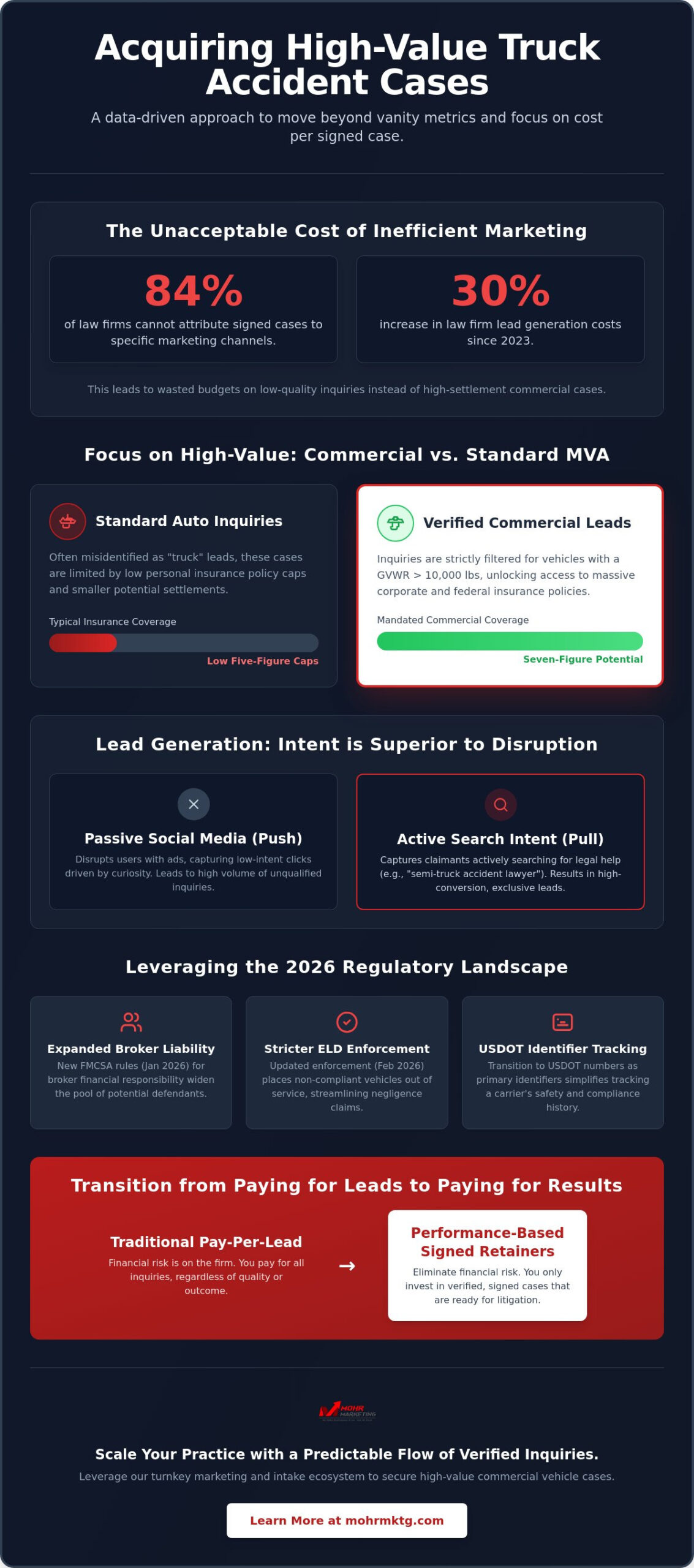
84% of law firms cannot attribute more than 75% of their signed cases to specific marketing channels. You’ve likely experienced the frustration of paying premium prices for truck accident leads only to find your intake team chasing standard fender-bender inquiries or leads with no commercial insurance coverage. The cost of law firm lead generation has surged by 30% since 2023. This makes marketing waste an unacceptable tax on your firm’s growth and profitability.
We understand that high-stakes professionals value efficiency and tangible outcomes. You’re about to learn how to acquire high-intent truck accident leads through verified generation and performance-based intake strategies that prioritize settlement value over raw volume. This guide details the 2026 FMCSA regulatory shifts, including the new financial responsibility requirements for brokers and the transition to USDOT identifiers. You’ll discover how to eliminate inefficient intermediaries and build a predictable flow of verified inquiries. We’ll show you how to move away from vanity metrics and focus on the only number that matters: the cost per signed case.
Key Takeaways
- Identify the critical insurance gap between standard passenger vehicles and commercial carriers to target high-settlement cases effectively.
- Prioritize search-intent truck accident leads over disruption-based marketing to secure claimants with significantly higher conversion potential.
- Transition from traditional Pay-Per-Lead models to Signed Retainers to eliminate the financial risk associated with unqualified inquiries.
- Implement a rigorous five-step intake process to optimize the speed to lead metric and prevent high-value cases from reaching competitors.
- Leverage a turnkey marketing and intake ecosystem to scale your practice with verified, commercial-grade motor vehicle accident inquiries.
The Strategic Value of Truck Accident Leads in 2026
High-performance law firms don’t treat all motor vehicle accidents the same. In 2026, the definition of truck accident leads is strictly limited to inquiries involving commercial vehicles with a Gross Vehicle Weight Rating (GVWR) exceeding 10,000 lbs. This distinction is critical. These cases represent a specialized class of litigation where the stakes are exponentially higher than standard passenger car claims. You aren’t just looking for a collision. You’re looking for a commercial liability event.
Standard auto policies often max out at low five-figure sums. Commercial carriers operate under a different reality. Federal law mandates significantly higher insurance minimums for interstate carriers, creating an insurance gap that differentiates these cases from standard passenger vehicle claims. While a standard MVA might be capped by a defendant’s limited personal assets, a truck case provides access to massive corporate policies designed to cover catastrophic loss. This is why a single verified truck inquiry can be worth ten standard auto leads.
Federal mandates have tightened significantly this year. As of January 16, 2026, the FMCSA implemented updated financial responsibility requirements for property brokers and freight forwarders. This expands the pool of potential defendants in every case. Projections for 2026 show commercial freight volume is rising, which directly correlates to increased accident frequency. Every inquiry represents a high-value opportunity to hold carriers and brokers accountable under these stricter standards.
Why Commercial Vehicle Cases Command Higher Settlements
Interstate trucking requires high-limit coverage that dwarfs personal auto insurance. Liability isn’t just on the driver. It extends to the carrier, the maintenance contractor, and the freight broker. Injuries are rarely minor when an 80,000-lb vehicle is involved. The physical forces at play ensure that safety features in passenger cars often fail. This leads to long-term disability claims and higher medical specials. Multi-party liability and catastrophic injury profiles are the primary drivers of seven-figure settlements.
The 2026 Landscape: Federal Safety Standards and Liability
Data drives modern litigation. The February 7, 2026, ELD enforcement update gives you immediate leverage. Enforcement officers can now place vehicles out of service if they use revoked Electronic Logging Devices. If your claimant was hit by a carrier using non-compliant tech, negligence is practically established at the scene. Strict Commercial driver’s license (CDL) regulations and the transition to USDOT numbers as primary identifiers make it easier to track a carrier’s safety history. You can now prove a pattern of non-compliance with mechanical precision, leaving the defense with little room to maneuver.
Intent-Based Generation: How to Identify High-Value Claimants
High-performance acquisition requires a shift from broad reach to precise intent. Not all inquiries are equal. High-value truck accident leads originate from active searchers, not passive social media users. A claimant typing “semi-truck accident lawyer” into a search engine is expressing direct intent. They need immediate legal intervention. This “pull” marketing approach is inherently more efficient than “push” strategies that disrupt users while they browse social feeds. When a user is actively seeking a solution, the conversion friction drops significantly.
Search Intent vs. Passive Social Media Disruption
Disruption marketing often captures low-quality inquiries. These users might click a banner out of curiosity, but they haven’t committed to the legal process. In contrast, search-intent leads represent individuals in the critical 24-hour window following a collision. Their psychology is focused on survival and recovery. Don’t waste your budget on lead aggregators that recycle months-old data from social media surveys. These “solar cowboys” of legal marketing sell volume, not value. You need real-time delivery because high-value claimants often contact multiple firms within minutes of their search. Speed is the only metric that preserves lead exclusivity in an open market.
Verification Protocols for Truck-Specific Inquiries
You must verify that a commercial vehicle was involved before committing resources. A “truck” in a lead’s mind could be a personal pickup. Professional lead generation filters for vehicles over 10,000 lbs and targets commercial insurance policies. Analyzing specific incident types, such as the causes of truck rollover crashes, helps categorize the severity of the claim early. High-intent keywords like “jackknife accident” or “18-wheeler collision” are instructional indicators of case value. To ensure the integrity of your pipeline, consider implementing police-report backed case acquisition strategies. This eliminates the “fender bender” problem and ensures you’re only pursuing cases with documented liability and significant property damage. If you’re ready to stop chasing unqualified clicks, you can request a consultation regarding our current inventory.
Evaluating Performance Models: Leads vs. Signed Retainers
Performance models dictate the velocity of your firm’s growth. You must decide whether you want to purchase the raw material or the finished product. In the high-stakes environment of commercial vehicle litigation, your choice of acquisition model determines your administrative burden and your ultimate return on investment. Buying truck accident leads as raw inquiries requires a different infrastructure than acquiring fully executed retainers.
Pay-Per-Lead: Volume-Based Growth
Pay-Per-Lead (PPL) is a volume strategy. It suits firms with aggressive, 24/7 in-house intake teams capable of immediate response. The primary risk in this model is “lead leakage.” If your team takes more than five minutes to contact a claimant, the conversion rate drops significantly. You must audit PPL providers for real-time delivery and absolute exclusivity. Many vendors sell the same inquiries to multiple firms, which forces you into a race that dilutes case value. PPL requires a rigorous internal filtering system to separate standard motor vehicle accidents from high-value commercial claims.
Pay-Per-Signed-Case: Performance-Based Scalability
Pay-Per-Signed-Case (PPSC) is the ultimate de-risking strategy for law firms. Instead of paying for a phone number that might not answer, you pay for a fully vetted, signed retainer ready for litigation. This model shifts the financial risk and the intake burden from the law firm to the marketing partner. Learn more about our truck accident signed cases and verified call transfers to see how this model streamlines your practice. We handle the heavy lifting of verification, ensuring every claimant meets your specific criteria before you ever see the file.
The delivery of a signed retainer involves a multi-step verification process. This includes confirming the involvement of a vehicle over 10,000 lbs, evaluating the severity of injuries, and verifying the commercial insurance carrier. By the time the case reaches your desk, the foundational work of establishing liability and claimant eligibility is complete.
You must stop evaluating marketing success based on raw inquiry volume. It’s a vanity metric that hides inefficiency. In 2026, research indicates the average cost per lead for a personal injury firm is $284, resulting in a cost per signed case of $468 based on a 7% conversion rate. If your internal conversion is below this benchmark, your acquisition costs are likely unsustainable. Calculate your ROI by dividing your total marketing spend by the number of files actually opened. If the cost per signed case doesn’t align with your settlement projections, it’s time to transition to a performance-based retainer model.
Optimizing Legal Intake for Commercial Vehicle Cases
High-quality truck accident leads are perishable assets. If you don’t convert them immediately, your marketing spend is effectively a donation to your competitors. Success in 2026 requires more than just acquiring data. It requires a rigorous, five-step intake protocol designed for high-stakes commercial litigation. Follow this sequence to maximize your conversion efficiency:
- Instant SMS Trigger: Deploy an automated text message the second a lead is generated to establish immediate contact.
- 300-Second Live Response: Ensure a live intake specialist calls the claimant within the first five minutes.
- Commercial Qualification: Verify the involvement of a vehicle over 10,000 lbs and identify the carrier’s USDOT number.
- Evidence Preservation: Advise the claimant on immediate steps, such as not speaking to insurance adjusters.
- Digital Retainer Execution: Send the retainer via SMS or email while the claimant is still on the phone.
This structured approach ensures you aren’t just collecting inquiries but securing cases. For a deeper analysis of how conversion efficiency impacts your bottom line, review The ROI of Legal Intake Services.
The First 5 Minutes: Why Speed is the Only Metric That Matters
Data from 2026 confirms that firms responding to an inquiry within five minutes see significantly higher conversion rates. After this window, the probability of reaching a claimant drops by as much as 10 times. You can’t rely on manual processes for national campaigns. You must implement 24/7 intake response systems. Use automated dialers and SMS integrations to bridge the gap between the initial search and the signed retainer. If you’re ready to scale, you can optimize your intake workflow with our verified delivery systems.
Qualifying the Commercial Claim: Critical Intake Questions
Specialized intake scripts are mandatory for truck accident leads. Your team must move beyond standard MVA questions to address commercial carrier specifics. Ask for the trucking company’s name, the driver’s CDL status, and the presence of any electronic logging data. You must also identify red flags early. Reject cases involving at-fault claimants or incidents with no commercial insurance coverage immediately to save resources. Communication should be empathetic yet clinical. You’re gathering data for a high-value legal action, not just a property damage claim. Focus on the severity of injuries and the commercial nature of the defendant to ensure every file you open has significant settlement potential.
Scaling Your Practice with Mohr Marketing’s Intake Ecosystem
Mohr Marketing provides a turnkey intake ecosystem that converts high-intent search traffic into verified legal assets. We don’t just generate data. We deliver signed retainers that allow your firm to scale without the administrative burden of traditional marketing. With 30 years of experience in high-stakes legal lead generation, we’ve refined a process that prioritizes quality over raw volume. This longevity is built on a foundation of transparency and a strict adherence to state law and bar mandates. You can explore our Mass Tort lead generation strategies for national scaling to see how our methodical approach applies to other high-value litigation areas.
Our infrastructure is designed for firms that value efficiency. We manage the entire lifecycle of a lead, from the initial keyword search to the final digital signature. This removes the friction that typically stalls practice growth. By integrating search-intent truck accident leads with a rigorous intake protocol, we ensure your firm only spends time on cases with documented commercial liability and significant settlement potential. We act as your strategic partner, protecting your resources while aggressively pursuing your market expansion.
The Turnkey Advantage: From Search Intent to Signed Case
We eliminate the intermediaries. Most agencies act as brokers, buying and reselling the same inquiries to multiple firms. We control the entire process. This direct model ensures that your truck accident leads are exclusive, fresh, and high-intent. Our performance-based model aligns our incentives with your firm’s growth. We only succeed when you secure a viable case. This eliminates the financial waste associated with traditional pay-per-click campaigns where you pay for clicks that never convert. Our data-driven strategies provide full transparency, giving you visibility into the mechanics of your acquisition pipeline.
Compliance and Transparency in 2026 Legal Marketing
Legal marketing in 2026 requires absolute precision and a commitment to ethics. Our rigorous verification process ensures every inquiry and signed case meets your specific criteria before delivery. We strictly adhere to national advertising standards for personal injury law, protecting your firm’s reputation and professional standing. Transparency is our operational standard. We provide the documentation you need to satisfy bar mandates and internal audits. Stop gambling on unverified traffic from “solar cowboys” who ignore regulatory shifts. Contact Mohr Marketing to secure exclusive truck accident cases today and start scaling your practice with mechanical accuracy and strategic value.
Dominate the 2026 Truck Accident Litigation Market
Success in commercial vehicle litigation requires a mechanical approach to acquisition that prioritizes settlement value and conversion efficiency. You’ve seen how shifting from raw inquiry volume to signed retainers eliminates marketing waste and de-risks your firm’s growth. Leveraging search-intent truck accident leads ensures you’re engaging with claimants at their highest point of need. This strategic advantage is only possible when you pair precise generation with a rigorous intake ecosystem.
Mohr Marketing brings 30+ years of legal marketing expertise to your practice. We provide verified inquiries and fully executed retainers while maintaining strict compliance with state bar mandates. We act as your strategic partner, removing the friction from your intake process so you can focus on litigation. It’s time to stop chasing unqualified clicks and start building a predictable pipeline of high-value commercial cases. Secure Your Exclusive Truck Accident Signed Cases Now and position your firm for sustained expansion.
Frequently Asked Questions
What qualifies as a high-quality truck accident lead?
A high-quality lead involves a commercial vehicle over 10,000 lbs, a non-at-fault claimant, and documented physical injuries. You need to ensure the defendant is a commercial carrier with interstate insurance limits. Standard motor vehicle accident inquiries don’t meet this threshold. We filter for specific commercial identifiers to ensure the case value justifies the acquisition cost.
Are your truck accident leads exclusive to my law firm?
Exclusivity is a non-negotiable standard for our truck accident leads. We don’t sell the same inquiry to multiple firms, as this creates a race to the bottom that diminishes conversion rates. Your firm receives the inquiry in real-time, allowing your intake team to establish a relationship without interference from competitors. This protection of your marketing resources is central to our partnership model.
How do you verify that a lead is actually a commercial truck case?
Verification involves a rigorous intake process that confirms the vehicle’s weight class and the driver’s commercial status. We ask for the trucking company’s name and, when possible, the USDOT number. This prevents “fender benders” involving personal pickups from entering your pipeline. We focus on identifying the commercial insurance policy early to establish the financial viability of the claim.
What is the difference between a lead and a signed retainer?
A lead is raw data representing a potential claimant’s interest, while a signed retainer is a fully executed legal contract. Leads require your team to perform the heavy lifting of follow-up and conversion. Signed retainers are delivered as litigation-ready files. This performance-based model removes the uncertainty of intake and allows your attorneys to focus on case strategy rather than sales.
How much do truck accident leads cost in 2026?
Costs for truck accident leads vary based on geographic targeting and the level of verification required. Research shows that truck-specific keywords on search engines carry some of the highest costs in the legal industry. While shared leads are cheaper, they often result in lower ROI. Investing in exclusive, intent-based inquiries is the most effective way to secure high-settlement cases without wasting budget.
Do you provide leads for specific commercial vehicle types like 18-wheelers or delivery vans?
We target a wide range of commercial vehicles, including 18-wheelers, semi-trucks, and heavy delivery vans. Any vehicle involved in interstate commerce or exceeding the 10,000-lb threshold is eligible. This includes specialized equipment like tankers or flatbeds. We tailor our search-intent strategies to capture claimants who specifically search for legal help following collisions with these specific vehicle types.
How fast should my firm respond to a new truck accident inquiry?
You must respond within five minutes to maximize your conversion potential. Data indicates that the probability of securing a retainer drops significantly after the first 300 seconds. Claimants are often in a state of crisis and will continue searching until they speak with a live professional. Your intake ecosystem must be prepared for 24/7 immediate response to capture these high-stakes opportunities.
Can I target cases based on the severity of the injury?
Case filtering based on injury severity is a standard component of our verification protocol. We prioritize inquiries involving catastrophic injuries, long-term disability, or significant medical treatment. This ensures that the cases you receive align with your firm’s litigation strengths. By rejecting minor property damage claims at the intake level, we maintain the high average settlement value of your pipeline.
Recent Posts
- NEC Baby Formula Case Acquisition: A Law Firm’s 2026 Guide
- Justifying Marketing Investment to Law Firm Partners: A Data-Driven Framework
- Roundup Cancer Lawsuit Leads: Buying Guide for Law Firms
Categories
- AI and Lead Generation
- Business Financing
- Call Verified MVA Leads
- Car Accident Help
- Car Accident Settlements
- Claimant Funding
- Compliance Program
- EMS-EMT Reports
- Geotargeting
- Google Maps Ranking
- Healthcare Practice Growth
- Law Firm Growth
- Law Office Operations
- Lead Generation
- Lead Generation For Attorneys
- Lead Generation For Chiropractors
- Lead Generation For Criminal Attorneys
- Lead Generation For D&A Treatment Centers
- Lead Generation For DUI Attorneys
- Lead Generation For Eye Doctors
- Lead Generation For Family Law Practices
- Lead Generation For PI Law Firms
- Lead Generation For Plastic Surgeons
- Leads For Healthcare Professionals
- Leads For Insurance Industry
- Legal Leads
- Legal Marketing
- Legal Updates
- Mass Tort Leads
- Medicare and Medicaid Leads
- Merchant Funding Leads
- Mold Leads
- Online Marketing Strategies
- Pre-Settlement Funding
- Signed MVA Cases
- Tort Updates
- Truck Accident Leads and Signed Cases
- Truck Accident Settlements
- Web Design