How EMS Report Information Impacts Injury Claims
August 14, 2026 by Mohr Marketing
In 2024, the National EMS Database recorded 60,298,684 activations across all 50 states. This data represents more than just medical records; it’s the clinical “black box” of your personal injury case. Most firms rely on surface-level police reports, but true litigation strength comes from mastering EMS report information at the source. You know the frustration of hit-or-miss data formats and the delays caused by complex confidentiality laws. These hurdles often stall case verification when speed is critical for conversion.
This article provides a direct roadmap to overcome those obstacles. You’ll learn to navigate the NEMSIS v3.5.1 standard to extract objective evidence that proves injury severity and claimant intent. We’ll break down the process for requesting records and show you how to use structured data to eliminate inefficient manual screening. By the end of this guide, you’ll have the technical knowledge to turn raw emergency data into a decisive competitive advantage for your firm’s MVA and personal injury leads. Stop guessing and start verifying with precision.
Key Takeaways
- Utilize electronic Patient Care Reports (ePCR) to establish an objective clinical baseline that often surpasses police reports in evidentiary value.
- Decode the NEMSIS v3.5.1 technical standard to isolate critical incident and patient data elements essential for high-stakes litigation.
- Streamline the acquisition of EMS report information by mastering HIPAA frameworks and navigating complex state-specific confidentiality exemptions.
- Optimize your intake process with a clear roadmap for identifying responding agencies and securing necessary medical releases without delay.
- Leverage objective medical verification to improve case conversion and align with data-driven lead acquisition strategies.
Understanding EMS Patient Care Reports (ePCR) in a Legal Context
The Electronic Patient Care Report (ePCR) serves as a foundational medical-legal document in personal injury litigation. Unlike a standard Electronic Health Record (EHR) found in a controlled hospital environment, the ePCR captures the raw, immediate clinical state of a claimant at the scene of an accident. While police reports prioritize liability and traffic violations, the ePCR provides granular, objective data regarding physical trauma. This distinction is critical for law firms. Police officers aren’t clinicians. They often miss subtle symptoms that paramedics document through standardized diagnostic tools.
High-stakes MVA litigation relies heavily on the “Mechanism of Injury” (MOI) found in these reports. Paramedics record the speed of impact, vehicle deformation, and the patient’s position within the cabin. This technical data bridges the gap between the crash scene and the clinical diagnosis. While statewide tracking systems like Florida’s EMSTARS provide regional data, national databases like NEMSIS ensure that the EMS report information you acquire follows a consistent, verifiable structure across jurisdictions.
The Evidentiary Value of Pre-Hospital Care
Pre-hospital records offer a unique window into the claimant’s condition before hospital intervention stabilizes them. Paramedics document initial vital signs, pupil response, and neurological status. These findings are often the most accurate indicators of traumatic brain injury or internal hemorrhaging. Beyond clinical data, ePCRs frequently contain “statements against interest.” Claimants or defendants often make spontaneous remarks to first responders during the high-stress period immediately following a crash. These admissions, captured in the narrative section of the report, can be more persuasive than testimony provided months later. Establishing a precise timeline from the initial dispatch to hospital arrival also prevents defense arguments regarding delayed care.
Legal Discoverability vs. Public Confidentiality
Accessing individual EMS report information requires navigating a complex layer of privacy laws. While aggregate data is often public for health surveillance, individual patient records are strictly protected. Most states classify these records as confidential, exempting them from standard public records requests. You must secure a signed, HIPAA-compliant authorization early in the intake process. Without this, the record remains shielded by both federal law and state statutes. Understanding this distinction is vital for case conversion. Firms that successfully audit these records can verify the validity of police report backed MVA cases by cross-referencing clinical findings with the officer’s initial assessment.
Technical Standards: Decoding NEMSIS and EMS Data Elements
The National EMS Information System (NEMSIS) provides the technical architecture for modern emergency medical records. It’s the gold standard for data collection. As of August 2026, the industry has fully transitioned to NEMSIS v3.5.1. This version improves how clinicians document care; it also enhances data portability for legal review. For attorneys, the value lies in three specific modules: Incident, Patient, and Situation. These modules contain the structured fields that verify the severity of a motor vehicle accident. When you audit EMS report information, look for these technical markers to ensure the record is complete and compliant.
Understanding the difference between National Elements and State-Specific Elements is vital. National elements are mandatory across all jurisdictions. They provide a baseline for consistency. State-specific elements might include additional local requirements that offer deeper context into regional response protocols. This technical framework ensures that the data you receive is uniform, regardless of which agency responded to the scene.
Essential Data Fields for Case Verification
The Mechanism of Injury (MOI) fields are the most critical for MVA litigation. Paramedics use structured data to record speed of impact, seatbelt usage, and airbag deployment. This objective data often contradicts or confirms early scene statements. Provider Impression provides the paramedic’s clinical assessment of trauma. It’s a professional opinion formed in real-time. Destination Rationale explains why a patient was taken to a specific trauma center instead of a closer community hospital. This field can justify the necessity of high-intensity medical care. To help your team Navigate HIPAA and other data hurdles, you need a system that prioritizes these clinical markers during intake.
Interpreting Narrative vs. Structured Data
Don’t ignore the paramedic’s written narrative. While structured data fields allow for fast, automated screening of truck accident signed cases, the narrative captures the “human” element. It documents pain, suffering, and emotional distress. You should look for discrepancies between the checkboxes and the handwritten notes. A “negative” box for loss of consciousness followed by a narrative describing confusion is a significant finding. These inconsistencies can become pivotal during deposition or trial. Refining your data audit process is the first step toward better case conversion. If you’re looking for a partner to help you scale your medical verification efforts, focusing on these technical standards is essential.
Hurdles in Acquiring EMS Report Information
Acquiring EMS report information is a process defined by friction. While the National Emergency Medical Services Information System (NEMSIS) provides a uniform data framework, it doesn’t bypass federal and state privacy protections. Most EMS agencies that bill electronically are classified as “Covered Entities” under HIPAA. This classification mandates strict adherence to the Privacy, Security, and Breach Notification Rules. For law firms, this means a standard public records request will likely fail. You must navigate a complex web of medical-legal requirements before a single data element is released.
State-specific exemptions often create additional roadblocks. For example, Florida’s Section 401.30(4) explicitly classifies EMS records as confidential and exempt from public disclosure. Navigating these laws on a national scale requires a standardized approach to record requests. Without a subpoena, you must establish “Authorized Representative” status. This usually requires a signed, HIPAA-compliant release from the claimant. Managing these requests often leads to significant delays in records departments. Slow turnaround times can stall case verification and hurt your conversion rates for MVA leads.
Navigating HIPAA and Privacy Mandates
Drafting ironclad medical authorizations is the first step in bypassing administrative bottlenecks. Your authorization must be specific. It should cite the relevant HIPAA sections and clearly state the scope of the request. Adhering to the “Minimum Necessary” rule is also essential. Requests that are too broad are often flagged and rejected by compliance officers. Ensure your intake staff is trained to handle this sensitive data with precision. Mishandling ePCR data doesn’t just risk your case; it creates significant liability for your firm. Professional verification processes eliminate these risks by ensuring every request meets federal standards from day one.
Public Data Requests for Strategic Planning
While individual patient records are shielded, aggregated data offers strategic value. You can use NEMSIS dashboards to identify high-volume accident zones across the country. This data helps in planning for mass tort signed cases where geographical trends indicate systemic issues. You can also request non-identifiable “run logs.” These logs provide timestamps and dispatch codes without revealing protected health information. However, remember that public-release research datasets have limitations. They lack the granular clinical findings necessary for individual litigation. Use public data for strategy and private records for proof.
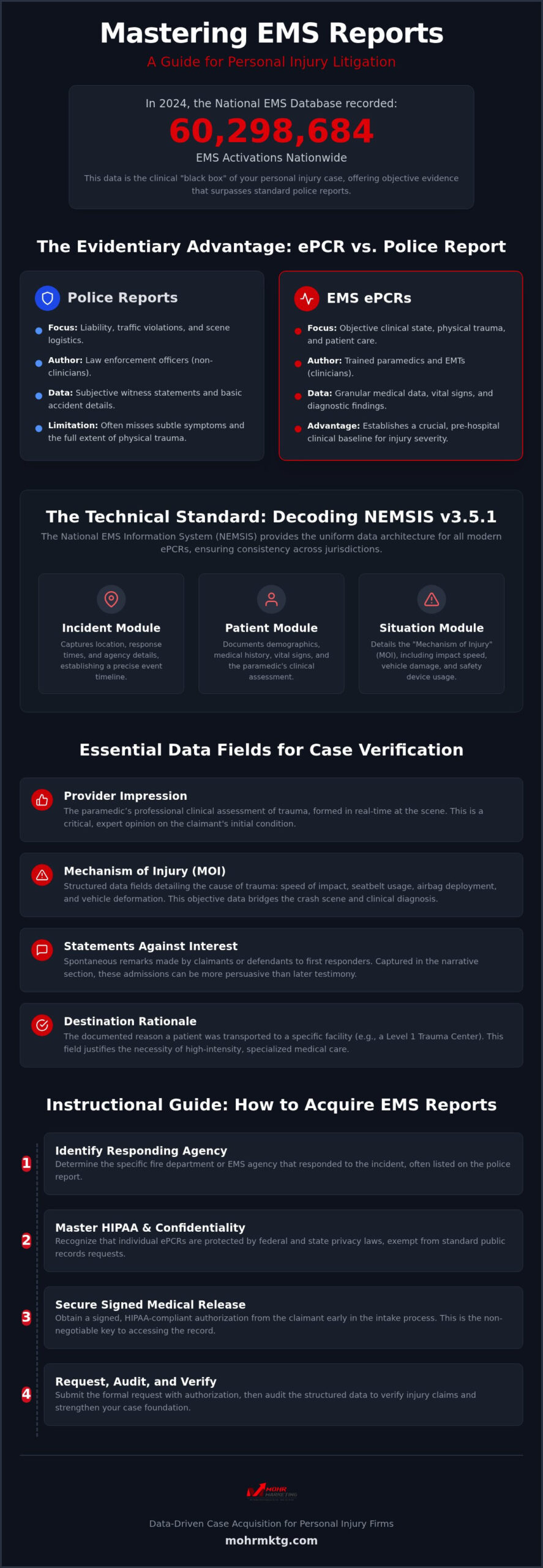
Instructional Guide: How to Request and Audit EMS Reports
Success in personal injury litigation depends on procedural precision. You must identify the responding agency immediately after intake. Don’t assume the fire department on scene handled the transport. Many jurisdictions use a tiered system where a municipal fire unit provides first response care while a private contractor or separate municipal EMS agency handles the actual transport. Use 911 dispatch logs to confirm every unit that arrived. If the case involved air-medical transport, you’ll need to contact a separate flight service provider to secure the necessary EMS report information.
Secure a signed, HIPAA-compliant release from the claimant during the initial intake. Waiting until you need the record creates unnecessary delays. Submit your formal request directly to the agency’s Records Custodian or Privacy Officer. Be specific about the EMS report information you require. You need the full ePCR, including the timestamped incident timeline and any associated cardiac monitor strips. Once the report arrives, audit it for completeness. Cross-referencing this data with police reports often reveals conflicts in the accident narrative or the timing of the impact.
Identifying the Responding Agency
Dispatch logs are your primary source of truth. They list every unit dispatched, arrive-on-scene times, and transport destinations. You must differentiate between agencies that provided medical care and those that merely assisted with vehicle extrication. In complex MVAs, multiple agencies may be involved. Missing a single transporting unit leaves a gap in the medical timeline that the defense can exploit. Use these logs to build a comprehensive list of all potential medical-legal records before you begin the formal request process.
The 5-Point Audit Checklist for Legal Teams
Audit the returned report for clinical consistency. Use this 5-point checklist to verify the strength of your case:
- Chief Complaint and Secondary Injuries: Ensure the documented pain at the scene matches the client’s current clinical allegations.
- Medications Administered: Use the administration of narcotics or advanced life support (ALS) protocols as an objective proxy for injury severity.
- Patient GCS (Glasgow Coma Scale): A score below 15 provides early, objective evidence for traumatic brain injury (TBI) claims.
- Signature of Patient: A patient signature verifies their presence, orientation, and level of consciousness at the scene.
- Timeline Verification: Compare EMS dispatch times with police report backed MVA cases to identify any evidentiary discrepancies.
Data-Driven Case Acquisition: The Mohr Marketing Advantage
High-intent lead generation requires more than just high volume. It demands clinical and technical verification. Mohr Marketing utilizes a rigorous validation process to ensure every lead meets strict case criteria. While other providers deliver raw inquiries based on anecdotal claims, we focus on objective data. We look for the technical markers discussed in previous sections, such as the Mechanism of Injury and clinician assessments found in EMS report information. This precision is the foundation of our Pay-Per-Signed-Case model. You don’t pay for the possibility of a case; you pay for a verified, signed retainer that stands up to defense scrutiny.
Our turnkey intake ecosystem eliminates the friction typically found in manual record acquisition. We’ve built a system that prioritizes transparency and reliability. By verifying the physical trauma and accident dynamics before the lead reaches your desk, we remove the guesswork from case conversion. This results-oriented approach allows your firm to scale aggressively without bloating your internal intake department or wasting resources on unviable claims.
Verified Leads vs. Raw Inquiries
The difference between a raw inquiry and a verified lead is the presence of objective proof. We verify the Mechanism of Injury early in the process. Our system filters for high-value litigation opportunities by cross-referencing claimant statements with EMS report information and police data. This front-end qualification significantly reduces your overall cost-per-case. You avoid the “sunk cost” of pursuing clients who lack documented trauma. By the time a lead is delivered, the clinical baseline is already established, ensuring your team focuses only on high-value Personal Injury Leads and MVA opportunities.
Strategic Growth through Performance Marketing
Leveraging 30 years of industry experience, Mohr Marketing acts as a strategic partner in your firm’s expansion. We understand the technicalities of healthcare data and the legal requirements of intake. This insider knowledge allows us to build a more streamlined path to success than traditional marketing agencies. Transparency in our verification process builds long-term ROI by ensuring every signed case is backed by a solid evidentiary foundation. You can optimize your MVA case acquisition with police-report-backed cases or explore our mass tort signed case solutions to maintain a leadership position in a competitive market. Our model is built for firms that value efficiency and tangible financial performance.
Secure Your Competitive Advantage Through Clinical Verification
Mastering the technical nuances of the ePCR is no longer optional for high-growth law firms. By auditing EMS report information with clinical precision, you move beyond anecdotal evidence and establish an objective baseline for injury severity. This technical proficiency allows your firm to verify high-intent claimants faster than competitors who rely solely on surface-level police reports. You’ve learned how to decode NEMSIS standards and navigate HIPAA hurdles to protect your firm’s resources and improve case conversion.
Efficiency in acquisition requires a streamlined intake ecosystem. Secure your HIPAA authorizations early and identify responding agencies with dispatch logs to eliminate administrative friction. Mohr Marketing leverages over 30 years of industry experience to handle this complexity for you. Our turnkey marketing system and performance-based Pay-Per-Signed-Case model deliver verified inquiries that are ready for litigation. We eliminate inefficient intermediaries, providing a direct path to high-value retainers and sustainable firm growth.
It’s time to stop chasing raw inquiries and start acquiring cases with certainty. Build your firm’s expansion on a foundation of transparency and data-driven results.
Frequently Asked Questions
What is the difference between a police report and an EMS report?
Police reports prioritize scene liability, traffic violations, and witness statements. EMS reports focus exclusively on clinical findings, vital signs, and medical interventions. While an officer documents the crash environment, a paramedic records the patient’s physiological response to trauma. These medical records provide objective data that is often shielded from public records requests, unlike standard police documentation.
Can an attorney request an EMS report without a client’s signature?
Attorneys cannot typically acquire individual EMS report information without a client’s signed HIPAA authorization or a valid subpoena. EMS agencies are “Covered Entities” under federal law and must protect patient privacy. Attempting to bypass this requirement through standard public records requests will lead to immediate rejection. Secure a signed release during the initial intake to prevent administrative delays.
What are the most important data elements in an EMS report for an MVA case?
Focus on the Mechanism of Injury (MOI) fields, which document impact speed and vehicle damage. The Provider Impression offers the clinician’s real-time assessment of trauma. Vital signs and the narrative section are equally critical. They provide a chronological baseline of the claimant’s condition before hospital stabilization. These elements are essential for verifying the severity of motor vehicle accident leads.
How long do EMS agencies typically keep patient care records?
Retention periods vary by state law and agency policy. Most EMS providers maintain records for seven years for adult patients. For minors, agencies often keep records until the patient reaches the age of majority plus a specified number of years. You should verify the specific statutes of limitation and record-keeping mandates in the jurisdiction where the accident occurred to avoid data loss.
Are EMS reports admissible as evidence in court?
EMS reports are generally admissible under the business records exception to the hearsay rule. They are created in the regular course of medical business and are considered highly reliable. These documents serve as evidence of the patient’s physical state immediately following an incident. Counsel can use them to establish the timeline of injury and the necessity of subsequent medical treatment.
What should I do if an EMS report contains inaccurate information about the accident?
You should contact the EMS agency’s Privacy Officer to request an amendment if you discover inaccuracies. HIPAA grants patients the right to request corrections to their medical records. Provide objective evidence, such as police photos or dispatch logs, to support the change. While the agency may not delete the original note, they can add an addendum that clarifies the record for future litigation.
How does HIPAA affect the acquisition of EMS data for law firms?
HIPAA classifies most EMS agencies as “Covered Entities,” meaning they must adhere to strict Privacy and Security Rules. This prevents the release of EMS report information to third parties without explicit, written consent. For your firm, this means your intake process must include HIPAA-compliant documentation. Failure to meet these federal standards results in denied requests and stalled case verification.
Why is the Glasgow Coma Scale (GCS) important in an EMS report?
The Glasgow Coma Scale (GCS) provides a standardized method for measuring a patient’s level of consciousness. It’s the primary indicator for traumatic brain injury (TBI) in a pre-hospital setting. A score below 15 suggests neurological impairment. Documenting a low GCS at the scene is vital for establishing the severity of a head injury before hospital intervention masks the symptoms.

Recent Posts
- NEC Baby Formula Case Acquisition: A Law Firm’s 2026 Guide
- Justifying Marketing Investment to Law Firm Partners: A Data-Driven Framework
- Roundup Cancer Lawsuit Leads: Buying Guide for Law Firms
Categories
- AI and Lead Generation
- Business Financing
- Call Verified MVA Leads
- Car Accident Help
- Car Accident Settlements
- Claimant Funding
- Compliance Program
- EMS-EMT Reports
- Geotargeting
- Google Maps Ranking
- Healthcare Practice Growth
- Law Firm Growth
- Law Office Operations
- Lead Generation
- Lead Generation For Attorneys
- Lead Generation For Chiropractors
- Lead Generation For Criminal Attorneys
- Lead Generation For D&A Treatment Centers
- Lead Generation For DUI Attorneys
- Lead Generation For Eye Doctors
- Lead Generation For Family Law Practices
- Lead Generation For PI Law Firms
- Lead Generation For Plastic Surgeons
- Leads For Healthcare Professionals
- Leads For Insurance Industry
- Legal Leads
- Legal Marketing
- Legal Updates
- Mass Tort Leads
- Medicare and Medicaid Leads
- Merchant Funding Leads
- Mold Leads
- Online Marketing Strategies
- Pre-Settlement Funding
- Signed MVA Cases
- Tort Updates
- Truck Accident Leads and Signed Cases
- Truck Accident Settlements
- Web Design