Emergency Vehicle Response: Impact on Accident Claims
August 12, 2026 by Mohr Marketing
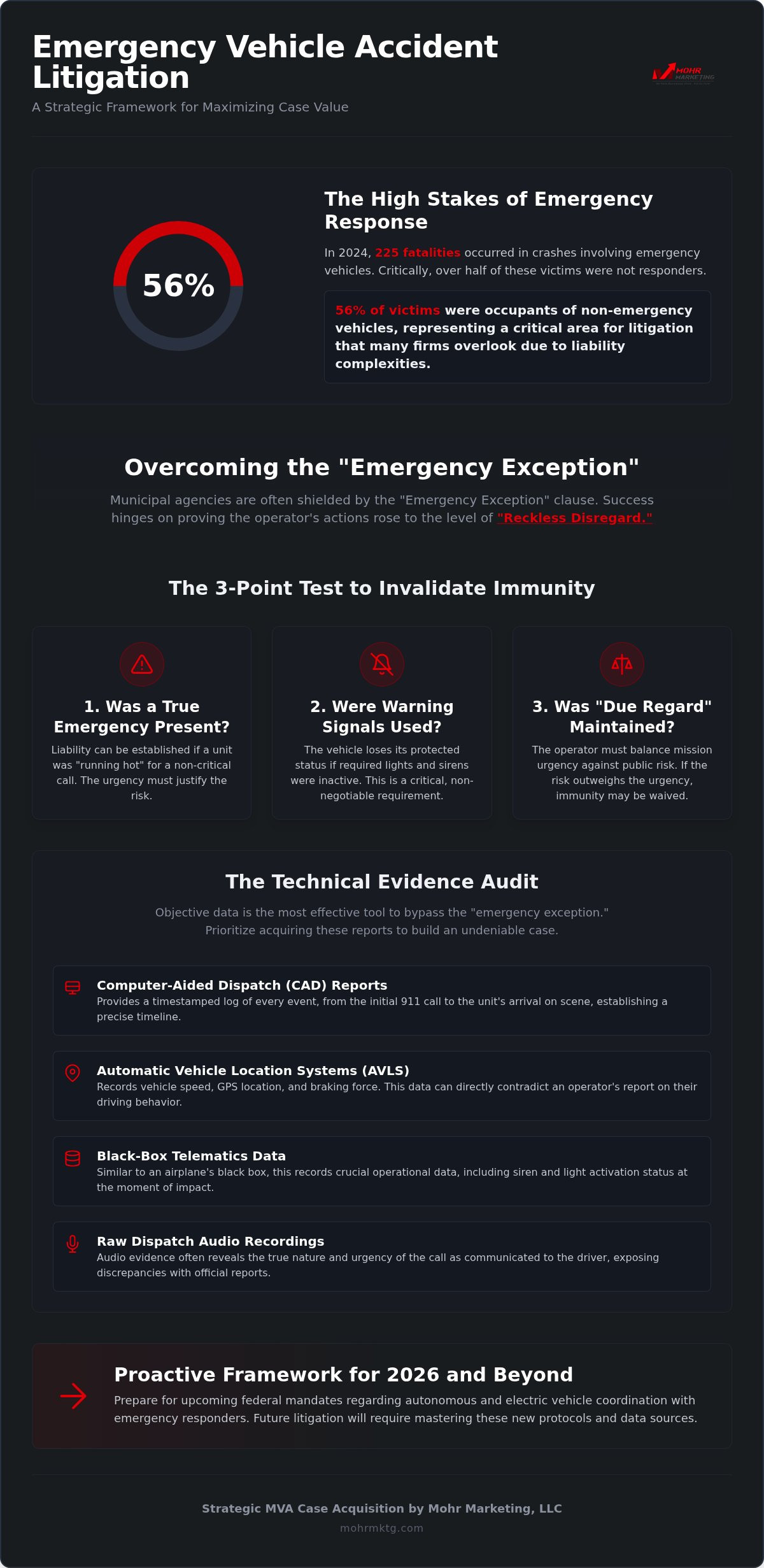
In 2024, 225 people died in crashes involving emergency vehicles. Over half of those victims, 56%, were occupants of non-emergency vehicles. While these incidents represent some of the most high-stakes litigation in the MVA sector, many firms struggle to bypass the “emergency exception” that often shields responders from liability. Understanding the mechanics of an emergency vehicle response to accident is not just a matter of roadside safety; it’s the primary driver of case valuation. If your firm isn’t analyzing dispatch logs and recent “Move Over” law expansions, you’re missing the data required to secure high-value settlements.
You likely recognize that these cases are notoriously difficult to vet and even harder to litigate without precise technical evidence. This article will teach you to master the legal nuances of emergency responses to identify high-value cases and optimize your firm’s acquisition strategy. We provide a clear framework for evaluating liability, acquiring critical dispatch data, and streamlining intake for complex leads. You’ll gain a strategic advantage by learning to navigate 2026 regulatory shifts, including new federal mandates for autonomous and electric vehicle emergency protocols.
Key Takeaways
- Identify the legal threshold between simple negligence and “reckless disregard” to successfully bypass the emergency exception clause in municipal liability cases.
- Utilize “Golden Hour” response metrics and dispatch delay data to objectively quantify increased medical damages and drive higher settlement values.
- Execute a technical evidence audit for every emergency vehicle response to accident by securing CAD reports and AVLS braking logs.
- Streamline your firm’s acquisition strategy by prioritizing MVA leads and signed retainers backed by verified police report data and technical crash indicators.
- Implement a proactive litigation framework that accounts for 2026 federal mandates regarding autonomous vehicle and emergency responder coordination.
The Mechanics of Emergency Vehicle Response to Accident Scenes
A standard emergency vehicle response to accident scenes follows a rigid protocol designed to balance speed with public safety. Lights and sirens do not grant an absolute right of way; they serve as a request for yield. Most jurisdictions mandate that drivers use these signals only when responding to “Code 3” emergencies involving an immediate threat to life or property. The hierarchy of response typically begins with Fire and EMS units for life-saving interventions, followed by Police for scene security and investigation. This coordination is vital during the “Critical 10 Minutes,” the window immediately following a collision where effective scene management prevents secondary crashes and ensures the preservation of physical evidence.
You must distinguish between a responding vehicle and a stationary scene-blocker when evaluating liability. A responding vehicle is often exempt from speed limits and signal compliance provided it maintains “due regard.” Conversely, a stationary vehicle acts as a physical barrier. Regulations in numerous areas have broadened “Move Over” requirements to encompass any vehicle displaying hazard lights. This shift places a higher burden on responders to properly mark their presence. Failure to deploy adequate flares or lighting during an emergency vehicle operation can transform a protected responder into a liable party if their positioning creates an unnecessary hazard.
Due Regard vs. Sovereign Immunity
Sovereign immunity often shields municipal agencies from standard negligence claims, but this protection is not absolute. To overcome this hurdle, you must prove the operator failed the “due regard” standard. This requires demonstrating that the driver’s actions were not just negligent, but rose to the level of reckless disregard for the safety of others. “Due regard” is legally defined as the operator’s duty to balance the life-saving necessity of the mission against the degree of risk created by their specific driving maneuvers. If the risk to the public outweighed the urgency of the call, immunity may be waived.
The Role of Dispatch and Telematics
Objective data is the most effective tool for bypassing the “emergency exception.” Computer-Aided Dispatch (CAD) reports provide a timestamped log of every milestone from the initial 911 call to the moment the unit arrived on scene. Modern emergency vehicles also utilize Automatic Vehicle Location Systems (AVLS) and black-box telematics that record speed, braking force, and siren activation status. You should always request the raw dispatch audio. These recordings often reveal the true urgency communicated to the driver, which can contradict official police reports. Utilizing police-report-backed MVA cases ensures your firm starts with a foundation of verified technical data rather than subjective eyewitness accounts, a service Mohr Marketing, LLC can assist with.
Liability Frameworks in Emergency Vehicle Accidents
Most state vehicle codes include an “Emergency Exception” clause. This legal provision allows responders to bypass standard traffic laws, such as speed limits and red lights, during a bona fide emergency. However, this exception is a conditional privilege, not a blanket immunity. To successfully litigate these cases, you must identify where the responder’s conduct exceeded the scope of these protections. Standard negligence is rarely enough to secure a judgment against municipal entities; you must typically meet the higher evidentiary burden of “reckless disregard.”
Sovereign immunity for responders generally collapses when three specific factors are present. First, you must determine if a true emergency existed. If a unit was “running hot” for a non-critical call, the exception may not apply. Second, you must verify the use of required warning equipment. If sirens or lights were inactive, the vehicle loses its protected status. Third, you must prove a failure of “due regard.” Private EMS providers and third-party contractors often lack the broad sovereign immunity enjoyed by police or fire departments, making them more accessible targets for standard negligence claims. If your firm needs to identify these opportunities, you can consult with our team for targeted acquisition data.
Proving “Reckless Disregard” in 2026
Proving reckless disregard requires evidence that the operator intentionally committed an act of an unreasonable character. In 2026, dashcam footage has become the gold standard for this proof. High-definition video can demonstrate if a driver failed to slow down before entering a “blind” intersection or if they forced other motorists into dangerous maneuvers. You should always audit the driver’s training records, specifically their Emergency Vehicle Operator Course (EVOC) certifications. A history of safety violations or expired certifications can turn a simple accident into a high-value case of negligent entrustment.
Comparative Fault in High-Speed Responses
Defense counsel will almost always pivot to comparative fault, citing the civilian driver’s failure to yield. According to recent emergency vehicle accident statistics, a significant portion of fatalities involve occupants of non-emergency vehicles who may have violated “Move Over” laws. As of 2026, states like Illinois and California have expanded these laws to include all stationary vehicles with hazard lights, increasing the complexity of yield-of-way disputes. To counter these defenses, you need high-intent leads backed by objective police data. Top Personal Injury Lead Generation Companies now prioritize cases where telematics and dispatch logs favor the plaintiff. This technical approach ensures that an emergency vehicle response to accident doesn’t automatically result in a dismissed claim due to perceived civilian fault.
Leveraging Response Data for Case Valuation and Acquisition
Data derived from an emergency vehicle response to accident is the most underutilized asset in case valuation. While defense teams focus on liability exceptions, plaintiffs’ firms must leverage response timestamps to quantify physiological decline. The “Golden Hour” is a medical standard stating that trauma patients have the highest survival and recovery rates if they receive surgical intervention within sixty minutes of the incident. Every minute of delay documented in CAD logs directly correlates with increased injury severity. This technical evidence transforms a standard injury claim into a high-stakes case by linking delayed intervention to permanent disability. To maximize ROI, firms should prioritize police-report-backed MVA cases that provide a verifiable timeline of these response failures.
Responders also act as immediate forensic observers. Scene photography taken by EMS or Fire units often captures vehicle positioning and debris fields before they’re cleared or altered. These images are essential for establishing impact speed and the force of the collision. Comprehensive research on emergency vehicle crashes indicates that the severity of these incidents is often exacerbated by the weight and velocity of the responding apparatus. When you can prove the response itself caused secondary harm or failed to meet timing standards, you move the needle on settlement demands.
Quantifying Damages through Response Logs
You can use arrival times to objectively prove the duration of “pain and suffering” at the scene. If a victim was trapped for 25 minutes before extrication, that period represents a distinct, compensable damage category. Don’t just look at the hospital records. Cross-reference EMS vitals, such as heart rate and oxygen saturation levels recorded during transport, with hospital admission records to show the trajectory of the patient’s decline. This is especially critical in Traumatic Brain Injury (TBI) cases. A delay in oxygenation due to a slow response can act as a multiplier for damages, as it often results in more profound long-term cognitive deficits.
Identifying High-Value Truck and Commercial Responses
Emergency responses involving commercial trucks carry significantly higher policy limits, often reaching into the millions. These cases require a different acquisition strategy. You must secure the “black box” or Event Data Recorder (EDR) data from the commercial vehicle immediately. This data provides objective proof of speed, braking, and steering inputs during the emergency vehicle interaction. Firms that focus on truck-accident signed cases gain a massive advantage by identifying these high-limit opportunities early. By combining EDR data with dispatch logs, you create a closed loop of evidence that makes municipal or corporate defenses nearly impossible to sustain.
Evidence Checklist: Emergency Vehicle Response Audits
A rigorous emergency vehicle response to accident audit requires a technical deep dive into both municipal and private records. You cannot rely on the summary provided in a standard police report. These documents often favor the responding agency and omit critical mechanical or behavioral failures. To build a high-value case, your firm must execute a structured discovery process that targets objective data points. Always subpoena the “Run Sheet” before filing a formal complaint. This document contains the primary observations of the responders and often includes details omitted from the final public record.
Your evidence checklist must include the following technical assets:
- CAD (Computer-Aided Dispatch) Reports: These provide the exact timestamps for the initial call, unit dispatch, and arrival. Gaps in these logs suggest response delays that impact medical outcomes.
- AVLS (Automatic Vehicle Location System) Data: This is the digital footprint of the vehicle. It provides GPS-verified speed, braking intensity, and the exact path of travel leading to the impact.
- Internal Disciplinary Records: Request the responding officer’s personnel file. A history of “reckless disregard” or safety violations proves a pattern of negligence.
- Maintenance Logs: Audit the service history for sirens, light bars, and braking systems. Mechanical failure due to poor maintenance is a direct path to municipal liability.
The Digital Paper Trail
Don’t limit your search to government data. You should immediately canvas the area for private dashcam and doorbell footage. Residents and local businesses often capture the seconds leading up to a crash, providing a perspective that official cameras miss. Radio traffic is equally vital. Analyze the recordings for signs of “distracted driving” or confusion between the unit and dispatch. Radio silence during a high-speed pursuit serves as evidentiary proof that the operator failed to maintain necessary communication with dispatch, potentially violating departmental safety protocols. This lack of coordination often precedes a failure of due regard.
Expert Witness Integration
Selecting the right expert depends on the specific failure in the emergency vehicle response to accident. Hire an accident reconstructionist to handle the physics of the impact, such as speed and crush analysis. Conversely, an emergency response expert is required to testify on departmental protocols and “due regard” standards. High-stakes litigation requires significant upfront investment. Understanding the ROI of Legal Intake Services allows your firm to justify these expert costs by ensuring you only invest in cases with high conversion potential. In 2026, a bulletproof expert report must integrate ISO 17840 format data for alternative-fuel vehicles and account for autonomous vehicle sensor logs to meet the latest evidentiary standards.
Scaling MVA Case Acquisition with Mohr Marketing
Standard lead generation is often a volume game that ignores the technical nuances of liability. When a case involves an emergency vehicle response to accident, the barrier to entry is higher. You need more than just a name and phone number. You need a claimant whose story is supported by the technical evidence we’ve outlined. Mohr Marketing, LLC specializes in providing Personal Injury Leads and MVA Leads that have passed rigorous verification. We focus on police-report-backed MVA cases, ensuring the foundational facts of the emergency response are in place before the lead reaches your desk. This pre-verification process filters out cases that would likely fail the reckless disregard standard.
Our turnkey ecosystem is designed for high-stakes firms that cannot afford to waste resources on unvetted intake. By providing Signed Retainers and Legal Intake Services, we remove the friction of the initial investigation. Your staff won’t have to spend dozens of hours chasing CAD logs for a case that might be barred by sovereign immunity. We deliver cases that are ready for immediate litigation. This allows your senior partners to focus on high-value strategy rather than administrative verification. With over 30 years of industry experience, we understand the mechanics of growth and the importance of eliminating inefficient intermediaries in the acquisition process.
Direct Access to High-Intent Claimants
We eliminate the inefficient middlemen that often dilute lead quality. Our marketing is transparent and data-driven, focusing on real search intent from individuals involved in serious collisions. For firms looking to scale beyond local jurisdictions, our Mass Tort Signed Cases offer a proven path to national expansion. To integrate these leads into your existing CRM, simply map our API endpoints to your intake fields. This ensures that every high-intent inquiry is captured and routed to the appropriate litigation team without manual data entry. This methodical approach maintains the momentum required for high-stakes MVA litigation.
Execute Your Growth Strategy
Stop chasing unverified inquiries that stall during the discovery phase. The difference between a stagnant firm and a market leader is the quality of their acquisition funnel. By partnering with Mohr Marketing, LLC, you gain a strategic ally that possesses deep insider knowledge of the legal business. We provide the technical data and signed cases necessary to overcome complex municipal defenses and secure higher settlements. This is the solution for firms that value efficiency and tangible financial performance. It’s time to transition from lead chasing to case litigating.
Dominate the Complex MVA Litigation Market
Piercing the “emergency exception” requires more than anecdotal evidence; it demands a technical audit of the responder’s actions. You must master the integration of CAD logs and AVLS telematics to prove a failure of due regard. These metrics don’t just establish liability. They provide the objective data needed to quantify physiological decline during the “Golden Hour,” directly increasing your case valuation. Mastering the nuances of an emergency vehicle response to accident is the only way to secure high-stakes settlements in this complex sector.
Mohr Marketing bridges the gap between raw data and signed cases. With 30+ years of legal marketing expertise, we provide verified inquiries and fully executed retainers that are ready for immediate litigation. Our turnkey intake ecosystem allows for seamless national scaling, providing your firm with a consistent stream of high-intent cases backed by verified police reports. We eliminate the friction of unverified leads, allowing your team to focus on high-value strategy.
Take control of your firm’s expansion and secure the technical advantage required to dominate the market. We’re ready to help you scale.
Frequently Asked Questions
Can I sue a police officer for an accident during a high-speed response?
Yes, you can sue, but the evidentiary burden is significantly higher than a standard motor vehicle accident. You must typically prove the officer acted with “reckless disregard” rather than simple negligence. Sovereign immunity often protects individual responders, so litigation usually targets the municipality or the specific law enforcement agency. Success depends on identifying violations of departmental protocols or state-mandated safety standards during the high-speed pursuit or response.
What is the “Due Regard” standard in emergency vehicle accidents?
Due regard is the legal obligation for emergency operators to prioritize public safety, even when traffic laws are suspended. It’s a balancing test. Courts examine whether the driver’s actions were reasonable given the urgency of the emergency. If the risk created by the driver’s maneuvers outweighed the need for a rapid arrival, the operator failed the due regard standard. This failure is the primary mechanism for bypassing sovereign immunity in most jurisdictions.
How do I obtain dispatch logs for an emergency vehicle response?
You must file a formal public records request or issue a subpoena to the municipal dispatch center to obtain these records. Specifically request the Computer-Aided Dispatch (CAD) report and the raw radio audio files. These documents provide a verified timeline of an emergency vehicle response to accident, including exact dispatch times and unit arrival milestones. This data is critical for identifying response delays that may have exacerbated the victim’s medical condition or injuries.
Does sovereign immunity always protect fire truck drivers in a crash?
Sovereign immunity isn’t an absolute shield for fire truck drivers. It only applies when the operator is responding to a bona fide emergency and following departmental safety protocols. If the driver was returning from a call or acting with “gross negligence,” immunity is typically waived. You must audit the unit’s dispatch status and maintenance logs to determine if the vehicle was legally entitled to emergency status at the time of impact.
What evidence is needed to prove a siren was not audible before an accident?
Proving an inaudible siren requires a combination of digital evidence and expert analysis. Secure dashcam footage from the plaintiff and surrounding doorbell cameras to establish the acoustic environment at the time of impact. You should also subpoena the vehicle’s AVLS data to verify if the siren was actually engaged. An acoustic engineer can then testify on how environmental factors, such as “sound shadows” or vehicle insulation, prevented the plaintiff from hearing the warning signals.
How does an emergency response impact the value of a personal injury case?
The mechanics of an emergency vehicle response to accident act as a damage multiplier. Dispatch logs showing significant arrival delays allow your firm to quantify the duration of the victim’s pain and suffering before medical aid arrived. Accidents involving municipal or commercial responders also typically involve higher insurance policy limits. This combination of increased injury severity and deep-pocketed defendants significantly elevates the potential settlement value for your firm.
Why are police-report-backed MVA leads more valuable for law firms?
These leads carry higher value because they come with a verified foundation of technical evidence. A police report provides an objective account of the scene, vehicle positioning, and initial fault determinations. For firms scaling their acquisition, these leads reduce the risk of investing in non-viable cases. Mohr Marketing provides these pre-verified inquiries to ensure your intake team only processes high-intent claimants who have a documented basis for a high-value personal injury claim.
What is the difference between negligence and reckless disregard in MVA law?
Negligence is a failure to use ordinary care, while reckless disregard is a conscious choice to ignore a high degree of risk. In most emergency vehicle cases, simple negligence is protected by sovereign immunity. You must prove the driver’s actions were an extreme departure from standard safety protocols. This requires demonstrating that the operator knew their driving maneuvers created a substantial risk of harm but proceeded anyway without regard for public safety.

Recent Posts
- NEC Baby Formula Case Acquisition: A Law Firm’s 2026 Guide
- Justifying Marketing Investment to Law Firm Partners: A Data-Driven Framework
- Roundup Cancer Lawsuit Leads: Buying Guide for Law Firms
Categories
- AI and Lead Generation
- Business Financing
- Call Verified MVA Leads
- Car Accident Help
- Car Accident Settlements
- Claimant Funding
- Compliance Program
- EMS-EMT Reports
- Geotargeting
- Google Maps Ranking
- Healthcare Practice Growth
- Law Firm Growth
- Law Office Operations
- Lead Generation
- Lead Generation For Attorneys
- Lead Generation For Chiropractors
- Lead Generation For Criminal Attorneys
- Lead Generation For D&A Treatment Centers
- Lead Generation For DUI Attorneys
- Lead Generation For Eye Doctors
- Lead Generation For Family Law Practices
- Lead Generation For PI Law Firms
- Lead Generation For Plastic Surgeons
- Leads For Healthcare Professionals
- Leads For Insurance Industry
- Legal Leads
- Legal Marketing
- Legal Updates
- Mass Tort Leads
- Medicare and Medicaid Leads
- Merchant Funding Leads
- Mold Leads
- Online Marketing Strategies
- Pre-Settlement Funding
- Signed MVA Cases
- Tort Updates
- Truck Accident Leads and Signed Cases
- Truck Accident Settlements
- Web Design