The Mechanics of Mass Tort Intake: Optimizing for Speed and Conversion
August 26, 2026 by Mohr Marketing
In high-stakes litigation, your mass tort intake process is either a profit center or a massive financial leak. There’s no middle ground. If your team takes thirty minutes to respond to a qualified inquiry, you’ve already lost the case to a faster competitor. You’re likely tired of seeing high lead costs paired with abysmal conversion rates. It’s frustrating to watch inefficient staff waste hours on unqualified claimants while the high-value opportunities slip through the cracks. We understand that the “speed to lead” window isn’t just a suggestion; it’s the heartbeat of a successful campaign.
This article provides the blueprint to master the high-volume intake strategies required to transform inquiries into fully executed retainer agreements. You’ll learn how to build a streamlined ecosystem that delivers signed retainers and predictable cost-per-case metrics. We’ll break down the mechanics of growth, focusing on rigorous verification and the removal of friction. By the end of this guide, you’ll have a clear path to securing higher intent opportunities while eliminating the intermediaries that drain your resources. We’re moving beyond basic call center tactics to a performance-driven infrastructure that prioritizes speed and precision.
Key Takeaways
- Identify the structural differences between high-volume mass tort intake and standard personal injury procedures to prevent lead leakage and capture every opportunity.
- Master the data-driven progression required to move a claimant from the initial digital inquiry to a fully executed retainer agreement with minimal friction.
- Compare performance metrics to understand why a pay-per-signed-case model offers a lower-risk investment for firms pursuing aggressive growth.
- Establish 24/7/365 operational availability to capture high-value opportunities within the critical speed to lead window.
- Leverage a turnkey ecosystem to eliminate inefficient intermediaries and secure verified, high-intent cases for your practice.
Understanding the Complexity of High-Volume Mass Tort Intake
Effective mass tort intake serves as the vital bridge between high-volume advertising and litigation-ready case files. It’s a specialized operation that transforms raw interest into a verified legal asset. Unlike standard personal injury procedures that manage local, isolated incidents, mass torts require an infrastructure capable of handling hundreds of inquiries simultaneously. The criteria are rigid and unforgiving. A single oversight during the initial screening of mesothelioma leads or complex pharmaceutical claims can render a potential case worthless, wasting both time and marketing capital.
In national campaigns, “speed to lead” isn’t a metric; it’s a survival requirement. High-stakes litigation moves fast, and your response time must match that pace to maintain brand authority. When a claimant reaches out, they expect immediate professional engagement. If your firm doesn’t provide it, they’ll move to a competitor within seconds. Professional intake staff don’t just collect data; they protect your firm’s reputation by providing a polished, authoritative first touchpoint that signals competence and urgency.
Why Traditional Intake Fails Mass Tort Campaigns
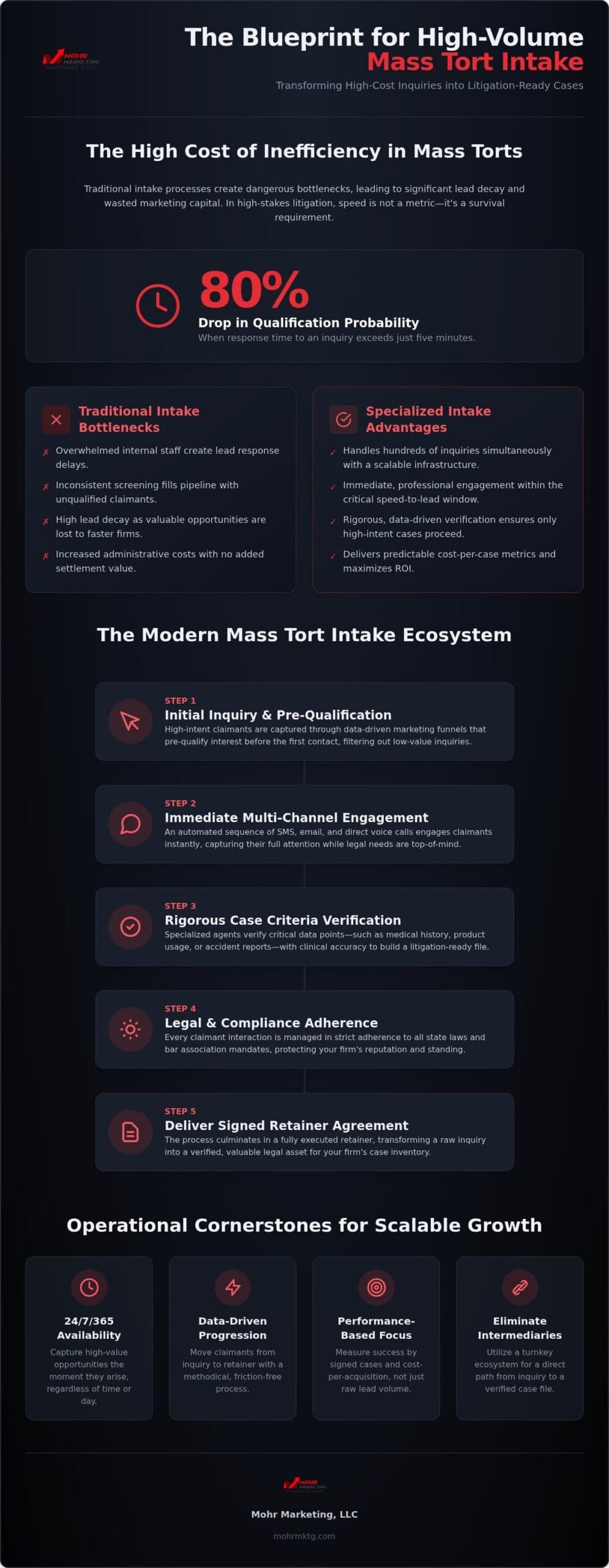
Internal staff often create a dangerous bottleneck during national surges. They aren’t trained for the relentless pace of a mass tort launch, leading to significant lead decay. If your response time exceeds five minutes, the probability of qualifying that claimant drops by nearly 80 percent. This lag creates a vacuum where expensive inquiries simply disappear. Inconsistent screening by overextended employees also puts your litigation budget at risk. Without precise adherence to case criteria, your pipeline fills with unqualified claimants, driving up administrative costs without increasing your settlement potential.
The Distinction Between General Inquiries and High-Intent Cases
Not all inquiries hold equal value. High-intent opportunities are born from specific search behaviors where individuals are actively seeking a legal remedy for a documented injury. These aren’t passive observers; they’re motivated claimants ready to sign. However, even high-intent inquiries require immediate, rigorous verification to confirm their value. This process separates legitimate truck accident cases from general noise. For a comprehensive look at how these inquiries fit into a larger growth strategy, consult our Mass Tort Lead Generation: A Roadmap to Scalable Growth in 2026. Verification is the only way to ensure your firm invests in cases that have a clear path to recovery.
The 2026 Mass Tort Intake Ecosystem: From Inquiry to Retainer
The 2026 mass tort intake ecosystem is a precision-engineered machine. It’s designed to minimize the distance between a claimant’s first click and a signed retainer. This isn’t a manual task; it’s a methodical progression. We use data-driven marketing funnels to pre-qualify every individual before they even speak to a representative. This ensures your resources aren’t wasted on tire-kickers. Compliance remains at the center of this process. Every interaction must strictly adhere to state laws and bar mandates to protect your firm’s standing. By adopting a turnkey ecosystem, you remove the friction that typically stalls large-scale litigation growth. This system eliminates inefficient intermediaries, providing a direct path from inquiry to case file.
Multi-Channel Verification and Screening
Speed is the primary driver of conversion. You must engage claimants immediately across multiple channels. Start with an automated SMS to confirm receipt, followed by an email and a direct voice call. This multi-touch approach ensures you capture the claimant’s attention while they’re still focused on their legal needs. During these interactions, you must verify specific case criteria like medical history or product usage with clinical accuracy. For high-value opportunities, we often use police reports to back truck accident signed cases. This objective data provides the verification necessary to move a case into the litigation phase with confidence. It’s about building a case file that is ready for the courtroom from day one.
The Role of Technology in Legal Intake Optimization
Modern mass tort intake requires seamless integration between your marketing data and your CRM. Real-time tracking allows you to see exactly where every inquiry sits in the funnel. If a claimant stalls at the retainer stage, automated follow-up sequences trigger to re-engage them without manual intervention. This prevents high-value cases from slipping through the cracks during high-volume surges. This technological precision is especially critical for mesothelioma leads built on real search intent. These claimants require a high level of empathy paired with procedural speed. If you’re looking to upgrade your current acquisition strategy, you can discuss your firm’s goals with our team. We focus on delivering results that translate directly to your bottom line.
Performance Metrics: Evaluating Lead Quality vs. Signed Cases
Your firm’s growth depends on how you define success in your mass tort intake strategy. Many firms fall into the trap of measuring performance by lead volume. This is a mistake. High volume often masks deep inefficiencies and wasted marketing spend. You must shift your focus from raw inquiries to the only metric that guarantees a return: the signed case. While a Pay-Per-Lead model might seem cost-effective initially, it places the entire burden of conversion on your internal staff. You’re paying for a name and a phone number, not a client. In contrast, a Pay-Per-Signed-Case model shifts the risk back to the provider. You only invest in verified, litigation-ready assets, making it a significantly lower-risk strategy for firms pursuing aggressive expansion.
The “true cost” of a lead is never just the purchase price. It includes the administrative overhead of your intake team, the cost of your CRM, and the lost opportunity value of cases your staff failed to reach in time. When you factor in these hidden expenses, the price of a raw lead often exceeds the cost of a pre-verified signed retainer. ROI must be your primary KPI. If your intake process doesn’t produce a predictable cost-per-case, you aren’t managing a campaign; you’re gambling with your firm’s capital.
Calculating the Cost-Per-Signed-Case
To audit your financial performance, you must break down acquisition fees against the projected settlement potential of each case type. Start by tracking the total spend required to secure a single executed retainer. This includes every dollar spent on advertising and the labor costs of the screening process. Transparent, data-driven marketing is the only way to achieve this level of precision. Without clear attribution, you can’t identify which channels are delivering value and which are draining resources. For a deeper dive into these metrics, review our guide on The ROI of Legal Intake Services. High-performing firms use these audits to pivot away from low-intent traffic toward verified cases.
Eliminating Intermediaries and Inefficient Aggregators
Intermediaries and lead aggregators often dilute case value by selling shared inquiries to multiple firms. This creates an environment where firms compete on speed for the same low-quality data. It’s a race to the bottom that destroys your conversion rates. Exclusive inquiries are different. They allow your tort intake professionals to build rapport and secure a retainer without the pressure of a multi-firm bidding war. Working with a strategic partner that controls the entire ecosystem ensures that every inquiry is unique to your firm. This control eliminates the friction of shared leads and provides a more streamlined path to a signed case file. You need a partner that protects your resources, not one that treats your firm as just another buyer in a crowded marketplace.
Operational Best Practices for Scaling Mass Tort Intake
Scaling mass tort intake requires a shift from reactive call answering to proactive process management. High-volume national campaigns don’t sleep. You must maintain 24/7/365 availability to capture claimants who search for legal remedies outside of standard business hours. If your intake operation shuts down at 5:00 PM, you’re effectively handing high-value cases to your competitors. This constant availability ensures your firm remains the first point of contact, regardless of the claimant’s time zone or schedule. It’s about being present when the intent is highest.
Efficiency also means maximizing your existing database. Many firms discard inquiries that don’t sign immediately, labeling them as “dead leads.” This is a waste of capital. A structured follow-up sequence often reveals that these claimants simply needed more time or additional information. By implementing a methodical re-engagement strategy, you can extract significant value from leads you’ve already paid for. This turns a static list into a dynamic pipeline of potential retainers without increasing your front-end marketing spend.
Scripting for Compliance and Conversion
Precision in scripting is the difference between a qualified case and a liability. Your intake scripts must be authoritative yet accessible. They need to guide the claimant through a complex emotional situation while gathering clinical facts. Every question must align with the specific litigation’s “Master Complaint” criteria. This ensures that the data you collect is legally relevant from the first interaction. Training is essential here. Intake professionals must be equipped to handle nuanced scenarios, such as those encountered in high-value mold case acquisition, where environmental and medical factors intersect. A well-trained team ensures that every inquiry is screened with mechanical accuracy.
Managing the Hand-Off to Litigation Teams
A signed retainer is only useful if it’s accompanied by a litigation-ready file. This means packaging the retainer with all necessary medical authorizations, incident documentation, and product usage proof. Your goal is to reduce the administrative burden on your attorneys. They shouldn’t be chasing down missing signatures or unreadable documents. Procedural precision during the mass tort intake phase ensures that cases can be handed directly to litigation teams for immediate action. Implement a rigorous auditing process to report on the health of your intake-to-litigation pipeline. This transparency allows you to identify bottlenecks and maintain a steady flow of verified cases into your practice.
The Mohr Marketing, LLC Advantage: Strategic Case Acquisition
Mohr Marketing, LLC represents more than a lead source; we’re a strategic partner built for firms that prioritize scalable growth. Our 30-year history in the legal sector provides a level of insider knowledge that traditional marketing agencies simply don’t possess. We’ve spent decades refining the mechanics of mass tort intake to eliminate the financial waste that plagues most campaigns. By operating on a performance-based model, Mohr Marketing, LLC aligns our success directly with yours. We don’t just provide data; we deliver mass tort signed cases that meet your specific litigation criteria. This assertive approach ensures your firm isn’t gambling on raw inquiries but investing in verified assets.
Our turnkey solutions are designed for professional practices that require procedural precision. We manage the entire progression from the initial digital inquiry to the delivery of an executed retainer. This seamless transition is powered by a data-driven ecosystem that adapts to market shifts in real-time. Mohr Marketing, LLC protects your firm’s resources by handling the rigorous verification processes that typically drain internal staff time. You avoid the high overhead of a massive in-house intake department while still pursuing aggressive national expansion. It’s a more streamlined, direct path to building a high-value case inventory without the friction of inefficient intermediaries.
Turnkey Solutions for Professional Practices
The transition from a digital inquiry to a signed case should be invisible to your internal team. Our turnkey model ensures that by the time a file reaches your desk, the claimant has already been screened, verified, and signed. This data-driven approach allows Mohr Marketing, LLC to stay ahead of market shifts, adjusting our targeting strategies to maintain a steady flow of high-intent opportunities. We focus on the mechanics of growth so you can focus on the law. By removing the administrative burden of initial screening, we allow your attorneys to maximize their billable hours on high-value litigation tasks. This isn’t just marketing; it’s operational optimization for the modern law firm.
Securing Your Firm’s Future in Mass Tort Litigation
Securing your firm’s future in the competitive mass tort market requires a partner you can trust. Before you scale, you must audit your current intake process with a critical eye. Track your speed to lead, your qualification rates, and your final cost-per-case. If your attorneys are spending more than ten minutes reviewing an intake file before it’s litigation-ready, your intake system has failed. Look for gaps in documentation and inconsistent claimant stories, as these are signs of a weak screening process. A reliable strategic partner provides the stability needed to weather the volatility of national litigation. We invite you to consult with Mohr Marketing, LLC on developing custom acquisition funnels that prioritize high-intent opportunities and eliminate friction. Our expertise ensures your firm remains a leader in the field, backed by a 30-year legacy of tangible results.
Dominate the National Mass Tort Market
Mastering the mechanics of mass tort intake is the only way to ensure your firm’s growth isn’t stalled by administrative friction. You’ve seen how a turnkey ecosystem transforms raw inquiries into litigation-ready files through multi-stage verification. It’s time to move beyond the high-risk Pay-Per-Lead model and embrace performance-based signed case acquisition. This shift ensures you only pay for results, not just potential.
Mohr Marketing, LLC offers over 30 years of legal marketing expertise to help you secure high-intent opportunities with clinical precision. We eliminate inefficient intermediaries and aggregators, ensuring every case file you receive is backed by a rigorous screening process. This strategic alignment protects your capital and firm resources while driving aggressive national expansion. Your firm deserves a partner that values efficiency as much as you do.
Your firm is ready for the next level of scalable litigation. We’re here to provide the direct path to success you’ve been searching for. Let’s start building your litigation-ready pipeline today.
Frequently Asked Questions
What is the difference between a mass tort lead and a signed case?
A mass tort lead is a raw inquiry from a potential claimant, whereas a signed case is a verified individual who has already executed a retainer agreement with your firm. Leads require significant labor to screen and qualify. Signed cases are litigation-ready assets that have passed through a rigorous mass tort intake process. By focusing on signed cases, your firm avoids the administrative burden and financial risk associated with chasing unverified inquiries.
How quickly should our intake team respond to a new mass tort inquiry?
Your intake team should respond to a new inquiry immediately to maintain a high conversion rate. Industry performance data indicates that the probability of qualifying a lead drops significantly as time passes. In a competitive national market, claimants often reach out to multiple firms simultaneously. Responding in seconds rather than minutes ensures your firm captures the claimant’s attention first, effectively closing the speed to lead window before competitors can engage.
Can we outsource mass tort intake without violating state bar mandates?
Law firms can outsource intake operations as long as they maintain ultimate oversight and ensure the provider adheres to state bar advertising and solicitation mandates. A professional strategic partner operates as an extension of your firm, following pre-approved scripts and rigorous verification protocols. This allows you to scale without the overhead of a massive internal department. Always verify that your partner understands the specific ethical requirements for the jurisdictions where you’re acquiring cases.
What information is required to qualify a claimant for a mass tort?
Qualifying a claimant requires documented proof of product usage or exposure, a diagnosed injury that matches the litigation criteria, and confirmation they aren’t already represented by counsel. You must gather specific dates of usage and medical treatment to align with the Master Complaint requirements. This detailed mass tort intake process ensures that every file handed to your litigation team is substantive and has a clear path toward recovery within the ongoing legal action.
How does a pay-per-signed-case model improve our law firm’s ROI?
A pay-per-signed-case model improves ROI by shifting the financial risk of lead conversion from the law firm to the marketing partner. You don’t waste capital on raw leads that never sign or don’t meet qualification criteria. Instead, you only invest in verified retainers. This predictability allows you to forecast settlement potential more accurately and reduces the internal staff costs traditionally required to screen high volumes of unverified inquiries.
What happens if a signed retainer is found to be unqualified later?
Professional providers typically offer a scrub or replacement policy if a signed retainer is found to be unqualified based on the agreed-upon criteria. This process protects your firm’s resources by ensuring you only pay for cases that actually fit the litigation profile. It’s essential to have a clear auditing process in place to identify these discrepancies early. This transparency builds trust and ensures that your acquisition budget is consistently producing high-value legal assets.
How do you handle 24/7 intake for national law firm campaigns?
Handling 24/7 intake for national campaigns requires a distributed infrastructure that covers every time zone without interruption. This is achieved through dedicated call centers staffed with trained professionals who are ready to engage claimants at any hour. This constant availability is vital because legal inquiries don’t follow a standard business schedule. By maintaining a 24/7/365 presence, your firm captures high-intent opportunities the moment a claimant decides to seek legal help, regardless of the time.
Why is “speed to lead” so critical in mass tort litigation?
Speed to lead is critical because mass tort claimants are often in a state of high urgency and will sign with the first professional firm that responds. If you delay, the claimant will likely find another firm through a competing advertisement. Rapid response times signal authority and competence, building immediate rapport. In high-volume national litigation, the firm that contacts the claimant first holds a significant competitive advantage in securing the fully executed retainer agreement.

Recent Posts
- Car Accident Lead Qualification: Guide for Law Firms
- Medical Malpractice Leads: A Strategic Guide for Law Firms
- Pay-Per-Lead Legal Marketing: A Guide for Law Firms
Categories
- AI and Lead Generation
- Business Financing
- Call Verified MVA Leads
- Car Accident Help
- Car Accident Settlements
- Claimant Funding
- Compliance Program
- EMS-EMT Reports
- Geotargeting
- Google Maps Ranking
- Healthcare Practice Growth
- Law Firm Growth
- Law Office Operations
- Lead Generation
- Lead Generation For Attorneys
- Lead Generation For Chiropractors
- Lead Generation For Criminal Attorneys
- Lead Generation For D&A Treatment Centers
- Lead Generation For DUI Attorneys
- Lead Generation For Eye Doctors
- Lead Generation For Family Law Practices
- Lead Generation For PI Law Firms
- Lead Generation For Plastic Surgeons
- Leads For Healthcare Professionals
- Leads For Insurance Industry
- Legal Leads
- Legal Marketing
- Legal Updates
- Mass Tort Leads
- Medicare and Medicaid Leads
- Merchant Funding Leads
- Mold Leads
- Online Marketing Strategies
- Pre-Settlement Funding
- Signed MVA Cases
- Tort Updates
- Truck Accident Leads and Signed Cases
- Truck Accident Settlements
- Web Design