Scale Your Practice with High-Intent EMS Generated Leads
July 2, 2026 by Mohr Marketing
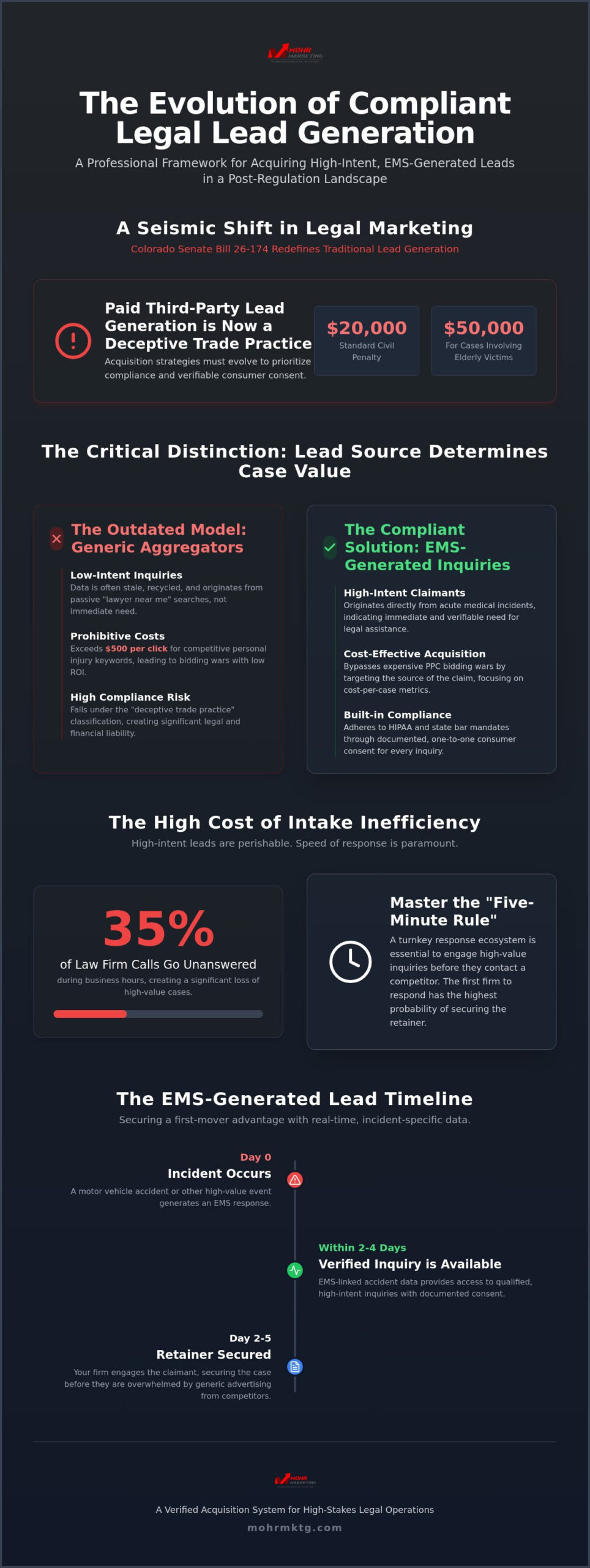
With Colorado Senate Bill 26-174 now classifying traditional third party lead generation as a deceptive trade practice, your current acquisition strategy might be a ticking legal liability. You already know that the difference between a high value retainer and a wasted marketing budget depends on the intent of the inquiry and the speed of your response. Generic aggregators often deliver stale data. This forces your team to chase low quality prospects while industry research shows 35% of law firm calls go unanswered during business hours.
This guide provides a professional framework for acquiring Emergency Medical Services generated leads that are verified, high intent, and compliant with 2026 mandates like California’s SB 37 and the FCC’s one to one consent rules. You’ll learn how to leverage EMS linked accident data available within two to four days of an incident to secure signed retainers. We’ll outline a methodical approach to scaling your practice by eliminating inefficient intermediaries and focusing on verified case acquisition that drives tangible ROI. Every step is designed to remove friction from your intake process while maintaining the mechanical accuracy required for high stakes legal operations.
Key Takeaways
- Identify high-intent inquiries originating from emergency medical contexts to distinguish them from low-quality aggregator data.
- Navigate complex regulatory frameworks by learning how to acquire Emergency Medical Services generated leads while adhering to strict HIPAA and state bar mandates.
- Shift focus from deceptive volume metrics to cost-per-case analysis by comparing the conversion rates of EMS-originated leads against standard PPC inquiries.
- Master the “Five-Minute Rule” to prevent high-value cases from slipping through your intake process using a turnkey response ecosystem.
- Accelerate firm growth through Mohr Marketing’s verified acquisition system, providing access to fully executed retainers and high-value legal inquiries.
What Are Emergency Medical Services Generated Leads?
Emergency Medical Services generated leads represent a specialized category of claimant inquiries originating directly from acute medical responses, trauma incidents, and emergency transport contexts. These aren’t generic marketing lists. They’re high-intent signals from individuals who have recently experienced a significant life event; such as a motor vehicle accident or a medical malpractice incident. For a growth-oriented law firm, this distinction is critical. Raw emergency data consists of public records or dispatch logs that lack context. A verified legal inquiry, however, is a prospect who has been qualified based on specific case criteria and clear legal intent.
The 2026 market favors this incident-specific approach because generic search volume has become prohibitively expensive. With Google Ads cost-per-click for personal injury keywords exceeding $500 in some competitive markets, firms can’t afford to bid on broad terms. EMS-generated leads allow you to bypass the bidding wars by identifying claimants based on the severity and context of their emergency medical interaction. This method targets the source of the claim rather than the search engine, providing a more direct path to high-value litigation.
The High-Intent Advantage of EMS Contexts
Proximity to the incident is the primary driver of high conversion rates. When a potential claimant is interacting with Emergency Medical Services (EMS), their need for professional assistance is immediate. This creates a higher level of intent compared to a passive “lawyer near me” search. You aren’t just finding a lead; you’re identifying a victim of a high-value incident. This context is particularly effective for identifying police-report-backed MVA cases and complex medical malpractice claims where the timeline of care is a central evidence component. Identifying high-value case types like toxic exposure or catastrophic injury requires this level of situational awareness to ensure the claimant meets strict case criteria.
EMS Leads in the 2026 Legal Landscape
The transition toward data-driven claimant acquisition has accelerated in 2026. National mass tort firms now prioritize real-time data over legacy television or radio campaigns. Technology now enables the identification of qualified inquiries within 48 to 96 hours of an emergency response. In states like Texas and California, EMS-linked accident data is available within 2-4 days of the incident. This speed allows firms to secure mass tort signed cases before the claimant is overwhelmed by generic advertising. Real-time data processing eliminates the friction of traditional intake, ensuring your firm maintains a competitive lead in high-stakes litigation. By focusing on the “real-time” aspect of emergency lead generation, you secure a first-mover advantage that generic aggregators cannot replicate.
Compliance and Ethics in EMS Lead Acquisition
Compliance isn’t a suggestion. It’s a survival requirement. As of August 12, 2026, Colorado Senate Bill 26-174 has officially classified paid legal lead generation as a deceptive trade practice. Violations carry civil penalties up to $20,000, or $50,000 for cases involving elderly victims. In this environment, acquiring Emergency Medical Services generated leads requires more than just a marketing budget. It requires a rigorous, transparent verification process that stands up to both state bar audits and criminal scrutiny. Professional, intent-based marketing replaces the “ambulance chasing” stigma by focusing on consumer-initiated inquiries rather than intrusive solicitation.
HIPAA and Data Privacy Standards
Protecting sensitive claimant information is the cornerstone of a compliant intake ecosystem. While the DEA’s Federal EMS Regulations focus on controlled substance registration, they highlight the rigorous administrative standards required for modern EMS contexts. Your firm must utilize secure, encrypted CRM systems to maintain national compliance during the intake of medical context inquiries. In 2026, the intersection of HIPAA and legal marketing is defined by the absolute requirement for consumer-driven data sovereignty and documented, one-to-one consent for every medical context inquiry. This ensures that every lead is not just a name, but a protected and verified record of intent.
State Bar and Legal Advertising Mandates
The regulatory pressure is mounting across the country. California Senate Bill 37, effective January 1, 2026, now mandates that every legal advertisement identify at least one attorney responsible for its content. Statutory damages for non-compliance range from $5,000 to $100,000 per violation. You cannot hide behind generic landing pages or cascading consent checkboxes. The FCC’s one-to-one consent rule has ended the practice of selling a single lead to multiple firms. Every inquiry must be exclusive to your firm from the moment of consent. Mohr Marketing addresses these challenges by implementing clear disclaimers and rigorous third-party verification for every inquiry.
Reliability is built through procedural precision. We eliminate inefficient intermediaries that create compliance gaps. By focusing on verified inquiries and fully executed retainers, we ensure your firm avoids the risks associated with unvetted data. To ensure your firm remains ahead of these shifting mandates, consider a consultation on our compliant acquisition strategies. Our 30 years of industry expertise allows us to navigate these complexities while maintaining your competitive advantage in high-stakes litigation.
Comparing EMS-Originated Leads to Generic Legal Inquiries
Raw lead volume is a vanity metric. It frequently hides deep operational inefficiency. Generic PPC inquiries often fail because they lack immediate, incident-backed intent. They attract “window shoppers” rather than claimants. In contrast, Emergency Medical Services generated leads originate from documented trauma. This context provides a foundational layer of evidence that standard search engine queries cannot match. By 2026, the average cost per signed personal injury case has reached approximately $468. When your firm pays for unverified volume, this cost skyrockets due to low conversion rates. Incident-backed leads bypass this waste by focusing on high-intent inquiries with a proven medical nexus.
Incident-backed leads also reduce the administrative burden on your firm’s intake staff. When a lead is verified through an EMS context, the core facts of the case are already established. Your team spends less time on discovery and more time on execution. This efficiency is critical in a market where 35% of law firm calls go unanswered. High-quality data ensures that when your staff does pick up the phone, they’re speaking with a qualified prospect who has a documented need for legal representation.
The ROI of Performance-Based Acquisition
Scalable growth requires a transition to performance-based models. You should stop paying for raw data that may never convert. A Pay-Per-Signed-Case structure ensures your marketing spend is directly tied to revenue potential. This model eliminates the financial drain of chasing “junk” leads that lack the necessary injury severity. To optimize your firm’s financial mechanics, review our guide on Mass Tort Lead Generation: A Roadmap to Scalable Growth in 2026. By paying only for fully executed retainers, you lock in your acquisition costs and protect your margins against the rising cost-per-click in the legal sector.
Case Value and Quality Markers
High settlements depend on verified medical evidence. Leads originating from the NHTSA’s Office of EMS framework carry inherent quality markers that generic leads lack. These markers include documented injury severity and immediate transport records. Incident-backed inquiries, such as police-report backed MVA cases, provide the objective data needed to overcome defense hurdles. You can identify “junk” leads by looking for red flags like missing transport details or inconsistent injury descriptions. If the emergency medical record doesn’t support the claimant’s narrative, the case viability is compromised. Verified EMS data ensures you only pursue cases with a high probability of a successful outcome.
How to Optimize Intake for EMS Generated Leads
Speed is the ultimate differentiator in legal case acquisition. For Emergency Medical Services generated leads, the “Five-Minute Rule” isn’t a suggestion; it’s a structural requirement. Research indicates that a delay of just a few minutes significantly decreases the likelihood of signing a case. When a claimant is in an emergency medical context, their need for a solution is at its peak. If your firm doesn’t respond immediately, they’ll move to the next available option. Implementing a turnkey intake ecosystem ensures that every high-intent inquiry is met with a professional response before the lead goes cold.
The transition from a verified inquiry to a fully executed retainer requires a seamless flow of information. You must qualify claimants through rigorous, incident-specific criteria from the first point of contact. This prevents your legal team from wasting resources on unviable claims. By establishing a direct pipeline from the emergency context to your intake desk, you maximize your firm’s conversion efficiency and capture high-value cases that generic aggregators often lose through slow processing. Success in this sector depends on the mechanical accuracy of your response systems.
The Mechanics of a 24/7 Intake Ecosystem
Automated responses and chatbots are insufficient for high-intent emergency leads. These prospects are often in high-stress situations and require the empathy and authority of a live, professional intake specialist. Human interaction builds the trust necessary to move a claimant toward a signed agreement. To understand how these systems impact your bottom line, review The ROI of Legal Intake Services. A 24/7 ecosystem ensures your firm is always open, capturing the high-value inquiries that your competitors miss during off-hours.
Verification and Case Criteria
Efficiency depends on filtering out noise. You need to establish strict “knock-out” questions that immediately identify whether a lead meets your specific case criteria. This involves verifying incident details against EMS transport records or police reports to ensure the injury severity justifies the pursuit. In 2026, advanced AI tools streamline the verification of incident-specific details by cross-referencing public records in real-time while human specialists manage the complex emotional nuances of the intake call. This hybrid approach ensures that only the highest-quality Emergency Medical Services generated leads reach your attorneys’ desks.
Scaling your practice requires an intake system that operates with precision and speed. Don’t let high-value cases slip through your intake process because of technical friction or slow response times. To implement a more effective strategy for your firm, contact our intake specialists today. We provide the infrastructure necessary to convert high-intent inquiries into signed retainers at scale.
Scaling Your Firm with Mohr Marketing’s Acquisition Ecosystem
Mohr Marketing eliminates the noise of generic lead generation. We provide a direct line to growth through 30 years of industry-specific expertise. You need more than raw contact info. You need verified inquiries that convert into revenue. Our ecosystem is built on transparency and results. We remove the inefficient intermediaries that dilute your ROI. By focusing on Emergency Medical Services generated leads, we target the highest intent available in the legal market. This isn’t just marketing. It’s a strategic expansion tool for high-stakes professionals who value mechanical accuracy and tangible outcomes.
We offer customized funnels for MVA, medical malpractice, and mass torts. Every campaign is data-driven. We use procedural precision to ensure every prospect meets your strict case criteria before they ever reach your desk. You gain access to a national network of verified inquiries. This allows your firm to scale without the overhead of unvetted acquisition. Our approach ensures that your intake team focuses only on high-value retainers, maximizing your firm’s operational efficiency.
Performance-Based Solutions for National Firms
Risk management is central to your firm’s success. Traditional lead buying is a gamble that often results in wasted capital. Our Pay-Per-Signed-Case model removes the uncertainty. You only pay for fully executed retainers. This ensures your acquisition budget is always tied to a tangible asset. We also provide specialized acquisition for high-value cases that require specific, incident-backed medical evidence. Getting started is straightforward. A managed digital marketing retainer provides the infrastructure you need to dominate your market. We handle the complex intake and verification. You handle the litigation.
The Future of Legal Case Acquisition
The 2026 legal market demands absolute transparency. Generic lead aggregators are failing because they can’t provide the verification required by new state mandates. Top-tier firms are moving toward strategic partners who possess deep insider knowledge. You need a partner who stays ahead of technological trends and regulatory shifts. Mohr Marketing acts as that partner. We protect your resources while aggressively pursuing your expansion. The path to success is streamlined and direct. Stop chasing unverified data. Start building a scalable practice. Scale your firm with verified signed cases from Mohr Marketing to secure your leadership position in the industry.
Secure Your Competitive Advantage in 2026
The shift toward incident-backed claimant acquisition is no longer a trend; it’s a requirement for firms targeting high-value litigation. You’ve seen how Emergency Medical Services generated leads provide the documented intent needed to bypass expensive bidding wars and low-quality aggregators. Success now depends on the mechanical accuracy of your intake and a commitment to strict state bar compliance. By focusing on verified, high-intent inquiries, you eliminate the friction that causes a significant portion of law firm inquiries to go unanswered during business hours.
Mohr Marketing brings 30+ years of legal marketing experience to your expansion strategy. We don’t just deliver data; we deliver results through a transparent, data-driven ecosystem. This approach ensures your firm scales without the risk of deceptive trade practices or administrative waste. Every signed case we provide is backed by a rigorous verification process designed to protect your resources and your reputation. The path to a more efficient and profitable practice is clear.
Ready to dominate your market and secure your path to scalable growth? Get High-Intent Signed Cases for Your Firm and start seeing the impact of professional, performance-based acquisition. Your practice’s next phase of expansion begins with a partner who prioritizes your ROI as much as you do.
Frequently Asked Questions
What exactly are EMS generated leads in a legal context?
These inquiries originate from individuals who have received treatment or transport from emergency medical providers following a trauma. Unlike broad search terms, these leads are rooted in a documented medical incident. This provides a high intent signal that the individual requires legal representation for a specific injury. It allows firms to identify claimants based on the severity of their medical encounter rather than generic search behavior.
How does Mohr Marketing verify the intent of emergency-context leads?
Verification occurs through a multi stage intake process that cross references incident details with available emergency transport data. We utilize professional intake specialists to confirm the claimant’s injury severity and legal interest. This mechanical precision ensures that Emergency Medical Services generated leads meet your firm’s specific case criteria before delivery. We eliminate the guesswork by focusing on objective medical evidence and consumer initiated inquiries.
Is it ethical for law firms to buy leads generated from EMS data?
Yes, provided the process adheres to state bar mandates and privacy regulations like HIPAA. Ethical acquisition relies on consumer initiated inquiries rather than direct solicitation or “ambulance chasing.” Every inquiry must involve one to one consent as required by 2026 FCC rules. We prioritize transparency and documentation to ensure your firm remains compliant with evolving legal advertising standards across all jurisdictions.
What is the difference between a lead and a signed case?
A lead is a verified inquiry from a prospect, while a signed case is a fully executed retainer agreement. Leads require your firm to handle the final conversion and intake process. Signed cases eliminate this friction by providing a claimant who has already committed to your representation. This distinction is the core of a performance based acquisition model designed to protect your firm’s operational margins.
How fast should my firm respond to an EMS-generated inquiry?
You should respond within five minutes of receiving the inquiry to maximize your conversion rates. Speed is the primary driver of success in emergency contexts where claimants are seeking immediate solutions. A delay of just ten minutes can result in a significant drop in contact rates. Immediate engagement secures the claimant before they have the opportunity to contact a competing firm.
Do EMS leads work for mass tort cases like Mesothelioma?
EMS originated data is highly effective for identifying acute respiratory emergencies often linked to toxic exposure. While Mesothelioma cases involve long term latency, emergency medical contexts often serve as the first point of documentation for severe symptoms. This allows firms to identify potential mass tort claimants during the initial phase of their medical journey. It provides a documented medical nexus that is critical for mass tort litigation.
What are the costs associated with pay-per-signed-case models?
Costs vary based on the specific case type, geographic target, and exclusivity requirements of your firm. Instead of paying for raw lead volume that may never convert, you pay a fixed fee for each fully executed retainer. This model protects your firm’s capital by ensuring your marketing spend is directly tied to a tangible legal asset. It replaces the uncertainty of traditional advertising with a predictable cost per acquisition.
Can I target specific case types like truck accidents or medical malpractice?
Yes, you can narrow your acquisition strategy to focus on high value categories like truck accidents or medical malpractice. Our ecosystem filters Emergency Medical Services generated leads based on the severity of the transport and the nature of the medical emergency. This precision allows you to build a docket of complex cases that offer higher settlement values. You define the criteria, and we deliver the verified inquiries that match your firm’s expertise.

Recent Posts
- In-House vs. Outsourced Law Firm Marketing in 2026
- Signs You Need a New Lead Generation Partner: A Law Firm Guide
- How to Find Plaintiffs for Mass Tort Cases: A Practical Guide
Categories
- AI and Lead Generation
- Business Financing
- Call Verified MVA Leads
- Car Accident Help
- Car Accident Settlements
- Claimant Funding
- Compliance Program
- EMS-EMT Reports
- Geotargeting
- Google Maps Ranking
- Healthcare Practice Growth
- Law Firm Growth
- Law Office Operations
- Lead Generation
- Lead Generation For Attorneys
- Lead Generation For Chiropractors
- Lead Generation For Criminal Attorneys
- Lead Generation For D&A Treatment Centers
- Lead Generation For DUI Attorneys
- Lead Generation For Eye Doctors
- Lead Generation For Family Law Practices
- Lead Generation For PI Law Firms
- Lead Generation For Plastic Surgeons
- Leads For Healthcare Professionals
- Leads For Insurance Industry
- Legal Leads
- Legal Marketing
- Legal Updates
- Mass Tort Leads
- Medicare and Medicaid Leads
- Merchant Funding Leads
- Mold Leads
- Online Marketing Strategies
- Pre-Settlement Funding
- Signed MVA Cases
- Tort Updates
- Truck Accident Leads and Signed Cases
- Truck Accident Settlements
- Web Design