Law Firm Lead Generation Cost: 2026 Benchmarks and ROI Analysis
July 18, 2026 by Mohr Marketing
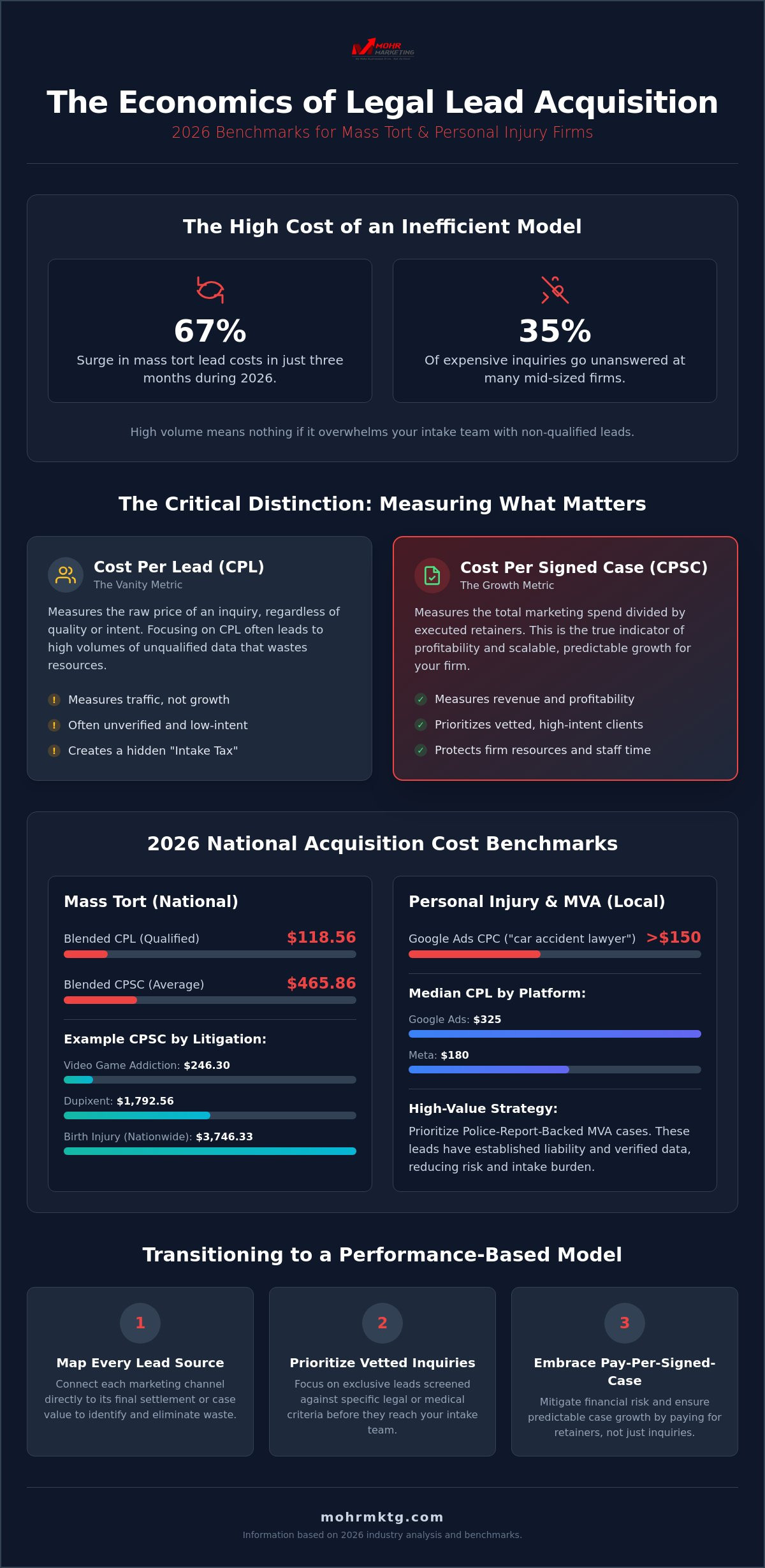
The cost of mass tort leads surged by 67 percent in just three months during 2026, yet 35 percent of those expensive inquiries go unanswered at many mid-sized firms. You’ve likely seen your PPC costs on Google and Meta climb while lead quality from aggregators remains inconsistent at best. In this environment, chasing the lowest mass tort lead pricing is a strategy for failure. High volume doesn’t matter if your intake team is overwhelmed by non-qualified “dead” leads that never convert to a retainer. It’s time to stop paying for the privilege of wasting your staff’s time.
You need a predictable model that prioritizes signed cases over raw inquiry volume. This article provides the 2026 benchmarks you need to master the economics of legal lead acquisition. We’ll show you how to shift your focus from high-cost inquiries to high-intent signed cases. You’ll learn to eliminate the middleman tax, improve your conversion rates, and build a scalable system for national case acquisition that actually protects your firm’s resources. We’re breaking down the mechanics of growth so you can move from uncertainty to mechanical accuracy in your marketing spend.
Key Takeaways
- Learn to differentiate between raw inquiry costs and the actual cost-per-signed-case to accurately measure your firm’s profitability.
- Benchmark your current mass tort lead pricing against 2026 national averages for specific litigations to identify underperforming campaigns.
- Identify and eliminate marketing waste by mapping every lead source directly to final settlement or case value.
- Reduce the burden on your intake team by prioritizing multi-step vetting and exclusive inquiries over shared, low-intent leads.
- Transition your acquisition strategy toward a performance-based model to mitigate financial risk and ensure predictable case growth.
Understanding Legal Lead Generation Costs: CPL vs. CPSC
Effective mass tort lead pricing requires a clear distinction between raw data and revenue-generating assets. Most law firms mistakenly focus on Cost Per Lead (CPL). This metric represents the raw price of an inquiry, regardless of whether that individual is reachable or qualified. In contrast, Cost Per Signed Case (CPSC) is the total marketing spend divided by the number of executed retainers. While CPL measures traffic, CPSC measures growth. In 2026, firms that fail to make this distinction often find themselves with high-volume dockets that yield zero settlements.
Modern lead generation strategies have shifted toward “Verified Intent” as the primary pricing standard. This model moves beyond simple contact information. It prioritizes individuals who have been screened against specific medical or legal criteria before the firm ever sees the data. A $100 lead often proves more expensive than a $1,000 signed retainer because the former requires dozens of hours of manual follow-up from your intake staff. If your team calls 50 unverified leads to get one signature, your operational overhead has already erased your profit margin.
The Vanity Metric Trap: Why Low CPL Can Kill Your ROI
Chasing a low CPL creates an “Intake Tax” that many firms ignore. Every unverified lead requires immediate outreach, multiple touchpoints, and rigorous vetting. This process consumes your most valuable resource: time. Lead decay is a reality; research from mid-2026 shows that 35 percent of calls to mid-sized firms go unanswered during business hours, leading to wasted spend. When your intake team spends all day chasing “dead” leads, morale drops and efficiency plummets. The real cost of a lead includes the media spend plus the cumulative hourly wages and overhead required for your intake team to process the inquiry.
Calculating Your Firm’s Maximum Allowable Acquisition Cost
To remain profitable, you must calculate your maximum allowable acquisition cost based on the lifetime value (LTV) of a mass tort docket. Use this formula: Average Case Value minus Litigation Costs minus desired Profit Margin equals your Marketing Budget. National benchmarks from July 2026 show a blended CPSC of $465.86 for certain torts, though specialized litigations like nationwide Birth Injury cases can reach $3,746.33. Firms should target mass tort signed cases to mitigate the risk of high-cost, low-conversion inquiries. Mastering your mass tort lead pricing means looking past the initial invoice and focusing on the final settlement potential of every retainer you sign.
2026 Price Benchmarks by Practice Area: PI, MVA, and Mass Tort
Legal acquisition costs vary significantly across practice areas. In 2026, the shift toward performance-based models has created a clear divide between raw inquiries and verified cases. Personal injury and motor vehicle accident (MVA) acquisition remains hyper-local; mass tort campaigns operate on a national scale with vastly different economic drivers. Understanding these benchmarks allows your firm to allocate capital where it generates the highest return on investment.
The MVA and Personal Injury Landscape
Search intent drives the cost of local personal injury leads. In highly competitive legal markets, Google Ads CPCs for “car accident lawyer” exceeded $150 by January 2026. This competition pushed the median CPL for personal injury to $325 on Google Ads and $180 on Meta. High-volume, local inquiry generation often results in a race to the bottom on price but a spike in intake labor. To combat this, many firms now prioritize police-report-backed MVA case acquisition. These cases command a premium because the liability is established and the data is verified, reducing the risk of signing non-viable clients. All advertising must remain truthful, cannot be deceptive or unfair to ensure compliance with federal standards while maintaining these high-intent funnels.
Mass Tort Economics: High Stakes, High Reward
The mass tort lead pricing structure is more volatile than standard personal injury. It’s dictated by the specific litigation stage and the depth of the qualification criteria. As of July 15, 2026, the blended cost per qualified lead for mass torts reached $118.56. However, the cost per signed case (CPSC) tells the real story of profitability. For example, Video Game Addiction cases averaged a CPSC of $246.30 in June 2026, while complex litigations like Dupixent reached $1,792.56. Nationwide Birth Injury cases represent the high end of the spectrum, with costs reaching $3,746.33 per signed retainer due to the rigorous medical verification required.
Firms must evaluate their docket based on “qualified claimant” criteria. A lower inquiry price often indicates a lack of screening, which leads to a higher disqualification rate during intake. By focusing on mass tort signed cases, you offload the financial risk of unverified inquiries. This strategy ensures that every dollar spent results in an executed retainer rather than a “dead” lead. If you’re ready to stabilize your acquisition costs, speak with our team about a performance-based model that fits your firm’s growth targets.
Factors That Drive Law Firm Acquisition Costs in 2026
Acquisition costs aren’t static. They’re influenced by a complex set of variables that determine whether your marketing spend is a strategic investment or a sunk cost. In 2026, firms that ignore these drivers find themselves paying a premium for low-intent data. To optimize your mass tort lead pricing, you must look beyond the initial invoice and analyze the structural factors that impact your final cost-per-signed-case.
Geographic arbitrage remains a powerful lever for cost reduction. While local personal injury keywords in major metros command astronomical prices, national campaigns allow you to target broader search intent across less saturated markets. This approach dilutes the competition and lowers the average entry price. However, the most significant driver of cost is the “Speed to Lead” metric. Research from mid-2026 indicates that 35 percent of calls to mid-sized firms go unanswered during business hours. Every missed call represents a total loss of the capital used to generate that inquiry. If your intake team isn’t responsive within seconds, your effective acquisition cost doubles instantly.
Exclusive vs. Shared Leads: The Hidden Cost of the Race
Shared leads are a financial trap. When a provider sells the same inquiry to four or five different firms, you aren’t buying a lead; you’re buying a race. The mathematical “loss rate” in this scenario is staggering. If you’re competing with four other firms, your probability of signing the case starts at 20 percent and drops every second you aren’t on the phone. Exclusive inquiries offer a far more stable and predictable scaling model because they eliminate this friction. While the upfront cost of an exclusive lead is higher, exclusive inquiries convert at triple the rate of shared inquiries, ultimately lowering your total spend per retainer.
Intake Efficiency: The Great Cost Optimizer
A turnkey intake ecosystem is the only way to combat the “Intake Tax.” This tax is the cumulative cost of labor spent chasing unverified or non-responsive leads. Multi-step vetting and 24/7/365 responsiveness ensure that your team only speaks with high-intent claimants who meet your specific criteria. This efficiency is critical for maintaining profitability in high-stakes litigations. By outsourcing the initial screening to professional Legal Intake Services, you ensure that no inquiry is wasted due to internal bandwidth constraints. This shift from raw data processing to high-intent conversion is what separates profitable firms from those struggling with rising mass tort lead pricing. Every minute saved in the intake process is a direct contribution to your firm’s bottom line.
Auditing Your Marketing Spend: Identifying and Eliminating Waste
Auditing your marketing budget isn’t a suggestion; it’s a requirement for survival in a saturated market. Many firms fail because they treat marketing spend as an overhead cost rather than a performance asset. To maintain a competitive advantage, you must implement a rigorous methodology to identify where your capital is producing results and where it’s being siphoned off by inefficient intermediaries. This process starts with a granular analysis of your lead supply chain.
Follow these five steps to clean your docket of wasted spend:
- Step 1: Map every lead source to a final settlement or case value. If a vendor delivers high volume but zero settlements, that source is a liability.
- Step 2: Measure the “Contact Rate” and “Disqualification Rate” by provider. Data from July 2026 indicates that only 14 percent of qualified mass tort leads convert to a signed retainer. If your providers fall below this benchmark, you’re likely paying for recycled or low-intent data.
- Step 3: Calculate the total labor cost of your intake department per signed case. This reveals the true mass tort lead pricing you’re paying once internal overhead is factored in.
- Step 4: Identify “Middleman Taxes.” Many agencies act as resellers, adding a markup to leads they didn’t generate. Eliminating these intermediaries preserves your budget for actual case acquisition.
- Step 5: Transition your budget to performance-based, pay-per-signed-case models. This shifts the financial risk from your firm to the provider.
Benchmarking ROI: What Does Success Look Like?
In 2026, success is defined by a 3:1 or 4:1 ratio of gross attorney fees to marketing spend. You must spot underperforming vendors before they drain your quarterly budget. Track your lead-to-retainer conversion rates weekly. If a campaign’s cost per signed case exceeds the national blended average of $465.86 without a corresponding increase in case value, it requires immediate optimization or termination. Don’t let “vanity metrics” like high click-through rates mask a lack of executed retainers.
The Direct-to-Source Advantage
Working with agencies that own their funnels reduces your effective mass tort lead pricing by removing the reseller’s margin. This direct-to-source model eliminates transparency gaps and ensures you know exactly where your inquiries originate. When you control the funnel, you control the quality. For a deeper look at building a sustainable acquisition engine, review our Mass Tort Lead Generation Roadmap. This guide provides the tactical framework needed to move away from unverified inquiries and toward a more profitable, signed-case model.
The Mohr Marketing Strategy: Pay-Per-Signed-Case
Traditional marketing models force law firms to absorb all the financial risk. When you pay for raw inquiries, you’re essentially gambling on the quality of the provider’s data and your own intake team’s efficiency. In 2026, the volatility of mass tort lead pricing makes this approach unsustainable. Mohr Marketing, LLC eliminates this uncertainty by shifting the focus from leads to executed retainers. Our pay-per-signed-case model ensures that your capital is only deployed when a high-intent claimant is secured. This strategy aligns our performance directly with your firm’s revenue goals.
With a 30-year industry legacy, we’ve refined a verification process that eliminates the risk of non-qualified claimants. We don’t just deliver data; we deliver assets. Our turnkey ecosystem combines aggressive national marketing with rigorous multi-step vetting and professional intake. This integrated approach removes the administrative burden from your staff, allowing your attorneys to focus on litigation rather than data entry. By controlling the entire funnel from initial search intent to the final signature, we provide a streamlined, direct path to success that traditional lead aggregators cannot match.
Signed Retainers as the Ultimate Cost-Control Tool
Paying for results is the only logical way to scale a modern law firm in a hyper-competitive environment. Consider the shift from a $150 CPL to a fixed cost-per-signed-case (CPSC) model. In the CPL model, a 10 percent conversion rate results in a $1,500 acquisition cost, plus the labor spent chasing the 90 percent who didn’t sign. A fixed CPSC model provides absolute budget certainty and protects your margins. This is particularly vital for firms pursuing high-value case acquisition for complex litigation, where the cost of a single error in qualification can be devastating.
Partnering for National Growth
Scalability requires infrastructure that most firms don’t want to build in-house. Leveraging our proprietary intake and verification technology allows you to dominate the mass tort and personal injury markets without the associated overhead. We act as your strategic partner, protective of your resources while aggressive in pursuing your expansion. In a market where mass tort lead pricing can fluctuate by 67 percent in a single quarter, having a fixed-cost partner is your greatest competitive advantage. You gain the reach of a national powerhouse with the mechanical accuracy of a seasoned veteran.
Dominate the 2026 Legal Market with Predictable Case Acquisition
Success in the modern legal landscape requires moving beyond raw inquiry volume. You’ve seen how the volatility of mass tort lead pricing can drain budgets when focused on unverified data. To scale effectively, your firm must prioritize cost-per-signed-case and eliminate the administrative burden of chasing non-qualified leads. Transitioning to a performance-based model isn’t just about saving money; it’s about securing the certainty of executed retainers.
Mohr Marketing leverages 30+ years of legal marketing authority to streamline your firm’s path to success. We’ve developed a verified, high-intent inquiry ecosystem that identifies qualified claimants before they ever reach your intake team. Our performance-based signed retainer model eliminates the financial risk of traditional advertising, providing you with a transparent and reliable growth engine. You don’t have to navigate market shifts alone when you have a strategic partner dedicated to your expansion.
Your firm’s expansion depends on mechanical accuracy and strategic partnerships. We’re ready to help you build a scalable, risk-mitigated future.
Frequently Asked Questions
What is the average cost per lead for personal injury lawyers in 2026?
Median CPL for personal injury lawyers on Google Ads reached $325, while Meta Ads averaged $180 as of mid-2026. In high-competition metropolitan areas like Los Angeles or Atlanta, Google Ads CPCs for “car accident lawyer” frequently exceed $150. These figures represent raw inquiries, not signed cases. Firms must track these raw costs against final retainer conversion rates to ensure the total acquisition remains profitable for the firm’s budget.
Is it more cost-effective to generate legal leads in-house or hire an agency?
Hiring a specialized agency is typically more cost-effective for firms seeking national scale without the burden of massive internal overhead. In-house teams often struggle with the technical complexity of managing high-CPC keywords and 24/7 intake requirements. Partnering with a veteran provider eliminates the “learning tax” and provides immediate access to proven marketing funnels. This allows your attorneys to focus on litigation while experts handle the mechanics of growth.
Why are mass tort signed cases more expensive than MVA leads?
Mass tort signed cases require deeper medical verification and specific litigation criteria that standard MVA leads don’t. While a police-report-backed MVA case has established liability and clear injury data, a mass tort retainer requires confirming usage, injury, and causation through a multi-step vetting process. The increased labor and higher qualification standards for these complex litigations naturally drive up the final cost-per-signed-case compared to localized motor vehicle accident inquiries.
How does lead exclusivity impact the final cost of acquisition?
Lead exclusivity carries a higher upfront price but offers a significantly lower cost-per-signed-case than shared data models. Shared leads force you into a race where your conversion probability drops with every passing second. By removing competition at the point of inquiry, exclusive leads convert at much higher rates. This stability makes your overall mass tort lead pricing more predictable and significantly easier to scale across national campaigns.
What is a reasonable lead-to-signed-case conversion rate for mass torts?
A benchmark conversion rate of approximately 14 percent for qualified leads is considered standard for mass torts as of July 2026. This means your intake team must be highly efficient to maintain a healthy profit margin. If your lead-to-signed-case conversion rate falls below 10 percent, it’s a clear signal that either your lead source is poor or your internal intake processes are failing to capture high-intent claimants.
Can professional legal intake services lower my overall lead generation costs?
Professional legal intake services lower costs by eliminating wasted spend on unreachable individuals and non-qualified inquiries. With 35 percent of calls to mid-sized firms going unanswered during business hours, a dedicated 24/7 intake ecosystem ensures you capture every high-intent claimant. This efficiency drastically improves your lead-to-retainer ratio. It effectively lowers the total capital required to sign a new case by ensuring no marketing dollar is wasted.
What are the risks of buying low-cost leads from legal aggregators?
Buying low-cost leads from legal aggregators often results in recycled data or unverified inquiries that lack real search intent. These “bargain” leads create a hidden “Intake Tax” by forcing your staff to chase dead ends and non-responsive contacts. This inefficiency drives up your actual mass tort lead pricing when you factor in the cumulative labor costs. Quality verification is always more cost-effective than raw, unvetted data in a performance-based market.
How do I calculate the ROI of my mass tort marketing campaign?
Calculate ROI by dividing your total gross attorney fees by your total acquisition spend, including media costs and intake labor. A successful campaign should target a 3:1 or 4:1 ratio to remain profitable. You must map every lead source to its final settlement value to identify which providers are delivering high-value assets and which are merely inflating your volume with low-intent inquiries that never result in a retainer.

Recent Posts
- Improving Law Firm Marketing ROI: A Practical Measurement Framework
- 4 Ways to Assess Unqualified Legal Leads and Their Costs
- Real-Time Legal Leads: How to Evaluate Speed, Quality, and Fit in 2026
Categories
- AI and Lead Generation
- Business Financing
- Call Verified MVA Leads
- Car Accident Help
- Car Accident Settlements
- Claimant Funding
- Compliance Program
- EMS-EMT Reports
- Geotargeting
- Google Maps Ranking
- Healthcare Practice Growth
- Law Firm Growth
- Law Office Operations
- Lead Generation
- Lead Generation For Attorneys
- Lead Generation For Chiropractors
- Lead Generation For Criminal Attorneys
- Lead Generation For D&A Treatment Centers
- Lead Generation For DUI Attorneys
- Lead Generation For Eye Doctors
- Lead Generation For Family Law Practices
- Lead Generation For PI Law Firms
- Lead Generation For Plastic Surgeons
- Leads For Healthcare Professionals
- Leads For Insurance Industry
- Legal Leads
- Legal Marketing
- Legal Updates
- Mass Tort Leads
- Medicare and Medicaid Leads
- Merchant Funding Leads
- Mold Leads
- Online Marketing Strategies
- Pre-Settlement Funding
- Signed MVA Cases
- Tort Updates
- Truck Accident Leads and Signed Cases
- Truck Accident Settlements
- Web Design