The Challenges of Growing a Law Firm: A Strategic Guide to Scalable Case Acquisition
September 4, 2026 by Mohr Marketing
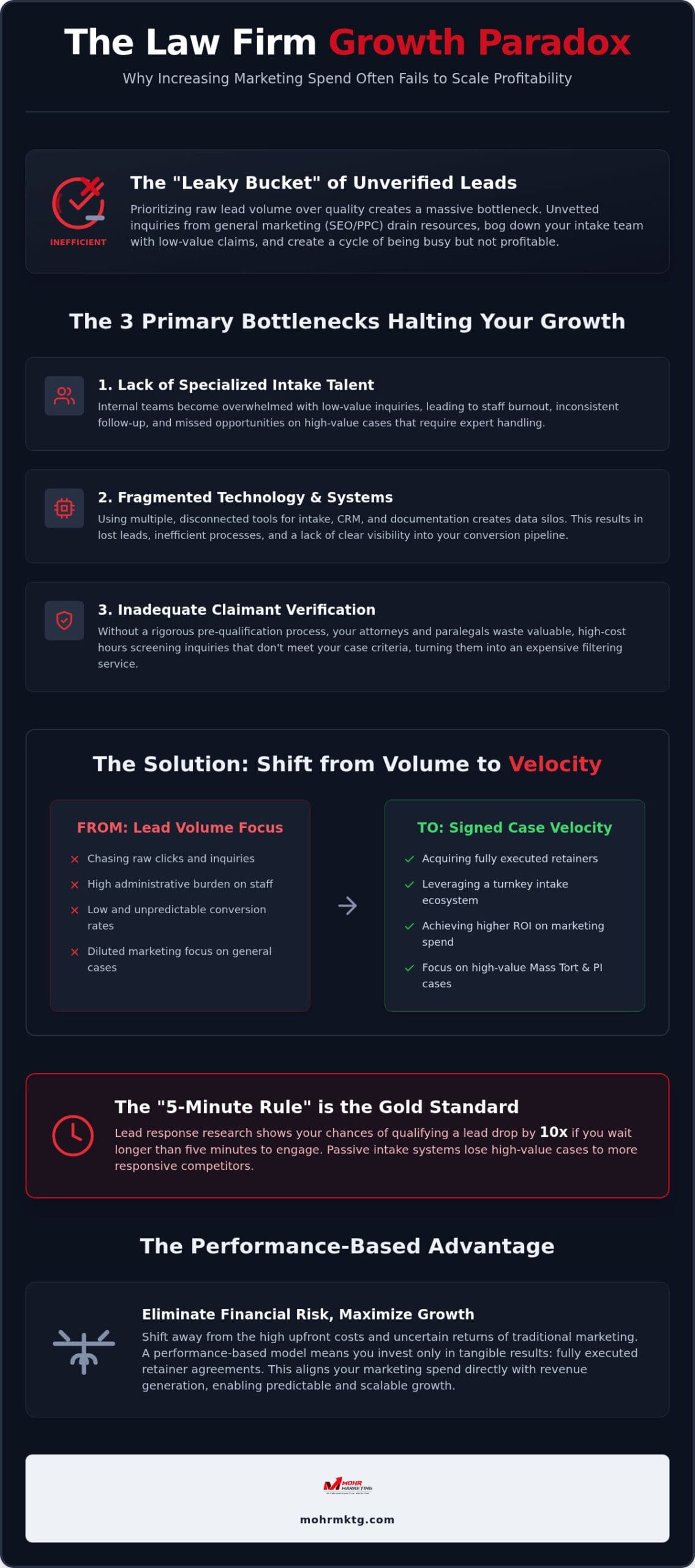
Your marketing budget is likely leaking revenue through a sieve of low-quality leads and inefficient intake. Most partners realize that the primary challenges of growing a law firm aren’t solved by simply increasing spend; they’re solved by fixing the conversion engine. It’s frustrating to watch high-value cases go to competitors with massive advertising budgets while your staff struggles with administrative friction and inconsistent processes.
This guide offers a strategic blueprint to eliminate those bottlenecks. We’ll show you how to scale your practice by prioritizing signed case velocity over raw lead volume. You’ll learn how to secure a predictable flow of qualified, signed cases and achieve a higher ROI on your marketing spend. We will break down the mechanics of a turnkey intake ecosystem that removes the burden from your legal team and focuses on tangible financial performance. It’s time to stop managing inquiries and start acquiring signed retainers with precision.
Key Takeaways
- Identify why increasing marketing spend often fails to scale profit due to the “leaky bucket” syndrome in intake.
- Overcome the internal challenges of growing a law firm by addressing fragmented technology and specialized intake staffing.
- Master the transition from managing raw inquiries to prioritizing signed case velocity for immediate practice growth.
- Leverage high-value Mass Tort and personal injury opportunities to build a diversified and scalable case portfolio.
- Reduce financial risk by shifting to a performance-based model that pays only for fully executed retainer agreements.
The Growth Paradox: Why Law Firms Stagnate Despite Higher Marketing Spend
Increasing your advertising budget doesn’t guarantee a proportional rise in revenue. In fact, many partners find that as they scale their spend, their profit margins actually compress. This is the growth paradox. It happens when a firm prioritizes raw lead volume over the quality of the inquiry. One of the core challenges of growing a law firm is identifying when your marketing has become a “leaky bucket.” You might be generating hundreds of clicks through standard SEO or PPC, but if those inquiries aren’t vetted, they create a massive bottleneck for your intake team. Traditional law firm business models often focus on visibility, yet visibility doesn’t pay the bills. Case acquisition does.
There is a sharp distinction between brand awareness and case acquisition. Massive “billboard” firms can afford to play the long game of general awareness. For a firm looking to scale efficiently, every dollar must be tied to a high-intent claimant. General PPC often attracts “window shoppers” or individuals with low-value claims that don’t fit your criteria. This disconnect is why many firms stagnate; they’re busy, but they aren’t profitable.
The Hidden Costs of Unverified Lead Generation
Every unverified lead carries a hidden price tag. Your intake staff must spend time calling, screening, and documenting inquiries that will never turn into a fee. This administrative burden is a silent killer of growth. Beyond the direct labor costs, there’s a significant opportunity cost. While your team is bogged down with “junk” inquiries, high-value claimants are likely calling your competitors. This cycle creates a psychological toll on your staff. Constant rejection and low conversion rates lead to burnout, which further degrades the quality of your intake process.
Shifting from Generalist Marketing to Strategic Acquisition
Generalist marketing dilutes your authority. When you market as a “jack of all trades,” you’re forced to compete with every other firm in your region. Scaling requires a shift toward high-value, specific litigation areas such as Mass Torts or complex personal injury. To fix your trajectory, you must audit your current lead-to-signed-case ratio. Follow these steps for a clear assessment:
- Track every inquiry received over the last 30 days.
- Identify how many of those leads actually met your firm’s specific case criteria.
- Calculate the percentage of qualified leads that resulted in a signed retainer.
If your conversion rate is low, it’s a sign that your marketing isn’t targeting high-intent users. Solving these challenges of growing a law firm requires moving away from raw data and focusing on fully executed agreements.
Identifying the Three Primary Bottlenecks in Legal Practice Scaling
Scaling a practice requires more than just capital; it requires the removal of systemic friction. The challenges of growing a law firm typically manifest in three specific areas: talent, technology, and verification. These bottlenecks don’t exist in isolation. They interact to create a ceiling that prevents a local firm from becoming a national powerhouse. If your intake staff isn’t trained to handle high-stakes litigation inquiries, your conversion rates will plummet regardless of your ad spend. Similarly, using fragmented tools instead of a unified ecosystem leads to data silos and lost opportunities. The most critical failure, however, is the verification bottleneck. Without a rigorous process to qualify claimants before they reach an attorney, your legal team becomes a high-priced screening department.
The Failure of Passive Intake Systems
Passive intake is a growth killer. In personal injury and mass tort litigation, the “5-minute rule” is the gold standard. Research in lead response management suggests that your chances of qualifying a lead drop by 10 times if you wait longer than five minutes to engage. Asking a potential claimant to leave a message or wait for a callback is the fastest way to lose a case to a more responsive competitor. Unverified inquiries that sit in a CRM without immediate action don’t just fail to convert; they distract your team and provide a false sense of pipeline health. Effective scaling requires a proactive, 24/7 engagement strategy that prioritizes immediate human connection.
Resource Allocation: Marketing vs. Operations
There is a dangerous tendency to scale marketing before optimizing operations. If you double your lead volume but your intake process is broken, you’re simply doubling your waste. Balancing caseload management with new client acquisition is a delicate act. Many firms find that internal hiring for intake is a slow, expensive process that can’t keep pace with aggressive growth targets. Outsourcing to a specialized partner who provides vetted legal intake services is often more efficient than building an in-house department from scratch. This allows your firm to focus on litigation and settlement while the partner handles the mechanical aspects of case acquisition. Strategic resource allocation means investing in systems that ensure every marketing dollar translates into a signed retainer.
- Talent: Specialized intake requires sales-level urgency combined with legal precision.
- Technology: A unified ecosystem prevents “case leakage” and ensures accurate data tracking.
- Verification: Rigorous screening protocols protect your attorneys’ time for high-value work.
Identifying these bottlenecks is the first step toward building a scalable practice. Once you understand where the friction exists, you can implement the turnkey solutions necessary to increase your signed case velocity.
Transitioning from Lead Volume to Signed Case Velocity
Most marketing agencies focus on lead volume, but this metric is deceptive. High lead volume without conversion is just noise. To overcome the structural challenges of growing a law firm, you must pivot your focus to signed case velocity. This metric measures the speed and efficiency with which an inquiry moves through your intake funnel to become a fully executed retainer. Velocity is the antidote to stagnation. It ensures that high-intent opportunities don’t sit in a queue where they eventually go cold or call a competitor.
Building a turnkey intake ecosystem is the primary way to increase this velocity. This requires a 24/7/365 infrastructure. Legal emergencies and high-stakes claimants don’t wait for business hours. If your firm isn’t available to verify a claim the moment it’s made, you’ve already lost the case. Understanding the ROI of legal intake services is essential here; it’s not an expense, but a revenue-generating asset that captures market share while others are offline.
The Mechanics of Professional Legal Intake
Professional intake is a rigorous discipline, not a clerical task. It starts with standardized screening protocols that ensure every inquiry meets your firm’s specific case criteria before an attorney’s time is ever requested. The first call must balance empathy with professional authority. Claimants are often in distress; they need to feel heard, but they also need to know they’re speaking with a firm that possesses the mechanical precision to win. Use data-driven strategies to refine your scripts. If a specific question in your intake process consistently causes drop-offs, change it. Constant iteration is the only path to a high-performance funnel.
Eliminating Friction in the Retainer Process
The final hurdle in signed case velocity is the retainer itself. Manual, paper-based retainers are relics that kill conversion rates. Transitioning to a digital-first approach allows for immediate execution while the claimant’s intent is at its peak. Friction in this stage often comes from common claimant objections regarding fees or timelines. Your intake team must be trained to handle these objections with clarity and confidence. For firms navigating the challenges of growing a law firm, focusing on mass tort signed cases provides the high-velocity growth needed to dominate a national market.
Strategic Case Selection: Leveraging Mass Tort and High-Value Personal Injury
Generalist models are built for survival, not dominance. One of the primary challenges of growing a law firm is the reliance on high-volume, low-margin cases that consume administrative resources without providing significant profit. Scaling requires a strategic pivot toward high-value litigation. Mass tort litigation serves as the ultimate engine for this expansion. It allows a firm to aggregate thousands of claimants under a unified legal theory, effectively industrializing the litigation process. This shift moves the firm from a “case-by-case” mindset to a portfolio-driven strategy that maximizes long-term revenue.
High-intent search terms are the foundation of this strategy. Broad keywords like “personal injury attorney” attract window shoppers and low-value inquiries. Conversely, specific terms related to medical devices, pharmaceuticals, or catastrophic accidents reach claimants with a high probability of conversion. Focusing on mass tort signed cases allows you to bypass the noise of general advertising and focus your spend on verified intent. This approach ensures that every dollar spent on acquisition is tied to a case with substantial settlement potential.
The Scalability of Mass Tort Leads
The volume-to-value ratio in mass torts is significantly higher than in standard personal injury. While you may invest more upfront in acquisition, the eventual settlement values often justify the spend. For example, focusing on mesothelioma leads for law firms targets a specific demographic with clear liability and high-stakes damages. Managing the longer litigation cycles of these complex torts requires financial discipline. You must ensure your firm has the capital reserves to sustain operations during the discovery and bellwether phases. This is where the velocity mentioned in previous sections becomes critical; the faster you sign a case, the sooner you can move it toward resolution.
High-Intent Personal Injury Acquisition
Not all personal injury cases are created equal. To maintain immediate ROI while building a mass tort inventory, firms should target police-report-backed MVA cases. These inquiries are verified by official documentation, reducing the time spent on investigation and screening. Strategic diversification also includes truck accident signed cases and high-value mold case acquisition. These niches offer higher settlement potential than standard fender-benders. By focusing on these specific areas, you eliminate the administrative drag of generalist practice and position your firm as an authority in high-stakes litigation.
The Performance Solution: Scaling with a Pay-Per-Signed-Case Model
Traditional marketing models are inherently flawed because they prioritize agency activity over firm outcomes. When you pay a monthly retainer for “management fees” or “brand awareness,” you’re assuming all the financial risk. This disconnect is one of the primary challenges of growing a law firm. If a campaign fails to produce results, the agency still gets paid, while your firm loses both capital and time. Transitioning to a performance-based model fixes this imbalance. By paying only for fully executed retainer agreements, you shift the burden of conversion and verification to your strategic partner. This ensures that every dollar leaving your firm is tied to a tangible asset with settlement potential.
Mohr Marketing utilizes 30 years of industry experience to eliminate the expensive “testing” phase that plagues traditional agencies. We don’t guess which keywords or intake scripts work; we deploy proven systems from day one. This high degree of mechanical accuracy allows you to achieve national scale without the need to hire more internal administrative staff. You focus on the litigation, while the turnkey ecosystem handles the acquisition.
Implementing a Data-Driven Growth Strategy
Shifting your firm to a pay-per-results mindset requires a structural change in how you view marketing. It’s no longer about a “budget” but about “capacity.” Follow these steps to implement a scalable growth strategy:
- Audit current acquisition costs: Calculate your true Cost Per Signed Case (CPSC) across all existing channels, including staff time spent on failed leads.
- Define strict case criteria: Establish non-negotiable qualifiers for your target litigation to ensure you only pay for cases that meet your standards.
- Set performance benchmarks: Monitor ROI through transparent reporting that tracks the lifecycle of every signed case from intake to resolution.
Once these metrics are established, you can scale your spend with confidence. If you know that every signed retainer generates a specific ROI, your marketing budget becomes an infinite loop of growth rather than a fixed expense.
Partnering for Scalable Success
Not all providers are equal. A standard lead aggregator simply sells data; a strategic partner provides a verified pipeline. You must evaluate partners based on their ability to ensure strict compliance with state laws and bar mandates. This is especially critical in mass tort and high-value personal injury litigation where regulatory scrutiny is high. Choosing a partner with a long-standing reputation for reliability and rigorous verification processes protects your firm’s license and its bottom line. It’s the difference between buying “leads” and acquiring “signed cases.”
Contact Mohr Marketing to scale your firm with signed cases
Building a Scalable and Profitable Legal Practice
Sustainable expansion requires a shift from passive lead generation to an aggressive, performance-based acquisition strategy. Solving the systemic challenges of growing a law firm depends on your ability to eliminate administrative friction and prioritize signed case velocity. By integrating a turnkey intake ecosystem, you ensure that high-intent claimants are verified and signed before they call a competitor. This transition allows your firm to focus on its core competency: litigating and settling high-value cases.
Success in modern legal competition isn’t defined by the size of your advertising budget but by the efficiency of your conversion engine. Mohr Marketing brings 30+ years of legal marketing expertise to your practice, offering a direct path to national scale. Our systems maintain strict adherence to bar mandate compliance while removing the burden of manual screening from your internal staff. You focus on the litigation. We provide the signed retainers. You can now scale your caseload without increasing your administrative headcount or sacrificing quality.
The path to a predictable, high-ROI practice is within reach. Take the strategic step toward a more efficient and assertive growth model today.
Frequently Asked Questions
What are the biggest challenges of growing a law firm in 2026?
The primary challenges of growing a law firm involve overcoming the “Growth Paradox” where higher marketing spend results in lower profit margins due to poor intake. Firms often struggle with the “Leaky Bucket” syndrome, losing high-value claimants to more responsive competitors. Scaling requires fixing these systemic bottlenecks by prioritizing signed case velocity and high-intent verification. This move ensures your resources are spent on litigation rather than sorting through unverified inquiries.
How can I increase my law firm’s lead conversion rate?
Improving conversion requires transitioning to a turnkey intake ecosystem that prioritizes immediate engagement. You should adopt the “5-minute rule” for all inquiries. Research indicates that responsiveness within this window significantly increases the likelihood of qualifying a claimant. Eliminating friction through digital retainers and standardized screening protocols also prevents case leakage. Focus on speed and precision to ensure every high-intent inquiry converts into a signed case before the lead goes cold.
Is it better to hire internal intake staff or outsource legal intake?
Outsourcing legal intake services is generally more efficient for firms targeting national scale. It provides 24/7/365 coverage that is difficult and expensive to maintain with internal staff. Strategic partners offer specialized training and established scripts that increase conversion rates immediately. This approach allows your firm to scale caseloads without the administrative burden of hiring, training, and managing an in-house team, keeping your internal focus on litigation and settlements.
Why is mass tort lead generation considered a high-growth strategy?
Mass tort lead generation allows firms to aggregate thousands of claimants under a single legal theory. This model industrializes the litigation process, creating a high volume-to-value ratio that standard personal injury cases cannot match. It’s a high-growth strategy because it builds a diversified portfolio of high-stakes cases with substantial settlement potential. By focusing on verified intent, firms bypass the noise of general advertising and secure a dominant position in complex litigation markets.
What is the difference between a pay-per-lead and a pay-per-signed-case model?
A pay-per-lead model charges for verified inquiries, while a pay-per-signed-case model focuses on fully executed signed retainers. The latter is a performance-based arrangement that eliminates the financial risk for the law firm. You only pay for converted opportunities ready for litigation. This model ensures that the marketing partner is incentivized to deliver quality over quantity, effectively shifting the burden of screening and verification away from your internal legal team.
How do I ensure marketing compliance when scaling nationally?
National scaling requires a partner with deep knowledge of state-specific bar mandates and advertising regulations. You should verify that your marketing agency has a rigorous internal review process for all creative assets and intake scripts. Mohr Marketing leverages over 30 years of industry experience to ensure strict compliance with state laws. This professional oversight protects your firm’s license and reputation while you expand your footprint across the entire United States.
What should I look for in a legal marketing agency for high-value cases?
Look for an agency that offers performance-based models and possesses a proven turnkey intake ecosystem. They should prioritize signed retainers over raw lead volume. Transparency in data-driven reporting is essential for monitoring ROI. A strategic partner with 30 years of experience understands the mechanical accuracy required to convert high-stakes claimants. Avoid agencies that focus on general brand awareness; choose a partner who delivers tangible financial performance and verified inquiries.
How can I scale my personal injury practice without increasing overhead?
Scaling without increasing overhead is achieved by utilizing a pay-per-signed-case model for your MVA and personal injury leads. This performance-based approach allows you to acquire signed retainers without hiring additional intake staff or administrative support. By outsourcing the mechanical aspects of case acquisition to a strategic partner, your firm can manage a higher volume of litigation. This strategy maximizes your ROI and ensures that growth is tied directly to revenue-generating assets.

Recent Posts
- Attorney Search Engine Marketing: Do It Yourself or Hire Help
- Improving Law Firm Marketing ROI: A Practical Measurement Framework
- 4 Ways to Assess Unqualified Legal Leads and Their Costs
Categories
- AI and Lead Generation
- Business Financing
- Call Verified MVA Leads
- Car Accident Help
- Car Accident Settlements
- Claimant Funding
- Compliance Program
- EMS-EMT Reports
- Geotargeting
- Google Maps Ranking
- Healthcare Practice Growth
- Law Firm Growth
- Law Office Operations
- Lead Generation
- Lead Generation For Attorneys
- Lead Generation For Chiropractors
- Lead Generation For Criminal Attorneys
- Lead Generation For D&A Treatment Centers
- Lead Generation For DUI Attorneys
- Lead Generation For Eye Doctors
- Lead Generation For Family Law Practices
- Lead Generation For PI Law Firms
- Lead Generation For Plastic Surgeons
- Leads For Healthcare Professionals
- Leads For Insurance Industry
- Legal Leads
- Legal Marketing
- Legal Updates
- Mass Tort Leads
- Medicare and Medicaid Leads
- Merchant Funding Leads
- Mold Leads
- Online Marketing Strategies
- Pre-Settlement Funding
- Signed MVA Cases
- Tort Updates
- Truck Accident Leads and Signed Cases
- Truck Accident Settlements
- Web Design