How to Build a National Personal Injury Practice: The 2026 Growth Blueprint
September 3, 2026 by Mohr Marketing
Scaling to a national level is not a marketing challenge; it’s an infrastructure and intake crisis that most firms fail to solve. You’ve likely hit a ceiling with local lead volume or watched your cost-per-acquisition climb while conversion rates stall. It’s frustrating to see your budget disappear into unverified inquiries that never turn into a signed retainer. You need a rigorous, performance-based roadmap for how to build a national personal injury practice that eliminates wasteful spending and focuses on verified outcomes.
We understand that high-stakes growth requires more than just a higher ad spend. This guide provides a strategic blueprint for 2026 to help you scale your firm across state lines with precision and authority. We’ll examine the critical shift from buying raw leads to acquiring signed retainers, the mechanics of multi-state compliance, and the technology required to maintain a predictable case stream. You’ll learn how to bypass the traditional learning curve and implement a turnkey ecosystem that turns national expansion into a repeatable, financial success. By the end of this manual, you’ll have the tactical knowledge to lower your acquisition costs and build a scalable infrastructure for mass tort and personal injury litigation.
Key Takeaways
- Transition from local SEO to a multi-jurisdictional model by implementing cloud-based infrastructure and 24/7 intake capabilities.
- Master how to build a national personal injury practice by shifting from high-risk lead buying to a performance-based signed retainer model.
- Reduce marketing waste and mitigate financial risk by prioritizing verified inquiries over unverified raw leads.
- Maximize conversion rates through a rigorous five-minute response protocol and a multi-channel follow-up strategy.
- Leverage a turnkey marketing and intake ecosystem to bypass the national advertising learning curve and accelerate firm growth.
Transcending Local Boundaries: The Shift to National Practice
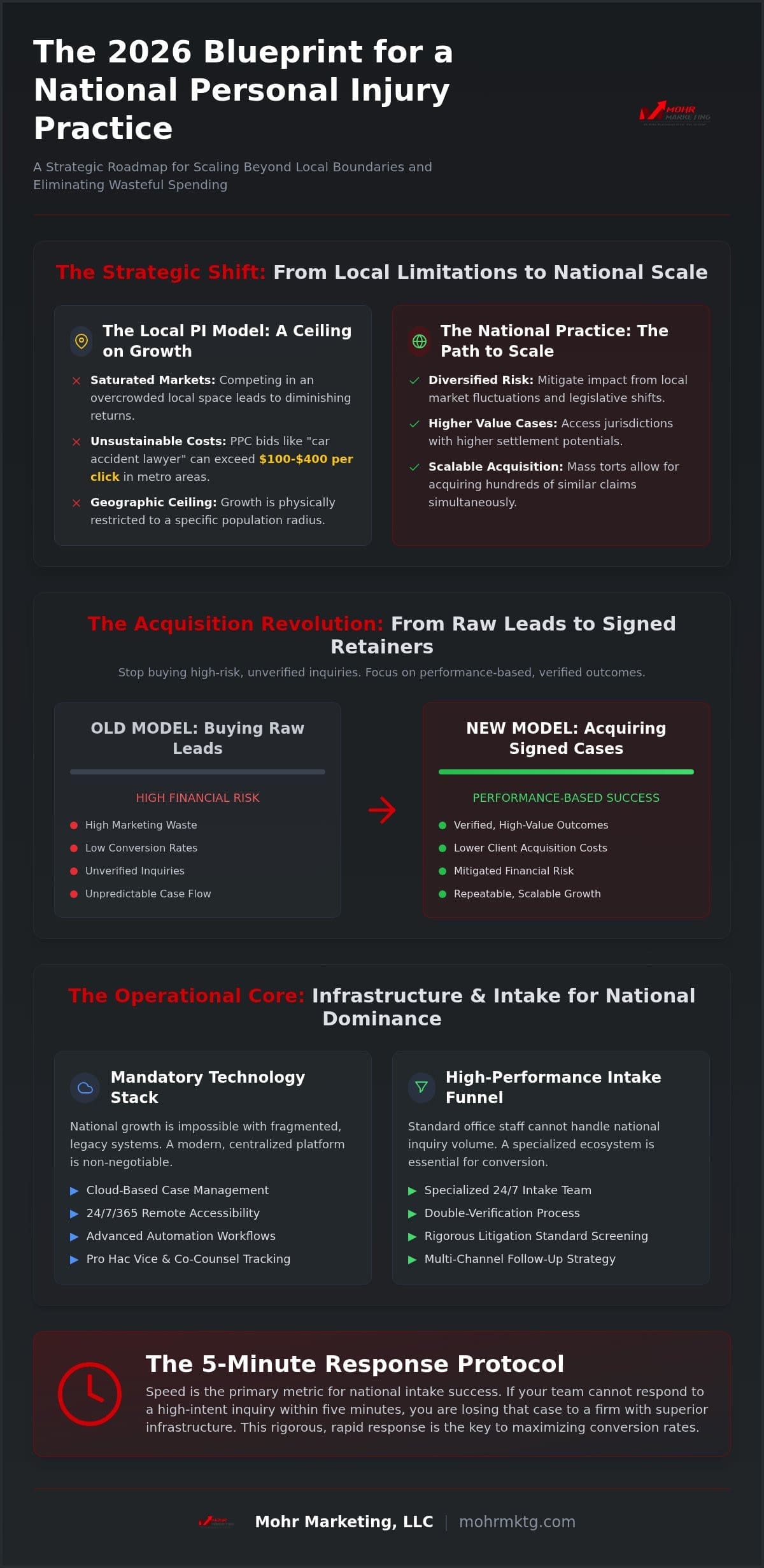
A national personal injury practice is a multi-jurisdictional operation that prioritizes high-value litigation over localized volume. It moves beyond the constraints of a single city or state to capture cases across the United States. Transitioning to this model requires a departure from traditional referral networks. Learning how to build a national personal injury practice involves shifting your firm’s focus to centralized case acquisition and sophisticated intake ecosystems. This model offers significant financial advantages, including diversified jurisdictional risk and access to higher settlement potentials found in specific venues.
The Limitations of the Local PI Model
Local markets are saturated. In 2026, the cost of traditional visibility like TV and billboards has reached a point of diminishing returns for many firms. Relying on local SEO creates a geographic ceiling. Your growth is restricted to a specific population radius. If a competitor outspends you or if local legislation changes, your entire revenue stream is at risk. For example, keywords like “car accident lawyer” can cost between $100 and $400 per click in competitive metro areas. This makes local PPC unsustainable for firms that don’t have a massive budget or a high-efficiency conversion engine. A national approach bypasses these local bottlenecks by targeting broader, high-intent audiences.
Why Mass Torts are the Engine of National Expansion
Mass torts provide the scale necessary for national growth. Unlike individual motor vehicle accident cases, mass torts allow you to acquire hundreds of similar claims simultaneously. This creates massive operational efficiencies. You can leverage mass tort signed cases to reach claimants across the country without maintaining physical offices in every state. This strategy is rooted in the fundamental principles of personal injury law, where negligence leads to widespread harm. Targeting specific high-intent queries for litigations like Camp Lejeune or high-value mold case acquisition ensures you’re capturing claimants at the peak of their search intent. This scalability is the primary driver of national expansion. It allows firms to build a predictable pipeline of cases that traditional local models cannot match. National growth is about volume and precision. By diversifying your case portfolio across multiple states, you protect your firm against local market fluctuations and legislative shifts.
Infrastructure Requirements for Multi-State Case Management
Learning how to build a national personal injury practice requires more than just capital; it requires a bulletproof operational manual. National growth demands a robust technological foundation. You can’t manage a multi-state docket using fragmented, legacy systems. A centralized, cloud-based case management platform is mandatory. It allows your team to access files, track deadlines, and communicate across time zones without friction. In 2026, roughly 60% of lawyers utilize practice management software, but national leaders require advanced automation to handle the complexity of pro hac vice admissions and co-counseling agreements. This structural agility ensures your firm remains operational 24/7/365, capturing leads from the East Coast to Hawaii without delay. Executing a national strategy also involves managing local counsel relationships in jurisdictions where you aren’t barred. Your infrastructure must track these partnerships with the same precision as your internal cases.
Centralized vs. Decentralized Intake Operations
Standard office staff are usually ill-equipped for national inquiry volumes. They lack the specialized training to process high-intent inquiries at speed. Implementing a specialized intake ecosystem is the only way to maintain a competitive speed-to-lead. National success relies on a double-verification process. First, an automated system or intake specialist screens for basic criteria. Second, a senior intake professional confirms the case’s merit against strict litigation standards. This ensures your attorneys only review high-value, viable files. Speed is the primary metric here. If your intake team can’t respond within five minutes, you’re losing cases to firms with better infrastructure.
Regulatory Compliance in National Advertising
Operating across state lines introduces a fragmented regulatory landscape. Staying Ethical in Legal Marketing requires strict adherence to ABA Model Rules 7.1 through 7.5. Each state Bar has specific mandates regarding disclosures and recordkeeping. You must maintain full audit trails for every lead acquired to protect your license. Transparent, data-driven marketing isn’t just about ROI; it’s a defensive necessity. Use partners who provide documented verification of how and where inquiries were generated. Understanding how to build a national personal injury practice means prioritizing compliance as highly as case volume. Ethics violations in one state can have reciprocal consequences across your entire practice.
If your current infrastructure is struggling to keep pace with expansion, you can consult with our intake specialists to audit your current workflow.
Performance-Based Acquisition: Signed Cases vs. Raw Leads
Traditional marketing agencies thrive on your uncertainty. They charge monthly retainers and management fees while delivering raw leads that often fail to convert. This “hope-based” marketing is the primary obstacle for firms learning how to build a national personal injury practice. Raw leads carry significant risk because the burden of conversion falls entirely on your internal staff. In contrast, a performance-based model focuses on Mass Tort Signed Cases. This approach eliminates marketing waste by ensuring you only pay for fully executed retainers that meet your specific litigation criteria. The transparency gap in traditional models disappears when the agency takes on the risk of lead qualification and follow-up.
The verification process is the engine of this model. It begins with high-intent digital inquiries and moves through a rigorous screening phase. Specialists verify the incident date, injury severity, and lack of prior legal representation. Only after a claimant passes these hurdles is a retainer sent for digital signature. This shift from buying inquiries to acquiring assets allows you to project revenue with mechanical accuracy. You’re no longer gambling on lead quality; you’re investing in a portfolio of verified cases ready for your legal team.
Eliminating the ‘Lead Lag’ and Intake Friction
Signed cases allow your attorneys to focus on litigation rather than sales. When you bypass the “lead lag,” your firm gains immediate operational momentum. To understand your true acquisition efficiency, you must calculate your Cost Per Signed Case. Divide your total marketing spend by the number of retained clients. Most firms find that while a raw lead might cost $150, their actual cost to acquire a retained client through traditional PPC exceeds $3,000 once labor and overhead are factored in. For firms needing immediate liquidity, prioritizing police-report-backed MVA cases ensures a steady stream of high-quality files with verified liability. This predictable cash flow is essential for funding long-term national expansion.
High-Value Litigation Targeting: Mold and Toxic Torts
Strategic expansion requires targeting high-value, niche litigations where search intent is high and competition is more technical than broad. Niche areas like high-value mold case acquisition offer a significant advantage. These cases often involve complex medical or environmental evidence that deters generalist firms. When you target these specific torts, you capture claimants who are actively searching for specialized expertise. Before committing to a national campaign, evaluate your case criteria. Ensure your acquisition partner understands the specific medical requirements or exposure thresholds needed for a viable claim. This precision is the hallmark of a successful national strategy. It ensures your resources are focused on the cases most likely to yield substantial settlements.
Optimizing the National Intake Funnel for Maximum Conversion
National expansion often fails not at the point of acquisition, but at the intake desk. High-volume inquiries can paralyze a standard office staff that isn’t trained for the intensity of a national docket. Optimizing your funnel is the only way to protect your marketing investment while learning how to build a national personal injury practice. Follow this five-step protocol to ensure maximum conversion efficiency:
- Step 1: Implement an immediate response system. You must contact all digital inquiries in under five minutes to prevent them from calling a competitor.
- Step 2: Utilize a multi-channel follow-up strategy. Use a combination of SMS, email, and outbound calls to reach claimants where they’re most responsive.
- Step 3: Deploy a rigorous screening protocol. Every inquiry should be measured against specific litigation requirements to ensure case viability.
- Step 4: Execute the retainer agreement via secure e-signature. This must happen while the claimant is still on the phone to secure the case immediately.
- Step 5: Perform a final quality audit. A senior reviewer must verify all data points before the case is officially moved to your litigation team.
The ‘Speed-to-Lead’ Mandate in 2026
Understanding how to build a national personal injury practice means acknowledging that lead value in 2026 is measured in seconds. Data indicates a sharp drop in conversion rates for inquiries that aren’t contacted within the first 60 seconds of their submission. Automated intake technology is necessary to initiate this first touch, but it must integrate with professional human verification to be effective. We define the ‘Intake Ecosystem’ as a sophisticated blend of automated technology and professional human interaction. This synergy ensures that no inquiry is wasted while maintaining the personal touch required to sign a claimant during a crisis.
Verification and Quality Control
Rigorous quality control separates high-revenue firms from those drowning in low-value paperwork. For complex truck accident signed cases, your intake team must verify driver logs, insurance limits, and commercial carrier details during the initial call. Using medical record reviews early in the process allows you to weed out weak claims before they consume your legal team’s resources. In a national model, signed retainers are the only valid metric for marketing success. Raw inquiries are just a cost center, but a signed retainer is a verified asset for your firm’s growth.
Scaling with Precision: The Mohr Marketing Strategic Partnership
Transitioning to a national scale requires a partner who understands the mechanical accuracy of case acquisition. Understanding how to build a national personal injury practice means prioritizing signed cases over raw inquiries. Mohr Marketing offers a turnkey marketing and intake ecosystem designed for firms that want to bypass the traditional advertising learning curve. We provide high-intent inquiries and signed cases nationally, specializing in mass torts and personal injury litigation. Our “Pay-Per-Results” approach to digital marketing eliminates the risk of traditional monthly retainers. By utilizing our infrastructure, you gain access to a predictable stream of signed retainers that meet your specific criteria.
Leveraging 30 Years of Industry Expertise
Success in national litigation depends on identifying opportunities before they become saturated. Our 30-year history provides the insider knowledge necessary to spot emerging mass torts and high-value personal injury trends. We eliminate inefficient intermediaries, ensuring your capital goes directly toward case acquisition rather than agency overhead. We operate as a straight-talker in a crowded market. Our focus remains on tangible outcomes and rigorous verification processes. This expertise allows us to deliver mesothelioma leads and other high-stakes inquiries with unmatched precision. We protect your resources by verifying every lead before it reaches your desk.
Getting Started: Your Roadmap to National Dominance
The first step in how to build a national personal injury practice is aligning your marketing spend with your firm’s specific litigation goals. We begin with a consultation to audit your current intake capacity and identify the most profitable jurisdictions for your practice. You’ll transition from stagnant local lead volume to a diversified national portfolio. Our performance-based model ensures that your firm scales with precision and minimal financial risk. We handle the complexities of multi-channel advertising and rigorous intake so your attorneys can focus on litigation. This is the most direct path to becoming a national powerhouse in 2026.
Contact Mohr Marketing to start scaling your national practice today.
Execute Your National Expansion Strategy
Mastering how to build a national personal injury practice requires a fundamental shift in how you view case acquisition. You’ve seen that local visibility is no longer sufficient for multi-state growth. Success depends on moving from high-risk raw leads to a performance-based signed case model. This approach minimizes financial waste and allows your legal team to focus on litigation rather than sales. You must also prioritize a compliance-first intake ecosystem that operates with mechanical speed across all time zones.
Mohr Marketing provides the 30+ years of legal marketing authority needed to navigate this transition. We offer a turnkey solution that delivers verified results and protects your firm’s resources from inefficient intermediaries. By adopting these strategies, you’ll secure a predictable stream of high-intent signed retainers and establish a dominant national presence.
Your firm is ready for the next level of growth. Take the first step toward national dominance today.
Frequently Asked Questions
How much does it cost to build a national personal injury practice?
Building a national practice requires a capital commitment that varies based on your acquisition model. Firms using traditional PPC management often see entry-level monthly ad spends between $5,000 and $10,000, while competitive firms spend upwards of $50,000. However, the total cost is better measured by the cost to acquire a retained client. Shifting to a performance-based model allows you to bypass management fees and focus capital on verified outcomes.
Is it ethical to advertise for personal injury cases in states where I am not licensed?
Advertising across state lines is permissible provided you adhere to ABA Model Rules 7.1 through 7.5 and individual state Bar mandates. You must ensure all communications are truthful and include necessary disclosures. Most firms execute this by partnering with local counsel in jurisdictions where they aren’t barred or by seeking pro hac vice admission. Utilizing a compliance-first marketing partner ensures your advertising remains within ethical boundaries across every state.
What is the difference between a lead and a signed retainer?
A lead is a raw inquiry from a potential claimant that requires further screening and follow-up. A signed retainer is a fully executed legal contract where the claimant has officially hired your firm. For those learning how to build a national personal injury practice, the distinction is critical. Buying raw leads places the burden of conversion on your staff, while acquiring signed retainers ensures you are only paying for verified, litigation-ready assets.
How do I manage the intake for a national mass tort campaign?
Managing national intake requires a 24/7/365 infrastructure to handle inquiries across multiple time zones. You must implement a speed-to-lead protocol where every digital inquiry is contacted within five minutes. A centralized intake ecosystem that combines automated follow-up with professional human verification is essential. This system should include SMS, email, and outbound calls to maintain high conversion rates and prevent claimants from contacting competing firms during the screening process.
What are the most profitable mass torts to target in 2026?
In 2026, high-value litigation often centers on environmental exposure and complex toxic torts. Specific areas like Camp Lejeune water contamination and high-value mold cases continue to yield high-intent inquiries. Emerging mass torts involving defective medical devices also offer significant settlement potential. Success requires targeting litigations with clear liability and a high volume of potential claimants. We recommend focusing on cases where real search intent drives the quality of the inquiries.
Can a small firm successfully compete on a national level?
Small firms can compete nationally by leveraging performance-based acquisition models to level the playing field. You don’t need a massive internal marketing department if you partner with a strategic provider that delivers signed retainers. Focusing on niche mass torts or high-value motor vehicle accidents allows you to build a national personal injury practice without the overhead of a large firm. Precision and intake efficiency are more important than total headcount in a national model.
How does performance-based marketing reduce my firm’s financial risk?
Performance-based marketing shifts the financial risk from the law firm to the marketing partner. Instead of paying monthly management fees with no guaranteed outcome, you only pay for verified inquiries or fully executed retainer agreements. This model eliminates wasteful spending on unverified leads and provides a predictable cost-per-acquisition. It allows you to scale your budget with confidence, knowing that every dollar spent is directly tied to a signed case for your firm.
What technology is essential for managing multi-state litigation?
Your technological stack must include cloud-based case management software to allow for remote collaboration across state lines. Secure e-signature platforms are mandatory for executing retainers while a claimant is still on the phone. Additionally, you need a multi-channel intake system that integrates SMS, email, and VoIP to track every touchpoint. These tools ensure that your firm remains agile and responsive, which is critical for maintaining a competitive edge in national litigation.

Recent Posts
- Attorney Search Engine Marketing: Do It Yourself or Hire Help
- Improving Law Firm Marketing ROI: A Practical Measurement Framework
- 4 Ways to Assess Unqualified Legal Leads and Their Costs
Categories
- AI and Lead Generation
- Business Financing
- Call Verified MVA Leads
- Car Accident Help
- Car Accident Settlements
- Claimant Funding
- Compliance Program
- EMS-EMT Reports
- Geotargeting
- Google Maps Ranking
- Healthcare Practice Growth
- Law Firm Growth
- Law Office Operations
- Lead Generation
- Lead Generation For Attorneys
- Lead Generation For Chiropractors
- Lead Generation For Criminal Attorneys
- Lead Generation For D&A Treatment Centers
- Lead Generation For DUI Attorneys
- Lead Generation For Eye Doctors
- Lead Generation For Family Law Practices
- Lead Generation For PI Law Firms
- Lead Generation For Plastic Surgeons
- Leads For Healthcare Professionals
- Leads For Insurance Industry
- Legal Leads
- Legal Marketing
- Legal Updates
- Mass Tort Leads
- Medicare and Medicaid Leads
- Merchant Funding Leads
- Mold Leads
- Online Marketing Strategies
- Pre-Settlement Funding
- Signed MVA Cases
- Tort Updates
- Truck Accident Leads and Signed Cases
- Truck Accident Settlements
- Web Design