High-Quality Mass Tort Leads: The 2026 Legal Acquisition Guide
August 25, 2026 by Mohr Marketing
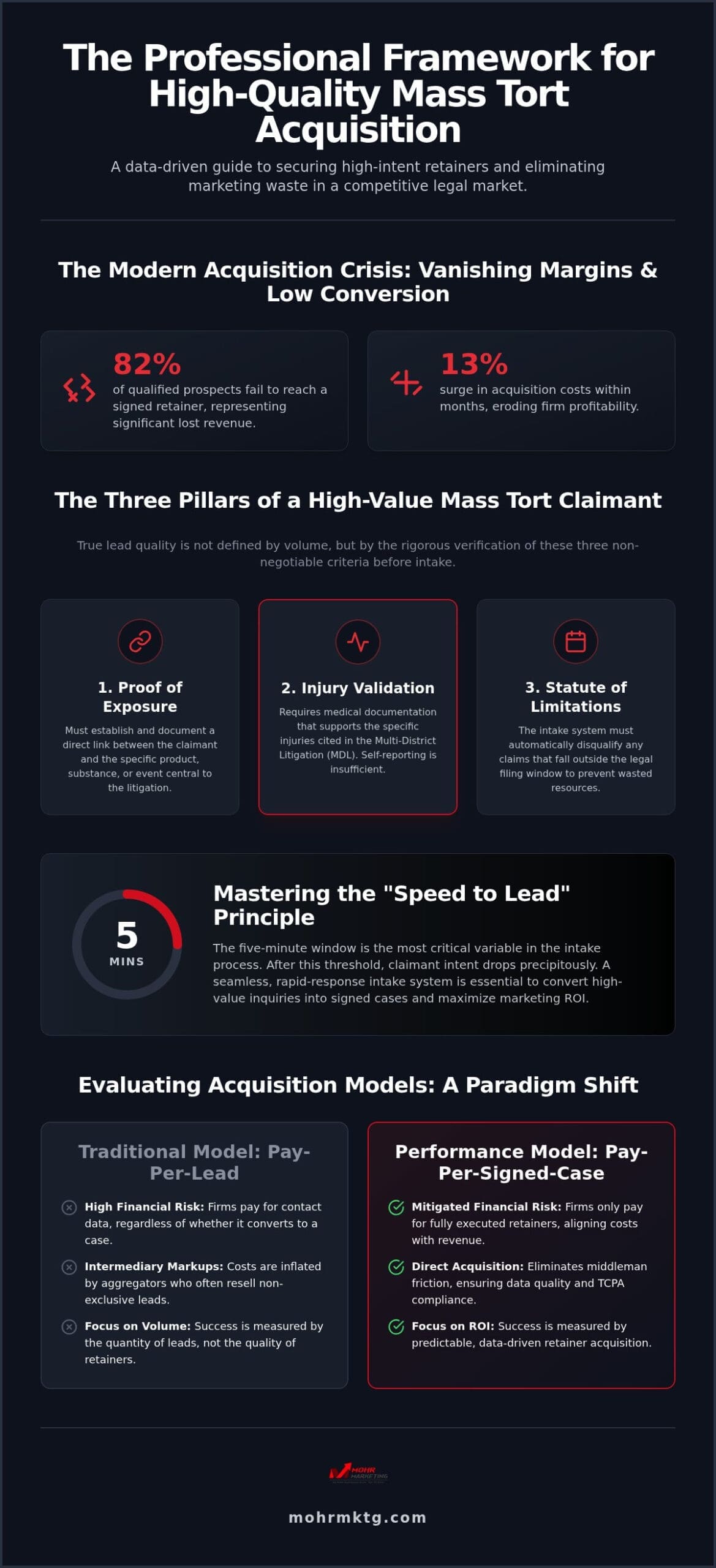
Paying for lead volume is the fastest way to erode your firm’s margin in a 2026 market where acquisition costs have surged by 13% in just a few months. Most firms remain trapped in a cycle of high-cost acquisition and low conversion, often watching 82% of their qualified prospects fail to reach a signed retainer. Securing high quality mass tort leads today requires more than a standard marketing budget; it demands a rigorous intake architecture that bypasses the inflated markups of inefficient intermediaries. You’ve likely experienced the frustration of non-compliant providers and intake processes that allow high-value cases to slip away.
We recognize that your objective is a predictable stream of fully executed retainers backed by transparent, data-driven ROI. This guide provides the professional framework needed to identify, verify, and acquire high-intent claimants while systematically eliminating marketing waste. We’ll walk through the specific verification protocols, the shift toward performance-based acquisition models, and the exact methods for removing middleman friction that currently compromises your expansion. By the end of this manual, you’ll have a clear path to a more streamlined and profitable legal operation.
Key Takeaways
- Identify high quality mass tort leads by prioritizing specific litigation, medical, and exposure criteria over raw contact data.
- Master the “Speed to Lead” principle to ensure inquiries are converted into cases within the critical five-minute threshold.
- Evaluate the financial advantages of the Pay-Per-Signed-Case model to mitigate risk and focus on fully executed retainers.
- Eliminate marketing waste and middleman markups by integrating a turnkey intake ecosystem into your acquisition strategy.
- Select mass tort campaigns strategically based on real-time market saturation and your firm’s operational capacity.
Defining High-Quality Mass Tort Leads in a Competitive Market
In 2026, lead volume is no longer a viable metric for law firm growth. High quality mass tort leads are defined by their proximity to a signed retainer, not their presence in a database. A lead only possesses value if it meets rigorous litigation, medical, and exposure criteria. For firms looking to understand What is a mass tort? and how to scale within one, the distinction between raw data and verified intent is critical. Raw contact lists are a liability. They drain intake resources and inflate your cost-per-acquisition without delivering viable cases.
True quality requires real-time intent verification. In a market where general legal lead costs have surged by 30% since 2023, you can’t afford to chase cold data. Direct-to-consumer acquisition allows firms to bypass expensive aggregators who often resell the same “exclusive” leads to multiple buyers. Controlling the marketing funnel ensures that the person on the other end of the line is actually seeking legal help right now. This approach is the only way to secure high quality mass tort leads while eliminating the middleman markups that currently compromise your marketing ROI.
The Three Pillars of Claimant Quality
To secure a high-value case, your acquisition process must filter for three specific markers before a lead ever reaches your desk. This creates a foundation for mass tort signed cases that actually hold up in court.
- Proof of Exposure: Verification must establish a direct link between the claimant and the specific product or event. Without documented exposure, the case cannot proceed through discovery.
- Injury Validation: Medical documentation must support the specific injuries cited in the Multi-District Litigation (MDL). Self-reported symptoms are insufficient for a strong filing.
- Statute of Limitations: Every viable claim has an expiration date. Your intake architecture must automatically eliminate cases that fall outside the legal filing window. This prevents wasted marketing spend on non-viable litigation.
The Intermediary Problem: Why Direct Acquisition Matters
Most lead providers operate as intermediaries. They buy traffic, scrape data, and sell it with a significant markup. This process dilutes quality. Every hand the data passes through increases the risk of non-compliance and data decay. Working with a specialized agency that owns the entire marketing funnel provides the transparency you need. It ensures that your firm adheres to the FCC’s one-to-one TCPA consent standards and state bar advertising rules. Direct acquisition protects your firm from ethics violations while ensuring you receive high quality mass tort leads that haven’t been shopped to five other firms. You need a strategic partner who is protective of your resources and aggressive in pursuing your expansion.
The Mechanics of Lead Verification and Intake Optimization
Generating interest is only the first step in a successful acquisition strategy. To maximize your return, you must deploy a turnkey intake ecosystem designed to bridge the gap between an initial inquiry and a signed case. The “Speed to Lead” principle is the most critical variable in this process. Research indicates that five minutes is the threshold for conversion; wait any longer, and the claimant’s intent drops significantly. Considering that approximately 18% of qualified mass tort leads convert into a signed retainer, every second spent in the intake queue directly impacts your firm’s bottom line. Securing high quality mass tort leads requires a seamless transition from the marketing funnel to a professional intake specialist who understands the legal definition of a mass tort and the specific nuances of the litigation at hand.
Effective intake isn’t just about answering the phone. It’s about data integration. Your digital marketing data must flow directly into your CRM to provide full-funnel tracking. This allows you to identify which specific search terms or creative assets are producing the highest-value retainers. By closing the loop between marketing spend and case acquisition, you can eliminate waste and double down on the channels that work. If your intake process isn’t optimized for speed and precision, you’re essentially subsidizing your competitors’ growth.
Multi-Step Screening Protocols
Rigor in screening is what separates a viable claimant from a data liability. You must develop a logic-based questionnaire that disqualifies non-viable inquiries instantly. Start by verifying exposure dates and medical diagnoses before moving to deeper case details. This prevents your intake team from wasting hours on claimants who don’t meet the MDL criteria. For high-value torts, verified call transfers are the gold standard. This ensures that the claimant is on the line and ready to speak with your firm the moment their eligibility is confirmed. Establishing these protocols helps ensure your firm receives high quality mass tort leads that have already survived a primary layer of scrutiny.
Data-Driven Intent Analysis
Not all traffic is created equal. You must differentiate between “curiosity seekers” and “high-intent claimants” by analyzing search behavior. Individuals searching for specific medical complications or litigation updates are far more likely to convert than those clicking on broad social media ads. Mohr Marketing utilizes real-time search intent data to drive volume, focusing on claimants who are actively seeking legal resolution. Leveraging historical conversion data allows you to predict which leads will likely result in a fully executed retainer. To see how this data-driven approach can stabilize your firm’s growth, you can review our intake integration options.
Exclusive Leads vs. Signed Retainers: Evaluating Acquisition Models
Choosing between exclusive leads and signed retainers is a strategic decision that dictates your firm’s financial risk profile. In the 2026 market, firms must decide where they want to own the risk. A pay-per-lead model requires you to manage the conversion process entirely. This often results in paying for high quality mass tort leads that never actually convert because of intake friction or criteria mismatches. Conversely, the Mass Tort Signed Cases model shifts the burden of verification and follow-up to the marketing partner. This model ensures you only pay for a “Fully Executed Retainer,” which is the gold standard for law firm growth. It represents a claimant who has already met all litigation criteria and legally committed to your representation.
Transitioning from buying leads to buying cases is a matter of operational maturity. If your internal intake team is overwhelmed or your conversion rate sits below the industry average of 18%, you’re losing money on raw data. You should move to a performance-based model when the cost of managing “dead leads” exceeds the premium of a signed case. This shift allows your firm to stop functioning as a high-volume call center and start functioning as a high-stakes litigation powerhouse. It’s a move from speculative spending to guaranteed acquisition.
The Pay-Per-Signed-Case Advantage
The primary benefit of this model is the total elimination of “dead lead” costs from your balance sheet. When you acquire high quality mass tort leads through a signed retainer program, you aren’t gambling on contact data. You’re purchasing a result. This allows you to focus firm resources on litigation and trial preparation rather than administrative intake. Scaling becomes predictable; you know exactly how many cases your budget will produce without worrying about the 82% of leads that typically fail to sign. It’s the most efficient way to build a massive docket with minimal overhead.
Risk Mitigation and Financial Performance
Performance-based models align the interests of the agency and the law firm. If the agency doesn’t deliver a signed case, they don’t get paid. This creates a powerful incentive for the provider to maintain rigorous quality controls and transparency in lead sourcing. To calculate your true ROI, you must compare the cost of a signed case against the total cost of a lead volume that includes marketing spend, intake labor, and software overhead. Often, the “cheaper” lead model is the more expensive path to a retainer. Transparency in this process protects your firm from the ethical risks associated with unverified or non-compliant lead generation practices.
Establishing a Scalable Mass Tort Acquisition Strategy
Scaling your firm’s docket in 2026 requires a transition from local outreach to a national acquisition framework. You must select torts based on a strategic hierarchy that balances current market saturation against your firm’s operational capacity. High-competition torts frequently command lead costs between $150 and $275. If your firm isn’t equipped to handle high-velocity intake, these costs will quickly erode your margins. A scalable strategy focuses on acquiring high quality mass tort leads through a diversified channel mix that mitigates the risk of platform-specific price hikes.
Advertising Compliance Standards
Operating on a national scale subjects your firm to a patchwork of state bar mandates and federal regulations. You must ensure all creative assets comply with ABA Model Rule 7.1 and the FCC’s one-to-one TCPA consent standards. Avoid making misleading promises regarding potential settlement amounts or timelines. Ethical lead generation isn’t just a regulatory hurdle; it’s a reputation management tool. Non-compliant marketing can lead to costly sanctions and damage the perceived value of your docket. Every disclaimer must meet the specific requirements of the states where you are actively advertising to ensure long-term viability.
Scaling Through Diverse Channels
A robust acquisition strategy balances high-intent search with high-volume awareness channels. High-intent channels like Google Search (PPC and SEO) are indispensable for torts where claimants are actively seeking answers, such as Mesothelioma. These claimants have a higher conversion rate because they’ve already identified their need for legal representation. Conversely, social media and OTT platforms are effective for broad awareness torts that require educating the public on exposure risks.
Allocate your budget based on funnel position. Devote approximately 60% of your spend to bottom-funnel, high-intent channels to ensure a steady stream of high quality mass tort leads. The remaining 40% should focus on mid-funnel awareness to build a pipeline for future litigation phases. This balanced approach protects your firm from the 30% surge in general legal lead costs seen since 2023. It ensures you aren’t over-reliant on a single source that could become prohibitively expensive overnight.
Securing High-Intent Cases with the Mohr Marketing Ecosystem
The legal market in 2026 doesn’t tolerate inefficiency. As acquisition costs rise, your firm needs a partner that understands the mechanics of growth. Mohr Marketing provides a turnkey ecosystem that removes the friction between a claimant’s search and your firm’s docket. Our foundation in 1994 gives us a historical perspective that newer, AI-only startups can’t replicate. Michael Mohr has spent over 30 years refining a system that prioritizes transparency and state law compliance. We don’t just generate inquiries; we act as a strategic partner for high-value case acquisition. This specialized focus ensures you receive high quality mass tort leads that meet the exact criteria of your active MDLs.
We’ve witnessed every major shift in mass tort litigation over the last three decades. This experience allows us to position your firm ahead of market shifts rather than reacting to them. By utilizing a “Direct-to-Consumer” approach, we bypass the aggregators that inflate your costs and dilute your lead quality. Our objective is to provide a direct path to success by eliminating the intermediaries that stand between you and a signed retainer.
The Turnkey Intake Ecosystem
Our ecosystem manages the entire claimant journey from the initial click to the final signature. We’ve refined our verification and transfer protocols to operate with mechanical precision. This isn’t a passive lead list; it’s a fully managed funnel that filters for exposure, injury validation, and statute of limitations. Our intake specialists are trained to handle high-stakes legal inquiries with the seriousness they deserve. This human element ensures that high-intent claimants don’t fall through the cracks of an automated system. By handling the intake process ourselves, we reduce your firm’s administrative burden. You aren’t hiring more staff to chase cold data. Instead, you’re receiving verified call transfers and signed retainers that are ready for your legal team to process immediately.
Performance-Based Growth in 2026
The shift toward performance-based models is the ultimate risk-mitigation strategy for modern firms. Mohr Marketing remains the leader in this space by providing transparent, data-driven results. We eliminate the inefficient intermediaries that drive up your cost-per-case. Our model ensures that your marketing budget is an investment in results, not a gamble on raw data. If you’re ready to stabilize your growth and scale your mass tort practice with high quality mass tort leads, it’s time to transition to a more professional acquisition framework. We provide the mechanical accuracy and strategic value you need to maintain a leadership position in a competitive market.
Contact Mohr Marketing to discuss your acquisition goals.
Strategic Growth in the 2026 Mass Tort Landscape
Success in the 2026 legal market requires a shift from speculative lead buying to results-driven acquisition. You’ve learned that high quality mass tort leads are defined by strict medical and exposure criteria; not just contact information. By integrating a turnkey intake ecosystem and moving toward a performance-based model, your firm can effectively eliminate the middleman markups that erode profitability. This transition allows you to focus on high-intent cases that meet specific litigation requirements while maintaining a lean operational footprint.
Maintaining strict compliance with state and bar mandates is no longer optional; it’s a prerequisite for protecting your firm’s reputation. With over 30 years of specialized industry experience, Mohr Marketing provides the mechanical precision needed to convert inquiries into fully executed retainers. This ecosystem handles the entire claimant journey, ensuring your team focuses on litigation rather than administrative intake. We prioritize transparency and reliability to ensure your firm remains ahead of market shifts. It’s time to stop subsidizing your competitors and start owning your market position with a strategic partner dedicated to your expansion.
We look forward to helping you build a more profitable and resilient practice through verified, high-intent case acquisition.
Frequently Asked Questions
What is the difference between a mass tort lead and a signed retainer?
A mass tort lead is contact data for an individual who may have a claim, while a signed retainer is a fully executed legal contract. Leads require your firm to perform manual intake and eligibility verification. Retainers arrive as finished opportunities. The claimant has already survived screening and legally committed to your representation. This distinction is vital for firms looking to acquire high quality mass tort leads without the administrative burden of internal intake.
How does Mohr Marketing verify the quality of mass tort claimants?
We utilize a multi-step screening protocol that validates exposure, injury, and the statute of limitations. Every claimant must provide specific documentation or verbal confirmation that matches the criteria of the active MDL. We filter out non-viable inquiries before they reach your firm. This mechanical precision ensures that you receive verified call transfers and signed cases that have already passed a rigorous layer of professional scrutiny.
Why should my firm avoid shared lead aggregators?
Shared aggregators often resell the same claimant data to multiple law firms. This triggers a race to the phone and diminishes lead value immediately. This practice also increases the risk of TCPA violations if consent isn’t properly managed for every recipient. Working with a strategic partner that provides exclusive, direct-to-consumer leads protects your reputation. It ensures you aren’t paying for data that has already been shopped to five other competitors.
What mass torts are currently delivering the highest ROI in 2026?
ROI depends on the litigation stage and your firm’s specific capacity. Torts with high-intent search volume, such as Mesothelioma, consistently deliver strong returns because claimants are actively seeking legal resolution. Emerging torts often offer lower acquisition costs during the discovery phase before competition escalates. You should select torts based on current market saturation and the specific medical criteria your firm is best equipped to litigate effectively.
How does the Pay-Per-Signed-Case model work for law firms?
In this model, your firm pays only for fully executed retainers rather than raw inquiries. We handle the marketing, initial intake, and signature collection. This shifts the financial risk from your firm to the marketing partner. It’s the ultimate strategy for predictable scaling. You can calculate your exact cost-per-case without accounting for the 82% of leads that typically fail to convert during a standard intake process.
Is mass tort lead generation compliant with state bar advertising rules?
Yes, provided the marketing partner adheres to ABA Model Rule 7.1 and the FCC’s one-to-one TCPA consent standards. We ensure all creative assets include necessary disclaimers and avoid misleading settlement promises. Our 30-year track record is built on maintaining strict compliance with state and bar mandates. This protects your firm from ethical sanctions while ensuring a steady stream of high quality mass tort leads for your practice.
How quickly can a new mass tort acquisition campaign be launched?
Most campaigns can be launched within a few business days depending on the specific tort and the required intake protocols. We already have the marketing infrastructure and intake scripts in place for major 2026 litigations. Once we align on your firm’s criteria and volume requirements, we activate our turnkey ecosystem. This speed allows your firm to capitalize on market shifts and emerging litigation trends before they become oversaturated by competitors.
What is the typical conversion rate from a verified lead to a signed case?
Industry data from August 2026 indicates that approximately 18% of qualified mass tort leads convert into a signed retainer. This rate fluctuates based on the specific tort and the efficiency of the intake process. Firms that use our turnkey ecosystem often see higher performance because we eliminate the delays that cause claimant intent to drop. Speed and professional screening are the primary drivers of successful conversion in any national campaign.

Recent Posts
- Car Accident Lead Qualification: Guide for Law Firms
- Medical Malpractice Leads: A Strategic Guide for Law Firms
- Pay-Per-Lead Legal Marketing: A Guide for Law Firms
Categories
- AI and Lead Generation
- Business Financing
- Call Verified MVA Leads
- Car Accident Help
- Car Accident Settlements
- Claimant Funding
- Compliance Program
- EMS-EMT Reports
- Geotargeting
- Google Maps Ranking
- Healthcare Practice Growth
- Law Firm Growth
- Law Office Operations
- Lead Generation
- Lead Generation For Attorneys
- Lead Generation For Chiropractors
- Lead Generation For Criminal Attorneys
- Lead Generation For D&A Treatment Centers
- Lead Generation For DUI Attorneys
- Lead Generation For Eye Doctors
- Lead Generation For Family Law Practices
- Lead Generation For PI Law Firms
- Lead Generation For Plastic Surgeons
- Leads For Healthcare Professionals
- Leads For Insurance Industry
- Legal Leads
- Legal Marketing
- Legal Updates
- Mass Tort Leads
- Medicare and Medicaid Leads
- Merchant Funding Leads
- Mold Leads
- Online Marketing Strategies
- Pre-Settlement Funding
- Signed MVA Cases
- Tort Updates
- Truck Accident Leads and Signed Cases
- Truck Accident Settlements
- Web Design