Exclusive Mass Tort Leads: A 2026 Guide to Performance-Based Case Acquisition
August 31, 2026 by Mohr Marketing
Why is your firm still racing four other competitors to reach the same claimant when you could be the only voice in the room? You’ve likely felt the frustration of paying for what were promised as exclusive mass tort leads, only to find the data has already been recycled across the industry. It’s an expensive, exhausting cycle that drains resources and kills conversion rates. Relying on shared data isn’t a growth strategy; it’s a liability that creates administrative burnout and unpredictable returns. To scale effectively in 2026, you need a model that prioritizes ownership and intent.
This guide provides a direct roadmap for law firms ready to transition from chasing data to signing cases. We’ll show you how to leverage high-intent signed retainer models to eliminate lead waste and reduce the burden on your internal staff. You’ll learn how to identify verified opportunities, maintain strict compliance with evolving mandates, and implement a performance-based system that delivers predictable docket growth. It’s time to shift the financial risk away from your firm and toward a model built on transparency and tangible outcomes.
Key Takeaways
- Identify why shared lead models destroy ROI and how to exit the “speed-to-lead” trap that drains firm resources.
- Secure exclusive mass tort leads through one-to-one routing standards that deliver high-intent claimants to your firm in real-time.
- Transition to a pay-per-signed-case model to transfer financial risk and focus your marketing budget on actual docket growth.
- Maintain strict compliance with 2026 TCPA regulations and state bar mandates to safeguard your firm’s reputation and legal standing.
- Streamline your expansion by utilizing a turnkey ecosystem that integrates expert marketing with professional legal intake services.
The High Cost of Shared Leads: Why Aggregators Are Failing Your Firm
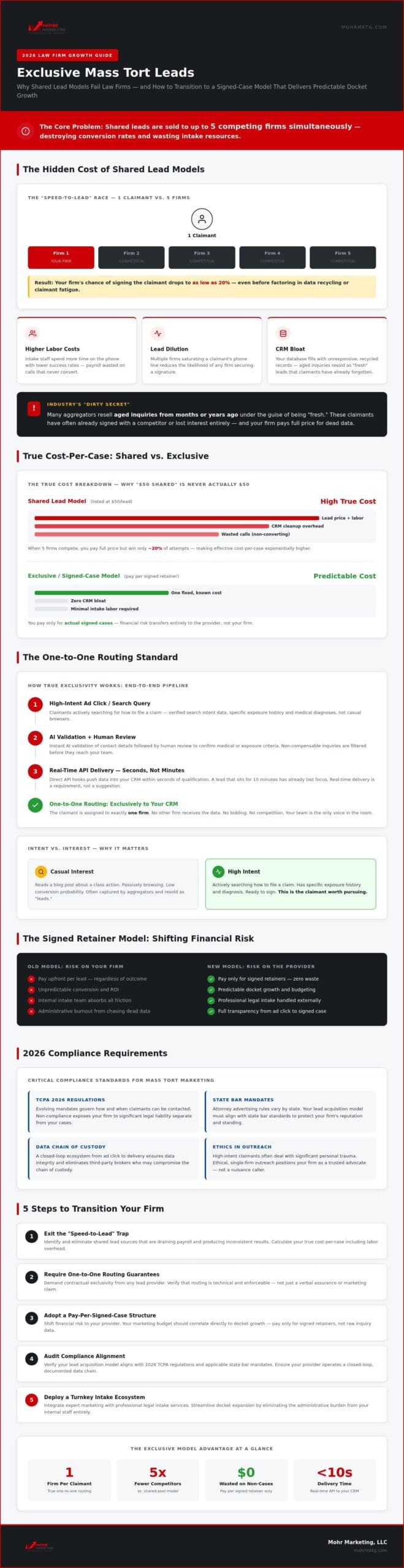
Shared lead models are built on volume, not value. Most aggregators sell the same inquiry to multiple firms simultaneously, often as many as five. This creates a “speed-to-lead” race where your intake team must dial within seconds just to be the first voice heard. It’s an inefficient use of payroll. If you aren’t the first one to connect, you’re usually ignored. This model treats legal representation as a commodity rather than a professional service.
The industry’s “dirty secret” is data recycling. Many aggregators resell aged inquiries from months or years ago under the guise of being “fresh.” These claimants have often already signed with a competitor or lost interest in the litigation entirely. Chasing recycled data wastes your team’s time and kills morale. When you invest in exclusive mass tort leads, you eliminate the competition for the claimant’s attention and ensure your team is working with real-time intent.
The Economics of Diminishing Returns in Shared Pools
Calculating your true cost-per-case requires looking beyond the initial purchase price. A $50 shared lead seems like a bargain until you factor in the conversion rate. If five firms are calling, your chance of signing that claimant drops significantly. You end up paying for multiple “dead” leads for every one you might actually contact. When you factor in the labor costs of chasing these “opportunities,” a shared lead often results in a higher cost-per-case than high-quality mass tort signed cases.
- Higher labor costs: Your intake staff spends more time on the phone with lower success rates.
- Lead dilution: Multiple firms saturating a claimant’s phone line reduces the likelihood of any firm securing a signature.
- CRM bloat: Your database becomes filled with unresponsive records that require constant cleanup.
Brand Erosion and the Race to the Bottom
High-intent claimants are often dealing with significant personal trauma. When their phone rings five times in ten minutes from different law firms, your brand is no longer seen as a premium advocate. It’s viewed as a nuisance. This aggressive multi-firm outreach dilutes your authority and creates claimant fatigue. Firms that prioritize exclusive mass tort leads position themselves as the sole, trusted resource from the first interaction. You aren’t just another telemarketing respondent. You’re the strategic partner they were searching for.
Defining True Exclusivity: The One-to-One Routing Standard
Exclusivity is often used as a marketing buzzword, but in 2026, it must be a technical reality. True exclusive mass tort leads are governed by one-to-one routing. This means the system identifies a claimant and assigns them to exactly one firm’s CRM. No other firm receives the data. No other firm can bid on it. This protocol eliminates the “speed-to-lead” friction and ensures your team isn’t competing with four other intake departments for the same conversation.
A closed-loop ecosystem is vital for transparency. By controlling the entire process from the initial ad click to the final delivery, we eliminate the “data brokers” who often repackage leads. This ensures the chain of custody for the data is never broken. Our verification protocols utilize AI for instant validation of contact details; this is followed by human review to confirm specific medical or exposure criteria. This rigorous process filters out non-compensable inquiries before they ever reach your team.
The Technology Behind Real-Time Delivery
In the mass tort space, “real-time” isn’t a suggestion; it’s a requirement. If a lead sits for ten minutes, the claimant’s focus has already shifted. Our technology uses direct API hooks to push data into your CRM within seconds of a successful qualification. One-to-one routing is the gold standard for lead security. This ensures the claimant isn’t bombarded by other firms, which protects your brand’s reputation from the very first interaction. It’s about precision, not just speed.
Intent vs. Interest: Identifying Compensable Claimants
There’s a massive gap between interest and intent. A casual “browser” might read a blog post about a class action. A “seeker” with high intent is actively searching for how to file a claim. We utilize search data to find those with specific exposure history and medical diagnoses. This is especially critical for complex cases like mesothelioma leads built on real search intent. By focusing on intent-driven behavior, we ensure your intake team spends their time on claimants who are ready to move forward.
Effective docket growth requires more than just volume; it requires a partner who understands the technical nuances of lead routing. If you want to see how these protocols can stabilize your case acquisition, you can speak with our strategic partners to review our current delivery standards.
The Signed Retainer Model: Shifting Financial Risk to the Provider
Traditional lead acquisition forces law firms to act as marketing agencies. You buy raw data and hope your intake team can convert it. This model is flawed because the firm bears all the financial risk if the lead doesn’t sign. By moving to a model focused on Mass Tort Signed Cases, you shift the burden of conversion back to the provider. You stop paying for “possibilities” and start paying for verified docket entries.
This transition is essential for firms looking to scale without bloating internal overhead. When you acquire exclusive mass tort leads that are already converted into signed retainers, your cost-per-acquisition becomes a fixed, predictable line item. You don’t have to worry about lead quality or contact rates because you only pay for the result. It’s a strategic shift that aligns the provider’s incentives with your firm’s growth goals.
Comparing Pay-Per-Lead vs. Pay-Per-Signed-Case
Firms must evaluate their internal capacity before choosing a model. If you have a massive, high-performing intake department, a pay-per-lead model might seem cheaper on paper. However, the hidden costs of chasing non-responsive leads often erase those savings. The signed-case model acts as the ultimate hedge against “junk” data. It forces the provider to ensure every lead meets strict criteria before it ever hits your desk.
For firms with limited administrative bandwidth, the pay-per-signed-case approach is superior. It allows you to maintain a lean staff focused on litigation rather than sales. You aren’t just buying exclusive mass tort leads; you’re buying the time your team would have spent on the phone. This efficiency gap is often the difference between a profitable campaign and a wasted budget. Performance-based models ensure your capital is always working toward a tangible asset.
Retainer-Ready Claimants: The Mechanics of Execution
Securing a retainer requires more than a phone call. It requires a seamless technological handoff. We utilize digital signatures and instant intake protocols to capture a claimant’s intent while it’s at its peak. This shortens the acquisition cycle from days to minutes. Professional intake specialists manage the entire process, ensuring the claimant understands the retainer and signs it immediately. This process removes the friction that typically causes high-intent leads to fall out of the funnel.
This turnkey approach ensures that by the time you see the case, the heaviest administrative lifting is complete. You receive a fully vetted file, ready for your legal team to review and file. By delegating the friction-heavy intake phase to experts, you ensure your marketing spend translates directly into case count. It’s the most direct path to scaling a mass tort docket in a competitive market.
Compliance and Ethics in 2026 Mass Tort Marketing
Legal lead generation is a high-stakes environment where oversight is mandatory. Your firm’s license depends on the ethical conduct of your marketing partners. In 2026, compliance isn’t just a checkbox; it’s a defensive strategy against predatory litigation and bar grievances. When you acquire exclusive mass tort leads, you must ensure the provider maintains a rigorous chain of custody. This documentation should track the claimant’s journey from the initial advertisement click through to the signed retainer. Without this, your firm’s vulnerable to claims of unauthorized practice of law or deceptive advertising.
Transparency in advertising is critical for high-value tort funnels. Claimants shouldn’t be misled about the nature of legal services or the potential outcomes of their case. We ensure all marketing materials are vetted against current bar mandates to prevent ethical conflicts. This proactive approach protects your brand’s reputation. It ensures that every lead generated is legally sound and ethically sourced. You don’t want to build a docket on a foundation of non-compliant data.
The 2026 Regulatory Landscape for Legal Lead Gen
The distinction between “referral fees” and “marketing costs” is a primary focus for state bars. While you can pay for marketing services, you cannot pay a non-attorney for a referral based on the outcome of a specific case. Documentation is your firm’s best defense against ethics complaints. You must be able to prove that your payments are for legitimate advertising and intake services rather than prohibited fee-splitting. In 2026, TCPA compliance requires explicit one-to-one consent between the consumer and the specific firm receiving the lead.
Due Diligence: Auditing Your Lead Provider
Protecting your firm requires a rigorous audit of any third-party provider. You shouldn’t take “compliance” claims at face value. A professional partner will provide full transparency into their lead-generation methods and intake protocols. Review our Mass Tort Lead Generation Roadmap to understand the standards required for scalable, ethical growth. Watch for these red flags during your audit:
- Vague descriptions of how data is sourced or verified.
- Inability to provide TCPA consent logs or “LeadiD” tokens.
- Claims of “guaranteed” volume that ignore strict case criteria.
- Lack of experience with specific state bar advertising mandates.
The Mohr Marketing Method: A Turnkey Ecosystem for Growth
Growth in the mass tort space isn’t just about lead volume. It’s about a systematic approach that bridges the gap between a digital inquiry and a signed case. We’ve spent 30 years refining a turnkey ecosystem that automates the friction-heavy parts of intake. This turnkey approach integrates digital marketing, call center operations, and document management into a single, automated funnel. This isn’t just about exclusive mass tort leads; it’s about building a predictable pipeline for your firm’s docket. Our national infrastructure allows us to target high-value litigation across the US, ensuring your firm isn’t limited by geography.
Our intake professionals do more than just answer phones. They are trained to secure retainers on your behalf using proven, verified protocols. This ensures that high-intent claimants don’t fall through the cracks of an inefficient internal team. We manage the entire lifecycle from the first click to the final digital signature. By the time a file reaches your desk, the claimant is already signed and ready for review. This level of precision allows you to allocate your resources toward litigation rather than administrative tasks.
Strategic Partnership vs. Vendor Relationship
A vendor sells you data and walks away. A strategic partner helps you identify which emerging torts offer the best ROI. We use insider knowledge to guide firms toward high-value opportunities before the market becomes oversaturated. For example, our work in High-Value Mold Case Acquisition demonstrates how we help firms pivot to specialized litigation with high compensable potential. We provide transparent, real-time reporting so you can optimize your portfolio based on actual performance data rather than guesswork. This collaborative approach ensures your firm stays ahead of market shifts.
Scaling Your Docket Without Increasing Overhead
The math is simple. If you double your case volume using traditional methods, you usually have to double your intake staff. Our turnkey system breaks that cycle. By outsourcing the intake friction to our specialists, you maintain professional standards without the administrative burden of hiring and training. You get the benefit of a national-scale marketing engine without the associated payroll costs. This scalability is what allows our partners to capture significant market share in new litigations within weeks rather than months.
This model allows your firm to remain agile and aggressive in a competitive landscape. You don’t have to choose between growth and profitability; our system is designed to deliver both. By leveraging exclusive mass tort leads within a performance-based ecosystem, you ensure every marketing dollar is tied to a signed case.
Contact Mohr Marketing to secure your exclusive mass tort leads.
Scale Your Docket with Predictable Performance
Transitioning to a model built on exclusive mass tort leads is the only way to escape the inefficiencies of shared data pools. By prioritizing one-to-one routing and performance-based signed retainers, your firm eliminates the “speed-to-lead” race and focuses resources on litigation. This strategic shift ensures that every marketing dollar contributes directly to a verified docket entry rather than a wasted inquiry.
Success in 2026 requires a partner who understands the technical nuances of intake and the strict requirements of state bar mandates. Mohr Marketing provides a turnkey ecosystem backed by over 30 years of industry experience. We deliver verified, high-intent inquiries and fully executed retainers, allowing you to scale your firm’s reach without bloating your internal administrative team. It’s the most direct path to sustainable growth in a high-stakes market.
It’s time to build a more resilient and profitable tort portfolio through strategic case acquisition.
Frequently Asked Questions
What exactly are exclusive mass tort leads?
Exclusive mass tort leads are high-intent inquiries routed to exactly one law firm in real-time. Unlike shared leads, which aggregators sell to multiple firms simultaneously, exclusive leads ensure you’re the only firm contacting the claimant. This eliminates the competitive race to the phone. These leads are generated through specialized digital funnels and verified for specific criteria before delivery, ensuring your intake team works only with unique, high-value opportunities.
How does the pay-per-signed-case model work for law firms?
In a pay-per-signed-case model, your firm pays a fixed fee for a fully executed retainer agreement rather than a raw inquiry. We manage the entire marketing and intake lifecycle, from the initial ad click to the final digital signature. This performance-based approach shifts the financial risk of lead conversion away from your firm. You only pay for qualified docket entries, which allows for predictable budgeting and efficient capital allocation.
Is buying mass tort leads ethical according to State Bar rules?
Acquiring leads is ethical when structured as a payment for marketing and intake services rather than a prohibited referral fee or fee-sharing arrangement. We maintain strict compliance with state bar mandates and non-attorney referral rules. Our process includes transparent documentation of the claimant’s journey. This ensures your firm adheres to advertising standards while delegating the administrative burden of lead generation to a strategic partner with 30 years of experience.
How do you verify the medical criteria of a mass tort lead?
We utilize a multi-layered verification process to confirm compensable criteria. Initial digital screening captures specific details regarding exposure history and medical diagnoses. This is followed by a rigorous human review conducted by professional intake specialists. These specialists verify that the claimant meets your firm’s exact litigation requirements before the lead is delivered or a retainer is signed. This filtering prevents non-compensable inquiries from ever reaching your legal team.
What is the typical conversion rate for exclusive mass tort leads vs. shared leads?
Conversion rates for exclusive mass tort leads are significantly higher than shared alternatives because you aren’t competing for the claimant’s attention. Shared leads suffer from claimant fatigue as multiple firms dial the same individual, which kills contact rates. While specific percentages vary by tort, exclusive leads provide a more stable ROI. You avoid the brand dilution that occurs when claimants receive aggressive outreach from five different firms simultaneously.
How quickly are exclusive leads delivered to our firm?
Delivery occurs in real-time, typically within seconds of a successful qualification. Our system uses direct API hooks to push verified data into your CRM immediately. In the mass tort landscape, speed is critical to capturing a claimant’s intent while it’s at its peak. By automating the handoff from our digital funnels to your intake department, we ensure your team can act on high-intent opportunities without any technical delay or administrative friction.
Can we customize the criteria for the mass tort leads we receive?
Yes, we customize lead criteria to align with your firm’s specific litigation goals and case selection standards. Whether you require specific exposure dates, confirmed medical diagnoses, or geographic parameters within our national scope, our funnels are adjusted to filter for those exact variables. This precision ensures you only receive inquiries that fit your docket’s requirements. We act as a strategic partner, adjusting the intake protocols as the litigation evolves.
What happens if a signed retainer is found to be non-compensable?
We utilize rigorous verification protocols to minimize the risk of non-compensable cases. If a signed retainer doesn’t meet pre-agreed criteria, our team reviews the intake data to maintain the integrity of your docket. Our performance-based models are built on transparency and long-term results. You should consult your specific strategic partnership agreement for the exact protocols regarding case validation. This ensures your marketing capital is always tied to high-value, compensable opportunities.

Recent Posts
- Mass Tort Claimant Acquisition: A Practical Framework for Law Firms
- Signed Cases for Attorneys: A 2026 Evaluation Guide
- How to Get More Personal Injury Cases: A 2026 Growth Guide
Categories
- AI and Lead Generation
- Business Financing
- Call Verified MVA Leads
- Car Accident Help
- Car Accident Settlements
- Claimant Funding
- Compliance Program
- EMS-EMT Reports
- Geotargeting
- Google Maps Ranking
- Healthcare Practice Growth
- Law Firm Growth
- Law Office Operations
- Lead Generation
- Lead Generation For Attorneys
- Lead Generation For Chiropractors
- Lead Generation For Criminal Attorneys
- Lead Generation For D&A Treatment Centers
- Lead Generation For DUI Attorneys
- Lead Generation For Eye Doctors
- Lead Generation For Family Law Practices
- Lead Generation For PI Law Firms
- Lead Generation For Plastic Surgeons
- Leads For Healthcare Professionals
- Leads For Insurance Industry
- Legal Leads
- Legal Marketing
- Legal Updates
- Mass Tort Leads
- Medicare and Medicaid Leads
- Merchant Funding Leads
- Mold Leads
- Online Marketing Strategies
- Pre-Settlement Funding
- Signed MVA Cases
- Tort Updates
- Truck Accident Leads and Signed Cases
- Truck Accident Settlements
- Web Design