How to Get More Personal Injury Cases: A 2026 Growth Guide
October 14, 2026 by Mohr Marketing
More leads can make a personal injury firm less efficient. If inquiries do not match the firm’s case criteria, cannot be tied to a marketing channel, or wait too long for follow-up, raw volume will not create sustainable growth. Learning how to get more personal injury cases means building a process that attracts suitable inquiries and moves them through intake and case review with clear accountability. That process can include verified cases and signed retainers, while keeping each outcome distinct.
Marketing activity can increase without producing more suitable cases. Incomplete attribution and intake bottlenecks can make it difficult to see where inquiries come from or why they fail to progress. Sustainable growth requires a system that connects acquisition, intake, and evaluation.
This guide explains how to define the cases your firm wants, assess marketing by outcomes rather than clicks alone, and improve intake follow-up. You will also learn how to distinguish a verified inquiry from a fully executed retainer and how connected marketing and legal intake support can make the path from first contact to case review easier to measure.
Key Takeaways
- Set a growth goal around the case types your firm can handle, then align marketing activity with that capacity.
- Match search intent to the right acquisition channels, from educational content to campaigns for urgent or case-specific needs.
- To understand how to get more personal injury cases, track progression from raw inquiries to qualified opportunities and signed retainers.
- Use a practical review cycle to identify which sources, case categories, and intake steps need attention.
- Connect marketing and intake support to make acquisition performance easier to assess and improve.
How to Get More Personal Injury Cases Starts with a Clear Growth Goal
Marketing can consume time and budget without showing which efforts lead to viable cases. Often, the issue is not a shortage of tactics. It is the lack of a shared definition of growth and a consistent way to measure progress from first inquiry through case review.
For a law firm, case growth means attracting inquiries that fit its practice focus and capacity, then evaluating them through a consistent process. Raw inquiry volume is not the same as qualified case growth. The goal is a manageable flow of suitable opportunities that the firm can review and, when appropriate, convert into signed retainers.
Set case-acquisition goals before choosing channels
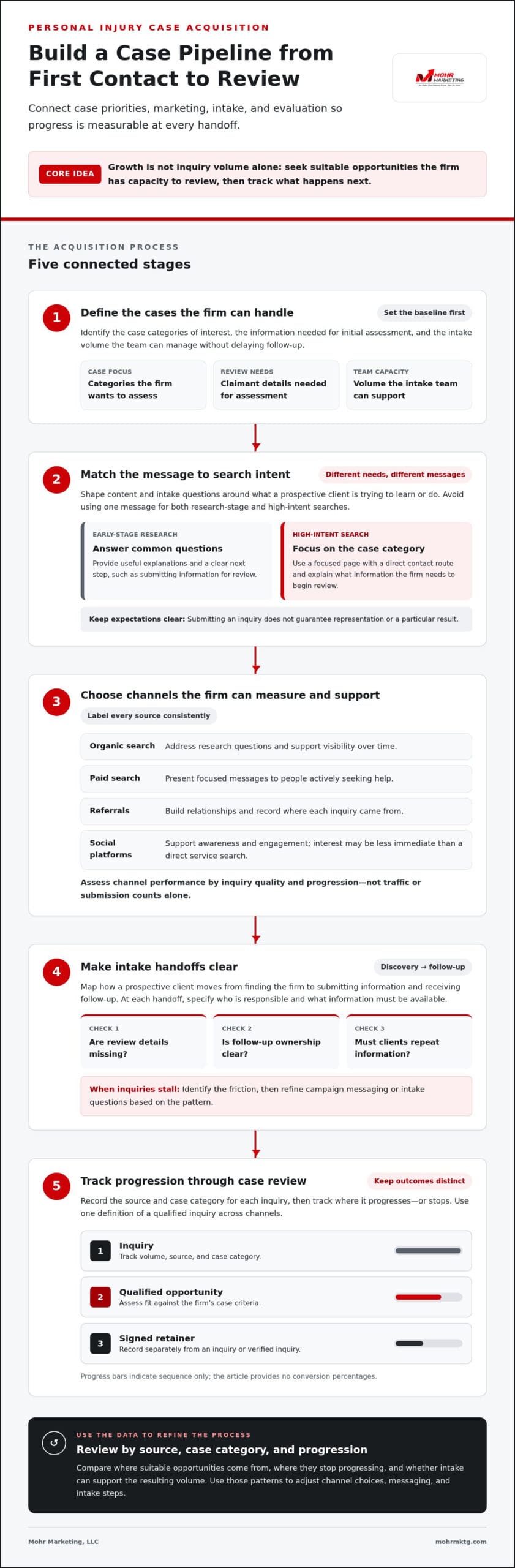
Start with the work the firm can responsibly investigate and staff. Define the case categories of interest, the claimant information the team needs to assess an inquiry, and the volume intake can handle without delaying follow-up. For example, a firm focused on motor vehicle accidents can establish what intake should collect before expanding campaigns for that category.
Set a baseline before changing the marketing mix. Track inquiries, qualified opportunities, signed retainers, and the source of each inquiry. Record the case category and where each inquiry stops progressing. This helps distinguish a channel that attracts attention from one that generates suitable opportunities. It also grounds growth targets in the team’s capacity rather than an isolated volume goal.
Case priorities should be specific enough to guide campaign and intake decisions. If the firm has a defined process for reviewing motor vehicle accident matters, a page about police report-backed MVA cases can show how criteria shape the opportunities it seeks to evaluate. The broader legal context matters, too. The Personal Injury Law Overview describes common concepts and case types that can help frame the firm’s focus.
Map the claimant journey from discovery to case review
Document each step from discovery to an initial decision. A prospective client might find the firm through search, a referral, or a social platform, submit information through a form, and then wait for follow-up and review. For each handoff, identify who is responsible and what information needs to be available.
Next, look for friction. Are inquiries missing details the review team needs? Is responsibility for follow-up unclear? Do prospective clients have to repeat information? Track where inquiries stall or are disqualified, then use those patterns to refine campaign messaging and intake questions. When assessing personal injury lead generation companies, apply the same discipline: examine how an inquiry is defined and how its source and progress are reported, not just how many are delivered.
A clear goal turns “how to get more personal injury cases” from a broad marketing question into a measurable operating plan. Define the case mix, quality threshold, intake capacity, and baseline first. Then select channels that support those priorities.
Build a Personal Injury Case Pipeline Around Search Intent and Targeted Demand
Once the firm has defined its case priorities, shape each campaign around what a prospective client is trying to learn or do. Search intent provides a useful signal. Someone researching fault or possible damages may need clear educational information, while someone looking for a lawyer after a collision may be ready to contact a firm. Using the same message for both searches can create a mismatch between expectations and intake.
Use search intent to shape both campaign messaging and intake questions. A relevant first step helps prospective clients understand what to do next and gives the firm information suited to its initial review.
Match campaign content to the question a potential client has
For early-stage searches, publish useful explanations that answer common questions and offer a clear next step, such as submitting information for review. For high-intent searches, create a focused page with a direct contact route and a concise explanation of what information the firm needs to begin its review. Make clear that submitting an inquiry does not guarantee representation or a particular result.
Give each case category its own relevant messaging. A motor vehicle accident page should address that type of incident, while a truck accident page should speak directly to truck-related inquiries. A generic personal injury campaign may attract broad interest, but it gives the firm less control over whether the message reflects the cases it can assess. For example, a campaign seeking truck accident matters should make the case category clear in its content and intake questions.
Choose a channel mix the firm can measure and support
Channels differ in intent and operating demands. Organic search content can address research questions and support visibility over time. Paid search can put focused messages in front of people actively seeking help. Referrals depend on relationship-building and a clear process for recording the source. Social platforms can support awareness and engagement, though interest there may be less immediate than a direct service search.
Choose channels based on the firm’s case priorities and its ability to handle the inquiries they generate. Use consistent source labels and one definition of a qualified inquiry across all channels. Review performance by case category as well as source, comparing inquiry quality and progression rather than traffic or submission counts alone.
- SEO: Develop useful, case-specific information for people researching their options.
- Paid search: Match focused ads and landing pages to high-intent queries, and plan for the intake workload they may create.
- Referrals: Record the referring source and assess inquiries using the same case criteria as other channels.
- Social platforms: Align educational or awareness content with a clear next step for interested people.
A targeted pipeline makes it easier to identify which messages attract suitable inquiries and which channels the firm can support. Firms refining how to get more personal injury cases can use this framework to align campaigns and intake with case fit. To discuss connecting acquisition priorities with intake support, review Mohr Marketing’s case-acquisition support.
More Personal Injury Leads Do Not Automatically Mean More Cases
Increasing inquiry volume alone may not improve case acquisition. If inquiries fall outside the firm’s practice focus, cannot be reached, or remain unreviewed because intake is stretched, a higher lead count can add work without adding signed cases. Measure each stage separately to see where the pipeline is producing value and where it is losing momentum.
Distinguish inquiry quality from inquiry quantity
A raw lead is a recorded response or contact submission. A verified inquiry is a contact opportunity that has been checked, but verification does not establish that the matter is viable or that the firm will accept it. A qualified opportunity meets the firm’s initial criteria for further review. A signed retainer is a separate, later outcome: an agreement executed by the prospective client and firm.
Case-fit criteria should reflect the firm’s practice focus and review process. They may include the incident category, the information available for evaluation, and whether the matter falls within the firm’s scope. A police-report-backed motor vehicle accident inquiry, for example, may provide a useful starting point for review, but the report alone does not mean the inquiry qualifies. The firm still needs to assess the matter using its own criteria. A focused police report-backed MVA case pipeline can make those distinctions easier to evaluate.
| Funnel stage | What it measures | What it cannot prove |
|---|---|---|
| Raw lead | An inquiry was recorded. | That the contact is accurate, reachable, or relevant. |
| Verified inquiry | Contact details or an opportunity were checked. | That the matter meets the firm’s case criteria. |
| Qualified opportunity | The inquiry meets initial, firm-defined criteria for review. | That the firm will accept the case or sign a retainer. |
| Signed retainer | A retainer was executed. | Any future case result or financial outcome. |
Measure movement through the intake funnel
For each inquiry, record its source, contact status, qualification outcome, case-review status, and signed-retainer status. Apply the same definitions across channels and reporting periods. Then compare patterns by case category and source. If a channel produces many raw leads but few qualified opportunities, examine targeting and message fit. If qualified inquiries rarely reach case review, investigate follow-up ownership, missing information, or staff capacity.
Responsiveness matters because an untouched inquiry may not progress. Screening questions that are unclear or unnecessarily demanding can also create friction. Review the handoffs as well as the marketing source. To assess the ROI of legal intake services, connect intake activity to progression through the funnel instead of treating contact volume as the final result.
This is the practical answer to how to get more personal injury cases: identify which stage needs improvement before increasing volume. Mohr Marketing provides verified inquiries, signed retainers, and legal intake services, helping firms connect acquisition with the intake process without treating any stage as a guaranteed outcome.
Use a Practical 30-Day Review Cycle to Improve Case Acquisition
A 30-day review cycle gives the firm a defined window to examine acquisition and intake, test a focused improvement, and document what the data shows. Treat it as an operating routine, not a promise that marketing results will change within a month. The purpose is to make decisions using consistent records rather than assumptions.
Keep the review focused. Changing several campaigns, messages, and intake steps at once makes it difficult to identify what influenced performance. Select one major variable to test while keeping the firm’s criteria for evaluating inquiries consistent.
Audit the current acquisition and intake process
Start with a snapshot of campaign sources, case categories, landing pages, inquiry records, and follow-up ownership. Note missing source information, inconsistent qualification records, and inquiries without a clear next step. Compare incoming volume with the team’s capacity to respond and complete initial reviews. The goal is to identify a specific bottleneck, not assign blame.
Use the cycle to organize the work:
- Days 1-7: Gather campaign and intake records. Check that each inquiry has a source, case category, contact status, and current review status.
- Days 8-14: Identify a priority issue, such as unclear case-category messaging or missing source attribution. Set a baseline using the firm’s current definitions.
- Days 15-21: Make one major change. For example, revise a page to describe a specific case category more clearly without changing the intake process at the same time.
- Days 22-30: Review available data, record operational observations, and decide whether to keep, revise, or stop the test.
Test, measure, and refine without overclaiming
Assess a test using more than inquiry count. Compare qualified inquiries and signed retainers alongside source, case category, spend, contact status, and staff capacity. If the team cannot manage the inquiry flow, more volume may obscure the underlying issue. If attribution is incomplete, improve the records before drawing conclusions about channel performance.
Document the change, why it was made, the dates reviewed, and the measures used. Note limitations, including small or incomplete data sets, and avoid presenting early movement as proof of a lasting result. Before publishing revised claims or campaign content, review applicable state bar advertising guidance and platform policies. Rules and platform requirements can differ, so include this review in the firm’s process.
Assess the current test before moving to another priority. This gives the firm a disciplined way to address how to get more personal injury cases while maintaining a clear record of decisions, capacity constraints, and next steps.
Connect Marketing and Intake with Mohr Marketing’s Case-Acquisition Support
A firm’s acquisition system works best when marketing priorities, inquiry handling, and case review are planned together. Mohr Marketing provides personal injury leads, verified inquiries, signed retainers, legal intake services, and managed digital marketing. The right combination depends on what the firm needs to strengthen: demand generation, intake capacity, or the connection between them.
These offerings support distinct points in the acquisition process. A verified inquiry is a checked contact opportunity, not a determination that the matter qualifies for representation. A signed retainer is a further step, an agreement executed by the firm and prospective client. Keeping these outcomes distinct helps set expectations and measure performance accurately.
Select support that matches the firm’s acquisition model
Start with the gap identified in the firm’s review. If the priority is adding opportunities for a defined practice area, personal injury leads may fit the acquisition objective. If the firm wants to evaluate matters at a later stage, signed retainers are a distinct option. Firms seeking to generate demand through marketing activity can use managed digital marketing, while legal intake support can connect incoming inquiries with the firm’s handling process.
For a motor vehicle accident focus, define the target case type and review criteria first. A firm examining truck accident matters, for example, can assess how signed cases for that category fit its acquisition model and intake workflow. Whatever the focus, clarify what information should be recorded at each stage so the source, qualification status, and subsequent outcome can be evaluated together.
Make the next step specific and low-friction
A useful discussion starts with a concise picture of the firm’s current operation. Identify the case categories it wants to pursue, the channels it uses, the intake steps from first contact to review, and any staffing constraints affecting follow-up. This context helps clarify whether the priority is inquiry quality, intake support, signed retainers, or coordinated marketing and intake.
Mohr Marketing brings more than 30 years of industry experience and emphasizes transparent, data-driven marketing strategies. Each campaign still needs to be assessed on its own terms. Performance depends on campaign context, qualification criteria, and firm operations, including the capacity to handle and review inquiries. A sound plan sets expectations around those factors rather than promising a fixed volume of leads, signed cases, or financial results.
If your firm is evaluating how to get more personal injury cases, bring its case priorities, current acquisition channels, and intake constraints into the discussion. This creates a practical starting point: where the process is working, where it loses momentum, and what support may address the gap.
Turn Your Acquisition Plan into a Repeatable Advantage
Growth becomes more manageable when the firm treats case acquisition as an ongoing business priority rather than a series of isolated campaigns. Assign responsibility for reviewing progress and making decisions so that useful findings lead to action.
Choose the next priority, decide what evidence will guide the next move, and set a date to evaluate it. This keeps the firm focused on deliberate progress instead of reacting to every short-term fluctuation. A disciplined approach to how to get more personal injury cases gives the team a clearer basis for making growth decisions over time.
Mohr Marketing can help your firm discuss its priorities and identify a practical direction based on its current acquisition approach and operating needs.
With a clear next step, your firm can move forward with greater focus and confidence.
Frequently Asked Questions
How long does it take to get more personal injury cases?
There is no reliable universal timeline for acquiring more cases. Paid campaigns may generate inquiries after launch, while organic visibility and referral development generally require sustained work. Timing depends on competition, targeting, campaign execution, and intake readiness. Before a campaign begins, set review intervals and decide what evidence to assess. Track qualified inquiries and signed retainers, and do not treat a short-term shift as proof of lasting performance.
Can a small personal injury law firm compete for more cases?
Yes. A smaller firm can focus on case categories it is equipped to evaluate and serve, then build marketing around those priorities. For example, a firm with limited intake capacity might concentrate on one defined case category before expanding its campaigns. Clear messaging and consistent follow-up help the team make informed decisions. The aim is not to copy a larger firm’s channel mix, but to build a sustainable process.
How much should a personal injury law firm spend on marketing?
There is no single marketing budget that fits every firm. Set objectives based on case priorities, existing performance, and the staff capacity available to handle new inquiries. Then review channel activity against qualified inquiries and signed retainers, rather than clicks or raw submissions alone. If the team lacks reliable source records, address that measurement gap before making major budget decisions. Document the reasoning behind each change.
Can a law firm market multiple personal injury case types at once?
Yes, if the firm can manage the inquiries and review processes each campaign may generate. Give each case category accurate, distinct messaging and a clear way to assess inquiry relevance. If resources are limited, sequence campaign launches rather than expanding every category at once. Review advertising content against applicable professional requirements, and avoid suggesting that every inquiry meets the firm’s criteria or will be accepted.
What information should a potential personal injury client provide in an initial inquiry?
An initial inquiry should collect enough appropriate information to identify the person, understand the general incident category, and determine a next step. Depending on the firm’s process and the form’s purpose, this may include contact details, the type of incident, and a brief description. Keep questions relevant to initial review, explain how submissions are handled, and do not imply that completing a form establishes representation or confirms eligibility.
Can a law firm combine in-house intake with outside marketing support?
Yes. A firm can keep case evaluation in-house while using outside support for selected marketing or intake functions. For example, staff may retain responsibility for review decisions while campaign support helps organize acquisition activity. Define who receives inquiries, who follows up, how information is shared, and how outcomes are reported. These arrangements should reflect the firm’s staffing, case focus, and operational requirements.
Should a personal injury law firm use client testimonials in marketing?
Testimonials require careful attention to accuracy and context. A client’s account should not be edited in a way that changes its meaning or implies that another person will achieve the same result. Before publication, review applicable professional advertising requirements and platform policies. Keep claims factual, avoid unsupported promises, and present the experience in a way that gives readers a fair understanding of what is being described.

Recent Posts
- How to Get More Personal Injury Cases: A 2026 Growth Guide
- How to Reduce Client Acquisition Cost for Law Firms Without Sacrificing Case Quality
- Generating Birth Injury Inquiries: A Guide for Law Firms
Categories
- AI and Lead Generation
- Business Financing
- Call Verified MVA Leads
- Car Accident Help
- Car Accident Settlements
- Claimant Funding
- Compliance Program
- EMS-EMT Reports
- Geotargeting
- Google Maps Ranking
- Healthcare Practice Growth
- Law Firm Growth
- Law Office Operations
- Lead Generation
- Lead Generation For Attorneys
- Lead Generation For Chiropractors
- Lead Generation For Criminal Attorneys
- Lead Generation For D&A Treatment Centers
- Lead Generation For DUI Attorneys
- Lead Generation For Eye Doctors
- Lead Generation For Family Law Practices
- Lead Generation For PI Law Firms
- Lead Generation For Plastic Surgeons
- Leads For Healthcare Professionals
- Leads For Insurance Industry
- Legal Leads
- Legal Marketing
- Legal Updates
- Mass Tort Leads
- Medicare and Medicaid Leads
- Merchant Funding Leads
- Mold Leads
- Online Marketing Strategies
- Pre-Settlement Funding
- Signed MVA Cases
- Tort Updates
- Truck Accident Leads and Signed Cases
- Truck Accident Settlements
- Web Design