Generating Birth Injury Inquiries: A Guide for Law Firms
October 13, 2026 by Mohr Marketing
More birth injury inquiries do not automatically mean more viable cases. If inquiry volume rises without matching your firm’s criteria, it can strain intake resources and make it harder to see which acquisition approaches are working. Generating birth injury case inquiries takes more than attracting attention. It requires reaching relevant audiences, setting clear expectations, and reviewing each inquiry through a consistent process.
That process matters in birth injury matters, where communication should be careful and respectful. Your firm needs a way to assess inquiry relevance, track what happens during intake, and evaluate performance beyond raw lead counts. A disciplined approach connects marketing activity to outcomes your team can define and measure.
This guide explains how to attract inquiries aligned with your firm’s criteria, compare acquisition approaches using consistent measures, and build a responsive, trackable intake workflow. It also covers how inquiry-based and signed-retainer models fit into an acquisition strategy, so your team can make informed decisions about quality, follow-up, and conversion performance.
Key Takeaways
- Distinguish a prospective inquiry from a confirmed case, and assess fit against your firm’s defined criteria.
- Make generating birth injury case inquiries part of a process that connects relevant search intent, clear educational content, and firm review.
- Compare organic search, paid campaigns, and managed acquisition by control, internal workload, and how results can be measured.
- Set intake ownership and documentation practices before launching a campaign so inquiry outcomes can be tracked consistently.
- Align verified inquiries or signed-retainer models with your firm’s acquisition goals without treating either as a promise of case eligibility or outcome.
Why Generating Birth Injury Case Inquiries Requires More Than Lead Volume
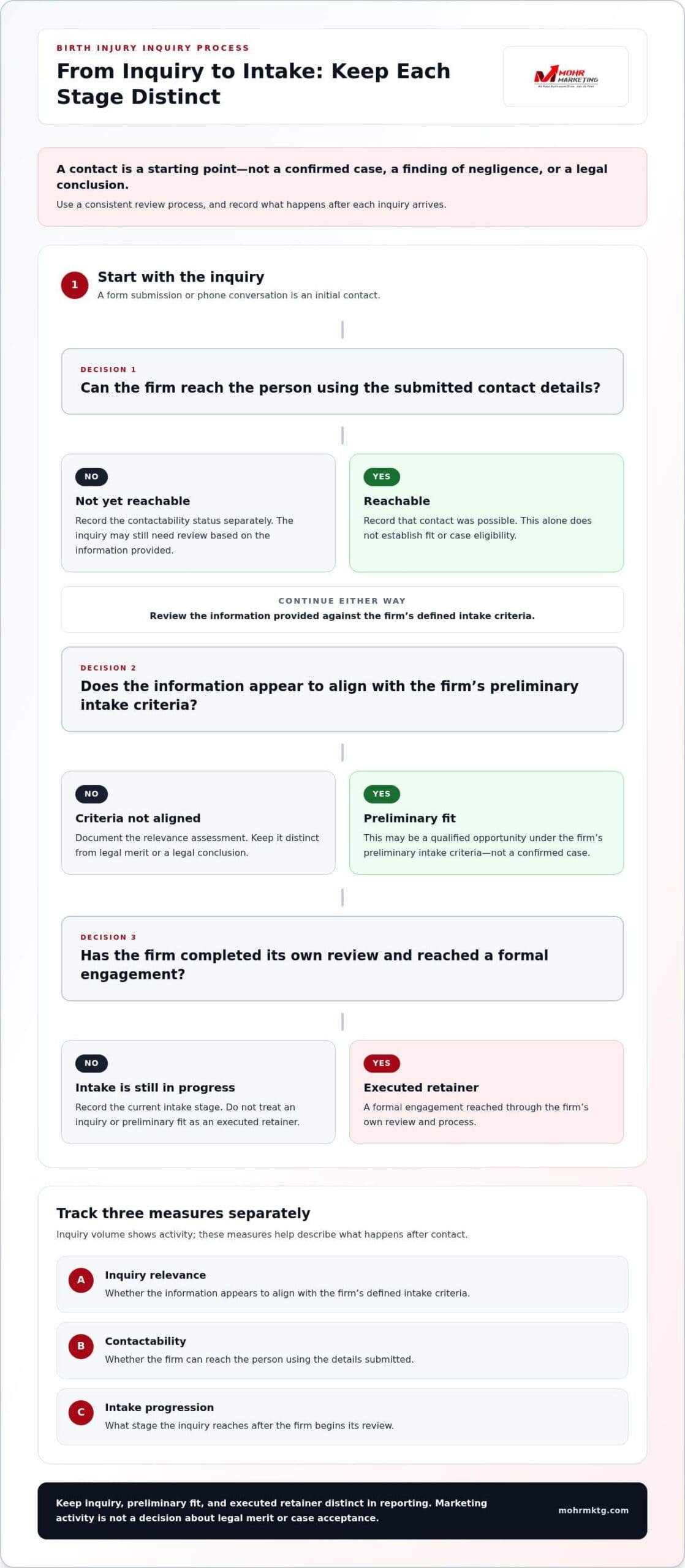
A birth injury inquiry is an initial contact from someone seeking information or asking a firm to review a concern. It is not a confirmed case, a finding of negligence, or a legal conclusion. Marketing can provide a path to contact, but the firm’s own review determines what happens next.
Raw inquiry counts show activity, not fit. A high total may include duplicate submissions, unreachable contacts, or people whose circumstances do not align with the firm’s criteria. Without recording what happens after each inquiry arrives, a firm cannot tell whether a campaign is reaching relevant audiences or simply generating more contacts.
An inquiry is an initial expression of interest; a qualified opportunity is one that meets the firm’s preliminary intake criteria; an executed retainer is a formal engagement reached through the firm’s own review and process. These are separate stages. Reporting should not treat them as interchangeable.
What makes birth injury inquiries a distinct marketing challenge?
Families may be trying to understand a complex medical event while looking for clear next steps. A plain-language overview of Birth Injury Overview can help orient readers to the subject, but an individual’s question is not the same as a firm’s legal evaluation. Campaigns should acknowledge uncertainty, explain what happens after someone reaches out, and avoid suggesting that every concern has a legal remedy.
Use respectful language across search ads, educational pages, forms, and follow-up messages. Avoid alarmist phrasing or claims that imply a particular injury proves fault. The goal is to help people understand how to take the next step without pressuring them or promising a result.
Which outcomes should a firm define before launching?
Before choosing a channel, document the firm’s criteria for relevant inquiries. These may reflect its practice focus and intake process. Keep those criteria distinct from marketing metrics: a campaign can be assessed on whether it attracts and routes relevant contacts, while legal merit and case acceptance remain matters for the firm’s evaluation.
Track three concepts separately:
- Inquiry relevance: Whether the information provided appears to align with the firm’s defined intake criteria.
- Contactability: Whether the firm can reach the person using the contact details submitted.
- Intake progression: What stage the inquiry reaches after the firm begins its review.
For example, a submitted form may appear relevant but still be awaiting review. Another inquiry may have been reviewed, but the person cannot yet be reached. Record each stage separately to compare campaign activity with intake performance. This prevents inquiry volume from standing in for quality.
How the Birth Injury Inquiry-Generation Process Works
A workable inquiry process connects what a person is looking for with information that addresses the question and a clear way to contact the firm. Each handoff should be consistent: a campaign sets expectations, its landing page follows through, and the form or call gives the firm information to begin its review. Generating birth injury case inquiries is more effective when these steps are planned as one journey rather than handled as separate marketing tasks.
Search intent leads to relevant information, relevant information invites an inquiry, and the firm evaluates that inquiry through its own intake process. This sequence keeps marketing focused on access and clarity, without presenting advertising or educational material as a decision about someone’s legal options.
Build campaigns around relevant search intent
Start with the questions families may bring to a search, such as how to understand a concern or what information may be useful when speaking with a law firm. Group topics by the need they address, then match each campaign and landing page to that need. A page reached through an ad about a specific concern should address that concern directly, rather than send readers to broad claims or unrelated material.
Educational content can explain general concepts and outline possible next steps while making its limits clear. It should not diagnose an injury, offer individualized legal advice, or suggest that every reader has a claim. Use plain, respectful language. The call to action should invite a person to share information or request contact, not imply that the firm has agreed to represent them.
Capture and assess inquiries consistently
A form submission or phone conversation is an entry point, not a promise of representation. Request information that supports the firm’s initial relevance review, such as a way to make contact and a concise description of the concern. Keep questions focused. A long or unclear form can create friction, while a form that collects too little context may leave intake staff without a useful starting point.
Define verification as checking submitted information against the campaign’s agreed process criteria. This can include confirming that required fields are present, reviewing whether the inquiry relates to the intended subject, and identifying details that need follow-up. Verification helps establish whether an inquiry is usable for the next intake step; it does not determine legal merit.
Route submitted inquiries into a consistent review process. Record the source, the information received, and the next action so the firm can trace how an inquiry moves from submission to review. Keep marketing assessment separate from legal evaluation. The law firm remains responsible for deciding whether to assess a matter further and whether it meets the firm’s standards.
Before launch, align campaign language, landing-page content, form questions, and intake handling. This reduces mismatched expectations and gives the firm a clearer view of how inquiries enter and progress. Firms refining this handoff can discuss a coordinated inquiry and intake approach.
Compare Birth Injury Inquiry-Generation Approaches Beyond Cost or Volume
Choose channels based on more than the number of inquiries they may generate. Weigh how much control your firm wants over messaging and execution, what work its team can sustain, and whether results can be measured against its own case criteria. No channel is automatically superior. A useful comparison accounts for budget oversight, internal capacity, and the intake process.
The options below differ in emphasis. Define responsibilities and reporting before launch so performance can be assessed consistently.
| Approach | Control | Work required | Measurement focus |
|---|---|---|---|
| Organic search | Builds visibility through the firm’s content and search presence. | Requires sustained planning, content development, and refinement. | Track relevant inquiries and intake progression alongside visibility. |
| Paid campaigns | Places messaging within defined campaign parameters. | Requires campaign oversight, budget governance, and review of messaging. | Connect campaign activity to inquiry relevance and subsequent intake stages. |
| Managed acquisition | Can coordinate inquiry generation with defined acquisition goals. | Work is organized through the agreed process; clarify internal ownership and handoffs. | Review inquiry quality, delivery, and agreed outcomes transparently. |
When should a firm use organic search or paid campaigns?
Organic search suits firms prepared to invest ongoing strategic effort in useful content and visibility. Paid campaigns can place targeted messaging in front of audiences within set parameters. A firm may use either approach or combine them, but both require consistent inquiry tracking and review of campaign language. Compare results using the same intake definitions, rather than judging one channel by clicks and another by later-stage outcomes.
Before allocating resources, identify who will oversee content or campaigns, who will review submitted inquiries, and how progress will be documented. If internal capacity is limited, the coordination required becomes a key factor. If budget governance is central, establish how campaign activity will be monitored before launch. These operational realities matter as much as channel choice.
How do inquiry and signed-retainer models differ?
Inquiry-based acquisition centers on delivering prospective contacts for the firm to review. Signed-retainer acquisition centers on delivering executed agreements, as applicable to the arrangement. The models focus on different stages of the acquisition process. Neither removes the need to define criteria, understand the agreed process, and assess performance using accurate records.
For a fair comparison, examine who is responsible at each stage, what is being measured, and how intake handling affects conversion efficiency. The title The ROI of Legal Intake Services captures a related consideration: acquisition performance depends not only on attracting interest, but also on how inquiries are handled and progressed. When generating birth injury case inquiries, separate channel activity from intake outcomes. This helps the firm identify where refinement may be needed without treating volume as proof of case acceptance or legal merit.
Put a Birth Injury Inquiry Program into Practice and Measure It
A campaign is easier to manage when the operating plan is settled before inquiries begin arriving. Define the firm’s criteria, select an acquisition channel, prepare the intake workflow, track outcomes, and use the resulting information to refine the program. This sequence connects marketing decisions to what the firm sees in intake, rather than treating inquiry volume as the only measure of progress.
- Document the firm’s criteria. Specify its geographic focus, relevant facts, and practice-fit considerations. These are firm-defined intake parameters, not legal thresholds or a substitute for evaluating an individual matter.
- Select a channel. Choose an approach that fits the firm’s goals, budget oversight, and capacity to maintain campaigns and content.
- Assign intake ownership. Name who reviews inquiries, handles follow-up, and records each disposition before launch.
- Set reporting definitions. Agree on how the team will record delivery, relevance, verification status, contact outcomes, and intake progression.
- Review and refine. Compare campaign activity with intake feedback, then make controlled adjustments based on documented patterns.
Set criteria, ownership, and measurement before launch
Write criteria in terms intake staff can apply consistently. Clarify how the firm will record an inquiry that appears relevant, one that needs more information, and one that does not align with the firm’s stated focus. Assign responsibility for each review and follow-up step so staff know who acts next. This also creates a clearer record of what happened after an inquiry was delivered.
Use distinct reporting labels for distinct stages. A delivered inquiry is not the same as a verified contact, a completed conversation, or an inquiry that progresses through intake. Keep definitions stable during campaign reviews so results can be compared meaningfully. For broader acquisition context, the Personal Injury Lead Generation Companies guide can be considered alongside the firm’s own operating criteria.
Use intake feedback to improve campaign quality
Intake records can reveal where messaging and incoming inquiries do not align. If inquiries repeatedly reflect a different concern than the campaign describes, review the search topic, ad language, landing page, and form together. If contact details are often incomplete, examine whether the form explains what information is requested and why. Treat feedback as a signal to investigate, not an automatic instruction to change the campaign.
Share aggregated disposition trends with marketing decision-makers and adjust one element at a time where practical. Then observe whether the change affects relevance, contactability, and progression using the same reporting definitions. A short-term increase or decrease in volume alone does not establish improved inquiry quality. For firms generating birth injury case inquiries, disciplined measurement means assessing the path from delivery through intake while leaving case evaluation to the firm.
How Mohr Marketing Supports Birth Injury Inquiry Generation
Generating birth injury case inquiries requires acquisition activity and intake operations to work toward the same defined goals. Mohr Marketing provides verified inquiries, signed cases, and managed digital marketing through a turnkey marketing and intake ecosystem for law firms. With more than 30 years of industry experience, Mohr Marketing connects acquisition strategy with clear processes and transparent performance, rather than treating inquiry volume as an end in itself.
Connect campaign strategy with verified opportunities
Begin with the firm’s acquisition objectives and intake criteria. High-intent opportunities can then be considered in the context of the intended audience and review process. Verification and intake coordination help structure how opportunities are delivered and handled, while the firm retains responsibility for evaluating a matter and deciding whether to pursue representation.
This separation is essential. Marketing can support access to prospective clients and provide a process for handling inquiries, but it cannot determine legal merit or guarantee that a firm will accept a matter. A coordinated approach makes the path from acquisition to intake understandable and provides performance information to assess activity against the firm’s goals.
A firm can define its objectives around practical questions:
- Audience fit: Are inquiries aligned with the firm’s stated focus and criteria?
- Process fit: Can the firm review and follow up on opportunities through its existing intake workflow?
- Performance visibility: Can decision-makers distinguish delivered inquiries from later stages in the firm’s own process?
Choose a performance model that fits the firm’s goals
The appropriate structure depends on what the firm wants to measure and how its team handles intake. Inquiry-based acquisition centers on prospective contacts for firm review. A signed-case model centers on executed retainers, as applicable to the arrangement. Managed marketing connects campaign strategy and acquisition activity with a coordinated process. Each model focuses on a different stage, so compare its structure and reporting with the firm’s objectives rather than assuming one model fits every practice.
Mohr Marketing’s data-driven, transparent approach helps firms evaluate acquisition activity against their defined goals. Clear expectations for inquiry delivery, intake coordination, and reporting give marketing decision-makers and firm staff a shared operating framework. The firm’s legal evaluation and representation decisions remain separate from marketing services, and no acquisition model should be treated as a promise of eligibility, acceptance, or legal outcome.
Discuss your firm’s birth injury inquiry-generation objectives and the acquisition structure that fits your intake process.
Make Your Next Acquisition Decision with Confidence
Use your next planning discussion to turn the inquiry-generation strategy into a clear decision agenda. Identify the question the firm needs answered first: whether campaign messaging reaches the intended audience, whether the intake experience gives people a clear next step, or whether current reporting supports sound comparisons. Agree on what evidence would inform that decision before making changes. This keeps generating birth injury case inquiries tied to a defined business objective rather than a push for activity alone.
Then choose a focused improvement and add it to the firm’s operating plan. Marketing and intake teams should understand what is changing, why it matters, and what information will guide the next review. A disciplined learning process helps firms adapt while maintaining careful communication in a sensitive practice area.
Mohr Marketing helps firms clarify acquisition objectives and consider an approach aligned with their intake operations.
A clear objective is a strong place to begin. With a considered plan, your team can move forward with purpose.
Frequently Asked Questions
What is a birth injury case inquiry?
A birth injury case inquiry is a contact from someone asking a law firm for information or review related to a birth injury concern. For example, someone might submit a website form describing a concern and requesting a call. That contact begins communication; it does not establish that a legal claim exists, that the firm will accept the matter, or that any conclusion has been reached.
How can a law firm generate birth injury inquiries?
A firm can connect relevant search topics with clear, educational landing pages and a straightforward way to contact the practice. For example, a page answering a general question about birth injury concerns should provide information that matches the topic and explain how to submit an inquiry. Generating birth injury case inquiries also requires reviewing campaign and intake records together, so the firm can assess whether messaging attracts the intended contacts.
What makes a birth injury inquiry qualified?
A qualified inquiry is one that meets the firm’s own preliminary criteria for further intake review. Those criteria may include practice fit, relevant information supplied, and whether the person can be reached. Qualification is an operational label, not a legal finding. For instance, a contact may warrant follow-up because key details are missing, while another may fall outside the firm’s stated focus.
Should a firm measure birth injury inquiries by volume or quality?
Measure both, but use inquiry volume as a count, not as a quality verdict. Compare it with indicators such as relevance to the firm’s criteria, successful contact, and progression through intake. If submissions increase while fewer people can be reached or reviewed, the extra volume may not advance the firm’s objectives. Consistent definitions let decision-makers compare channels without confusing activity with useful outcomes.
Can marketing materials promise that a family has a birth injury case?
No. Marketing materials should not present an inquiry or described concern as proof that a family has a case. Content can explain general information and invite a person to request contact, while avoiding claims about eligibility, acceptance, or likely outcomes. The firm must make its own legal evaluation through its process. Clear, measured language also helps set appropriate expectations before someone submits information.
How does intake affect birth injury inquiry-generation performance?
Intake determines how consistently the firm handles, documents, and advances incoming contacts. If staff use different definitions for relevance or fail to record follow-up outcomes, campaign reports may not show where the process is working or breaking down. A shared disposition system can distinguish an unreachable contact from one awaiting review. That feedback gives marketing decision-makers a more useful basis for refining campaign messaging.

Recent Posts
- How to Reduce Client Acquisition Cost for Law Firms Without Sacrificing Case Quality
- Generating Birth Injury Inquiries: A Guide for Law Firms
- Digital Retainer Signing Guide for Law Firms
Categories
- AI and Lead Generation
- Business Financing
- Call Verified MVA Leads
- Car Accident Help
- Car Accident Settlements
- Claimant Funding
- Compliance Program
- EMS-EMT Reports
- Geotargeting
- Google Maps Ranking
- Healthcare Practice Growth
- Law Firm Growth
- Law Office Operations
- Lead Generation
- Lead Generation For Attorneys
- Lead Generation For Chiropractors
- Lead Generation For Criminal Attorneys
- Lead Generation For D&A Treatment Centers
- Lead Generation For DUI Attorneys
- Lead Generation For Eye Doctors
- Lead Generation For Family Law Practices
- Lead Generation For PI Law Firms
- Lead Generation For Plastic Surgeons
- Leads For Healthcare Professionals
- Leads For Insurance Industry
- Legal Leads
- Legal Marketing
- Legal Updates
- Mass Tort Leads
- Medicare and Medicaid Leads
- Merchant Funding Leads
- Mold Leads
- Online Marketing Strategies
- Pre-Settlement Funding
- Signed MVA Cases
- Tort Updates
- Truck Accident Leads and Signed Cases
- Truck Accident Settlements
- Web Design