Digital Retainer Signing Guide for Law Firms
October 10, 2026 by Mohr Marketing
What if the biggest obstacle to a signed retainer is not the signature itself, but the handoff that comes before it? Digital retainer signing for law firms works best when document delivery is part of a defined intake process. Qualified prospects can stall when follow-up has no clear owner, status updates are unclear, or the firm treats eSignature software as the entire solution. A fast signature matters, but so does a reliable path from inquiry to completed agreement.
Digital signing can reduce friction, but firms need clear steps, accountable ownership, and visibility into each prospect’s progress to make that improvement stick. This guide maps the process from qualified inquiry through intake, retainer delivery, follow-up, and completion. It also explains which measures can reveal workflow gaps and how to assess signed-retainer support as part of a broader acquisition strategy. The goal is a controlled process that preserves intake quality while helping qualified prospects move forward.
Key Takeaways
- Separate signing from qualification, legal review, and case acceptance so each stage has a clear purpose.
- Define the sequence from inquiry qualification to document preparation, review, delivery, follow-up, and completion.
- Evaluate digital retainer signing for law firms beyond the signature tool, including intake coordination, workflow visibility, and completion records.
- Identify where prospects wait or repeat information, then assign ownership and follow-up to reduce avoidable friction.
- Decide whether your firm needs document execution, intake support, or a broader acquisition approach that connects verified inquiries with signed retainers.
What Digital Retainer Signing Means for a Law Firm’s Intake Process
Digital retainer signing is the electronic execution of a law firm’s engagement agreement. It records the parties’ signatures, but it is only one event in a larger process. It does not qualify an inquiry, complete the firm’s legal review, resolve unanswered intake questions, or determine whether the firm will accept a case.
A signing tool captures an agreement; a retainer workflow moves a qualified prospect through firm review, document delivery, follow-up, and a clear acceptance decision. This distinction matters because responsibility can pass among intake staff, attorneys, and administrative teams. Without an owner for the next step, an agreement may sit unsigned or be signed without being reviewed and recorded.
Where digital signing fits between inquiry and case opening
Begin with the inquiry. The firm screens the prospect, gathers relevant information, and assesses whether the matter meets its criteria. Before sending an agreement, the firm decides whether the inquiry is sufficiently qualified, whether it needs further legal review, and whether the firm is prepared to offer an engagement agreement.
Once approved for delivery, the agreement goes to the prospect for review and signature. The firm then checks the returned document, records the outcome, and determines the next step toward opening a matter. A signed agreement is an important record, but it does not independently establish that the firm has accepted the case. For background on the federal framework, see the Electronic Signatures in Global and National Commerce Act (ESIGN Act). The firm should verify how applicable requirements affect its documents and procedures.
What digital signing can and cannot solve
Electronic delivery can reduce paper-based handoffs by eliminating the need to print, mail, and manually return physical copies. Depending on the firm’s process and tools, it can also make it easier to see whether an agreement is awaiting signature or has been completed.
Technology cannot decide whether an inquiry meets the firm’s criteria, explain unresolved legal questions, or ensure someone follows up. Assign an owner at every transition: who approves sending, who monitors the agreement, who follows up if it remains incomplete, and who reviews the signed record. Define a next action for exceptions, such as a prospect requesting clarification or returning an incomplete agreement.
These principles apply across practice areas. A firm handling motor vehicle matters, for example, can connect intake and signed-case acquisition through a workflow like its truck accident signed cases and verified call transfer leads. Signing belongs within a managed path from inquiry to firm decision, not in isolation.
Digital Retainer Workflow: From Intake to Execution
A reliable workflow makes every handoff visible. Define the action at each stage and the person accountable for moving it forward. Record enough to explain the decision and next step, without using workflow fields as a substitute for the firm’s screening or legal judgment.
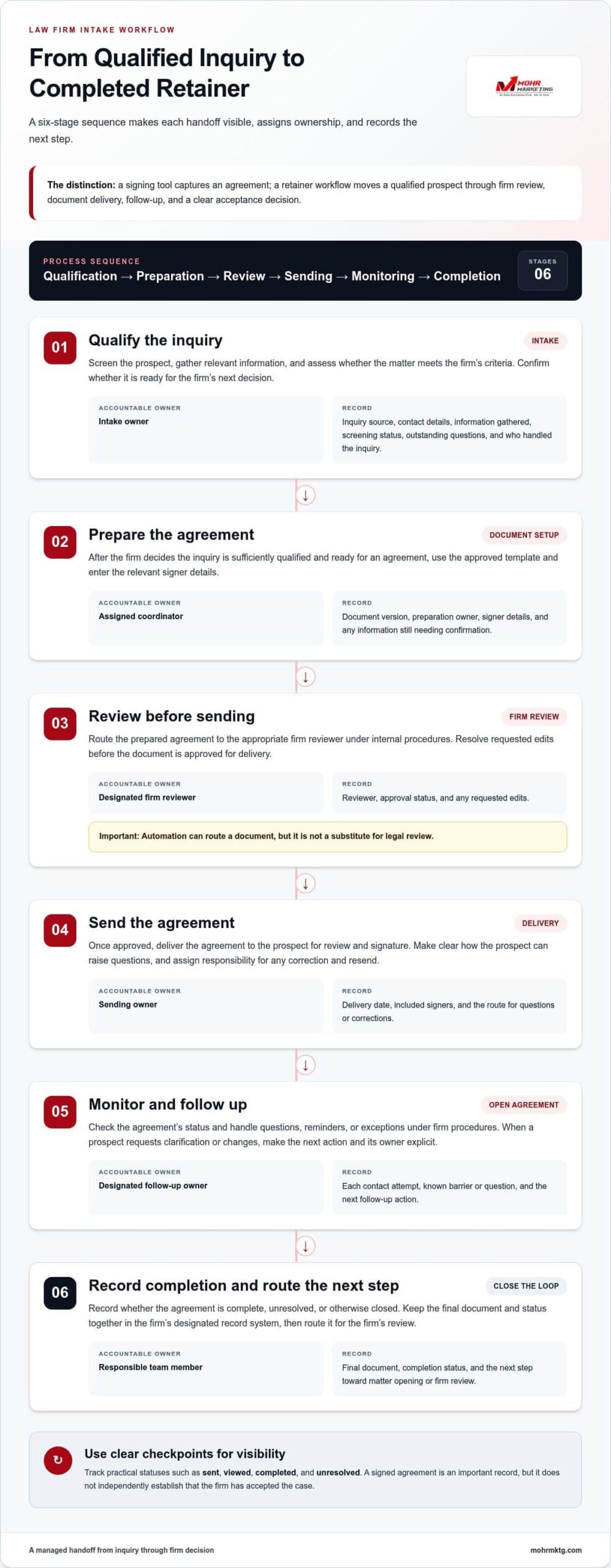
The workflow moves from qualification to preparation, review, sending, monitoring, and recording completion. Use these stages as a practical operating sequence:
- Qualify: The intake owner records the inquiry source, contact details, information gathered, screening status, and outstanding questions. The record should show who handled the inquiry and whether it is ready for the firm’s next decision.
- Prepare: The assigned coordinator selects the firm’s approved agreement template and enters the relevant signer details. Track the document version, preparation owner, and any information still needing confirmation.
- Review: Route the prepared agreement to the appropriate firm reviewer under internal procedures. Record who reviewed it, whether it was approved for sending, and any requested edits. Automation can route a document, but it is not a substitute for legal review.
- Send: The sending owner records when the agreement was delivered, which signers were included, and how the prospect can raise questions. If a correction is needed, assign responsibility for preparing and resending the document.
- Monitor: The designated follow-up owner checks the agreement’s status and handles questions, reminders, or exceptions under firm procedures. Log each contact attempt and its next step rather than leaving the status to inference.
- Record completion: The responsible team member records whether the agreement is complete, unresolved, or otherwise closed, then routes it for the firm’s review. Keep the final document and status together in the firm’s designated record system.
Prepare and route the retainer with clear ownership
Approved templates and consistent signer details can prevent avoidable preparation errors. Define the handoff: intake provides the relevant information, a coordinator prepares the document, and the firm’s designated reviewer checks it before delivery. Record ownership at each transfer so staff know where to route corrections and document preparation remains distinct from legal judgment.
Track incomplete signatures and close the loop
Use practical status checkpoints such as sent, viewed, completed, and unresolved. Assign one owner to review open agreements, note questions or barriers, and determine the next follow-up action under firm procedures. If a prospect does not complete the document or requests changes, record the reason when known and who will resolve it. Close the record only when the outcome is clear.
Reviewing these handoffs can reveal where intake needs stronger ownership or support. Firms assessing how to connect inquiry handling with retainer completion can discuss their intake and signed-retainer workflow with Mohr Marketing.
How to Evaluate Digital Retainer Signing Beyond the Signature Tool
Compare the full path to a completed retainer, not just the screen where a person signs. A platform may support document preparation, signer routing, and status tracking. Intake determines how an inquiry is handled before an agreement is sent, while signed-retainer delivery connects those steps to a completed document. A signature platform manages execution; intake manages the path to execution.
Use this framework to distinguish capabilities and identify where your firm needs more than software:
Document execution: Can the team prepare an agreement, enter signer-specific information, route it to the appropriate parties, and see its current status?
Intake: Does the process capture inquiry details, screening progress, outstanding questions, and the responsible staff member before an agreement is considered?
Verification: Can the firm review the information it needs to make its own decisions and distinguish verified details from unanswered or unconfirmed items?
Signed-retainer delivery: Does the workflow produce a completed agreement and a clear record of its outcome, or must the firm still coordinate the steps around signing?
Compare workflow capabilities with firm procedures
Assess how document preparation, signer-specific fields, and routing fit the firm’s review sequence. Check whether everyone who needs to act can access status information and whether the completion record can be maintained in the firm’s designated system. A “completed” status is useful, but it should not replace review of the returned agreement or the firm’s recordkeeping practices.
Fit matters as much as features. If an agreement requires internal review before it goes to a prospect, for example, make that handoff visible rather than allowing document delivery to bypass firm procedures. Treat legal sufficiency as a separate question. Requirements can depend on the circumstances and jurisdiction, so firms should verify applicable details with appropriate legal guidance.
Separate software from intake and acquisition support
Signing software handles document actions. By itself, it does not qualify an inquiry, resolve missing information, or ensure follow-up when a prospect pauses. Those tasks depend on the firm’s intake process and assigned ownership. To evaluate legal intake conversion efficiency, examine how prospects move from initial contact through screening and agreement delivery, not only how quickly a document can be signed.
Managed intake support addresses the people and process around inquiries. Signed-case acquisition connects that work to fully executed retainer agreements from qualified claimants. For firms handling mass tort matters, mass tort signed cases illustrate the difference between buying a signing tool and assessing signed-retainer delivery as an acquisition outcome. Compare each option with the gap you need to address and how it fits the firm’s workflow.
How Law Firms Can Improve Digital Retainer Completion Without Adding Friction
Before changing tools, identify where prospects lose momentum. Review recent inquiries and trace the steps from initial contact to agreement completion. Note where someone waits for a response, is asked for information already provided, or receives a document without clear instructions. These friction points often reveal process gaps that digital retainer signing for law firms alone cannot correct.
Look for patterns rather than isolated exceptions. A delay may result from unclear review ownership, missing information, confusing instructions, or a handoff with no clear owner. Address the underlying cause before adding another tool or reminder.
Reduce avoidable delays in the signing journey
Give each prospect a clear next step and a contact point for questions. Coordinate intake and document handling so teams do not request the same information twice, and limit handoffs to people who need to act or review. Use plain-language instructions, readable documents, and a delivery method the prospect can access. These changes can reduce confusion without adding unnecessary steps.
Use this checklist to identify friction before revising the workflow:
- Can the prospect tell what action is expected after receiving the agreement?
- Does the team know who owns a pending agreement and its next follow-up?
- Are information requests repeated during intake and document preparation?
- Can staff tell whether a delay needs clarification, correction, or further review?
- Are unresolved outcomes recorded with a reason and next action, when known?
Standardize the response when an agreement remains incomplete, a prospect asks a question, or the firm needs to correct a document. Define who handles each situation and how it is escalated under firm procedures. Consistency helps prevent duplicate messages and gaps in communication while allowing the firm to respond to individual circumstances.
Measure process performance without confusing activity with outcomes
Track agreements sent through to completed, unresolved, or otherwise closed outcomes. Where records allow, compare results by inquiry source and workflow stage. This can show whether a bottleneck occurs during screening, preparation, review, delivery, or follow-up. Make a specific process change in response, then review the same measures to see whether it addressed the observed friction.
Separate activity from results. The number of agreements sent describes volume; it does not show whether inquiries were qualified, retainers were completed, or what decision the firm made afterward. Keep these measures distinct and set expectations using the firm’s own data rather than unsupported conversion benchmarks. Tracking process and outcome separately helps leadership determine whether the issue calls for training, clearer ownership, or a broader intake change.
Connect Digital Retainer Signing to a Complete Law-Firm Acquisition Strategy
A signing tool addresses document execution. Intake support addresses how inquiries are handled and advanced. A broader acquisition partner can connect lead generation, qualification, intake, and completed retainers as parts of one operating strategy. The right fit depends on where prospects stall and what the firm needs to manage internally. Evaluate digital retainer signing for law firms as one link in that chain, not as a substitute for it.
Mohr Marketing supports law firms with verified, high-intent inquiries, legal intake services, and fully executed retainer agreements. Its pay-per-signed-case service delivers fully executed retainers from qualified claimants, connecting acquisition and intake activity to a documented signing outcome. The firm remains responsible for its legal decisions and case acceptance.
Match the service model to the firm’s operational need
If the firm already manages inquiries and follow-up effectively but needs electronic document execution, a signing tool may address that specific need. If prospects wait for screening, repeat information, or receive inconsistent follow-up, intake support may be more relevant. When the gap spans qualified inquiry generation through retainer completion, a broader acquisition partner can coordinate those stages.
These needs are distinct, not interchangeable. A completed retainer is a measurable process outcome, but it does not guarantee that a firm will accept a matter or achieve a particular case result. Define the firm’s decision points and desired handoffs first. Then assess whether the gap is in document handling, inquiry management, or the connection between them.
Move from workflow assessment to a focused conversation
Before discussing a service model, summarize the practice focus, how inquiries enter the firm, who handles intake, and where agreements tend to stall. Bring examples of handoffs that create delays or leave ownership unclear. This provides a practical starting point and helps distinguish a tool requirement from a need for coordinated intake or signed-retainer acquisition.
Mohr Marketing brings more than 30 years of industry experience to legal marketing and intake. Its approach connects lead generation, legal intake, and signed retainers rather than treating the signature as an isolated event. This can help firms assess how verified inquiries and completed agreements fit within their acquisition strategy, without promising case outcomes.
Make the Next Step Clear
Use your workflow assessment to identify one decision the firm can make now: clarify who owns the next handoff, resolve a recurring delay, or determine whether the gap calls for document execution, intake support, or a broader acquisition strategy. A focused change gives the team a practical starting point and makes it easier to assess whether the process is improving.
Effective digital retainer signing for law firms is not simply a matter of sending agreements electronically. It depends on matching the signing process to the firm’s goals, internal procedures, and prospect experience. Start with the most important point of friction, then build a more direct path forward.
To discuss how Mohr Marketing’s legal intake and signed-retainer services could fit your acquisition strategy, contact the team.
Frequently Asked Questions
Are digital retainer agreements legally binding for law firms?
Electronic signatures may be legally recognized, but a firm should not assume every document and situation is treated the same way. Applicable rules can depend on the agreement and jurisdiction. Before adopting an electronic process, have the firm’s legal team review whether it fits the documents involved and how the firm obtains consent, confirms signer identity, and retains the completed record. This is general information, not legal advice.
How does digital retainer signing work for a law firm?
A firm first decides whether an inquiry is ready for an engagement agreement under its own procedures. The agreement is prepared, reviewed, and sent to the intended signer electronically. After signing, staff review the returned record and determine the next internal action. Linking the agreement to the inquiry’s matter or intake reference can help staff find its context without searching email.
Can a law firm send a retainer agreement electronically after intake?
Yes. A firm can send an agreement electronically after intake when its review process authorizes that step. For example, intake staff may collect preliminary information, then route the inquiry for attorney review before preparing an agreement. Give the prospect clear instructions and a way to raise questions. Keep a record of the approved agreement version and recipient so staff can address later questions about what was sent.
What should a law firm track when a retainer is sent but not signed?
Record the agreement’s current status, the date of the latest activity, the staff member responsible, and the next planned action. Note whether the prospect viewed the document, asked a question, requested a change, or indicated they would not proceed. If the reason is unknown, record it as unknown rather than guessing. These details help the team distinguish a technical issue from a decision still pending with the prospect.
Does eSignature software qualify legal leads or provide intake services?
No. eSignature software supports document preparation, delivery, and signing. It does not independently assess whether an inquiry fits a firm’s criteria or conduct an intake conversation. A platform may show that a document was opened, for example, but it cannot establish whether an unanswered question needs human follow-up. Firms need a defined intake process and responsible staff to handle screening, clarification, and prospect communication.
How can law firms connect signed retainers with lead generation?
Track the inquiry source alongside intake status, agreement delivery, and the firm’s decision after receiving a signed document. This lets the team examine where qualified prospects progress or stall without treating every inquiry or signature as an accepted case. For example, compare records by campaign source and note whether screening or follow-up remains incomplete. Use those observations to refine acquisition and intake processes, while leaving case acceptance to the firm.
What is the difference between a digital signature platform and signed-retainer services?
A digital signature platform provides a tool for electronic document execution. Signed-retainer services connect the agreement to a broader process that can include qualified claimant inquiries and intake, with fully executed retainer agreements delivered as an outcome. Mohr Marketing provides legal intake and signed-retainer services, not standalone eSignature software. The law firm retains control of its legal review and decisions about whether to accept a matter.

Recent Posts
- Digital Retainer Signing Guide for Law Firms
- Car Accident Lead Qualification: Guide for Law Firms
- Medical Malpractice Leads: A Strategic Guide for Law Firms
Categories
- AI and Lead Generation
- Business Financing
- Call Verified MVA Leads
- Car Accident Help
- Car Accident Settlements
- Claimant Funding
- Compliance Program
- EMS-EMT Reports
- Geotargeting
- Google Maps Ranking
- Healthcare Practice Growth
- Law Firm Growth
- Law Office Operations
- Lead Generation
- Lead Generation For Attorneys
- Lead Generation For Chiropractors
- Lead Generation For Criminal Attorneys
- Lead Generation For D&A Treatment Centers
- Lead Generation For DUI Attorneys
- Lead Generation For Eye Doctors
- Lead Generation For Family Law Practices
- Lead Generation For PI Law Firms
- Lead Generation For Plastic Surgeons
- Leads For Healthcare Professionals
- Leads For Insurance Industry
- Legal Leads
- Legal Marketing
- Legal Updates
- Mass Tort Leads
- Medicare and Medicaid Leads
- Merchant Funding Leads
- Mold Leads
- Online Marketing Strategies
- Pre-Settlement Funding
- Signed MVA Cases
- Tort Updates
- Truck Accident Leads and Signed Cases
- Truck Accident Settlements
- Web Design