How to Improve Law Firm Intake Process: A 2026 Guide to Maximizing Signed Case Yield
July 17, 2026 by Mohr Marketing
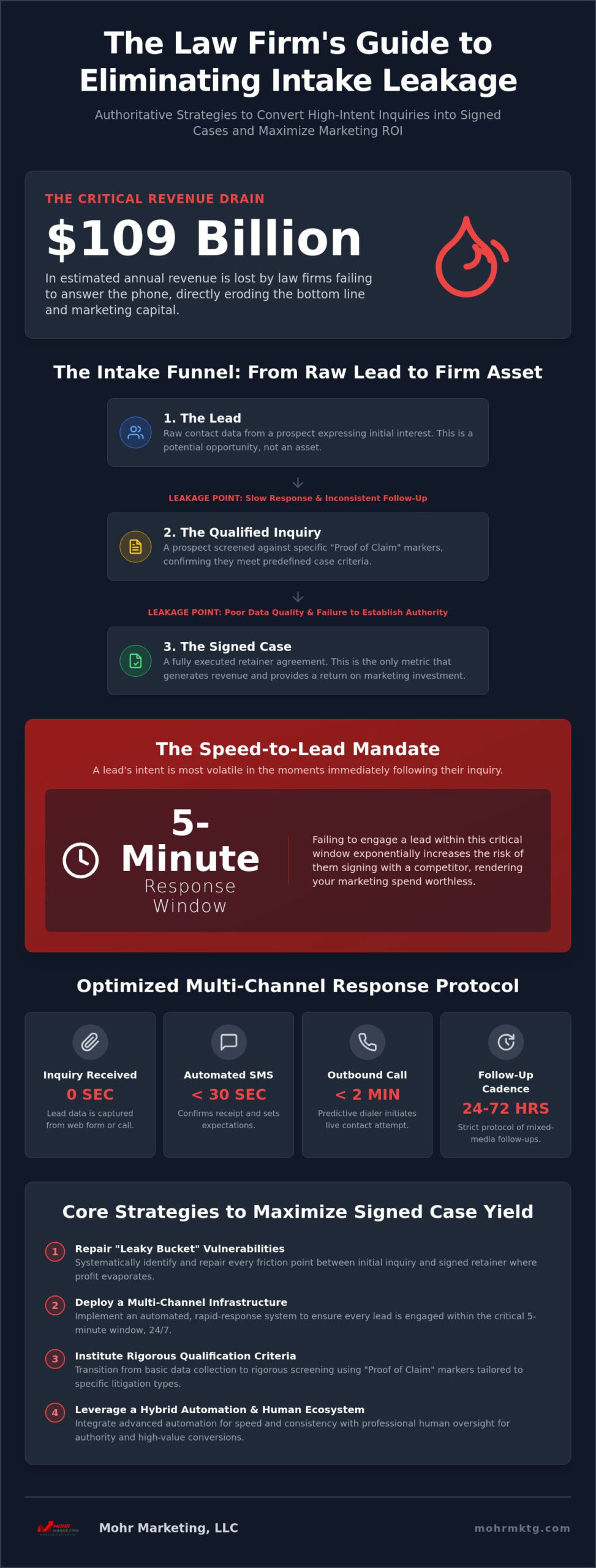
An estimated $109 billion in annual revenue is lost every year because law firms fail to answer the phone. For firms investing heavily in mass tort or personal injury marketing, this leakage is not merely a missed opportunity; it is a direct erosion of your bottom line. You already understand that a high cost per lead is irrelevant if conversion rates remain stagnant due to slow response times or inconsistent qualification. Firms that fail to respond within five minutes essentially hand high-value cases to their competitors and deplete marketing capital without generating a return.
This 2026 guide by Mohr Marketing, LLC provides the authoritative strategies required to improve law firm intake process and maximize your signed case yield. You will learn how to eliminate lead leakage and convert high-intent inquiries into fully executed retainer agreements with mechanical precision. We will detail the exact steps to standardize your qualification criteria, accelerate your speed-to-lead metrics, and scale your operations for national campaigns. It is time to move beyond processing leads and begin securing the high-value cases your firm requires for sustainable growth.
Key Takeaways
- Identify and repair “Leaky Bucket” vulnerabilities where profit evaporates between the initial inquiry and the signed retainer.
- Deploy a multi-channel infrastructure to improve law firm intake process speed, ensuring every lead is engaged within the critical 5-minute window.
- Transition from basic data collection to rigorous qualification using “Proof of Claim” markers tailored to specific litigation like mass torts.
- Leverage a hybrid ecosystem that integrates advanced automation with professional human oversight to maximize conversion of high-intent leads.
- Evaluate the strategic advantages of a pay-per-signed-case model to eliminate the financial risk of internal intake inefficiencies.
The Economics of Legal Intake: Why Your Process Is Leaking Profit
Legal intake is the critical infrastructure linking marketing expenditure to firm revenue. In high-stakes litigation, this process must be viewed as a mechanical yield problem. To improve law firm intake process efficiency, you must recognize that every friction point between initial contact and the final signature is a potential point of profit failure. In 2026, intake is no longer a back-office administrative task; it is the front-line competitive sales function that determines the success of your entire acquisition strategy.
The “Leaky Bucket” syndrome describes the cumulative loss of potential revenue at every stage of the funnel. If the transition from a raw lead to a signed retainer is not seamless, you effectively deplete marketing capital without securing an asset. To identify these leaks, your firm must distinguish between three distinct stages of the acquisition cycle:
- The Lead: Raw contact data from a prospect who has expressed initial interest.
- The Qualified Inquiry: A prospect who has been screened and meets specific “Proof of Claim” markers.
- The Signed Case: A fully executed retainer agreement, which is the only metric that generates value for the firm.
Minor inefficiencies result in exponential losses. When a firm treats intake as a clerical function, it overlooks the reality that claimants are often shopping their cases to multiple firms simultaneously. The firm that establishes professional authority first captures the case.
Calculating the True Cost of Lead Leakage
Efficiency is a mathematical multiplier for your ROI. A 10% decrease in intake efficiency can effectively double the cost per signed case because the fixed costs of lead generation remain constant while the output diminishes. This creates the “Ghost Lead” phenomenon, where high-value prospects contact your firm but sign with a competitor before your staff can follow up. Delays signal a lack of institutional urgency to the claimant, which immediately erodes trust and prompts them to look elsewhere.
Identifying Bottlenecks in the Traditional Law Firm Model
Staff distractions are the primary cause of lead leakage in the traditional model. Internal employees often juggle active case management with new inquiries, leading to “Qualification Fatigue.” When staff members are overwhelmed by volume, they begin to skip critical questions or rush through screening scripts. This inconsistency results in poor data quality and missed opportunities. Furthermore, inquiries arriving after-hours or on weekends are frequently lost to competitors who utilize professional legal intake services. Mohr Marketing, LLC provides the specialized infrastructure required to eliminate these bottlenecks and ensure that every high-intent inquiry is converted into a viable file.
Optimizing Response Infrastructure: The Speed-to-Lead Mandate
The infrastructure required to improve law firm intake process must be built for immediate, multi-channel engagement. While the necessity of a five-minute response window is well-documented, many firms lack the mechanical systems to execute this mandate consistently. In 2026, relying solely on business-hours staffing is an ineffective model that ensures high-value leads sign with more agile competitors. A robust response framework must operate with the understanding that a lead’s intent is most volatile in the moments immediately following their inquiry.
Modern intake requires a sophisticated blend of technology and human interaction. Many firms are currently exploring AI in legal intake to manage the initial surge of data, yet technology alone cannot replace the authority required to secure a retainer. Your system must bridge the gap between a digital submission and a live voice conversation through a synchronized multi-channel approach that includes SMS, email, and outbound voice protocols.
Implementing a Multi-Channel Immediate Response System
A rigorous response protocol begins with an automated SMS acknowledgment delivered within 30 seconds of form submission. This immediate touchpoint confirms receipt and discourages the prospect from continuing their search. Simultaneously, your system should trigger a predictive dialer to initiate an outbound call within two minutes. If the initial attempt is unsuccessful, follow a strict escalation protocol: three follow-up attempts within the first 24 hours, followed by a 72-hour cadence of mixed-media touches before the lead is moved to a long-term nurture sequence.
The Role of Professional Intake Call Centers
General answering services are insufficient for the complexities of personal injury or mass tort litigation. You require specialized intake professionals who possess the training to handle sensitive inquiries with both empathy and procedural precision. One of the most efficient ways to bypass the “chase” phase of acquisition is through verified call transfer leads. This model delivers a live, pre-screened prospect directly to your team, ensuring that your staff only spends time on high-intent inquiries. If your current response times are lagging, it is advisable to evaluate your infrastructure with a strategic partner like Mohr Marketing, LLC.
Rigorous Case Qualification: Moving Beyond Basic Contact Info
High-volume lead generation is useless without a rigorous filtering mechanism. To improve law firm intake process, you must shift from gathering basic contact data to verifying “Proof of Claim” markers during the initial interaction. This prevents your legal team from wasting billable hours on non-viable inquiries. Efficiency is a choice. By deploying conditional logic in digital intake forms, you can filter out non-qualified claimants before they ever reach a live agent, saving thousands in labor costs.
Custom screening scripts are mandatory for complex litigation. Whether you’re targeting Camp Lejeune victims or motor vehicle accidents, the questions must be surgical. For personal injury firms, verification is paramount. Utilizing police report-backed MVA cases ensures that liability and insurance coverage are established before your staff ever picks up the phone. This level of precision eliminates the guesswork that plagues traditional intake models.
Developing Case-Specific Screening Rubrics
Every mass tort campaign requires a strict rubric to ensure case quality. You must identify the “Must-Have” criteria early in the conversation. This includes verified exposure to the toxin or product, a specific medical diagnosis that matches the litigation’s current science, and a clear path through the statute of limitations. Early disqualification is a strategic win; it protects your attorney’s bandwidth. Integrating medical record retrieval into the intake phase further solidifies the case value before the file is even opened in your practice management software.
Standardizing the Retainer Execution Process
The transition from “interested prospect” to “signed client” is the most volatile phase of the funnel. Use mobile-first e-signature tools to capture intent while it’s at its peak. Your intake team must be trained to handle common claimant objections immediately. Most prospects hesitate due to cost concerns; your staff should confidently explain the contingency fee model to remove this friction. In a performance-driven ecosystem, the ultimate goal is fully executed retainers. This model shifts the conversion risk away from the firm, ensuring you only invest in cases that meet every rigorous qualification standard you’ve set.
The Intake Ecosystem: Integrating Automation and Human Expertise
Technology is a force multiplier, not a standalone solution. Many firms attempt to improve law firm intake process by purchasing expensive software, only to find their conversion rates remain flat. Software cannot empathize with a car accident victim or navigate the complex emotions of a medical malpractice claimant. The Mohr Marketing, LLC “Turnkey Ecosystem” solves this by integrating high-performance automation with a managed human component. We centralize data within a single environment to prevent lead duplication. This ensures every dollar of your marketing spend is accounted for and no inquiry is lost in an administrative shuffle.
Data silos kill efficiency. Centralization is mandatory. In a properly integrated ecosystem, every interaction is recorded, transcribed, and audited. This creates a feedback loop that informs both your marketing strategy and your intake protocols. By treating intake as a mechanical system rather than a series of isolated phone calls, you eliminate the friction that typically slows down the path to a signed retainer. Automation handles the repetitive tasks, while human experts focus on the high-value work of securing the client’s trust. This hybrid model provides the scalability of software with the persuasive power of a professional closer.
Leveraging AI for Intake Auditing and Sentiment Analysis
AI serves as a tireless auditor. By transcribing and analyzing intake calls, AI identifies “Missed Opportunities” where an agent failed to ask a critical qualifying question or handle an objection effectively. Sentiment analysis reveals if a prospect was frustrated or hesitant, allowing for immediate, targeted follow-up. This data-driven approach lets you refine intake scripts in real-time based on what actually converts. You can also automate follow-up sequences for prospects who “need to think about it,” ensuring your firm remains at the top of their mind without requiring manual staff intervention. This level of oversight ensures that your intake staff maintains peak performance during high-volume surges.
Bridging the Gap Between Marketing and Litigation
The bridge between marketing and litigation must be seamless. Your intake ecosystem should push verified data directly into your firm’s CRM without manual entry. Real-time reporting on mass tort lead generation metrics is essential for scaling campaigns with confidence. This transparency ensures you maintain strict compliance with state bar mandates while aggressively pursuing market share. When your intake process is integrated with your litigation goals, you stop chasing leads and start managing a predictable pipeline of high-value cases.
Transitioning to a Performance-Based Intake Model
Managing an in-house intake department is an exercise in managing friction. It requires constant investment in human resources, training, and technology stack maintenance. For firms looking to aggressively scale, the traditional “In-House Management” model often becomes a bottleneck rather than an asset. Transitioning to a “Pay-Per-Signed-Case” model shifts the operational burden. In this performance-based framework, you stop paying for the potential of a case and start paying for the reality of a client. This is the most direct way to improve law firm intake process outcomes while protecting your firm’s marketing capital.
The strategic advantage of this shift lies in the total transfer of conversion risk. In a standard lead-generation model, the law firm bears the cost of every missed call and every unqualified inquiry. A performance model aligns the interests of the agency and the firm with absolute precision. If a case doesn’t sign, the agency isn’t paid. This creates a relentless incentive for the intake team to optimize every second of the claimant interaction. It ensures that only high-intent, fully qualified prospects reach your docket.
A performance model delivers signed retainers directly into your firm’s workflow. This eliminates the “chase” phase entirely. Your attorneys can focus on litigation and case management rather than supervising an intake call center. By removing the variable of human error in the early stages of the funnel, you create a predictable pipeline of revenue that is insulated from internal staffing fluctuations.
Eliminating Marketing Waste with Signed Retainers
Budgeting for national practice scaling is notoriously difficult when conversion rates are inconsistent. Paying for signed cases provides a level of financial predictability that raw leads cannot match. You can calculate your exact acquisition cost per case with total certainty. This transparency is critical when reviewing the ROI of legal intake services. When your cost is tied to a fully executed agreement, marketing waste is effectively eliminated. You’re no longer subsidizing the “Leaky Bucket” syndrome mentioned earlier in this guide.
Next Steps: Auditing Your Current Yield
Before you commit to a new acquisition strategy, you must audit your current performance. Identify and track three specific metrics today: your speed-to-lead, your qualification rate, and your final signing rate. If your speed-to-lead exceeds five minutes or your signing rate is below industry benchmarks for your specific litigation area, your internal process is costing you cases. Most firms discover they lack the infrastructure to manage the volatility of high-volume national campaigns. If your audit reveals these gaps, the most efficient path forward is to partner with an expert who provides a turnkey intake and acquisition ecosystem. Stop managing the friction of intake and start focus on the mechanics of growth.
Secure Your Competitive Advantage in 2026
The transition from processing inquiries to securing signed cases is the ultimate differentiator in high-stakes litigation. You’ve established that a results-oriented intake culture is mandatory for survival in an increasingly competitive landscape. By moving beyond administrative data collection and implementing the hybrid human-automation strategies detailed in this guide, you transform your firm into a high-yield conversion engine. To truly improve law firm intake process efficiency, you must treat every lead as a critical financial asset that requires surgical precision to secure.
Mohr Marketing, LLC offers 30+ years of legal marketing authority to firms ready to scale national campaigns with confidence. Our performance-based signed case models provide exclusive, verified high-intent inquiries that eliminate the traditional risks associated with lead conversion. We act as your strategic partner, removing the friction of the intake funnel so your attorneys can focus on litigation and maximizing recovery for your clients.
Your firm’s expansion depends on the strength of your intake infrastructure. Take the first step toward a more profitable, streamlined docket by auditing your current conversion metrics today.
Frequently Asked Questions
How can I measure the effectiveness of my current intake process?
Track conversion rates at three distinct stages: lead-to-qualified-inquiry, inquiry-to-retainer-sent, and retainer-sent-to-fully-executed. These metrics highlight exactly where lead leakage occurs in your funnel. Calculate your total marketing spend against signed cases to determine your true cost per acquisition rather than just your cost per lead.
What is the ideal response time for a new legal lead?
The ideal response time is under five minutes. Research shows that firms responding within this window see a 300% increase in conversion rates compared to those that wait longer. Speed is the primary predictor of success because prospects often sign with the first firm that establishes a human connection and acknowledges their urgency.
Should I use an automated chatbot or a live person for initial intake?
Use a hybrid approach that prioritizes immediate human interaction for high-intent inquiries. While automated tools can handle basic data gathering, they often lack the empathy required to secure high-value cases. To improve law firm intake process efficiency, use automation for initial SMS acknowledgment and then transition to a live intake specialist within seconds.
How do I handle after-hours and weekend inquiries effectively?
Deploy a 24/7/365 intake infrastructure that utilizes professional call centers and automated response sequences. Approximately 35% of calls to law firms go unanswered during business hours; this number is even higher after-hours, leading to significant revenue loss. Ensure your after-hours team has the authority to qualify leads and send digital retainers immediately.
What are the most common reasons prospects fail to sign a retainer?
Prospects fail to sign due to slow follow-up, complex signing procedures, or a lack of trust established during the initial call. Friction in the e-signature process or a failure to explain the contingency fee model clearly often leads to hesitation. Eliminating these administrative hurdles is essential to maximizing your signed case yield and lowering acquisition costs.
Is it ethical to outsource the legal intake process to a third party?
Yes, outsourcing is ethical provided the third party complies with state bar mandates and does not provide legal advice. Professional intake services act as a specialized administrative extension of your firm. They focus on gathering facts and verifying “Proof of Claim” markers, leaving the final legal determination and attorney-client relationship to your firm.
How does a pay-per-signed-case model differ from traditional lead generation?
A pay-per-signed-case model shifts the conversion risk from the law firm to the marketing partner. In traditional lead generation, you pay for raw data regardless of whether the lead signs. In a performance-based model, you only pay for fully executed retainer agreements, which provides absolute predictability for your firm’s marketing budget and growth targets.
What software is essential for a modern law firm intake process?
You need an integrated stack that includes a specialized CRM, automated SMS tools, and mobile-friendly e-signature software. To improve law firm intake process performance, ensure these tools are centralized within a single ecosystem. This prevents data duplication and allows for real-time auditing of every interaction to ensure compliance and quality control.

Recent Posts
- Personal Injury Signed Retainers: The Strategic Guide to Scalable Case Acquisition in 2026
- Motor Vehicle Accident Leads: A 2026 Guide to High-Intent Case Acquisition
- Legal Intake Solutions: The 2026 Guide to Maximizing Law Firm ROI
Categories
- AI and Lead Generation
- Business Financing
- Call Verified MVA Leads
- Car Accident Help
- Car Accident Settlements
- Claimant Funding
- Compliance Program
- EMS-EMT Reports
- Geotargeting
- Google Maps Ranking
- Healthcare Practice Growth
- Law Firm Growth
- Law Office Operations
- Lead Generation
- Lead Generation For Attorneys
- Lead Generation For Chiropractors
- Lead Generation For Criminal Attorneys
- Lead Generation For D&A Treatment Centers
- Lead Generation For DUI Attorneys
- Lead Generation For Eye Doctors
- Lead Generation For Family Law Practices
- Lead Generation For PI Law Firms
- Lead Generation For Plastic Surgeons
- Leads For Healthcare Professionals
- Leads For Insurance Industry
- Legal Leads
- Legal Marketing
- Legal Updates
- Mass Tort Leads
- Medicare and Medicaid Leads
- Merchant Funding Leads
- Online Marketing Strategies
- Pre-Settlement Funding
- Signed MVA Cases
- Tort Updates
- Truck Accident Leads and Signed Cases
- Truck Accident Settlements
- Web Design