Mass Tort Claimant Acquisition: A Practical Framework for Law Firms
October 16, 2026 by Mohr Marketing
More claimant volume can create less value when a firm cannot distinguish a raw inquiry from a prospect who meets its screening criteria or has signed a retainer. Effective mass tort claimant acquisition is a governed funnel, not a volume-buying exercise. It connects search intent, screening, documented consent, and intake capacity so firms can assess what each campaign is delivering at every stage.
A high volume of inquiries will not strengthen a campaign if responses fall outside the firm’s criteria, consent records are incomplete, or the intake team cannot review prospects effectively. Firms also remain responsible for ensuring their advertising and intake practices comply with applicable requirements, even when they work with an acquisition partner.
This practical framework explains how to structure acquisition from first search through signed retainer, define screening criteria, and evaluate campaign quality beyond lead counts. It also shows how to align delivery with firm capacity and make consent documentation and compliance part of the operating process. The result is a clearer basis for managing campaigns with control, transparency, and measurable stages.
Key Takeaways
- Define case criteria before launching a campaign so screening reflects the claimants your firm is prepared to assess.
- Track each stage of mass tort claimant acquisition separately, from initial inquiry to screened prospect and signed retainer.
- Evaluate campaign quality using activity, screening evidence, and retainer data, while keeping legal decisions with the firm.
- Assign responsibility for prospect review, follow-up, and reporting before increasing campaign volume.
- A coordinated, direct-to-firm model can connect advertising, screening, and intake without reseller markup.
Mass Tort Claimant Acquisition: What It Covers, and Where It Fits
Mass tort claimant acquisition is the process of identifying, screening, and engaging potential claimants for a specific case through relevant campaign messaging and a defined intake path. It connects a person’s search for case-related information with a law firm’s opportunity to evaluate that person’s circumstances. It is a marketing and intake function, not legal representation, a legal assessment, or a prediction of case outcomes. For background on the litigation structure, see What is a Mass Tort?
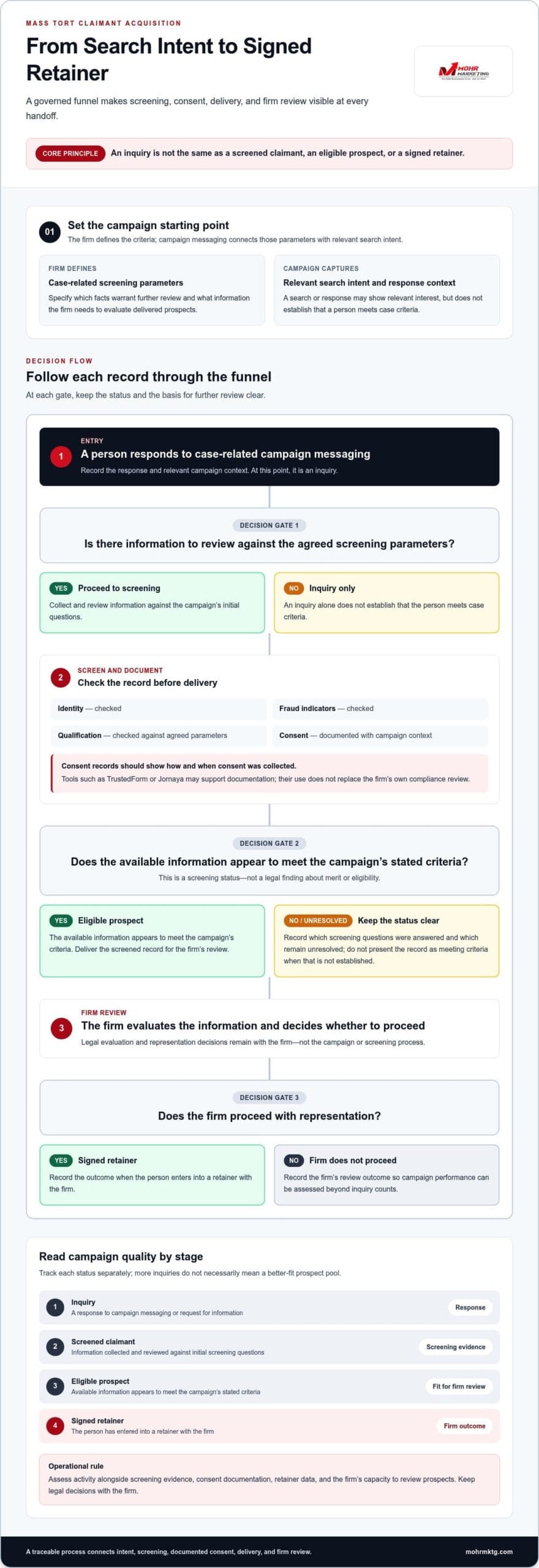
Use clear stages so the team does not treat every response as the same kind of opportunity:
- Inquiry: Someone responds to campaign messaging or requests information. An inquiry alone does not establish that the person meets case criteria.
- Screened claimant: Information has been collected and reviewed against the campaign’s initial screening questions. Record which questions were answered and which remain unresolved.
- Eligible prospect: The available information appears to meet the campaign’s stated criteria. This is a screening status, not a legal finding about merit or eligibility.
- Signed retainer: The person has entered into a retainer with the firm. The firm controls its legal evaluation and representation decisions.
Where acquisition fits in a mass tort campaign
Acquisition sits between case selection and the firm’s legal review. The firm identifies the matter and defines the criteria it wants campaigns to capture. Advertising then connects relevant consumer search intent with case-specific information. Screening organizes responses for review; the firm evaluates the facts and decides whether to proceed. For example, a campaign focused on high-value mold case acquisition should reflect the matter’s defined criteria, rather than broad interest in mold exposure generally.
Keep the boundary clear: campaign messaging can inform and screen, but it cannot determine legal merit or guarantee that a firm will accept a case. That distinction protects the integrity of the acquisition process and the firm’s evaluation.
Why volume alone is an incomplete objective
More inquiries can create more work without producing a better-fit prospect pool. If responses fall outside the firm’s criteria, intake staff still need to review and disposition them. The objective is not simply to increase response counts. It is to attract relevant intent, capture the information needed for screening, document consent, and deliver prospects in a format the firm can review.
Set criteria before judging campaign output. Define which facts warrant further review, what screening information is needed, and how the firm will evaluate delivered prospects. Then assess volume alongside prospect fit and follow-up capacity, without assuming a universal conversion rate. For a broader view of planning and campaign structure, the mass tort lead generation roadmap can help place acquisition within the wider strategy.
How a Mass Tort Claimant Acquisition Funnel Moves from Search to Retainer
A reliable funnel makes each handoff visible. It starts with defined case parameters and ends with the firm’s review of a prospect’s information and, where appropriate, a signed retainer. Acquisition quality depends on both fit and a traceable process. Each stage should produce information the next stage can use, rather than simply adding another name to a list.
Start with case criteria and search intent
Before a campaign attracts prospects, translate the firm’s case criteria into clear screening parameters and align them with the questions consumers are asking. Someone searching for information about a particular product and a reported injury may show relevant intent, but a search alone does not establish that the person meets criteria. Mohr Marketing’s AI WebTracker captures high-intent prospects at the moment of search, connecting that intent with case-specific campaign messaging.
- Define criteria. The firm identifies the case-related facts the campaign should screen for. The output is a shared set of parameters that guides messaging and initial qualification.
- Capture intent. Campaign messaging reaches prospects seeking information related to the matter. The record should show the response and relevant campaign context, rather than treating general interest as proof of fit.
- Screen. Before delivery, the process checks identity, fraud indicators, consent, and qualification against the agreed parameters. The resulting screened record should make the basis for further review clear.
- Document consent. Retain information showing how and when consent was collected, along with the applicable campaign context. Third-party tools such as TrustedForm or Jornaya may support consent documentation, but using a tool does not replace the firm’s own compliance review.
- Deliver. Send the prospect and relevant screening details through the agreed workflow. The firm should be able to distinguish a screened prospect from an inquiry and understand what information is available for review.
- Review. The firm evaluates the information, decides whether to pursue representation, and records the outcome, including whether a retainer is signed. That feedback can inform later campaign assessment without shifting legal decisions to the marketing or screening process.
Screen, document, and deliver with a clear record
Keep screening evidence and consent records connected to the prospect they describe. A usable delivery record should identify the campaign source, screening status, and available consent documentation. This supports a consistent review process and helps the team identify where a prospect’s journey stopped. The firm’s legal team remains responsible for evaluating representation and case acceptance.
For firms structuring campaigns around defined criteria and documented handoffs, mass tort signed cases are one part of a broader acquisition workflow. To discuss how the stages can align with your firm’s intake process, connect with Mohr Marketing.
How to Assess Mass Tort Claimant Acquisition Beyond Lead Volume
Lead counts show activity, not whether a campaign is producing records the firm can use. Assess mass tort claimant acquisition across distinct stages, then compare the evidence at each stage with the campaign’s stated criteria. This keeps reporting grounded in observable activity and avoids treating early interest as a signed case or legal outcome.
| Stage | What to assess | What an acquisition partner can report | What remains with the firm |
|---|---|---|---|
| Activity | Responses and inquiries associated with the campaign | Campaign activity and inquiry records | Whether the activity matches the firm’s strategic priorities |
| Screening evidence | Available identity, fraud, consent, and qualification checks | Screening status and supporting records | Whether the information is sufficient for legal review |
| Signed retainers | Prospects who execute a retainer with the firm | Delivery and intake information within the agreed workflow | Retainer decisions and engagement records |
| Downstream legal outcomes | Case acceptance, litigation developments, and financial results | Not established by delivery metrics alone | Legal evaluation, case decisions, litigation, and revenue |
Evaluate evidence of fit and verification
Compare delivered records with the criteria the firm supplied. Check whether recorded answers address the campaign’s screening questions and whether each prospect’s status is clearly identified. Mohr Marketing applies Scammer Scrub fraud-filtering to every delivery. Treat screening and consent documentation as evidence of process, not as a legal conclusion or substitute for the firm’s own review.
A useful report makes gaps visible. If a record lacks information needed to assess a criterion, distinguish that from a record that appears to meet the initial screening parameters. Keep consent documentation connected to the relevant prospect and campaign so the firm can review what was captured and make its own compliance assessment. Reporting can describe the evidence; it cannot decide whether that evidence is legally sufficient.
Separate acquisition signals from legal and financial outcomes
A qualified inquiry and a signed retainer represent different acquisition stages. The first indicates that a response has been screened against campaign parameters; the second reflects an engagement decision made by the firm. Executed retainers can be tracked as a distinct measure, as shown in Mohr Marketing’s mass tort signed cases offering.
Do not use delivery volume or screening status as a proxy for case acceptance, litigation results, or revenue. Those outcomes depend on further review and events beyond acquisition reporting, and none can be guaranteed. A clear scorecard separates what the campaign can document from what only the firm can determine. Delivery evidence measures process; case outcomes depend on further firm review.
Prepare Your Firm to Run a Mass Tort Claimant Acquisition Campaign
A campaign is only as workable as the firm’s ability to govern it. Before launch, align case criteria, internal decision ownership, prospect-review capacity, and reporting expectations. This gives the acquisition partner clear direction and gives the firm a defined process for evaluating delivery. Without those agreements, campaign activity can outpace the firm’s ability to assess it.
Set campaign scope and internal ownership
Assign an owner for each decision. Identify who approves case criteria, reviews campaign materials, and evaluates delivered prospects. These responsibilities may sit with different people, but each handoff needs a clear decision-maker. Define what information is needed for review and who records each prospect’s disposition so campaign feedback remains consistent and useful.
Match the acquisition scope to available review capacity. Decide which team will assess records, how prospect information will reach that team, and what workload the firm can manage. Set reporting expectations with the acquisition partner before launch. Agree on which activity and screening indicators will be shared, how the firm will return disposition feedback, and how both sides will review whether delivery remains aligned with the agreed criteria.
Agree on workflow and review points before launch
Establish a shared workflow for campaign creative, structure, and intake review. Identify who approves messaging and how changes are reviewed before use. Map the route from delivery to internal assessment, including where records are stored and how questions or missing information are handled. These operating decisions reduce ambiguity and make it easier to identify where a handoff needs attention.
- Criteria: Confirm the case parameters that guide targeting and screening.
- Approvals: Name the people responsible for reviewing campaign materials and changes.
- Capacity: Set a delivery scope the firm can review and act on.
- Reporting: Define what the partner reports and how the firm shares assessment outcomes.
Treat compliance and consent as shared operating requirements
Mohr Marketing’s process includes screening for identity, fraud, consent, and qualification, supporting a documented review workflow. These measures do not guarantee compliance or remove the firm’s responsibilities. The law firm remains responsible for applicable attorney-advertising and professional-conduct rules and should obtain its own legal counsel. For a dedicated discussion, consult the article on mass tort advertising compliance pillars as part of campaign planning.
Use the prelaunch review to clarify which records and process details the firm needs, who reviews them, and how concerns are escalated. A compliance-focused workflow supports oversight; it is not a substitute for legal judgment. Clear ownership makes that distinction part of day-to-day operations.
Scale Mass Tort Claimant Acquisition Through a Direct-to-Firm Model
Scaling mass tort claimant acquisition takes more than increasing campaign activity. Firms need a connected process for reaching prospects, screening them against case criteria, managing intake, and reviewing delivery. Mohr Marketing’s Mass Tort Acquisition brings advertising, screening, and signed-retainer delivery together as a coordinated service, rather than treating acquisition as a standalone list of names.
What the direct-to-firm model is designed to support
In a direct-to-firm model, campaign delivery goes to the law firm without reseller markup. This creates a more direct working relationship and path from prospect capture to firm review. Mohr Marketing’s AI WebTracker captures high-intent prospects at the moment of search, while screening addresses identity, fraud, consent, and qualification before delivery. The firm can review campaign structure, creative, and intake workflow to align the process with its case criteria and operational capacity.
Mohr Marketing has served law firms since 1994, reports serving thousands of firms, and has more than 50 active tort campaigns. These points describe experience and campaign breadth, not a promise of lead volume, signed cases, revenue, or legal outcomes. Each firm determines how it evaluates prospects and whether to pursue representation.
For a specific example of case-focused acquisition, Mohr Marketing’s mesothelioma leads for law firms illustrate the role of search intent and defined criteria in campaign design. The practical question is whether campaign messaging and screening align with the firm’s matter, and whether its intake process can manage the resulting delivery.
Define a measured next step with Mohr Marketing
Before expanding a campaign, discuss the case criteria it should reflect, the objectives the firm intends to assess, and the capacity available to review delivered prospects. Consider campaign structure, creative, screening, and intake workflow together. A clear scope helps both sides understand what will be measured and what remains the firm’s responsibility.
Mohr Marketing states that proposals are delivered in one business day. A proposal can establish a campaign plan, but it cannot guarantee performance or replace the firm’s legal review. Applicable attorney-advertising and professional-conduct requirements remain the firm’s responsibility, and firms should obtain their own legal counsel.
Build the Next Stage Around Evidence
The next stage of mass tort claimant acquisition should begin with a decision, not an assumption: what evidence would justify maintaining, adjusting, or expanding the campaign? Set that decision point with your team before activity begins. It gives campaign reviews a practical purpose and keeps growth tied to what the firm can assess and manage.
Use each review to identify a clear action. Refine the criteria if delivered prospects do not match the matter. Adjust the workflow if records are difficult to evaluate. Consider expanding only when the firm has the capacity and evidence to support that choice. This approach makes campaign management a deliberate operating process rather than a race to increase volume.
A measured plan gives your firm room to learn, adapt, and pursue growth with control.
With clear decision points in place, your team can move forward with greater confidence.
Frequently Asked Questions
Can a law firm run claimant acquisition campaigns for more than one mass tort at a time?
Yes. Campaign scope can be adapted across practice areas, but each matter should have its own criteria, messaging, and review process. For example, a firm handling two distinct mass torts should define which case-specific facts belong in each campaign rather than applying one broad screening standard. Assign firm-side reviewers for each matter so prospects are assessed against the right criteria and campaign results remain distinguishable.
Is a signed retainer the same as a legally accepted mass tort case?
No. A signed retainer records an agreement between the firm and the client; it does not, by itself, establish a legal conclusion about the claim or predict its outcome. The firm must conduct its own legal evaluation and make decisions about representation and case acceptance. Track retainer status separately from later case assessments or litigation developments.
How can a firm document consent for mass tort advertising inquiries?
A firm can maintain records that show how consent was obtained and connect those records to the relevant inquiry and campaign. Tools such as TrustedForm and Jornaya are examples of third-party services used to support consent documentation. The firm should determine, with its own legal counsel, what records and processes fit its circumstances. A vendor tool can support documentation, but it does not establish that every legal requirement has been met.
Are mass tort campaign inquiries exclusive to one law firm?
Under Mohr Marketing’s Joint Advertising program, inquiries are exclusive to the participating firm, and campaign budgets are not shared with other attorneys. This is a feature of that program, not a universal rule for every mass tort inquiry or marketing arrangement. Firms should understand the campaign structure and delivery terms that apply to their engagement before treating exclusivity as a performance assumption.
Does mass tort claimant acquisition involve cold-calling?
The Joint Advertising program uses inbound contacts or follow-up to consumer requests, not cold-calling. A consumer initiates contact or has asked to receive a response before follow-up occurs. That distinction clarifies how prospects enter the intake process. Firms remain responsible for reviewing their communications and applicable requirements, including how staff handles later contact with an inquiry.
Who is responsible for a law firm’s advertising compliance?
The law firm is responsible for ensuring its advertising complies with applicable attorney-advertising and professional-conduct rules. A marketing partner’s screening, documentation, or campaign review can support the firm’s oversight, but it cannot guarantee compliance or transfer that responsibility. The firm should have its own legal counsel assess the requirements relevant to its campaigns and review materials and processes in light of its professional obligations.
Does a mass tort acquisition service guarantee a specific number of signed cases?
No. Results, lead volume, signed case counts, and revenue are not guaranteed unless expressly set out in a signed written agreement. Campaign reporting can show activity and documented acquisition stages, but it cannot promise how many prospects will sign or what legal or financial outcomes may follow. Firms should distinguish measurable delivery from later decisions and results, and assess campaign performance using the terms and evidence relevant to their engagement.
To discuss a mass tort acquisition plan aligned with your firm’s criteria, intake capacity, and review process, contact Mohr Marketing.

Recent Posts
- Mass Tort Claimant Acquisition: A Practical Framework for Law Firms
- Signed Cases for Attorneys: A 2026 Evaluation Guide
- How to Get More Personal Injury Cases: A 2026 Growth Guide
Categories
- AI and Lead Generation
- Business Financing
- Call Verified MVA Leads
- Car Accident Help
- Car Accident Settlements
- Claimant Funding
- Compliance Program
- EMS-EMT Reports
- Geotargeting
- Google Maps Ranking
- Healthcare Practice Growth
- Law Firm Growth
- Law Office Operations
- Lead Generation
- Lead Generation For Attorneys
- Lead Generation For Chiropractors
- Lead Generation For Criminal Attorneys
- Lead Generation For D&A Treatment Centers
- Lead Generation For DUI Attorneys
- Lead Generation For Eye Doctors
- Lead Generation For Family Law Practices
- Lead Generation For PI Law Firms
- Lead Generation For Plastic Surgeons
- Leads For Healthcare Professionals
- Leads For Insurance Industry
- Legal Leads
- Legal Marketing
- Legal Updates
- Mass Tort Leads
- Medicare and Medicaid Leads
- Merchant Funding Leads
- Mold Leads
- Online Marketing Strategies
- Pre-Settlement Funding
- Signed MVA Cases
- Tort Updates
- Truck Accident Leads and Signed Cases
- Truck Accident Settlements
- Web Design