Exclusive Mass Tort Leads: A 2026 Comparison Guide for Law Firm Growth
June 22, 2026 by Mohr Marketing
In 2026, exclusivity isn’t a premium upgrade; it’s a structural requirement for mass tort profitability. You’re likely tired of high acquisition costs and the exhaustion of chasing non-responsive leads that have already been sold to several other firms. It’s frustrating to watch your intake team waste hours on shared opportunities that never result in a signed retainer, especially when California’s SB 37 now places strict liability on you for every vendor’s marketing claim. To scale effectively, you must secure exclusive mass tort leads that belong solely to your firm.
This guide will teach you how to differentiate between shared aggregators and high-intent acquisition models to maximize your ROI. We’ll examine the current 2026 cost-per-lead data, including the June 2026 blended average of $111.99, and show you how to stabilize your intake pipeline. You’ll learn the precise steps to transition to a model that simplifies growth while ensuring total regulatory compliance. We’re moving past the wide-net approach to focus on the mechanics of high-conversion legal marketing and the elimination of inefficient intermediaries.
Key Takeaways
- Identify why shared lead models fail in the 2026 market by analyzing the hidden operational costs of low contact rates.
- Define the structural requirements for exclusive mass tort leads to ensure your intake team only engages with high-intent, real-time inquiries.
- Compare the risk-reward profiles of raw leads, exclusive inquiries, and signed retainers to select the optimal model for your firm’s ROI.
- Implement a precise two-step audit of your lead provider’s acquisition channels and verification scripts to ensure compliance with SB 37 regulations.
- Bridge the gap between inquiry and retainer by integrating verified acquisition with turnkey intake solutions for scalable firm growth.
The Failure of Shared Lead Models in Modern Mass Tort Litigation
Shared lead models are a relic of a less competitive legal market. They operate on a “race to the bottom” philosophy, where a single inquiry is sold to three, five, or even ten different law firms simultaneously. This creates an immediate, aggressive contact race. The firm with the fastest auto-dialer might get the first word, but they rarely get the best results. Understanding what is a mass tort clarifies why this approach fails. These are complex, high-stakes litigations involving vulnerable claimants. Treating them like commodities in a bidding war dilutes trust and destroys conversion rates.
Relying on non-exclusive data forces your firm into a cycle of diminished returns. By the time your intake team reaches a claimant, they’ve often been bombarded by half a dozen other firms. This leads to immediate “lead fatigue.” The claimant stops answering the phone. They block numbers. They become skeptical of the entire legal process. In the 2026 regulatory environment, specifically under California’s SB 37, this model also carries significant risk. You are strictly liable for the conduct of your marketing vendors. If a shared aggregator uses misleading tactics or aggressive outreach to secure that lead, your firm bears the professional and financial penalty.
The Hidden Cost of Friction
Low-cost shared leads are a financial illusion. Firms often choose them to save on upfront costs, but they ignore the “Intake Tax.” This is the burdened cost of your internal resources. You pay for the CRM seats, the intake staff wages, and the technology stack required to chase non-responsive inquiries. When your team spends 90% of their time calling leads that never pick up, your real cost per acquisition skyrockets. Exclusive mass tort leads eliminate this friction. They ensure your team’s energy is focused on high-intent claimants who are expecting your call. Efficiency is the only metric that scales. Wasted hours are unrecoverable capital.
Claimant Experience and Brand Erosion
Your firm’s reputation is its most valuable asset. When a claimant receives five calls in five minutes, they don’t see a competitive market; they see a predatory one. This negative feedback loop erodes the professional authority required to sign high-value cases. Transitioning to exclusive mass tort leads changes the dynamic. It allows your intake process to feel like a professional legal consultation rather than a telemarketing pitch. For firms looking for even greater efficiency, moving toward Mass Tort Signed Cases bypasses the intake struggle entirely. It ensures you only pay for results, not the privilege of competing with your peers for the same phone number.
Defining True Exclusivity in Mass Tort Acquisition
In the current legal market, the term “exclusive” is frequently misused by aggregators looking to offload low-intent data. To secure exclusive mass tort leads that actually convert, you must look beyond the label and examine the underlying technical architecture. True exclusivity means the inquiry is captured, verified, and delivered to your firm’s CRM in milliseconds. There’s no middleman “warming up” the lead and no delay that allows the claimant to continue browsing for other representation. Every second of delay increases the risk of claimant shopping and diminishes your retainer rate.
Compliance in 2026 demands 100% transparency in lead origin. You need to verify the lead’s source to ensure it aligns with FTC advertising guidelines and strict state regulations like California’s SB 37. This data must include the exact landing page, the ad creative used, and the timestamp of the submission. Without this granular level of detail, your firm is exposed to significant liability. Quality acquisition isn’t just about the contact info; it’s about the documented journey of the claimant from the first click to the final verification.
Real-Time Routing Mechanics
Technical exclusivity is binary. Either your firm is the sole recipient, or it isn’t. Beware of “temporary exclusivity” windows, where a provider promises a lead is yours for 24 hours before selling it to a secondary market. This model is a bait-and-switch that incentivizes aggressive, low-quality intake. Permanent exclusivity is the only way to build a stable docket. To audit your provider’s routing, follow these instructions:
- Demand real-time delivery logs that include millisecond timestamps for both capture and transmission.
- Verify that the lead data is hard-coded to your firm’s unique API endpoint.
- Cross-reference the lead’s IP address to ensure it matches the stated geography and isn’t a recycled entry.
High-Intent Search vs. Passive Interruption
The source of the lead dictates its quality. Social media platforms rely on passive interruption, catching users while they’re distracted by other content. This often produces “curious clickers” who don’t meet strict case criteria. In contrast, search-based leads target motivated claimants actively seeking legal help. For instance, mesothelioma leads built on search intent consistently outperform those from broad social campaigns. You’re looking for individuals who have already identified their injury and are ready to sign. If you’re ready to upgrade your acquisition strategy, speak with our team about current availability.
Comparative Analysis: Shared Leads vs. Exclusive Leads vs. Signed Cases
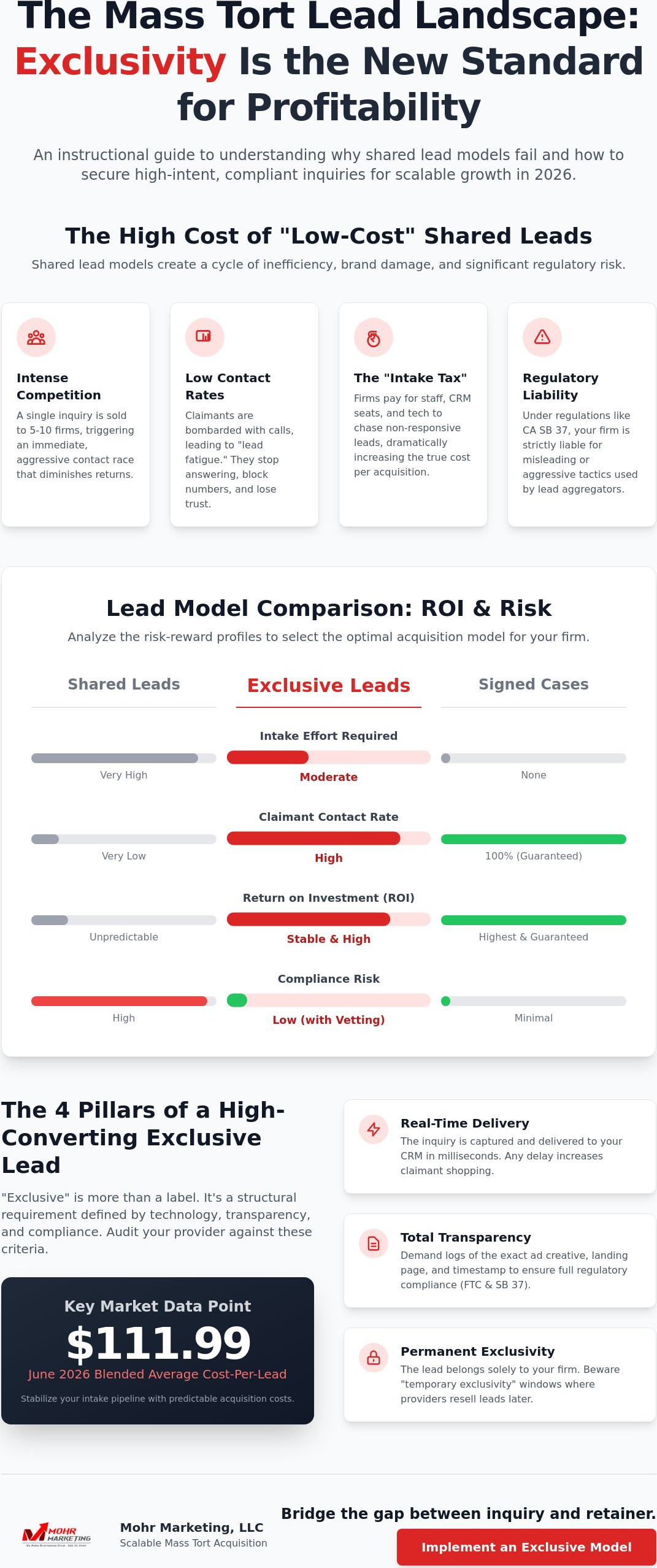
Selecting the right acquisition model is a strategic decision that dictates your firm’s operational efficiency and final margins. Shared leads offer the lowest entry price but carry a high risk of non-conversion. Because multiple firms compete for the same claimant, contact rates frequently drop. This creates a massive operational drain on your staff. Exclusive mass tort leads provide a more balanced risk-reward profile. They ensure your firm is the sole point of contact, which significantly increases the likelihood of a signed retainer. For firms targeting aggressive national growth in 2026, the Pay-Per-Signed-Case (PPSC) model is the most scalable solution. Learn how signed cases optimize ROI by shifting the entire intake burden to the provider.
Each model has a different impact on your firm’s internal structure. Shared leads require a high-volume, aggressive intake team. This often leads to high turnover and “lead fatigue” among staff. Exclusive leads allow for a more consultative approach, which preserves your brand’s professional authority. Signed cases eliminate the need for an internal sales-focused intake department entirely. By purchasing a fully executed agreement, you bypass the friction between the initial inquiry and the retainer. This allows your legal team to focus on litigation and case management rather than chasing unresponsive phone numbers.
The Performance Benchmark
Performance is best measured by the “Time-to-Retainer” metric. Shared leads often require dozens of touchpoints over several weeks to secure a signature, if one is secured at all. This delay increases the “burdened cost” of the lead, which includes CRM licensing and staff wages. With exclusive mass tort leads, this timeline is compressed. The claimant isn’t being harassed by competitors, so they’re more likely to engage with your team immediately. Signed cases represent the ultimate zero-friction solution. In this model, the claimant has already met the specific medical and exposure criteria and signed a contract before the file reaches your desk. It’s the most efficient path to docket growth.
Compliance and Data Integrity
Regulatory scrutiny is at an all-time high. Firms must strictly adhere to the 2026 Mass Tort Advertising Compliance Checklist to avoid severe penalties. Under California’s SB 37, attorneys can face civil penalties ranging from $5,000 to $100,000 per unique advertisement for non-compliant content. Shared lead models often obscure the origin of the data, making it nearly impossible to audit advertising disclosures. Exclusive models simplify this process by providing 100% transparency regarding the landing page and ad creative used. This documented consent is vital for TCPA compliance and protects your firm’s reputation during audits. Reliable growth is built on clean data and verifiable lead origins.
Instructional Guide: Auditing Your Mass Tort Lead Provider
Protect your firm’s capital by conducting a rigorous audit of your acquisition partners. Securing exclusive mass tort leads requires more than a verbal agreement; it necessitates a technical and procedural deep dive. Use the following steps to evaluate your current or prospective provider. Transparency is the only metric that guarantees compliance and performance.
- Step 1: Request a detailed breakdown of lead generation channels. Your provider must disclose exactly where the traffic originates. Search-based intent is superior to social media interruption. Demand to see the live landing pages.
- Step 2: Audit the intake and verification scripts. Review the exact questions asked during the intake phase. Ensure they capture specific medical diagnoses and exposure dates. Vague scripts result in high fallout rates.
- Step 3: Secure the “Exclusivity Guarantee” in writing. The contract must explicitly state that the lead is never sold to a secondary firm or recycled for a different campaign.
- Step 4: Analyze the provider’s transparency and reporting frequency. Real-time dashboards are the standard for 2026. If your provider only offers weekly spreadsheets, you’re operating on stale data.
- Step 5: Test the “Speed-to-Lead” capabilities. Submit a test lead. It should appear in your CRM within five seconds. Any longer indicates a middleman or a technical bottleneck that will cost you retainers.
Red Flags in Legal Lead Generation
Identify and eliminate providers who utilize “recycled” data. These are leads harvested from older, unrelated campaigns and repackaged for current torts. They result in immediate “lead fatigue” and potential bar complaints. Be wary of any vendor who refuses to share their advertising creatives. Hidden ads often contain misleading promises that create significant liability under SB 37. Avoid incentivized or “survey” lead generation. If a claimant was promised a gift card to fill out a form, they’re not a motivated litigant; they’re a “curious clicker” who will waste your intake team’s time.
Verification Protocols to Demand
Demand higher standards for data integrity. For specific litigations, you should require the value of police-report-backed cases to ensure the validity of the claim from the outset. This level of verification reduces the friction between the initial inquiry and the signed retainer. High-value inquiries should be handled via real-time call transfers. This ensures a “warm” handoff while the claimant’s intent is at its peak. If you suspect your current acquisition model is failing these tests, contact us for a consultation to review your growth strategy.
The Mohr Marketing Ecosystem: Scalable Mass Tort Acquisition
Mohr Marketing operates as a high-impact partner for firms that prioritize efficiency over raw volume. We’ve spent 30 years refining the mechanics of legal growth, moving past the common pitfalls of shared aggregators. Our ecosystem is designed to deliver exclusive mass tort leads that meet rigorous verification standards before they ever reach your desk. Whether your firm is targeting Mesothelioma litigation or high-value Truck Accidents, our approach remains the same. We identify high-intent claimants through real search data and eliminate the noise of unverified inquiries. You aren’t just buying data; you’re investing in a strategic expansion plan backed by three decades of industry expertise.
Our methodology focuses on the removal of friction. As we’ve discussed in previous sections, the “burdened cost” of a lead is what kills firm profitability. We solve this by ensuring that every inquiry is filtered through a strict case criteria protocol. This isn’t a wide-net approach. It’s a targeted strike on the most motivated claimants in the market. By leveraging exclusive mass tort leads, you remove the competition from the equation. You gain the time and space needed to build a professional relationship with the claimant, which is essential for high-stakes litigation.
The Turnkey Advantage
Intake is the most common point of failure in mass tort campaigns. Most firms don’t have the capacity to maintain a 24/7 intake team that can handle the technical requirements of 2026. Mohr Marketing solves this by integrating turnkey intake solutions directly into the acquisition process. We bridge the gap from initial inquiry to signed retainer. This allows you to scale national campaigns without increasing your administrative overhead. Our “straight-talker” approach is a commitment to protecting your resources. We don’t hide behind vague metrics. We provide procedural precision that ensures every lead is a legitimate opportunity for growth.
Next Steps for Performance Growth
Advancing your firm requires a mindset shift. You’ve got to stop thinking about the cost per lead and start focusing on the cost per signed case. This transition is essential for maintaining a competitive advantage as advertising costs fluctuate. To begin, audit your current acquisition pipeline against the standards we’ve outlined in this guide. If your current provider can’t meet our 2026 transparency requirements, it’s time to pivot. Read our full Roadmap to Scalable Growth to understand the technical requirements of modern case acquisition.
Your next step is a direct strategy call. We’ll analyze your current docket needs and identify the niche torts where our exclusive acquisition models can deliver the highest ROI. Growth shouldn’t be a gamble. It should be a methodical, compliant, and aggressive pursuit of market leadership. Secure your firm’s future by partnering with a veteran who understands the stakes and the mechanics of success.
Dominate Your Market with Strategic Case Acquisition
Scaling a mass tort docket in 2026 requires a departure from the high-friction models of the past. You’ve seen how shared leads dilute ROI and increase administrative burden. To maintain a competitive edge, your firm must pivot toward exclusive mass tort leads that are verified at the source. This transition ensures that your intake team focuses on high-intent claimants rather than competing in a race to the bottom with other firms. By prioritizing transparency and real-time delivery, you protect your firm’s reputation and ensure compliance with strict state bar mandates.
Mohr Marketing brings over 30 years of industry experience to your growth strategy. We offer performance-based models designed to eliminate the risk of unverified data. Our processes ensure strict adherence to state laws, including the latest 2026 advertising regulations. It’s time to move beyond the limitations of shared aggregators and embrace a more streamlined path to success. Secure your exclusive mass tort cases with Mohr Marketing today. We look forward to helping you build a more profitable and compliant legal practice.
Frequently Asked Questions
What is the difference between an exclusive lead and a shared lead?
An exclusive lead is sold to one firm only, ensuring you are the sole point of contact for that claimant. Shared leads are sold to multiple firms simultaneously, which triggers an aggressive race to call. This competition often leads to claimant fatigue and significantly lower contact rates. Exclusive models preserve your brand’s authority and allow for a consultative intake process rather than a telemarketing sprint.
Are exclusive mass tort leads compliant with state bar advertising rules?
Yes, but compliance depends on the transparency of the lead provider. Exclusive mass tort leads are compliant when the marketing materials follow regulations like California’s SB 37, which requires clear office disclosures and prohibits misleading claims. Because exclusive models provide a documented path from the ad creative to the inquiry, they are much easier for your firm to audit for regulatory and bar mandate adherence.
How does the Pay-Per-Signed-Case model work for mass torts?
The Pay-Per-Signed-Case (PPSC) model allows your firm to purchase fully executed retainers instead of raw inquiries. The provider handles all initial marketing, screening, and intake procedures. You only pay when a claimant meets your specific medical and exposure criteria and signs a contract with your firm. This shifts the financial risk away from the firm and eliminates the operational friction of internal intake teams.
What specific verification steps are taken for exclusive leads?
Verification involves a multi-layered screening process to confirm the claimant meets the litigation’s core requirements. This includes verifying specific medical diagnoses, exposure windows, and the lack of existing legal representation. We use custom, rigorous scripts to filter out “curious clickers.” This ensures that every inquiry delivered to your CRM is a high-intent opportunity that aligns with your firm’s specific case criteria and growth goals.
Can I target specific geographic regions with exclusive leads?
Yes, you can restrict campaigns to specific states, counties, or judicial districts. Geographic targeting is essential for firms that want to focus on jurisdictions where they have established expertise or where the legal landscape is most favorable. This precision ensures your exclusive mass tort leads are relevant to your practice areas. It prevents wasted spend on regions where your firm does not intend to litigate.
How quickly are exclusive leads delivered to our intake team?
Delivery occurs in real-time, usually within seconds of the claimant submitting their information. Our technical infrastructure uses direct API routing to push data into your CRM instantly. Speed is a critical factor in conversion; reaching a claimant while their intent is at its peak is the best way to prevent them from shopping for other counsel. Real-time delivery is a standard requirement for modern mass tort acquisition.
What happens if an exclusive lead does not meet the agreed-upon case criteria?
Leads that fail to meet the documented campaign criteria are subject to a replacement or credit policy. We establish strict parameters before the campaign begins, covering everything from diagnosis to statute of limitations. If a lead is delivered that doesn’t meet these specific standards, it is flagged for review and replaced. This protects your firm’s capital and ensures you only pay for inquiries that have a legitimate path to litigation.
Why are exclusive leads more expensive than shared aggregator leads?
The higher upfront price reflects the lack of competition and the significantly higher probability of a signed retainer. Shared leads are cheaper because the provider earns revenue by selling the same data to multiple buyers. However, exclusive leads carry a much lower “burdened cost.” Because they require fewer intake hours and convert at a higher rate, the final cost per signed case is often lower than that of shared models.

Recent Posts
- Law Firm Intake Process Optimization: The 2026 Technology Guide
- In-House vs. Outsourced Legal Intake: A Strategic Comparison for 2026
- Vetting Mass Tort Leads: Guide to Case Viability
Categories
- AI and Lead Generation
- Business Financing
- Call Verified MVA Leads
- Car Accident Help
- Car Accident Settlements
- Claimant Funding
- Compliance Program
- EMS-EMT Reports
- Geotargeting
- Google Maps Ranking
- Healthcare Practice Growth
- Law Firm Growth
- Law Office Operations
- Lead Generation
- Lead Generation For Attorneys
- Lead Generation For Chiropractors
- Lead Generation For Criminal Attorneys
- Lead Generation For D&A Treatment Centers
- Lead Generation For DUI Attorneys
- Lead Generation For Eye Doctors
- Lead Generation For Family Law Practices
- Lead Generation For PI Law Firms
- Lead Generation For Plastic Surgeons
- Leads For Healthcare Professionals
- Leads For Insurance Industry
- Legal Leads
- Legal Marketing
- Legal Updates
- Mass Tort Leads
- Medicare and Medicaid Leads
- Merchant Funding Leads
- Online Marketing Strategies
- Pre-Settlement Funding
- Signed MVA Cases
- Tort Updates
- Truck Accident Leads and Signed Cases
- Truck Accident Settlements
- Web Design