Why FMCSA Integration and Police Report Verification Transform Truck Accident Leads
April 17, 2026 by Mohr MarketingWhy FMCSA Integration and Police Report Verification Matter for Truck Accident Leads
One of the biggest challenges in truck accident lead generation is separating true trucking opportunities from everything else that gets labeled “truck.” Without structure, you can easily end up with ordinary passenger vehicle cases that happen to involve a pickup, or worse, inquiries that have little or nothing to do with a commercial vehicle collision. Intake teams then spend time chasing down details that should have been screened at the campaign level, and premium trucking resources end up diluted across marginal files.
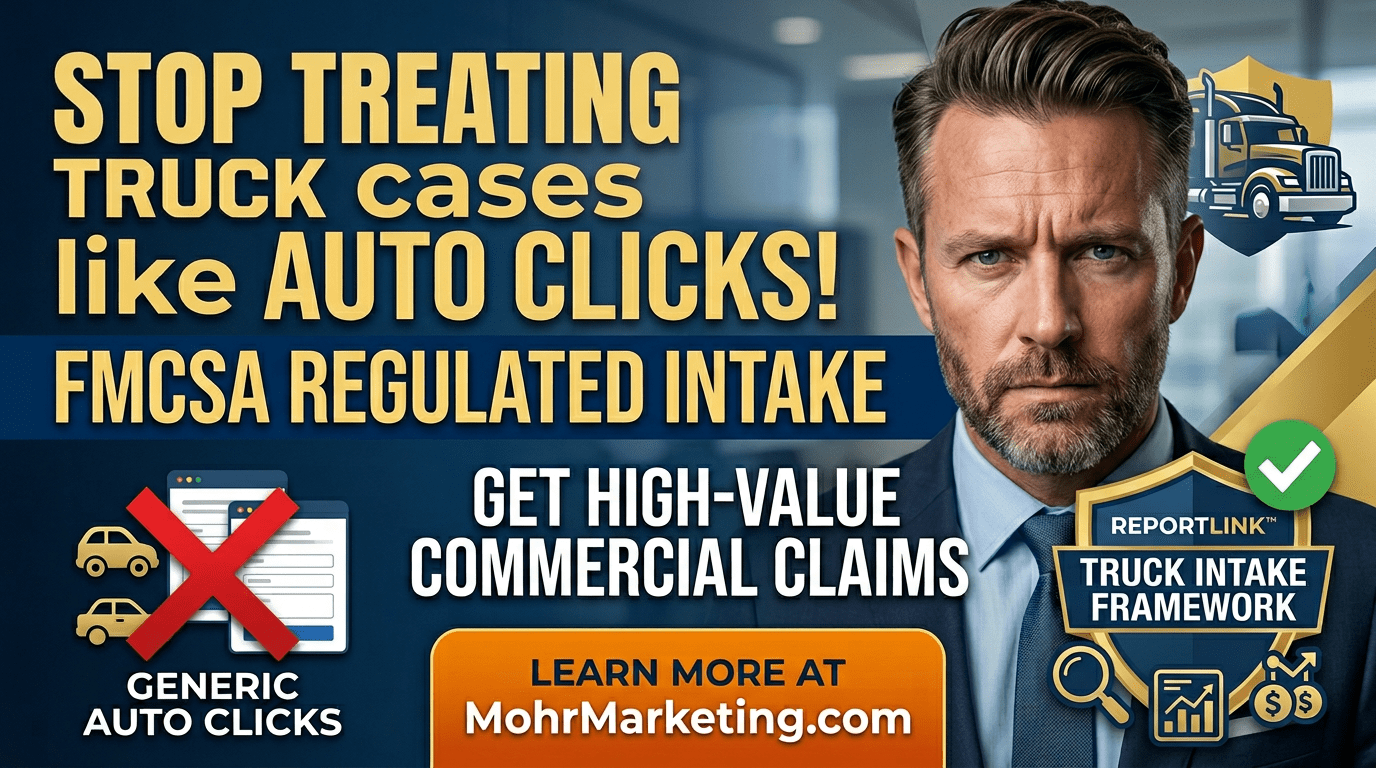
ReportLink™ Turns Truck Accident Prospects Into Attorney-Ready Opportunities
A truck‑specific authority experience with FMCSA integration changes that starting point. By incorporating an FMCSA‑integrated settlement calculator into the authority‑site experience, Mohr Marketing encourages prospects to think in terms of commercial carriers, DOT‑regulated vehicles, and the factors that actually drive trucking value. The questions are not generic “Were you hurt?” prompts; they are designed around the realities of tractor‑trailers, cargo vehicles, and commercial policies. That framing alone pushes out a significant portion of low‑relevance inquiries that might otherwise slip through a broad PI funnel.
As prospects move through the calculator, they are also educated about issues your litigation team cares about: the role of carrier responsibilities, how FMCSA standards affect operations, and why commercial policy limits matter for serious injury cases. This education component is not just marketing language; it primes claimants to understand why documentation, timelines, and accuracy are critical in trucking claims. By the time they reach the end of the workflow, they have spent more time thinking about their case and the facts behind it than in a typical one‑page form experience.
Layering in a police report verification touchpoint before submission pushes the interaction beyond casual curiosity. Prospects are prompted to confirm whether law enforcement responded, identify the approximate date and location of the crash, and describe the vehicles involved in a way that tracks how a crash report would read. They are also reminded that documentation will matter, from the initial police report to future records like medical bills and employment information. The tone is still claimant‑friendly, but the message is clear: this is a serious process for serious truck cases.
This pre‑submission workflow means the truck accident lead that reaches your firm has already passed through a set of questions and interactions tuned to commercial vehicle claims. Instead of a single “truck accident” checkbox, you see context clues about vehicle class, carrier involvement, and potential regulatory issues. You also see whether the claimant has a reportable event with law enforcement involvement or a situation that will require more investigative effort. That is a much stronger basis for prioritizing outreach and evaluating fit than a generic form fill.
When that lead is then structured through ReportLink™, your intake team can review it with more context, stronger data points, and a clearer sense of whether the opportunity lines up with your trucking criteria. ReportLink™ pulls together the data from the FMCSA‑framed calculator and verification step into an organized record, so your staff can quickly identify red flags, high‑value indicators, and gaps that need follow‑up. In practice, that means your best people spend more time on real truck cases and less time trying to figure out whether an inquiry is even in the right category.
For firms that treat trucking as a strategic practice area, FMCSA integration and police report verification are not nice‑to‑have features; they are essential filters in the acquisition process. They help align your marketing investment with the kinds of commercial vehicle claims your trial team wants, while giving intake a more reliable foundation to work from on day one. Over time, that structure supports a more predictable trucking docket, stronger files, and better outcomes for both your firm and your clients.
If you want FMCSA‑aware intake and police‑report‑oriented verification built into the front end of your trucking pipeline, reach out to Mohr Marketing to discuss how this framework can support your team.
Build a serious trucking docket on purpose, not by accident—talk to Mohr Marketing about truck‑specific acquisition and ReportLink™.
Ready to fill your docket with valid cases?
Partner with Mohr Marketing to secure high-quality, compliant plaintiffs.
Contact Mohr Marketing to deploy the Compliance Shield today.
Click Here Get a Custom Quote
Let’s discuss your specific needs and how our Truck Accident leads and signed cases, Compliance Program, and AI Lead Generation Technology can help you achieve your growth goals.
Mohr Marketing Team
Recent Posts
- Improving Law Firm Marketing ROI: A Practical Measurement Framework
- 4 Ways to Assess Unqualified Legal Leads and Their Costs
- Real-Time Legal Leads: How to Evaluate Speed, Quality, and Fit in 2026
Categories
- AI and Lead Generation
- Business Financing
- Call Verified MVA Leads
- Car Accident Help
- Car Accident Settlements
- Claimant Funding
- Compliance Program
- EMS-EMT Reports
- Geotargeting
- Google Maps Ranking
- Healthcare Practice Growth
- Law Firm Growth
- Law Office Operations
- Lead Generation
- Lead Generation For Attorneys
- Lead Generation For Chiropractors
- Lead Generation For Criminal Attorneys
- Lead Generation For D&A Treatment Centers
- Lead Generation For DUI Attorneys
- Lead Generation For Eye Doctors
- Lead Generation For Family Law Practices
- Lead Generation For PI Law Firms
- Lead Generation For Plastic Surgeons
- Leads For Healthcare Professionals
- Leads For Insurance Industry
- Legal Leads
- Legal Marketing
- Legal Updates
- Mass Tort Leads
- Medicare and Medicaid Leads
- Merchant Funding Leads
- Mold Leads
- Online Marketing Strategies
- Pre-Settlement Funding
- Signed MVA Cases
- Tort Updates
- Truck Accident Leads and Signed Cases
- Truck Accident Settlements
- Web Design