Qualifying Personal Injury Leads with EMS Reports: A Guide to Objective Case Valuation
September 7, 2026 by Mohr Marketing
The most expensive mistake a personal injury firm can make is trusting a claimant’s memory over a paramedic’s data. Qualifying personal injury leads with EMS reports isn’t just a best practice; it’s the only way to verify case value before sinking thousands into discovery. You’ve likely spent hours chasing leads that sounded like six-figure settlements, only to find out the “serious injury” was a minor soft-tissue claim with no ambulance transport. It’s frustrating to watch your cost-per-acquisition climb while your conversion rate stays stagnant due to inconsistent claimant statements.
This guide shows you how to leverage objective Emergency Medical Services data to filter high-value litigation opportunities and eliminate intake friction. You’ll learn to use ePCR data as a strategic filter to identify high-intent claimants and avoid dead-end investigations. We’ll walk through the impact of the NEMSIS 3.5 transition, the new 15-day HIPAA record access deadlines, and how to build a repeatable system for objective case valuation. By the end of this article, you’ll have a clear roadmap for securing higher-quality signed retainers without the typical intake guesswork.
Key Takeaways
- Identify EMS reports as the primary objective data source to bypass unreliable or exaggerated claimant statements during the initial intake process.
- Master the process of qualifying personal injury leads with EMS reports by focusing on high-value indicators like the Chief Complaint and Mechanism of Injury.
- Implement a report-first intake workflow that prioritizes Immediate Transport status to accelerate conversion speeds and reduce resource waste on low-value cases.
- Mitigate the risk of Minor Impact Soft Tissue defenses by securing contemporaneous scene documentation found in electronic Patient Care Records.
- Utilize a multi-step verification ecosystem to acquire high-intent, report-backed leads, shifting the burden of qualification from your firm to a strategic partner.
The Strategic Value of EMS Reports in Personal Injury Qualification
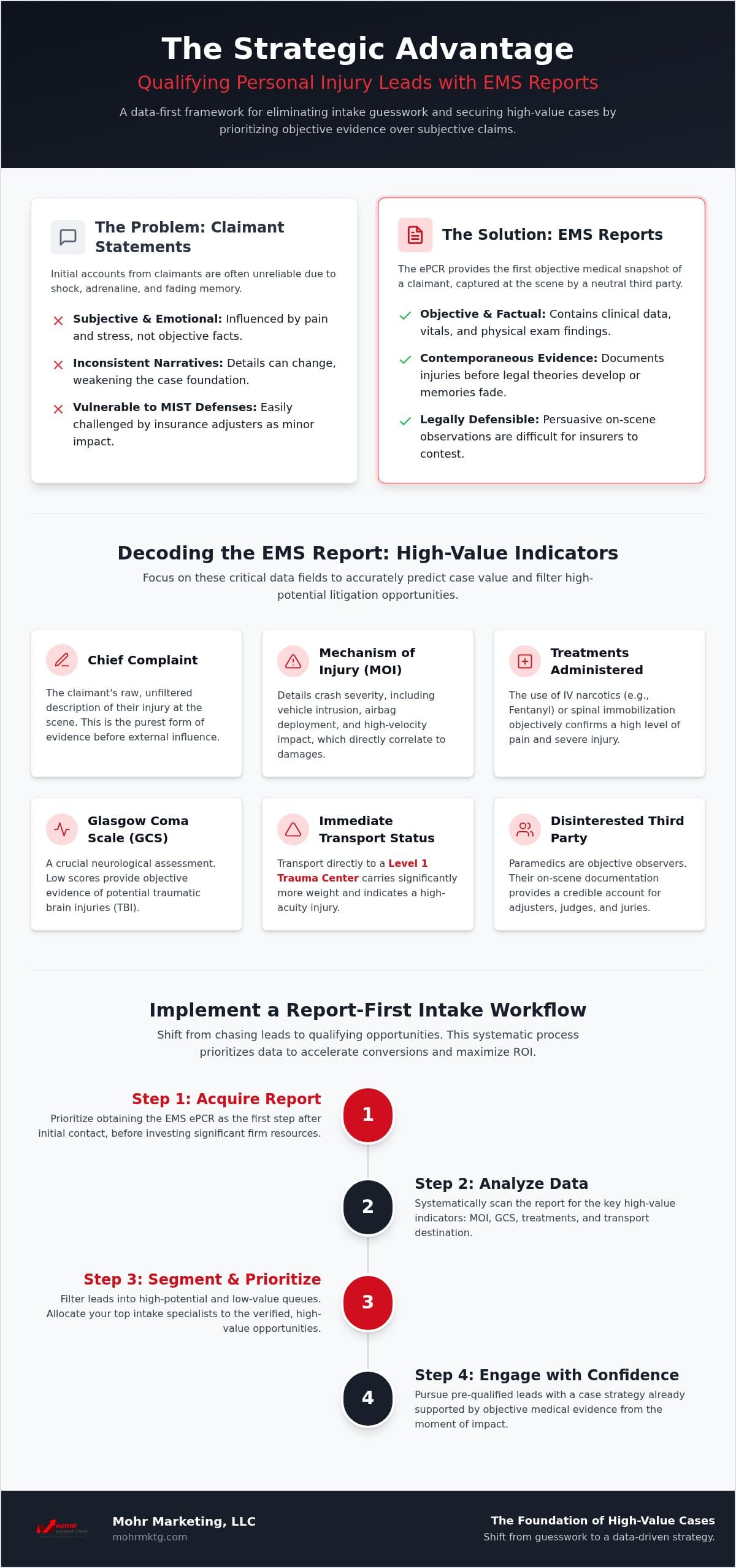
The Emergency Medical Services (EMS) report, or electronic Patient Care Record (ePCR), is the first objective medical snapshot of a claimant. It captures clinical data at the point of impact; this happens long before legal theories are developed or memories begin to fade. Qualifying personal injury leads with EMS reports allows your firm to move beyond the “he-said, she-said” of initial intake. While a claimant might describe a catastrophic event, the ePCR provides the ground truth. It contains vitals, Glasgow Coma Scale (GCS) scores, and physical exam findings recorded by a disinterested third party.
Objective Evidence vs. Subjective Narrative
Claimants are often unreliable historians. In the immediate aftermath of a motor vehicle accident, adrenaline masks pain and shock clouds memory. This creates a dangerous gap between what a claimant remembers and what a paramedic actually records. Insurance adjusters exploit this gap to dismiss claims as Minor Impact Soft Tissue (MIST) incidents. The EMS report bridges this divide by providing a systematic documentation of a patient’s medical history and current injuries at the scene.
Attorneys need facts before feelings to build a viable case. Paramedics document the mechanism of injury (MOI), noting vehicle intrusion, airbag deployment, and the patient’s position. These on-scene observations are far more persuasive than delayed symptoms reported days later. If the report notes a self-extricated patient with no visible distress, the case valuation changes instantly. Using this data early prevents your firm from wasting resources on leads that will eventually crumble under defense scrutiny.
Predicting Case Value Before the Retainer
EMS data points correlate directly with settlement potential. High-value litigation opportunities often start with specific indicators found only in the ePCR. Indicators such as immediate transport to a Level 1 trauma center, the administration of IV narcotics, or documented loss of consciousness serve as the gold standard for lead verification. It’s a strategic filter that separates high-stakes opportunities from low-value noise.
Implementing a report-first strategy allows you to prioritize your high-volume funnel. With the 2026 HIPAA updates expected to reduce record access deadlines to 15 days, obtaining these reports is faster than ever. Instead of treating every lead with equal weight, you can rank opportunities based on objective clinical markers. This is the foundation of police report backed MVA cases, where verification happens before intake friction begins. By treating the EMS report as a prerequisite for high-stakes acquisition, you eliminate guesswork and focus your budget on cases with verified surgical potential.
Decoding the EMS Report: Key Data Points for Case Valuation
The EMS report serves a dual legal and liability purpose, acting as the primary evidentiary bridge between the crash site and the courtroom. When qualifying personal injury leads with EMS reports, your intake team must focus on specific data fields that correlate with high settlement outcomes. Start with the “Chief Complaint.” This field captures the patient’s first reported injury before they’ve had time to consult with counsel or overthink their symptoms. It’s the rawest form of medical evidence you’ll ever receive.
The “Mechanism of Injury” (MOI) is equally critical for establishing liability and damages. Paramedics document vehicle speed, point of impact, and safety device performance. If the MOI indicates high-velocity impact with significant vehicle intrusion, the case value increases regardless of the claimant’s initial demeanor. Audit the “Treatments Administered” section for high-value markers. The administration of narcotics like Fentanyl or Morphine, or the use of spinal immobilization, indicates a severity level that insurance adjusters find difficult to contest. Finally, verify the “Transport Destination.” Admission to a Level 1 Trauma Center carries significantly more weight than a standard ER visit. To ensure you aren’t missing these high-value indicators, speak with a strategic partner about automating your verification workflow.
The Glasgow Coma Scale (GCS) and Neurological Indicators
Understanding the Glasgow Coma Scale is essential for identifying Traumatic Brain Injury (TBI) potential early in the intake process. The GCS ranks neurological function from 3 to 15 based on eye, verbal, and motor responses. While a perfect score is 15, any score below 15 on-scene is a critical indicator of a high-value lead. Instruct your intake team to flag any mention of “Loss of Consciousness” (LOC) or “Altered Mental Status.” Even a brief LOC can substantiate long-term neurological claims that standard soft tissue cases lack.
Vital Signs and Physical Assessment Findings
Abnormal vital signs on-scene provide objective proof of shock or internal trauma. Tachycardia or hypotension immediately following an accident supports claims of significant physical distress that subjective narratives cannot match. The physical assessment section often contains clinical markers that claimants may not mention during a phone call. Look for specific terminology:
- Deformity: Indicates a probable fracture or structural joint damage.
- Crepitus: The grating sensation of bone ends rubbing together, confirming high-impact trauma.
- Guarding: Involuntary muscle contraction indicating severe internal pain or potential organ damage.
The ePCR stands as the definitive record of the claimant’s immediate post-accident physical state. Using these objective metrics allows you to rank leads by medical necessity rather than just the claimant’s enthusiasm for a lawsuit.
EMS Documentation vs. Claimant Statements: Eliminating Intake Bias
Paramedics are trained to document the scene with clinical detachment. Claimants, conversely, view the accident through a lens of trauma and adrenaline. Comparing the “Scene Description” in an ePCR to the claimant’s version of events is the most effective way to eliminate intake bias. When a claimant describes a high-speed collision but the EMS report notes “minor vehicle damage” and “no intrusion,” the case valuation drops instantly. Qualifying personal injury leads with EMS reports allows you to audit these statements in real-time before you commit to a signed retainer.
Discrepancies aren’t just details; they’re deal-breakers. Insurance adjusters rely on the Minor Impact Soft Tissue (MIST) defense when objective documentation is absent. Without a report to corroborate the mechanism of injury, the defense will argue the impact was insufficient to cause the claimed injuries. You must also account for “Refusal of Care” or “Against Medical Advice” (AMA) notations. An AMA notation doesn’t necessarily kill a case, but it requires an immediate strategic pivot. Use these discrepancies to disqualify fraudulent or low-intent inquiries immediately. It’s better to lose a lead at intake than to lose a case at mediation.
The ‘Gap in Treatment’ Trap
Insurance companies use gaps in medical treatment to devalue personal injury leads. If a claimant waits three days to visit an urgent care clinic, the adjuster will claim an intervening event caused the injury. EMS reports bridge this gap. They provide a contemporaneous record of injury starting the moment first responders arrive. Using EMS transport documentation serves as definitive proof of immediate medical necessity. It establishes a chronological chain of causation that is nearly impossible for the defense to break.
Verifying High-Intent with Objective Data
High-intent leads are defined by their medical reality, not their verbal enthusiasm. Objective reports eliminate the “buyer’s remorse” often seen in low-quality leads where the claimant realizes their injuries aren’t as severe as they initially thought. This is why police report-backed MVA cases are the industry standard for scalable growth. By relying on verified data, you reduce the churn associated with PI intake. These report-backed leads ensure your firm is only investigating cases with a high probability of significant settlement potential. Shifting to an objective verification model protects your resources and focuses your team on high-stakes litigation opportunities.
Implementing a Report-First Intake Workflow for Scalable Growth
Scaling a personal injury firm requires a shift from reactive intake to a proactive, data-driven workflow. Integrating report requests at the very start of the process is essential. When qualifying personal injury leads with EMS reports, your team must prioritize “Immediate Transport” status. These leads convert at a significantly higher rate because the medical necessity is already established. Train your intake staff to ask questions that mirror ePCR fields. Instead of asking “where does it hurt,” they should ask “did the paramedics mention your Glasgow Coma Scale score” or “what trauma center were you taken to.” This alignment ensures that the verbal narrative matches the coming documentation. Understanding the ROI of legal intake services is critical here; professional intake partners handle these complex data points with a level of precision that internal teams often lack.
Standardizing the Intake Ecosystem
To achieve scalable growth, you must standardize the process of qualifying personal injury leads with EMS reports through a rigorous checklist. Every lead should be scored based on report-derived metrics like mechanism of injury and neurological indicators. A standardized checklist prevents high-value cases from slipping through the cracks while filtering out low-value noise.
- Identify High-Value Indicators: Flag cases involving airbag deployment or vehicle extrication immediately.
- Automate Scoring: Assign point values to specific ePCR data points to rank leads for attorney review.
- Adopt a Turnkey Model: Use a system that requests authorizations and reports simultaneously to prevent high-value cases from stalling.
A turnkey approach eliminates the friction that causes claimants to shop around. It allows you to secure the retainer before the competition even accesses the police report. This methodical approach transforms your intake department from a cost center into a high-performance acquisition engine.
Managing HIPAA and Data Compliance
Operational efficiency means nothing without strict adherence to state laws and bar mandates. You must establish a professional protocol for obtaining medical authorizations during the first contact. With HIPAA rules expected to shorten record access times from 30 days to 15 days in 2026, your firm’s ability to manage protected health information (PHI) is a competitive advantage. This level of data security is especially vital in mass tort lead generation, where high-volume data handling increases the risk of breach. Ensure your intake ecosystem uses encrypted portals and compliant storage to protect both the firm and the claimant. By maintaining rigorous verification and security processes, you build the trust necessary to sign high-stakes cases quickly.
Securing High-Intent Leads with Mohr Marketing’s Verification Ecosystem
Mohr Marketing eliminates the uncertainty of case acquisition through a rigorous, multi-step verification ecosystem. We don’t just provide contact information; we deliver high-intent opportunities that have already passed through a clinical and legal filter. By specializing in personal injury lead generation, we ensure every inquiry meets strict criteria before it reaches your desk. This process mirrors the objective standards discussed throughout this guide, specifically the process of qualifying personal injury leads with EMS reports to confirm medical necessity and liability.
Our performance-based model removes the financial risk from your firm’s expansion. We provide fully executed agreements and signed retainers, allowing your attorneys to focus on litigation rather than intake logistics. As a strategic partner for national law firm scaling, we act as the protective barrier between your resources and low-value, unverified leads. We handle the rigorous verification and report-backed qualification so your firm doesn’t have to.
Signed Retainers: The End of the Qualification Struggle
The “Pay-Per-Signed-Case” model is the ultimate risk-mitigation strategy for modern firms. Instead of gambling on raw lead data, you pay only for performance. Mohr Marketing handles the entire intake and verification cycle. We secure the medical authorizations, verify the transport status, and ensure the claimant is ready to move forward. This turnkey approach is applied across our entire portfolio, including specialized case acquisition for high-value mold cases and high-impact motor vehicle accidents. We manage the friction of the intake process so your team can focus on high-stakes litigation.
Transparency and Data-Driven Growth
With a 30-year legacy in the industry, Mohr Marketing prioritizes transparency and tangible results. Many firms struggle because they rely on shared aggregators that sell the same low-quality lead to multiple competitors. This creates a race to the bottom that destroys ROI. We provide exclusive, verified opportunities that are built on rigorous data standards. Moving away from unverified lead sources is a prerequisite for sustainable growth in 2026.
We maintain strict compliance with state laws and bar mandates, ensuring your firm’s reputation remains protected throughout the acquisition process. Our system is built for firms that value mechanical accuracy and strategic expansion. If you’re ready to stop wasting resources on “soft tissue” dead ends, it’s time to shift to a report-backed model. Contact Mohr Marketing today to scale your firm with high-intent, report-backed leads.
Transform Your Intake Into a High-Performance Acquisition Engine
Relying on subjective narratives is a strategic liability. Qualifying personal injury leads with EMS reports ensures that your firm’s resources are dedicated only to cases with verified clinical markers and high settlement potential. By auditing objective data points like transport status and mechanism of injury early, you eliminate the intake friction that stalls growth and creates resource waste. This transition from guesswork to data-driven qualification is the only way to maintain a competitive advantage in a high-volume market.
Mohr Marketing provides the expertise needed to navigate this transition effectively. With 30+ years of legal marketing experience, we offer a performance-based pay-per-signed-case model that guarantees results. Our turnkey ecosystem operates with strict adherence to bar mandates and state compliance; this ensures your growth is both rapid and secure. It’s time to replace unreliable intake methods with a system built on mechanical accuracy and strategic value.
Take the final step toward a more efficient, profitable practice by prioritizing objective evidence from the first point of contact.
Frequently Asked Questions
What is an EMS report and why is it critical for personal injury leads?
An EMS report, or electronic Patient Care Record (ePCR), is the first clinical documentation generated after an accident. It’s critical because it provides a disinterested, third-party assessment of injuries before legal interests or memory lapses influence the narrative. When qualifying personal injury leads with EMS reports, firms gain access to vital signs and on-scene observations that prove or disprove the claimant’s subjective statements, ensuring resources are only spent on viable cases.
How do I obtain an EMS report for a potential client during intake?
Obtaining these records requires a signed HIPAA authorization from the claimant during the initial intake call. Under the updated HIPAA Security Rule expected in 2026, the deadline for providing patient records is reduced from 30 days to 15 days. Firms should utilize third-party portals like ChartSwap to expedite retrieval. Standardizing this request during the first contact ensures that the ePCR is available for review before significant investigative costs are incurred.
Can an EMS report be used to disqualify a personal injury lead?
Yes, these reports are powerful tools for immediate disqualification. If the ePCR notes that the patient was “self-extricated,” “ambulatory on scene,” or “refused transport” (AMA), the case likely lacks the medical severity required for a high-value settlement. These notations provide a roadmap for insurance adjusters to build a Minor Impact Soft Tissue (MIST) defense. Identifying these “dead-end” indicators early prevents your firm from wasting time on leads that won’t convert.
What specific fields in an EMS report indicate a high-value MVA case?
Focus on the “Chief Complaint” and “Mechanism of Injury” (MOI) fields. A high-value MVA case often features documented vehicle intrusion, airbag deployment, or a Glasgow Coma Scale (GCS) score below 15. Additionally, the “Treatments Administered” section should be audited for narcotic administration or spinal immobilization. Finally, a “Transport Destination” to a Level 1 Trauma Center is a definitive clinical marker of a high-stakes litigation opportunity that warrants immediate attention.
Is an EMS report more important than a police report for lead qualification?
While a police report is essential for establishing liability, the EMS report is often more important for determining damages. A police officer documents the crash mechanics, but a paramedic documents the human toll. Damages drive case valuation in the early stages of intake. By qualifying personal injury leads with EMS reports, you verify the physical reality of the injury, which is the primary factor in deciding whether to issue a retainer agreement.
How does Mohr Marketing verify the quality of personal injury leads before delivery?
Mohr Marketing utilizes a rigorous, multi-step verification process backed by over 30 years of industry experience. We screen every inquiry against specific clinical and legal criteria to ensure high intent and medical necessity. Our turnkey ecosystem handles the initial heavy lifting of intake, filtering out low-value “soft tissue” noise. This ensures that the opportunities delivered to your firm are already vetted for the high-stakes potential required for a successful personal injury practice.
What is the difference between a lead and a signed retainer in PI marketing?
A lead is a verified inquiry from a claimant who meets specific criteria but has not yet committed to a firm. A signed retainer is a fully executed agreement where the claimant has already chosen your firm for legal representation. Mohr Marketing offers a performance-based, pay-per-signed-case model. This structure eliminates the risk of paying for leads that don’t convert, providing a direct, streamlined path to scalable firm growth and expansion.
How can I integrate EMS report data into my firm’s existing CRM or intake workflow?
Integrate this data by adding specific ePCR fields to your CRM’s intake questionnaire. Train your staff to ask about transport status, trauma center destination, and on-scene treatments during the first call. You can then automate lead scoring based on these objective metrics. This ensures that high-value cases are prioritized for immediate attorney review. Standardizing this data collection within your workflow removes intake friction and creates a repeatable system for objective case valuation.

Recent Posts
- Qualifying Personal Injury Leads with EMS Reports: A Guide to Objective Case Valuation
- Getting Medical Malpractice Cases: 2026 Law Firm Guide
- Performance Marketing for Law Firms: 2026 Scaling Guide
Categories
- AI and Lead Generation
- Business Financing
- Call Verified MVA Leads
- Car Accident Help
- Car Accident Settlements
- Claimant Funding
- Compliance Program
- EMS-EMT Reports
- Geotargeting
- Google Maps Ranking
- Healthcare Practice Growth
- Law Firm Growth
- Law Office Operations
- Lead Generation
- Lead Generation For Attorneys
- Lead Generation For Chiropractors
- Lead Generation For Criminal Attorneys
- Lead Generation For D&A Treatment Centers
- Lead Generation For DUI Attorneys
- Lead Generation For Eye Doctors
- Lead Generation For Family Law Practices
- Lead Generation For PI Law Firms
- Lead Generation For Plastic Surgeons
- Leads For Healthcare Professionals
- Leads For Insurance Industry
- Legal Leads
- Legal Marketing
- Legal Updates
- Mass Tort Leads
- Medicare and Medicaid Leads
- Merchant Funding Leads
- Online Marketing Strategies
- Pre-Settlement Funding
- Signed MVA Cases
- Tort Updates
- Truck Accident Leads and Signed Cases
- Truck Accident Settlements
- Web Design