Optimizing the Mass Tort Client Intake Process for Scalable Case Acquisition
July 6, 2026 by Mohr Marketing
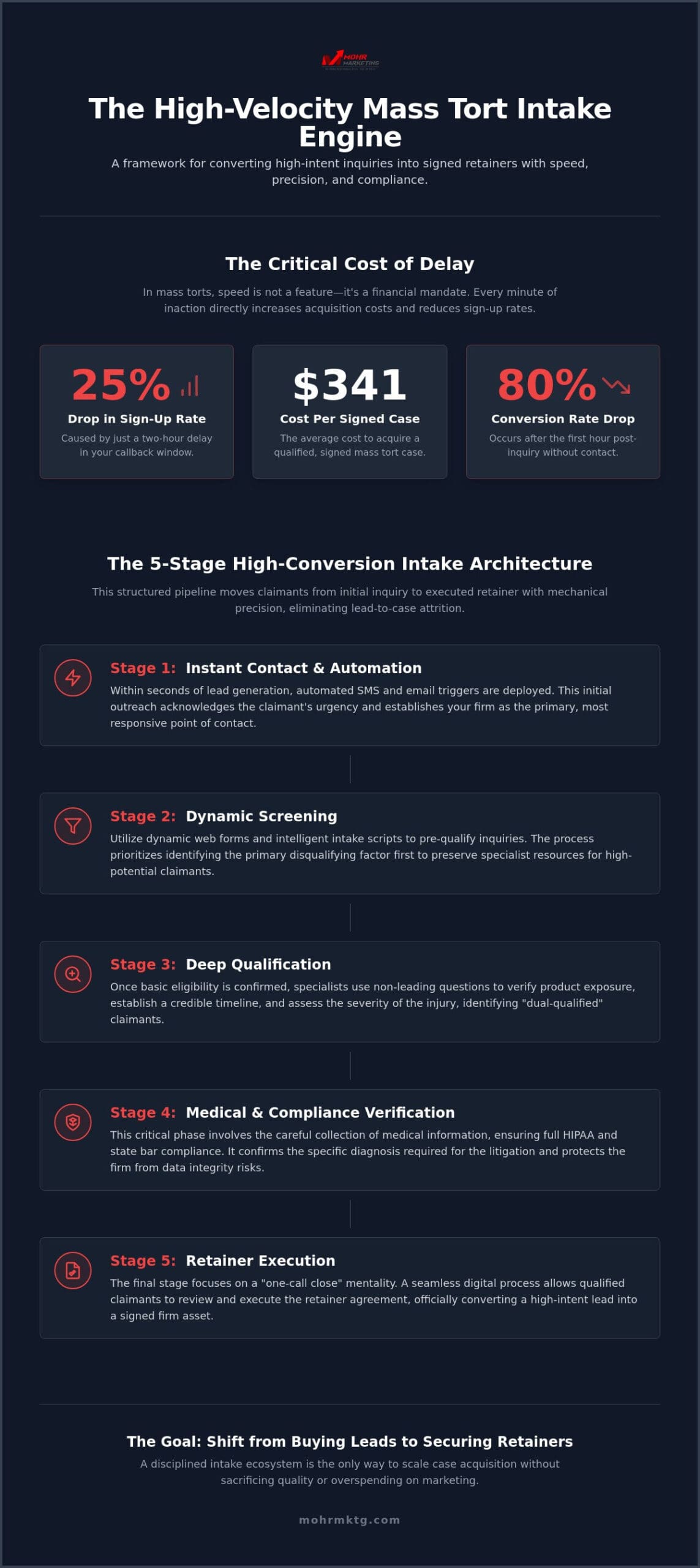
A two-hour delay in your callback window could be costing your firm a 25% drop in sign-up rates. In a market where the average cost to acquire a signed mass tort case sits at $340.94 as of June 2026, inefficiency isn’t just a bottleneck; it’s a direct financial drain. Most firms spend thousands on lead generation only to watch high-intent claimants slip through the cracks due to inconsistent screening or slow response times. You already know that winning in mass torts isn’t just about who has the biggest marketing budget. It’s about who has the most disciplined intake engine.
Optimizing your mass tort client intake process is the only way to scale case acquisition without sacrificing quality or overspending. This guide shows you how to build a high-velocity intake ecosystem that converts inquiries into signed retainers with mechanical precision. You’ll discover how to implement a repeatable, high-speed workflow that lowers your cost-per-acquisition and secures a higher percentage of qualified cases. We will break down the specific procedural shifts required to move from reactive lead handling to a proactive, results-driven acquisition model that maximizes every marketing dollar spent.
Key Takeaways
- Learn why standard personal injury workflows fail in high-volume campaigns and how to pivot to a high-stakes filtering model.
- Master a 5-stage architecture designed to optimize the mass tort client intake process by bridging the gap between automated screening and human verification.
- Discover how to integrate AI for rapid lead sorting while maintaining the specialized human empathy required for sensitive, high-value torts.
- Identify critical HIPAA and state bar compliance requirements to protect your firm from solicitation penalties and data integrity risks.
- Shift your acquisition strategy from buying raw leads to securing fully executed retainers through a turnkey intake ecosystem.
The Strategic Role of Mass Tort Client Intake in 2026
Marketing generates interest, but the mass tort client intake process secures the asset. In 2026, this process acts as the high-stakes filter between raw digital inquiries and signed litigation. It’s the most critical juncture in the case acquisition lifecycle. Without a rigorous intake engine, your marketing spend is merely a donation to your competitors. Mohr Marketing, LLC views this stage as the definitive gatekeeper for firm profitability and long-term docket growth.
Successful firms focus on identifying “dual-qualified” claimants. These individuals possess both a verifiable medical injury and the legal standing to join a mass tort. This requires more than a call center script. It requires an integrated ecosystem where marketing data informs the initial conversation. When an intake specialist knows which ad creative triggered the call, they can tailor the screening process for higher conversion and better claimant experience.
Why Traditional Intake Models Fail in Mass Torts
Traditional personal injury intake models are designed for steady, low-volume traffic. They cannot handle the sudden lead surges typical of national campaigns. When a new bellwether trial update or a regulatory change triggers a spike in inquiries, internal law firm staff often become overwhelmed. This leads to the “leaky bucket” syndrome, where high-value opportunities are lost due to operational friction.
When this happens, qualified leads are lost to long hold times and inconsistent screening. Passive answering services are insufficient. They collect names. They fail to drive the claimant toward a signed case. To scale, firms must transition to proactive conversion specialists who understand the urgency of the tort and the specific criteria required for litigation. Efficiency in this area is the difference between a profitable campaign and a total loss.
The Financial Impact of Speed-to-Lead
Speed determines profitability. The “five-minute rule” isn’t a suggestion; it’s a financial mandate. Industry data indicates that conversion rates drop by 80% after the first hour of lead generation. In the competitive 2026 landscape, claimants often click on multiple ads simultaneously. The firm that calls first usually wins the retainer.
Data from June 23, 2026, confirms that maintaining a two-hour callback window for warm leads increases sign-up rates by 15% to 25% compared to next-day follow-up. With the average cost to acquire a signed mass tort case at $340.94, every lost lead increases your blended acquisition cost. Rapid response times are a core component of a modern mass tort client intake process. They fundamentally lower the cost-per-signed-case by capturing the claimant before they move on to a competitor’s offer.
The 5-Stage Architecture of a High-Conversion Intake Process
A high-velocity mass tort client intake process is a structured pipeline, not a series of disconnected events. To scale case acquisition effectively, your firm must move claimants from the first digital touchpoint to a fully executed retainer with mechanical precision. This requires a “one-call close” mentality that prioritizes speed while maintaining rigorous verification checkpoints at every stage of the funnel. Mohr Marketing, LLC designs these workflows to eliminate the friction that typically causes lead-to-case attrition.
Stage 1 & 2: Instant Contact and Dynamic Screening
The moment a lead is generated, automated SMS and email triggers must fire within seconds. This initial outreach acknowledges the claimant’s urgency and establishes your firm as the primary point of contact. Use dynamic web forms to pre-qualify inquiries before the first phone call occurs. Your intake scripts should prioritize the primary disqualifying factor first. If a claimant didn’t use the product or lacks the specific medical diagnosis, the call should end quickly to preserve resources. When managing these high-volume interactions, firms must remain aware of their ethical obligations when delegating client intake to non-lawyer staff or third-party services.
Stage 3 & 4: Deep Qualification and Medical Verification
Once basic eligibility is confirmed, the process shifts to deep qualification. Specialists must verify product exposure through specific, non-leading questions that establish a credible timeline. You need to assess injury severity using standardized medical criteria tailored to the specific tort. This stage is also where you identify potential “dual-representation” issues. Ask directly if the claimant has already signed with another firm or received a prior settlement from an earlier MDL phase. This prevents your team from wasting time on non-viable files that can’t be litigated under current court orders.
Stage 5: The Digital Retainer Execution
The final stage is the execution of the digital retainer. You should deliver the e-signature document while the claimant is still on the phone. This maintains the momentum of the conversation and prevents “signer’s remorse” or simple forgetfulness. If a retainer isn’t signed instantly, implement a staccato follow-up sequence of texts and calls over the next 48 hours. Firms looking to bypass the technical and staffing hurdles of building this infrastructure often opt for Mass Tort Signed Cases, which arrive fully vetted and ready for the litigation team. If your current conversion rates are lagging behind industry benchmarks, you should contact us to audit your workflow and identify where your pipeline is leaking.
Balancing Technology with Human Empathy in Screening
Scalability in the mass tort client intake process relies on a delicate equilibrium. Automation handles volume. Empathy handles conversion. Mohr Marketing, LLC implements a hybrid strategy that leverages technology for speed while preserving the human touch for complex, high-stakes claims. This approach ensures that no claimant feels like a number in a database, even when your firm is processing thousands of inquiries per week. By integrating AI at the top of the funnel, you filter out non-viable leads quickly, allowing your human specialists to focus their energy on high-intent claimants who require a more sophisticated interaction.
Leveraging AI for Scalable Data Extraction
AI tools in 2026 go beyond simple transcription. They provide real-time sentiment analysis and script compliance monitoring. This is a critical defensive measure against regulatory scrutiny. For instance, California’s SB 37 mandates strict accuracy in attorney advertising. AI ensures that intake specialists don’t deviate into prohibited legal advice or misleading claims. Automated extraction of exposure dates and medical facilities into your CRM removes human error. This creates a clean data trail for your litigation team to follow. Additionally, AI chatbots manage after-hours screening, ensuring that inquiries generated at midnight receive an immediate response and preliminary qualification. This constant availability prevents leads from going cold before your team can initiate a human follow-up.
The Human Element: Building Trust with Claimants
Technology cannot replicate the trust required for high-value torts. Claimants dealing with life-altering illnesses, such as Mesothelioma or high-value mold exposure, require an empathetic listener. You must train your intake staff in trauma-informed conversation techniques. This involves active listening and validating the claimant’s experience without making premature legal promises. The transition from a digital ad to a human voice should be seamless. If the marketing message promises compassion, the intake call must deliver it. A hybrid model allows for rapid sorting during high-volume surges without overwhelming your staff. When AI flags a lead as highly qualified, it can be routed immediately to a senior specialist.
When a claimant feels heard, they are significantly more likely to execute a retainer on the first call. Empathy is a strategic conversion tool that bridges the gap between a digital inquiry and a signed case. It transforms a cold transaction into a professional relationship based on reliability and expertise. This methodical approach reduces the cognitive load on your team, preventing burnout and maintaining the high-energy register needed for successful conversion. Refining your mass tort client intake process through this hybrid lens is the only way to maintain quality while scaling your docket in a competitive market.
Ensuring Compliance and Data Integrity in Legal Intake
Compliance is the foundation of a scalable mass tort client intake process. Without it, your firm faces catastrophic litigation risk and heavy regulatory penalties. As of 2026, the landscape has shifted toward extreme transparency and consumer protection. You must treat data integrity as a non-negotiable operational standard rather than a checkbox. Protecting the firm’s standing is just as important as signing the next case.
HIPAA and TCPA Compliance Frameworks
Handling claimant medical data requires strict adherence to HIPAA standards. All intake platforms must utilize end-to-end encryption. This ensures that sensitive health information remains protected from the first digital touchpoint. Beyond medical data, you must navigate the evolving TCPA landscape. As of April 11, 2025, new FCC rules require businesses to honor consent revocation requests within 10 business days. Every outbound follow-up call must be backed by a logged, timestamped consent record. In 2026, penalties for non-willful TCPA violations are $500 per message or call, while willful violations reach $1,500. There’s no cap on these penalties.
Your intake scripts must undergo regular audits. There’s a fine line between “qualification” and “solicitation.” Scripts should focus on gathering facts to determine eligibility rather than offering legal advice. This distinction is critical for staying within state bar mandates. For example, California’s SB 37, effective January 1, 2026, prohibits misleading statements about a lawyer’s skills or record. Penalties for false advertising under this law range from $5,000 to $100,000 per unique advertisement. Your intake team is often the first point of verbal contact; they must be trained to avoid any statements that could be construed as misleading.
Verification Strategies to Prevent Case Fraud
Fraudulent leads and “double-dipping” erode your ROI. You must implement ID verification and IP tracking at the point of entry. This filters out bot-generated inquiries and fraudulent digital leads before they reach your staff. Cross-referencing claimant data with national databases helps identify litigious plaintiffs or individuals who have already filed with other firms. This prevents the administrative nightmare of duplicate filings and protects your reputation with the MDL courts.
Data transparency is your best defense. Law firms must audit their lead providers to ensure that every signed retainer is backed by a clean, verifiable paper trail. For a broader perspective on building a compliant acquisition machine, review our Roadmap to Scalable Growth. Rigorous intake doesn’t just protect you; it preserves the financial integrity of the entire litigation pool. If you’re concerned about your current exposure, contact us to conduct a compliance audit of your intake scripts and data protocols.
The Mohr Marketing Method: Moving Beyond Leads to Signed Cases
Growth is not achieved through high lead volume; it is secured through signed litigation. Many firms attempt to build a custom mass tort client intake process internally, only to realize the complexity of managing 24/7 staffing, technical redundancy, and regulatory shifts. Mohr Marketing, LLC provides a direct alternative by shifting the focus from purchasing raw inquiries to acquiring fully executed retainers. We function as a strategic partner that manages the entire infrastructure, allowing your firm to concentrate on the legal merits of the docket rather than the mechanics of the call center.
Eliminating the Intake Burden via Pay-Per-Signed-Case
Maintaining an in-house intake department requires significant capital for salaries, training, and technology licenses. This creates high fixed costs that persist even during campaign lulls. Mohr Marketing, LLC removes this financial risk through a performance-based model. You pay only for verified, signed opportunities that meet your firm’s specific litigation criteria. This ensures that every marketing dollar spent results in a tangible legal asset ready for the litigation team.
Our protocol for mesothelioma case acquisition demonstrates this precision. We perform deep medical vetting and exposure verification before a file is ever transferred to your office. By offloading these friction points to Mohr Marketing, LLC, you gain the ability to scale your docket rapidly without expanding your administrative payroll. This model provides the predictability required for long-term capital allocation in complex mass tort litigation.
Integrating Performance Marketing with Intake Precision
A successful intake engine must be fueled by high-intent data to be effective. Mohr Marketing, LLC uses real search intent data to inform our screening protocols. When a claimant enters the funnel through specific criteria, such as Camp Lejeune or defective pharmaceutical queries, our specialists utilize scripts tailored to those exact legal requirements. This integration ensures a higher level of accuracy during the initial qualification phase and reduces the time spent on non-viable inquiries.
This data-driven approach allows the Mohr Marketing, LLC model to scale across national campaigns without a drop in quality. We invite firms to audit their internal conversion metrics against our benchmark. If your staff can’t maintain the velocity required to capture high-intent inquiries in real-time, your growth will remain stagnant. Transitioning to a turnkey solution for your mass tort client intake process is a strategic decision to eliminate intermediaries and secure market share in the most competitive torts. You can acquire Mass Tort Signed Cases directly, bypassing the traditional lead-to-case attrition entirely.
Scale Your Mass Tort Litigation with Precision
A fragmented mass tort client intake process is a direct threat to firm profitability. In the 2026 legal landscape, success requires more than just high lead volume; it demands a high-velocity ecosystem that converts inquiries with mechanical precision. By implementing the 5-stage architecture and hybrid screening models discussed, your firm can transform a reactive call center into a proactive acquisition engine. Maintaining strict data integrity and compliance is not just a regulatory requirement but a strategic foundation for sustainable growth.
Mohr Marketing, LLC eliminates the administrative friction of intake through a performance-based Pay-Per-Signed-Case model. With over 30 years of industry experience and a rigorous adherence to HIPAA and state bar standards, we provide the infrastructure needed to scale your docket without increasing fixed overhead. Stop wasting leads; acquire fully executed Mass Tort retainers today. Take the direct path to high-value case acquisition and ensure your firm remains a leader in the competitive mass tort arena.
Frequently Asked Questions
What is the difference between a mass tort lead and a signed retainer?
A mass tort lead is a potential claimant who has expressed interest but has not yet been vetted or committed to representation. In contrast, a signed retainer is a fully executed legal agreement that converts a qualified inquiry into an active case for your firm. The transition from lead to retainer is where most firms experience high attrition rates. Focusing on acquiring signed retainers eliminates the risk of paying for non-viable inquiries that never reach the litigation stage.
How quickly should my firm follow up with a mass tort inquiry?
Your firm should establish contact within five minutes of receiving an inquiry. Immediate response is a competitive necessity because claimants often interact with multiple advertisements simultaneously. The first firm to initiate the mass tort client intake process typically secures the representation. Waiting even one hour significantly increases the likelihood that the claimant will sign with a competitor, directly inflating your cost-per-signed-case and reducing the overall efficiency of your acquisition budget.
What are the most common mistakes made during the client intake process?
The most common errors include slow response times, inconsistent screening by untrained staff, and failing to secure a digital signature while the claimant is still on the phone. Many firms also neglect to verify medical diagnoses or product exposure timelines early in the conversation. These failures lead to a “leaky bucket” syndrome where high-quality leads are lost to competitors or disqualified too late in the process, wasting valuable firm resources.
Should I use an in-house team or an outsourced service for mass tort intake?
An outsourced, performance-based service is generally superior for firms looking to scale. In-house teams often struggle with the high-volume surges typical of national campaigns and carry significant fixed overhead. Using a specialized partner allows you to shift to a pay-per-signed-case model. This ensures you only pay for verified assets that are ready for litigation, removing the management burden and administrative friction of maintaining a 24/7 internal call center.
How do I ensure my mass tort intake scripts are compliant with state bar ethics?
Scripts must focus strictly on factual qualification rather than offering legal advice or making guarantees about case outcomes. You should conduct regular audits to ensure your team avoids misleading statements, particularly in light of 2026 regulations like California’s SB 37. Clear distinctions between “qualification” and “solicitation” are essential. All outbound communication must also strictly adhere to TCPA consent protocols and HIPAA data protection standards to mitigate litigation risk.
What technology is essential for managing high-volume mass tort intakes?
Essential technology includes a CRM with automated SMS triggers and integrated e-signature tools for immediate document execution. In 2026, AI-driven screening is also vital for real-time sentiment analysis and ensuring script compliance. These tools allow for a high-velocity mass tort client intake process that maintains data integrity at scale. Without an integrated tech stack, your team will fail to capture high-intent leads before they go cold or move to a more responsive firm.
How can I improve my conversion rate from inquiry to signed case?
Improve conversion by prioritizing speed-to-lead and implementing a “one-call close” strategy. Ensure your intake specialists are trained in trauma-informed conversation to build trust quickly with claimants. Delivering a digital retainer via text or email while the claimant is still on the phone prevents second-guessing and distractions. A seamless transition from the initial marketing click to the verbal screening creates a professional experience that encourages immediate commitment.
What medical documentation is typically required during the intake phase?
During intake, you must collect proof of a specific medical diagnosis, hospital or clinic names where treatment occurred, and verifiable dates of product exposure. While full medical records are obtained later, capturing these core details during the initial screening is vital for assessing case viability. This data allows your team to cross-reference claims against the specific criteria of the MDL, ensuring that only qualified cases move forward to the litigation phase.
Recent Posts
- Bar-Compliant Legal Marketing: 2026 Guide for Law Firms
- Auto Accident Lead Generation: Build a Verified Case Pipeline in 2026
- Car Accident Case Acquisition: Strategic Law Firm Guide
Categories
- AI and Lead Generation
- Business Financing
- Call Verified MVA Leads
- Car Accident Help
- Car Accident Settlements
- Claimant Funding
- Compliance Program
- EMS-EMT Reports
- Geotargeting
- Google Maps Ranking
- Healthcare Practice Growth
- Law Firm Growth
- Law Office Operations
- Lead Generation
- Lead Generation For Attorneys
- Lead Generation For Chiropractors
- Lead Generation For Criminal Attorneys
- Lead Generation For D&A Treatment Centers
- Lead Generation For DUI Attorneys
- Lead Generation For Eye Doctors
- Lead Generation For Family Law Practices
- Lead Generation For PI Law Firms
- Lead Generation For Plastic Surgeons
- Leads For Healthcare Professionals
- Leads For Insurance Industry
- Legal Leads
- Legal Marketing
- Legal Updates
- Mass Tort Leads
- Medicare and Medicaid Leads
- Merchant Funding Leads
- Mold Leads
- Online Marketing Strategies
- Pre-Settlement Funding
- Signed MVA Cases
- Tort Updates
- Truck Accident Leads and Signed Cases
- Truck Accident Settlements
- Web Design