Strengthen PI Retainers with Detailed EMS Reports
July 3, 2026 by Mohr Marketing
Most personal injury cases are won or lost in the first sixty minutes after an accident. Despite this, the most critical evidence from that window often sits unread in a municipal filing cabinet. You’ve likely experienced the frustration of waiting weeks for records from municipal agencies, only to receive EMS reports filled with technical medical shorthand that obscures the true value of the claim. Inconsistent reporting standards across different providers make it difficult to verify injuries quickly, which slows down your intake process and impacts your bottom line.
It’s time to turn these administrative hurdles into a competitive advantage. This guide provides a strategic framework to master the acquisition and analysis of these records to maximize case value and strengthen your retainers. You’ll learn a streamlined process for requesting files from diverse agencies and how to identify high-value injury markers hidden in electronic Patient Care Reports (ePCRs). We’ll also cover techniques for faster verification to improve your overall case conversion rates. This approach transforms raw medical data into a precise tool for firm growth.
Key Takeaways
- Understand how the 2026 transition to electronic PCRs (ePCRs) impacts your firm’s data storage and retrieval requirements.
- Identify the specific data blocks within EMS reports that contain critical liability admissions and high-value injury markers.
- Implement a standardized two-step process to secure HIPAA-compliant records from municipal and private providers without administrative friction.
- Filter high-value surgical cases from lower-priority claims by cross-referencing arrival data with established liability markers.
- Scale your firm’s operations by transitioning from manual record acquisition to receiving pre-verified signed retainers and mass tort leads.
What are EMS Reports (PCRs) and Why Do They Matter?
The Patient Care Report (PCR) serves as the primary medical and legal record for any pre-hospital encounter. It’s the first medical footprint of a personal injury claim. Understanding the structural integrity of a case begins with EMS reports. These documents record the patient’s condition, the mechanism of injury, and the immediate interventions performed at the scene. By 2026, the industry is finalizing a comprehensive transition from traditional paper records to electronic PCRs (ePCRs). This digital shift categorizes these reports as a specialized type of Electronic Health Record (EHR), which allows for more granular data collection and faster retrieval for legal teams.
In personal injury law, these reports function as contemporaneous evidence. They capture the raw, unfiltered state of the victim and the accident scene within minutes of the event. Unlike hospital records, which are often filtered through the lens of long-term clinical treatment, EMS reports focus on the trauma mechanism. This makes them significantly more reliable for establishing a direct link between a specific accident and the resulting injuries. They provide the “why” and “how” that later clinical notes might omit.
The Role of NEMSIS in Standardized Reporting
The National EMS Information System (NEMSIS) provides the framework that makes modern reporting useful for legal analysis. Specifically, the NEMSIS 3.5 standards have standardized data fields across state lines. This uniformity means that a report from a rural provider in Utah uses the same data architecture as one from a major trauma center in California. For your firm, this consistency is a strategic asset. Standardized data allows your intake team to automate initial case reviews. They can quickly scan for specific injury codes or trauma markers without deciphering the unique handwriting or idiosyncratic formatting of individual paramedics.
EMS Reports vs. Hospital Records
Hospital records are essential, but they often lack scene-specific details that are vital for establishing liability. EMS providers document “scene findings” that an ER physician never sees. This includes vehicle extrication details, the position of the patient upon arrival, and environmental factors like weather or road conditions. While a hospital focuses on clinical findings and stabilization, the EMS narrative captures the “transfer of care” details. This section often contains spontaneous statements from the claimant or witnesses that can make or break a case. Cross-referencing these scene-specific findings with police report-backed MVA cases ensures a comprehensive view of liability that a hospital bill simply cannot provide. The EMS narrative bridges the gap between the impact and the operating room.
Anatomy of a High-Value EMS Report
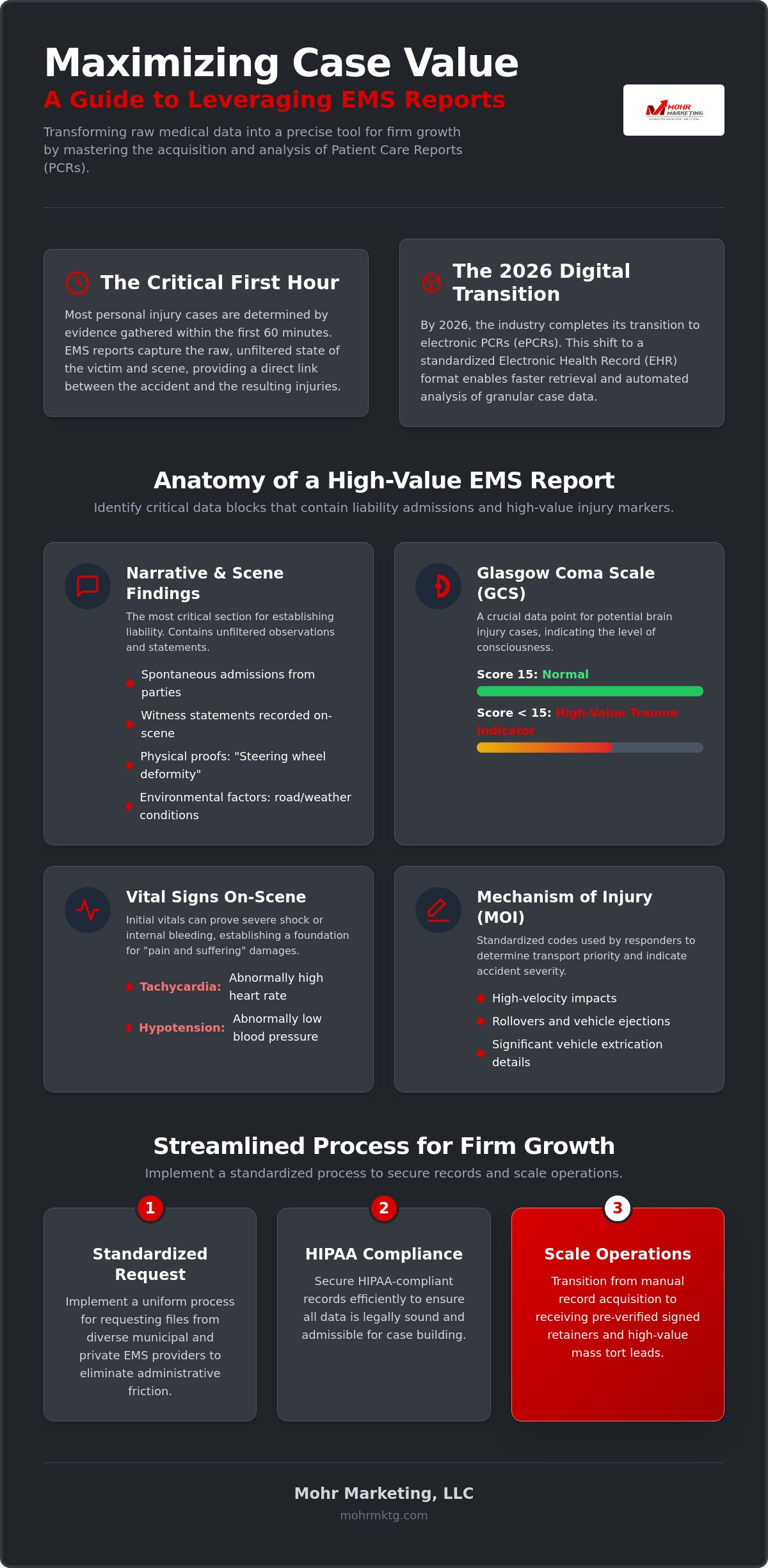
Analyzing EMS reports requires more than a casual glance at the patient’s name and the destination hospital. You must treat these documents as evidentiary blueprints. Every report must adhere to specific state regulations for patient care reports, which mandate the documentation of patient history, physical examination findings, and all treatments provided. Legal teams should focus immediately on the “Narrative” section. This is where paramedics record spontaneous admissions from the driver or witnesses and describe the physical state of the scene. Look for descriptors such as “steering wheel deformity” or “windshield starring.” These are physical proofs of impact force that hospital records often omit.
The Glasgow Coma Scale (GCS) is another non-negotiable data point, especially in potential brain injury cases. A GCS score of 15 is normal, but any lower number recorded at the scene indicates a high-value trauma case. Don’t ignore the vitals. Tachycardia or hypotension on-scene can prove internal bleeding or severe shock, establishing a foundation for “pain and suffering” damages early in the litigation process. If your firm struggles to extract these markers at scale, you can consult with our intake specialists to optimize your verification process.
Decoding Trauma Scores and Injury Codes
First responders use standardized trauma scoring systems to determine transport priority. You should prioritize cases where the “Mechanism of Injury” (MOI) codes indicate high-velocity impacts, rollovers, or ejections. These codes act as a filter in your intake funnel. A case with an MOI code for a 40 mph side-impact collision is objectively more valuable than a parking lot tap. Use these metrics to allocate your firm’s resources toward the highest ROI opportunities.
Medication and Treatment Protocols
The administration of on-scene medications provides immediate insight into the patient’s distress level. If a paramedic administers narcotics like Fentanyl or Morphine, the injury’s severity is documented in real-time. Advanced Life Support (ALS) interventions, such as intubation or needle decompression, signify life-threatening conditions. Always cross-reference these treatments with the final hospital diagnosis. A discrepancy between the scene treatment and the ER discharge can sometimes reveal a failure to diagnose, which may open paths for additional claim types or increased settlement leverage.
- GCS Scores: Any score below 15 requires immediate neuro-evaluation follow-up.
- Medication Logs: Narcotics use establishes immediate, documented pain.
- Narrative Gold: Spontaneous statements at the scene are often the most honest.
The Retrieval Process: How to Request EMS Records Efficiently
Efficiency in legal intake depends on a standardized record retrieval protocol. You can’t afford to treat EMS reports as an afterthought. The first step is identifying the responding agency. This requires cross-referencing dispatch logs or police records to determine if a municipal fire department or a private ambulance company handled the transport. Once identified, you must secure a HIPAA-compliant authorization form from the claimant. Don’t rely on generic medical releases; many agencies require specific language tailored to pre-hospital care providers.
Determining the specific request portal is the next logistical hurdle. Many agencies now utilize third-party digital clearinghouses, while others still require physical mailings to a specific records clerk. After receiving the file, audit it immediately. Look for missing narrative pages or excessive redactions that hide critical scene details. Finally, ensure administrative fees are paid through the correct channel. As of July 2026, agencies like the Sacramento County EMS and the Sacramento Metropolitan Fire District have implemented updated fee schedules based on comprehensive cost-of-service studies. This reflects a nationwide trend toward more rigid, cost-based administrative pricing for records access.
HIPAA Compliance and Legal Authorizations
A standard medical release is often insufficient for EMS agencies. Use a specific “Disclosure of Health Information” form that explicitly names the ambulance provider. To minimize rejections, include a Power of Attorney (POA) with your request. This proactive step prevents the “insufficient authority” denials that frequently stall case momentum. Maintaining a rigorous chain of custody for digital records is vital to ensure the evidence remains admissible during trial. Understanding the intersection of EMS documentation and legal liability is essential for protecting your firm’s interests during the discovery phase.
Overcoming Common Retrieval Obstacles
“Incident not found” errors are common and usually stem from incorrect scene data. Verify the exact intersection, time of dispatch, and any patient aliases used on-scene before submitting your request. Private EMS providers often have different retention policies than fire department-based services. If you’re managing police report-backed MVA cases, use the officer’s badge number to contact the dispatch center directly for clarification. This direct path bypasses bureaucratic friction and accelerates your verification timeline. For high-stakes litigation, consider sending a formal preservation letter to ensure digital ePCR data isn’t purged before your request is processed.
Leveraging EMS Data to Verify Case Value and ROI
Maximizing firm ROI requires aggressive case filtering. EMS reports provide the objective data needed to distinguish high-value surgical cases from low-impact soft tissue claims before you commit significant litigation capital. If a report indicates immediate immobilization or the use of advanced life support, the case value is inherently higher. Considering the updated 2026 administrative fees for records, such as the new fee schedules in Sacramento County, you don’t want to waste money on requests for low-value leads. This saves your firm from the financial drain of pursuing claims with limited settlement potential.
Establish liability by cross-referencing arrival times with police report-backed MVA cases. If the EMS crew arrived before law enforcement, their observations of vehicle positioning and driver behavior are the most reliable evidence available. Analyzing the “Scene Description” can also reveal third-party defendants. For example, a paramedic might note a malfunctioning traffic light or a commercial truck lacking proper reflective tape. These details expand the pool of liable parties and increase the total case value. This verification-first approach ensures you only allocate resources to cases with a high probability of a substantial settlement.
Identifying High-Value Markers Early
Look for technical indicators of catastrophic injury. For truck accident signed cases, scan for terms like “mechanical extrication” or “crush injury.” These markers justify the immediate deployment of accident reconstruction experts. In high-value mold case acquisition, EMS narratives documenting acute respiratory distress provide the contemporaneous medical link needed to prove toxic exposure. These narratives also provide raw material for compelling “pain and suffering” arguments during mediation.
Integrating Data into Your Intake Ecosystem
Your intake staff must ask questions that align with PCR data structures. This synchronization allows you to verify a claimant’s story against the official record in real-time. Utilizing professional legal intake services ensures that preliminary scene info is gathered with precision. Building a “verification-first” culture improves the quality of your signed retainers and protects your firm from the costs of chasing unviable leads. Contact our team to optimize your verification process.
Scaling Your Firm with Verified Case Acquisition
Scaling your firm shouldn’t mean hiring more administrative staff to chase paperwork. If your current model relies on paralegals manually hunting down EMS reports and deciphering technical shorthand, you’ve hit a growth ceiling. You’re trading high-value legal hours for clerical tasks. The most efficient firms are moving toward a model of receiving mass tort signed cases that are already verified against objective medical data. This transition eliminates the verification lag that kills case momentum and drains firm resources.
Working with an agency that understands the verification stage of a lead is a significant competitive advantage. It’s the difference between a raw inquiry and a high-intent opportunity. Mohr Marketing, LLC utilizes data-driven strategies to ensure every lead meets strict criteria before it reaches your desk. We don’t just provide leads; we provide a filtered pipeline of claimants who have already passed a rigorous intake process. This allows your attorneys to focus on litigation and settlement rather than administrative vetting. By the time a case reaches your firm, the heavy lifting of data cross-referencing is complete.
The Mohr Marketing, LLC Advantage
Mohr Marketing, LLC offers a turnkey marketing and intake ecosystem designed for high-stakes professional practices. We operate on performance-based models, such as Pay-Per-Signed-Case, which aligns our success directly with yours. With 30 years of experience in the legal and medical business sectors, we understand the nuances of high-value case acquisition. We bridge the gap between initial trauma and a signed retainer by applying procedural precision to every lead. Our system filters out unviable claims early, ensuring your firm only invests in cases with a documented path to ROI. This mechanical accuracy in lead processing removes the guesswork from your firm’s growth strategy.
Next Steps for National Growth
The first step toward scaling is auditing your current intake process for data gaps. If you don’t have a standardized way to verify injuries through EMS reports or on-scene narratives, your conversion efficiency is suffering. You need a partner who can deliver high-intent opportunities without the friction of traditional lead generation. Contact Mohr Marketing, LLC today for a consultation on how to modernize your case acquisition strategy. It’s time to stop chasing records and start closing cases. Scale your firm with verified signed cases today.
Optimize Your Firm’s Acquisition Strategy
Mastering the acquisition and interpretation of EMS reports is no longer an administrative option; it’s a strategic necessity for high-growth firms. By identifying trauma markers and liability admissions early, you protect your firm’s resources from low-value soft tissue claims. You now have the framework to navigate the 2026 reporting landscape and streamline the retrieval process to maintain case momentum. This procedural precision ensures that every signed retainer in your pipeline is backed by contemporaneous medical evidence.
Mohr Marketing, LLC provides a direct path to scaling your firm without the friction of manual record retrieval. With over 30 years of industry experience, we ensure strict compliance with state laws and bar mandates. Our performance-based Pay-Per-Signed-Case model allows you to acquire pre-verified, high-intent opportunities with mechanical accuracy. Transition from chasing paperwork to litigating high-value claims by integrating our expert intake ecosystem into your practice today.
Get High-Intent Signed Cases Verified by Experts
Start scaling your case volume with confidence and precision.
Frequently Asked Questions
How do I find out which EMS agency responded to an accident?
Check the police report first for an agency name or unit number. If the report is incomplete, contact the local Public Safety Answering Point (PSAP) to request the Computer-Aided Dispatch (CAD) log. This log provides a definitive list of every unit dispatched to the scene. You can then match these unit IDs to the specific municipal or private providers operating in that jurisdiction.
What is the difference between an ePCR and a traditional EMS report?
An ePCR is a digital Patient Care Report that follows NEMSIS data standards for structured information. Traditional reports were often paper-based and prone to illegibility or missing data fields. The modern ePCR allows your firm to use automated tools to scan for specific injury codes and trauma markers. This digital shift ensures more consistent documentation of the patient’s condition from the scene to the hospital.
Can a law firm request EMS reports without a signed client authorization?
No, HIPAA regulations strictly prohibit the release of protected health information to third parties without a valid patient authorization. While a court-issued subpoena can sometimes compel the release of records, it’s a slow and adversarial process. Securing a HIPAA-compliant signature during the initial intake is the most efficient way to obtain EMS reports without unnecessary legal delays.
Are EMS reports admissible as evidence in a personal injury trial?
Yes, these reports are generally admissible under the business records exception to the hearsay rule. They’re highly valued by courts because they’re contemporaneous records created by medical professionals during their standard duties. Because they’re written minutes after an accident, they carry significant weight in establishing the initial mechanism of injury and the patient’s immediate physical state before any litigation began.
How long do EMS agencies typically keep patient care records?
Retention periods are governed by state law and usually range from seven to ten years for adult patients. For cases involving minors, agencies often maintain records until the patient reaches the age of majority plus a set number of years. You should submit your requests as early as possible to prevent data loss. Some private providers may purge digital records sooner if their internal policies allow it.
What should I do if an EMS report contains factual errors about the accident?
Contact the agency’s medical director or records department to request a formal addendum. Paramedics rarely alter an original report once it’s filed, but they can submit a supplemental narrative to correct objective errors. Documenting these discrepancies immediately prevents the defense from using the original mistake to challenge your client’s credibility or the severity of the documented injuries during a trial.
How much do municipal agencies usually charge for EMS record retrieval?
Fees vary based on local ordinances and the complexity of the request. Many agencies have moved to cost-based fee structures following comprehensive studies. As of July 1, 2026, several California agencies implemented updated fee schedules to reflect the actual administrative cost of processing records. You should expect to pay between $20 and $50 for most standard retrieval requests, depending on the provider’s specific ordinance.
Why is the Narrative section of the EMS report so important for my case?
The narrative contains the paramedic’s subjective scene observations and any spontaneous statements made by the parties involved. It often documents physical evidence like “steering wheel deformity” or “windshield starring” that proves the force of impact. These details provide the raw material for pain and suffering arguments. It captures the unfiltered reality of the scene in a way that standardized checkboxes and hospital bills cannot replicate.

Recent Posts
- In-House vs. Outsourced Law Firm Marketing in 2026
- Signs You Need a New Lead Generation Partner: A Law Firm Guide
- How to Find Plaintiffs for Mass Tort Cases: A Practical Guide
Categories
- AI and Lead Generation
- Business Financing
- Call Verified MVA Leads
- Car Accident Help
- Car Accident Settlements
- Claimant Funding
- Compliance Program
- EMS-EMT Reports
- Geotargeting
- Google Maps Ranking
- Healthcare Practice Growth
- Law Firm Growth
- Law Office Operations
- Lead Generation
- Lead Generation For Attorneys
- Lead Generation For Chiropractors
- Lead Generation For Criminal Attorneys
- Lead Generation For D&A Treatment Centers
- Lead Generation For DUI Attorneys
- Lead Generation For Eye Doctors
- Lead Generation For Family Law Practices
- Lead Generation For PI Law Firms
- Lead Generation For Plastic Surgeons
- Leads For Healthcare Professionals
- Leads For Insurance Industry
- Legal Leads
- Legal Marketing
- Legal Updates
- Mass Tort Leads
- Medicare and Medicaid Leads
- Merchant Funding Leads
- Mold Leads
- Online Marketing Strategies
- Pre-Settlement Funding
- Signed MVA Cases
- Tort Updates
- Truck Accident Leads and Signed Cases
- Truck Accident Settlements
- Web Design