Mass Tort Advertising in 2026: A Professional Guide to Scalable Case Acquisition
August 29, 2026 by Mohr Marketing
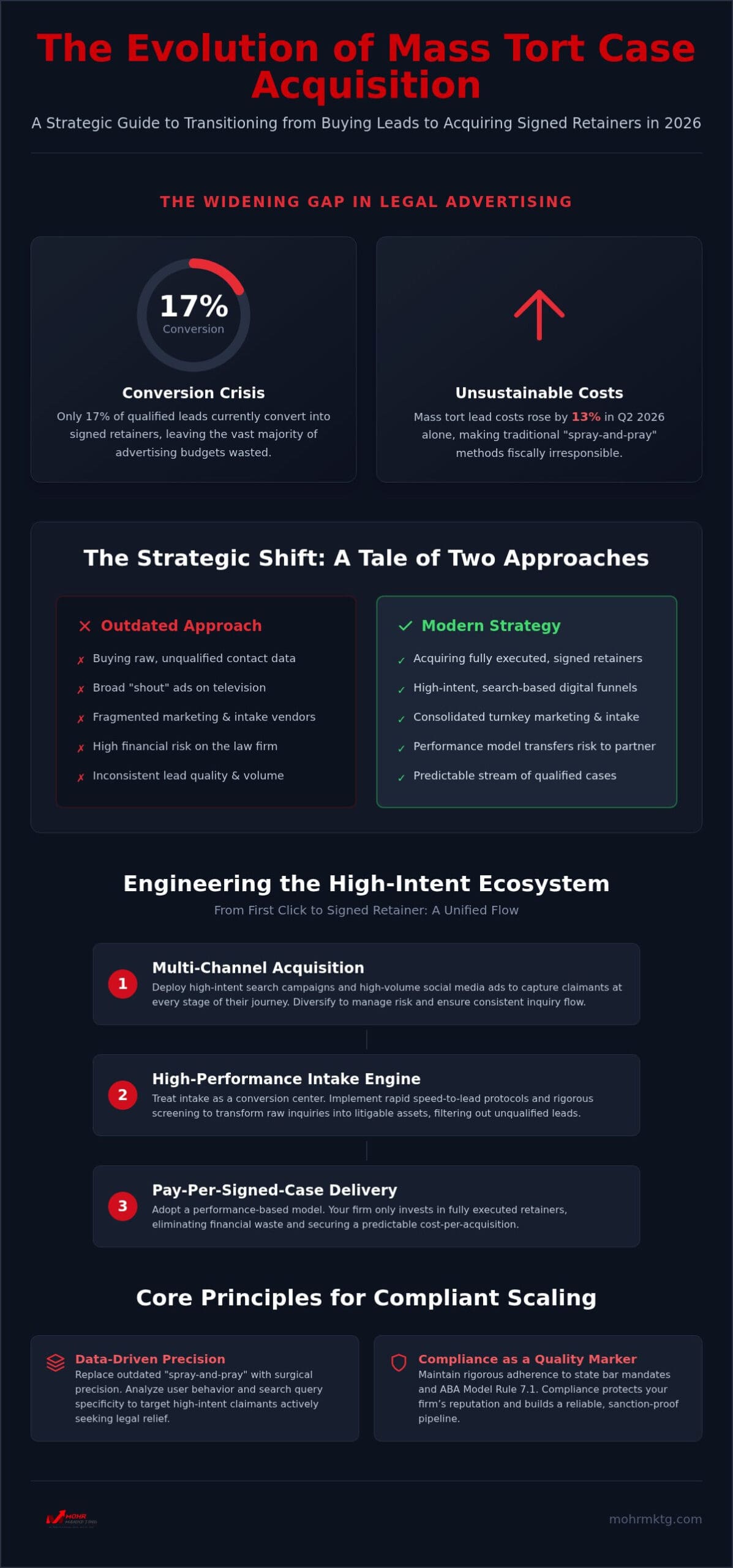
Only 17% of qualified leads currently convert into signed retainers, leaving the vast majority of advertising spend on the cutting room floor. You likely recognize that traditional mass tort case acquisition strategies are becoming unsustainable as lead costs rose 13% in the second quarter of 2026 alone. Buying raw contact data is no longer a viable path to growth when the market demands immediate, high-intent engagement. The gap between a raw inquiry and a signed retainer is widening, leaving firms with mounting overhead and empty dockets.
It’s frustrating to manage a high cost-per-lead only to face intake bottlenecks and inconsistent lead quality. You need a predictable stream of qualified cases to maintain a competitive advantage. This guide will teach you how to master the mechanics of high-intent advertising and transition your firm from buying leads to acquiring fully executed signed retainers. We’ll examine the shift toward search-based acquisition, the necessity of a turnkey intake ecosystem, and the specific protocols required to lower your cost-per-acquisition in a complex 2026 legal landscape.
Key Takeaways
- Modernize your approach by moving beyond broad television reach to high-intent digital funnels that capture claimants at the peak of their search intent.
- Deploy multi-channel mass tort case acquisition strategies to diversify risk and ensure a consistent volume of qualified inquiries across national markets.
- Adopt a pay-per-signed-case performance model to transfer financial risk from your firm to your marketing partner while securing fully executed retainers.
- Treat intake as a high-performance conversion engine where speed-to-lead and rigorous screening transform raw inquiries into litigable assets.
- Consolidate your growth efforts with a turnkey ecosystem that combines marketing and intake to eliminate the friction and high costs of fragmented vendor relationships.
The Evolution of Mass Tort Advertising: Navigating the 2026 Landscape
Mass tort advertising is a specialized branch of legal marketing tailored for multi-claimant litigation. It functions as the engine for practice growth, but the mechanics have changed. What is a mass tort? It’s a civil action involving numerous plaintiffs against corporate defendants, often centered on defective products, pharmaceuticals, or environmental hazards. In 2026, the plaintiff-side legal advertising market has surpassed $400 million annually. This financial surge has triggered extreme market saturation. Generic ad copy no longer converts because claimants are inundated with similar messaging across every digital platform. Successful mass tort case acquisition strategies now require a transition from broad awareness to surgical precision.
The historical reliance on television “shout” ads is over. While TV once dominated, it lacks the targeting necessary to manage rising costs. Between April and August 2026, lead costs increased by 13%, forcing firms to abandon broad demographic targeting in favor of high-intent digital funnels. These funnels capture claimants at the exact moment they search for legal relief. This ensures your budget is spent on active seekers rather than passive viewers who may never qualify for a claim.
The Shift from Awareness to Intent
Claimants in 2026 are increasingly skeptical of flashy social media promises. They’ve seen the same hooks for years and now prioritize transparency and authority. Search-based intent has become the gold standard for capturing high-value cases. For example, acquiring mesothelioma cases requires filtering for real search intent and strict medical criteria. Data-driven targeting replaces the outdated spray-and-pray method by analyzing user behavior patterns and query specificity. With 162 active MDLs currently on the federal docket, your mass tort case acquisition strategies must focus on these high-intent signals to maintain a profitable cost-per-signed-case.
Regulatory Pressures and Bar Compliance
Aggressive scaling is only sustainable if it’s compliant. Adherence to state bar mandates is a non-negotiable component of modern advertising. Every ad must include specific attorney advertising disclaimers and utilize non-promise language. Professional firms prioritize these standards to protect their reputation while pursuing national reach. Compliance isn’t a hurdle; it’s a quality marker. By maintaining rigorous verification and sticking to ABA Model Rule 7.1 guidelines, you eliminate the risk of bar sanctions while building a more reliable pipeline of litigants. This disciplined approach ensures that your firm remains a leader in a crowded, high-stakes market.
Engineering the High-Intent Funnel: Multi-Channel Strategies for 2026
Building an effective funnel requires more than creative assets. It demands a technical architecture designed to filter out noise. The anatomy of a 2026 mass tort ad consists of three pillars: a high-impact hook, experience-based copy, and a direct CTA. The hook identifies the specific injury or drug exposure immediately. Experience-based copy builds trust by demonstrating an understanding of the claimant’s medical or financial burden. Finally, the CTA must provide a clear, low-friction path to the next step. For high-volume categories like motor vehicle accidents, successful mass tort case acquisition strategies utilize police-report backed data. This verification layer ensures the incident is documented and litigable before any marketing dollars are spent on intake.
The Role of Multi-Channel Diversification
Platform reliance is a risk. Relying solely on social media creates a single point of failure. You must balance the high volume of social platforms with the high intent of Google Search. Social media provides the scale necessary for large MDLs, but search captures users at the peak of their intent. Channel selection should be tort-specific. For example, truck accidents often require a different mix of search and display advertising to reach specific claimant profiles. Diversification ensures national reach and protects your pipeline from algorithm shifts. It’s about risk management; if one platform changes its advertising policies, your entire case acquisition engine shouldn’t stall.
Landing Page Optimization for Legal Claimants
In 2026, your landing page is a qualification filter, not a lead form. Mobile-first design is the standard because most claimants engage via smartphones. A trust audit of your page should reveal essential elements: attorney disclaimers, clear privacy policies, and secure data handling markers. Skeptical visitors require immediate proof of authority to convert. Use dynamic forms to pre-qualify claimants. These forms ask conditional questions based on medical criteria, ensuring only viable cases move to the intake stage. This reduces the burden on your staff and ensures they only spend time on litigable assets. If you need to audit your current funnel performance, consult with our strategic team to identify conversion gaps and improve your throughput.
Financial Performance Models: Lead Buying vs. Signed Case Acquisition
The traditional pay-per-lead model is failing. It forces firms to gamble on raw data. You pay for a phone number; you don’t pay for a client. This creates a fundamental disconnect between marketing spend and actual revenue. In contrast, the pay-per-signed-case model aligns your costs directly with your results. You only pay for fully executed retainers. This shift is a critical component of modern mass tort case acquisition strategies. It transforms marketing from a speculative expense into a predictable asset purchase.
Cheap leads carry high hidden costs. When industry data indicates that only 17% of qualified leads convert into signed cases, your intake team wastes 83% of their time on dead ends. This inefficiency drains your overhead and slows your momentum. A signed-case model transfers this operational risk to the partner. You receive a litigable asset, not a research project. This allows your firm to focus on litigation rather than managing a high-volume call center.
Risk Mitigation in Mass Tort Acquisition
Firms are pivoting toward performance-based models to protect their margins. Managed retainers often hide deep inefficiencies in the acquisition funnel. By focusing on the signed case, you ensure that every dollar spent results in a tangible client. This approach forces marketing and intake to align perfectly. If the intake process fails, the marketing partner doesn’t get paid. This incentive structure guarantees higher quality and faster processing. It’s the most efficient way to scale a practice without bloating internal payroll or risking capital on unverified inquiries.
Transparency and Data-Driven Reporting
Data is the only antidote to ghost leads and fraudulent inquiries. You must demand real-time dashboards and clear chain-of-custody documentation for every claimant. Auditing your partners based on Cost Per Acquisition (CPA) rather than Cost Per Lead (CPL) is essential. CPL is a vanity metric; CPA is a financial reality. Rigorous verification protocols eliminate non-litigable inquiries before they ever reach your docket. This level of transparency ensures your mass tort case acquisition strategies are built on a foundation of verifiable performance, not optimistic estimates. You need to know exactly where every case originated and how it was qualified.
The Intake Ecosystem: Converting Inquiries into Litigable Assets
An intake ecosystem is a conversion engine, not a call center. It’s the mechanism that transforms raw inquiries into secured assets. Many firms treat intake as an administrative afterthought, but in 2026, it’s the primary driver of ROI. Speed-to-lead is the only metric that matters here. Research shows that lead costs increased 13% in early 2026, making every missed call a significant financial loss. If you don’t reach a claimant within the first five minutes of their inquiry, your chances of conversion drop precipitously. Effective mass tort case acquisition strategies require 24/7/365 availability to capture motivated claimants exactly when they’re ready to engage. For complex litigation like high-value mold cases, this ecosystem must also handle rigorous medical verification to ensure the claimant meets the specific exposure and injury criteria required for the MDL.
The Anatomy of a High-Conversion Intake Call
Successful intake calls balance empathy with professional authority. The agent must act as a “straight-talker” who guides the claimant through a structured interview. You aren’t just collecting contact information; you’re verifying facts and qualifying legal viability. Verification involves confirming the basic incident details, while qualification ensures the case meets the strict criteria set by your firm. The goal is the one-call close. Moving from the initial inquiry to an e-signature in minutes prevents the claimant from shopping their case to competitors. This requires a seamless transition from the screening questions to the retainer presentation without any technical or procedural friction.
Automating the Retainer Process
Secure the attorney-client relationship instantly using integrated e-signature technology. In a national market, waiting for physical paperwork is a recipe for attrition. Your system should trigger an electronic retainer the moment a claimant is qualified. If a high-intent lead becomes non-responsive, automated SMS and email follow-ups are essential to maintain engagement. These multi-touch sequences keep your firm top-of-mind until the document is signed. Understanding the ROI of Legal Intake Services is vital for firms looking to optimize their conversion efficiency. By automating the follow-up and signature stages, you allow your legal team to focus on litigation while the acquisition engine runs in the background.
Scaling Your Practice: Implementing a Turnkey Acquisition Strategy
A managed ecosystem is the superior alternative to fragmented vendor relationships. When you juggle separate marketing agencies, intake centers, and screening services, you create friction. This friction increases your cost-per-acquisition and dilutes lead quality. Implementing integrated mass tort case acquisition strategies through a turnkey system eliminates these inefficiencies. It removes the “middleman” effect where data is lost between platforms. To avoid rookie mistakes, partner with a strategic expert possessing 30+ years of industry experience. This longevity ensures they’ve navigated multiple litigation cycles and regulatory shifts that would sideline less experienced providers.
Scaling nationally requires a methodical approach. Don’t commit millions to an unproven campaign. Start with a pilot program to verify the unit economics of a specific tort. Once you’ve confirmed the cost-per-signed-case meets your firm’s ROI requirements, move to volume. This progression protects your capital while allowing for aggressive expansion. Your goal is to position your firm as the logical conclusion of the claimant’s search journey. When your funnel is engineered correctly, the claimant feels they’ve found the definitive authority for their specific injury. They stop searching because you’ve provided the solution.
Moving Beyond Shared Aggregators
Shared leads are a liability. When multiple firms call the same claimant, it creates a race to the bottom that destroys your conversion rates. Exclusivity is the only way to protect your CPA and maintain your firm’s reputation. By building custom-built funnels, you create a “moat” around your firm that competitors can’t easily cross. This is a fundamental shift in professional mass tort case acquisition strategies. For a detailed breakdown of this transition, see Mass Tort Lead Generation: A Roadmap to Scalable Growth. Custom funnels ensure that the leads you generate are yours alone, allowing your intake team to build genuine rapport without the pressure of a multi-firm bidding war.
Next Steps for Performance-Driven Growth
Your first step is an audit of your current lead providers. Look for waste, high attrition, and lack of transparency. Select your next mass tort based on current litigation windows and the unit economics of the specific MDL. Don’t chase “hot” torts without analyzing the underlying data first. Once you’ve identified a viable opportunity, request a consultation for a performance-based campaign. This ensures your growth is driven by tangible results rather than marketing promises. Transitioning to a turnkey model is the most direct path to scaling your practice and securing a dominant market position in 2026.
Secure Your Competitive Advantage in the 2026 Mass Tort Market
The legal landscape in 2026 doesn’t reward passive advertising. You’ve seen how high-intent digital funnels and a rigorous intake ecosystem transform raw inquiries into litigable assets. Successful mass tort case acquisition strategies now depend on a transition from buying unverified leads to acquiring fully executed signed retainers. By aligning your financial performance with actual case signatures, you eliminate the overhead of failed conversions and inefficient vendor management. This approach protects your capital while ensuring your docket is filled with high-value cases ready for litigation.
Leverage our 30+ years of industry expertise to build a predictable, scalable practice. Our data-driven multi-channel strategy ensures your firm remains the definitive solution for claimants in a saturated market. We provide fully verified signed retainers so you can focus on your core legal duties rather than managing a call center.
It’s time to stop managing raw data and start litigating cases with confidence.
Frequently Asked Questions
What is the average cost-per-signed-case in mass tort advertising?
The cost to acquire a signed mass tort case fluctuates based on the specific litigation and current market demand. In 2026, firms are seeing a wide range of acquisition costs, where highly competitive torts require a more significant investment compared to emerging litigation. Monitoring these market shifts is essential for maintaining profitable mass tort case acquisition strategies. You should focus on the cost-per-signed-case as the most accurate reflection of your actual acquisition efficiency.
How do you ensure mass tort ads remain compliant with state bar rules?
Compliance is managed through strict adherence to ABA Model Rule 7.1 and specific state bar mandates. Every ad copy undergoes a rigorous verification process to ensure non-promise language and the inclusion of mandatory attorney advertising disclaimers. We prioritize transparency and one-to-one consent standards under the TCPA. This protective approach ensures your firm scales aggressively without compromising its professional reputation or risking regulatory sanctions in a complex legal market.
Why is immediate intake critical for mass tort claimant acquisition?
Speed-to-lead is the primary driver of conversion efficiency. If a claimant isn’t contacted within five minutes of their inquiry, the likelihood of securing a signed retainer drops significantly. In 2026, lead costs have increased by 13%, making every minute of delay a direct financial loss. Our 24/7/365 intake ecosystem ensures that motivated claimants are qualified and signed the moment their search intent is highest, preventing them from seeking other counsel.
What is the difference between an exclusive lead and a shared lead?
An exclusive lead is delivered only to your firm, whereas a shared lead is sold to multiple competitors simultaneously. Shared leads create a race to the bottom and lower your conversion rate. Exclusivity protects your cost-per-acquisition by allowing your intake team to build rapport without a multi-firm bidding war. We focus on custom-built funnels that generate exclusive, high-intent inquiries to maximize your firm’s growth and financial ROI.
Can a small firm compete in national mass tort advertising?
Small firms can compete effectively by utilizing a turnkey ecosystem that provides the same infrastructure as larger practices. You don’t need a massive internal department to scale. By leveraging a pay-per-signed-case model, you can acquire high-quality cases without the upfront risk of managing complex digital marketing funnels. This levels the playing field, allowing firms of all sizes to implement national mass tort case acquisition strategies with precision and predictable costs.
How does Mohr Marketing, LLC verify the medical criteria of a claimant?
Medical verification is conducted through a structured, multi-step screening process during the initial intake call. Agents utilize dynamic forms to confirm specific exposure dates, diagnosis details, and treatment history. For high-value cases, we verify that the claimant meets the exact criteria required by the MDL docket. This rigorous filtering ensures that every signed retainer delivered is a litigable asset with a high probability of success, protecting your firm’s resources.
What torts are currently most active for advertising in 2026?
Key emerging mass torts for 2026 include GLP-1 weight-loss drugs like Ozempic, PFAS “forever chemicals,” and social media addiction litigation. Platform liability cases involving child safety on platforms like Roblox and Discord are also seeing significant activity. As of August 3, 2026, there are 162 active MDLs on the federal docket. Selecting the right tort depends on current litigation windows and the specific unit economics of each case.
How long does it typically take to see ROI on a mass tort campaign?
Mass tort campaigns typically require a return on investment horizon of 3 to 7 years. While you acquire signed cases quickly, the litigation process and settlement cycles take time to mature. This is why a strategic, long-term approach is necessary for practice growth. Firms should have the capital requirements to support these campaigns, often ranging from $500,000 to several million dollars, to achieve sustainable results over the entire litigation lifecycle.

Recent Posts
- Real-Time Legal Leads: How to Evaluate Speed, Quality, and Fit in 2026
- Commercial Vehicle Accident Client Acquisition: A Law Firm’s 2026 Guide
- Mass Tort Claimant Acquisition: A Practical Framework for Law Firms
Categories
- AI and Lead Generation
- Business Financing
- Call Verified MVA Leads
- Car Accident Help
- Car Accident Settlements
- Claimant Funding
- Compliance Program
- EMS-EMT Reports
- Geotargeting
- Google Maps Ranking
- Healthcare Practice Growth
- Law Firm Growth
- Law Office Operations
- Lead Generation
- Lead Generation For Attorneys
- Lead Generation For Chiropractors
- Lead Generation For Criminal Attorneys
- Lead Generation For D&A Treatment Centers
- Lead Generation For DUI Attorneys
- Lead Generation For Eye Doctors
- Lead Generation For Family Law Practices
- Lead Generation For PI Law Firms
- Lead Generation For Plastic Surgeons
- Leads For Healthcare Professionals
- Leads For Insurance Industry
- Legal Leads
- Legal Marketing
- Legal Updates
- Mass Tort Leads
- Medicare and Medicaid Leads
- Merchant Funding Leads
- Mold Leads
- Online Marketing Strategies
- Pre-Settlement Funding
- Signed MVA Cases
- Tort Updates
- Truck Accident Leads and Signed Cases
- Truck Accident Settlements
- Web Design