Law Firm Lead Generation Cost: The 2026 Economics of Case Acquisition
June 23, 2026 by Mohr Marketing
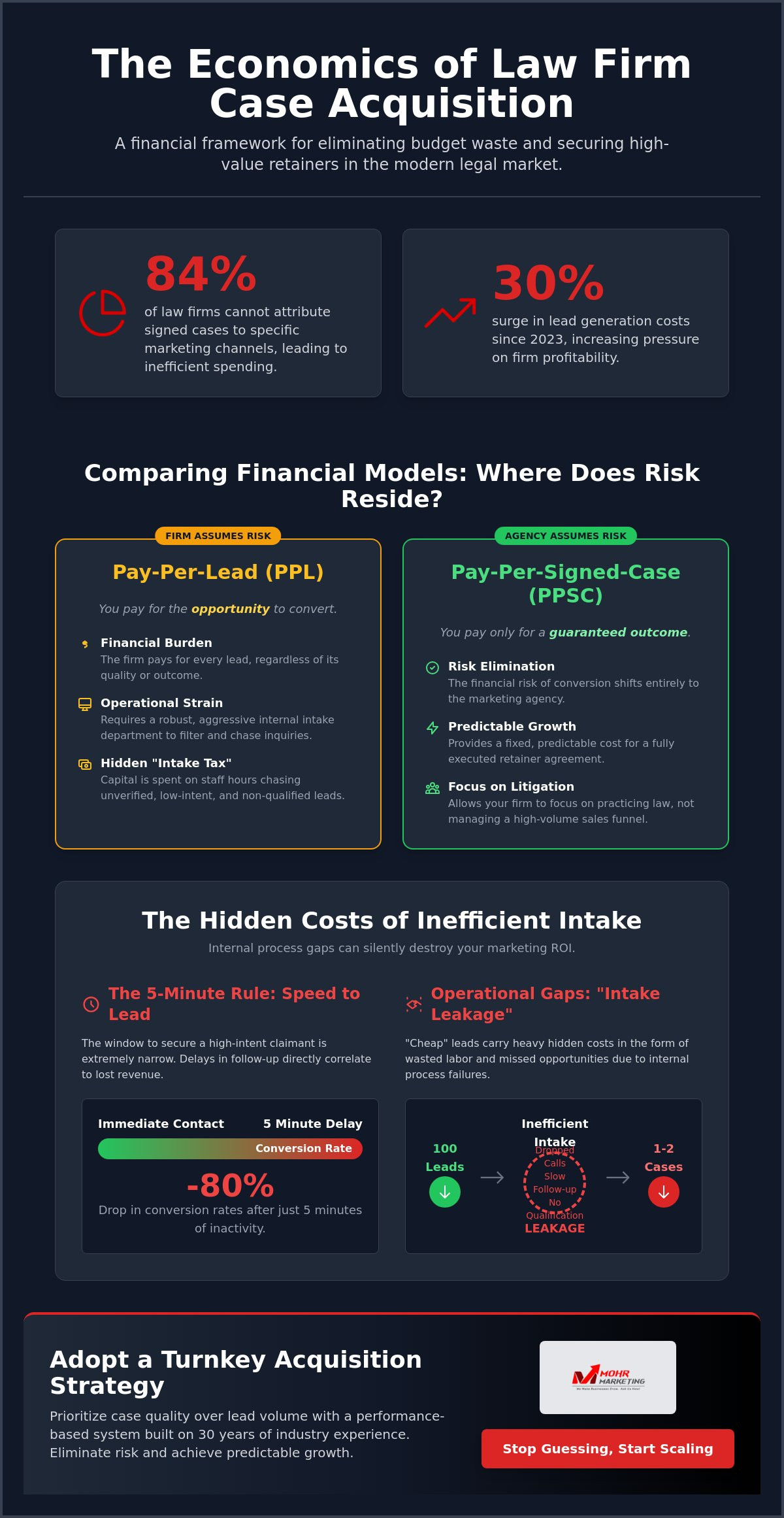
Recent data shows that 84% of law firms are unable to attribute more than 75% of their signed cases to specific marketing channels. You’re likely feeling the squeeze as the law firm lead generation cost across the industry has surged by up to 30% since 2023. It’s an exhausting cycle of paying for high-volume, low-intent noise that forces your staff to chase dead-end inquiries instead of litigating cases. You know that a high cost-per-lead is only acceptable if it results in a predictable, high-value retainer; yet most providers offer little more than unverified data and empty promises.
This article provides the financial frameworks you need to master the 2026 legal market and eliminate budget waste. You’ll learn how to pivot from chasing vanity metrics to securing high-intent claimants with a predictable return on investment. We’re breaking down the current economics of case acquisition, the critical impact of zero-click search trends, and the methodology for building a turnkey system that delivers signed retainers without the need for internal marketing management. It’s time to stop guessing and start scaling your firm based on verified performance data and mechanical accuracy.
Key Takeaways
- Evaluate the financial shift from Pay-Per-Lead models to Pay-Per-Signed-Case structures so you don’t pay for inquiries that never convert.
- Understand the specific economic drivers behind high-stakes Mass Tort and Personal Injury acquisition to better allocate your firm’s capital.
- Identify the operational gaps where “Intake Leakage” occurs and how these internal inefficiencies unnecessarily inflate your law firm lead generation cost.
- Master the “Speed to Lead” rule to secure high-intent claimants before your conversion rates drop by 80% after just five minutes of inactivity.
- Adopt a turnkey acquisition strategy that prioritizes case quality over lead volume, utilizing a system built on 30 years of industry experience by Mohr Marketing, LLC.
Decoding the Economics: Why Law Firm Lead Generation Costs Vary
To master your firm’s growth, you must first redefine your metrics. Your law firm lead generation cost isn’t merely the invoice from a vendor for a batch of contact details. It is the total capital investment required to move a claimant from the initial inquiry to a fully executed signed retainer. In the modern legal marketplace, lead generation has evolved from a simple numbers game into a complex exercise in financial engineering. You’re no longer just buying attention; you’re bidding for intent.
Three critical factors dictate the volatility of these costs: practice area competition, lead exclusivity, and verification depth. High-volume, low-intent digital noise is cheap to produce but expensive to process. Conversely, high-intent, verified inquiries demand a premium because they bypass the friction of traditional intake. If you focus on the upfront price rather than the conversion efficiency, you’re likely subsidizing your competitor’s growth through wasted labor and missed opportunities.
Market Dynamics and Competition
National competition for high-value cases, particularly in Mass Torts, creates a hyper-competitive auction environment. When thousands of firms bid on the same limited pool of claimants, auction prices escalate predictably. Seasonal trends and sudden legislative shifts also trigger volatility in lead availability. Real-time delivery carries a significant premium over aged data for a simple reason: the window for conversion is narrow. Fresh data allows for immediate engagement, while aged leads often represent a graveyard of lost opportunities where the claimant has already signed with a faster firm.
The Quality vs. Quantity Trade-off
The disparity between a raw web form submission and a live call transfer is vast. Raw forms often include disconnected numbers or non-qualified inquiries that drain your staff’s time. Live transfers ensure a prospect is on the line and ready to speak. A higher upfront law firm lead generation cost typically results in a lower cost-per-signed-case because it eliminates the “Intake Gap.” Intent-based acquisition focuses on claimants who are actively searching for a remedy, not those who were merely targeted by passive social media ads. By paying for depth of verification, you reduce the labor required to filter out unqualified noise.
Cheap leads carry heavy hidden costs. You pay for them in administrative hours, redundant follow-ups, and the missed revenue of cases your staff was too busy to sign. Strategic firms prioritize precision over volume. They understand that the goal isn’t to fill a CRM with names; it’s to fill a docket with viable, high-value litigation.
Pay-Per-Lead vs. Pay-Per-Signed-Case: Comparing Financial Risks
Choosing between Pay-Per-Lead (PPL) and Pay-Per-Signed-Case (PPSC) is a strategic decision about where you want the conversion risk to sit. In a PPL model, you pay for the opportunity to pitch. The agency delivers contact data, but the burden of proof and the labor of conversion remain with your firm. If the lead doesn’t answer or lacks the standing to sue, you’ve already spent your capital. This model requires a robust, aggressive intake department to be viable. You aren’t just buying a name; you’re buying a task for your staff.
PPSC shifts the financial risk entirely to the agency. You pay only for fully executed retainer agreements. This eliminates the uncertainty of the law firm lead generation cost by providing a fixed price for a concrete outcome. Instead of managing a funnel of “maybe” inquiries, you manage a docket of “ready-for-litigation” files. For firms focusing on high-stakes litigation rather than sales management, this performance-based model offers a more predictable path to growth. It’s the difference between buying ingredients and buying a finished meal.
The Pay-Per-Lead (PPL) Financial Profile
PPL pricing fluctuates based on lead exclusivity, geographic targeting, and the depth of filtering applied. While the entry price is lower than a signed case, you must account for the “Intake Tax.” This is the internal cost of paying staff to chase unverified inquiries. High-volume firms with dedicated, 24/7 internal intake capabilities often prefer this model to maintain a constant stream of raw data. However, for smaller or mid-sized firms, the hidden costs of chasing no-shows can quickly inflate the effective law firm lead generation cost beyond the point of profitability. If your intake team isn’t elite, PPL is often a recipe for budget depletion.
The Pay-Per-Signed-Case (PPSC) ROI Advantage
The primary advantage of PPSC is the elimination of financial waste. You no longer lose money on non-qualified inquiries or prospects who disappear before signing. Every dollar spent results in a verified claimant who meets your specific criteria. This model is particularly effective for complex litigation, such as Mass Tort signed cases, where the verification process is rigorous and time-consuming. By outsourcing the intake and signing process, your firm can focus on legal strategy rather than administrative follow-up. It’s a cleaner, more surgical approach to firm expansion.
If your firm values mechanical accuracy and strategic efficiency over raw lead volume, a performance-based approach is often the superior choice. You can consult with our team to evaluate an acquisition strategy that aligns with your specific practice area goals.
Benchmark Cost Factors by Practice Area
Your law firm lead generation cost is fundamentally tethered to the potential recovery value of the case. In the legal market, you aren’t just competing against other firms; you’re competing against the settlement math of the insurance industry. This is why a mass tort claimant with verified usage and injury commands a higher price than a general slip-and-fall inquiry. To allocate your budget effectively, you must understand the specific economic drivers behind each practice area’s acquisition funnel. High-stakes litigation requires a different financial framework than high-volume, low-margin practice areas.
Mass Tort and Complex Litigation
Mass tort cases represent the highest tier of investment because they require multi-step, rigorous verification before they are viable for litigation. Unlike general inquiries, these leads must meet strict medical and exposure criteria. For instance, Mesothelioma leads serve as the gold standard for high-value acquisition. They require a specialized funnel built on real search intent rather than passive social media browsing. When you pay for these cases, you’re paying for the elimination of noise. The “criteria-matching” process ensures that only claimants with confirmed diagnoses and documented exposure reach your desk, which justifies the premium. In this sector, attempting to lower the upfront law firm lead generation cost by relaxing criteria often leads to a higher cost-per-signed-case due to the volume of unqualified files your staff must manually reject.
Personal Injury and MVA Acquisition
Personal injury acquisition is increasingly divided between generic inquiries and verified, data-backed cases. General PI leads often lack the necessary documentation to prove liability or damages immediately. Contrast this with police report-backed MVA cases. By securing leads that already include verified accident data, you bypass the initial investigation phase, accelerating your time-to-settlement. Similarly, truck accident signed cases command a premium because they typically involve higher policy limits and more severe injuries. The auction price for these cases is driven by the high intent of the search data and the mechanical accuracy of the verification. Niche practice areas, such as medical malpractice or high-value mold case acquisition, follow a similar logic. The more specific the criteria and the higher the potential damages, the more competitive the acquisition landscape becomes. Your goal is to secure high-intent data that proves a case exists before your intake team ever picks up the phone.
The Hidden Costs of Lead Generation: How Intake Impacts ROI
Many firms obsess over the initial price of an inquiry while ignoring the structural flaws in their conversion process. This “Intake Leakage” is the primary reason why a law firm lead generation cost can spiral out of control. It doesn’t matter how competitive your acquisition price is if your internal systems fail to secure the retainer. When a high-intent claimant reaches out, they’re often at their most motivated. If you don’t meet that motivation with immediate action, they’ll move to the next firm on the list.
The “Speed to Lead” rule is absolute. Research shows that a response time of under 60 seconds can decrease your effective cost per acquisition by 30% to 40%. Conversely, conversion rates plummet by 80% if a lead isn’t contacted within the first five minutes. In 2026, claimants expect an instantaneous connection. Professional intake services aren’t a luxury; they’re a necessary cost-reduction strategy that prevents your marketing budget from evaporating into missed calls and unreturned messages.
The Cost of Internal Friction
Using attorneys or senior paralegals to perform initial screenings is an inefficient use of specialized labor. The opportunity cost is staggering. Every hour a billable professional spends on the phone with an unqualified prospect is an hour lost to litigation and case strategy. A turnkey ecosystem removes this friction by handling the administrative burden of the initial contact. By utilizing 24/7 intake availability, you ensure that no lead is wasted, regardless of when the claimant decides to reach out. This level of responsiveness reduces the effective cost-per-case by maximizing the utility of every inquiry.
Verification as a Cost-Saving Filter
Rigorous screening serves as the ultimate barrier against budget waste. A multi-point verification process, including medical record checks, incident confirmation, and conflict analysis, ensures that only viable cases enter your CRM. This level of procedural precision prevents “bad data” from clogging your firm’s operations. The goal isn’t to generate a high volume of conversations; it’s to secure a consistent flow of signed retainers. By filtering out non-qualified inquiries before they reach your legal team, you protect your firm’s most valuable resource: time. You can contact us to optimize your intake and acquisition strategy for maximum efficiency.
Optimizing Your Acquisition Strategy with Mohr Marketing, LLC
Mohr Marketing, LLC operates as a strategic partner for firms that prioritize case quality over raw lead volume. With 30 years of industry experience as a seasoned veteran, we understand that an escalating law firm lead generation cost is only sustainable if it translates directly to firm revenue. We eliminate the friction of traditional lead buying by offering a “Direct-to-Retainer” model. This approach ensures you aren’t paying for the mere opportunity to pitch a prospect. Instead, you’re paying for fully executed retainer agreements that are verified and ready for your legal team to litigate immediately. This model shifts the conversion risk away from your firm and places the focus squarely on results.
Transparency is the foundation of our data-driven marketing strategy. We provide the mechanical accuracy required to scale a firm predictably in a volatile market. By removing inefficient intermediaries and unverified data sources, we lower the barrier to entry for complex litigation. Your firm gains a distinct competitive advantage through a streamlined, direct path to case acquisition that bypasses the noise of the general market. We don’t just provide data. We provide a turnkey system that allows you to bypass the need for internal marketing management.
The Mohr Marketing, LLC Ecosystem
Our Verified Inquiry workflow is designed to ensure every opportunity meets your specific criteria before it reaches your desk. This system is built on real search intent, capturing claimants at the moment they seek a legal remedy. We manage national campaigns for Mass Tort and Personal Injury with the precision necessary to maintain high conversion rates across various jurisdictions. For firms looking to expand into specific, high-intent markets, we offer niche growth opportunities such as High-Value Mold Case Acquisition. This ecosystem allows you to scale case volume without increasing your administrative overhead or hiring additional intake staff.
Transitioning from a lead-based model to a performance-based retainer campaign is a methodical and instructional process. We begin by defining your specific case criteria, medical requirements, and geographic targeting. Our reporting is completely transparent, providing you with clear data on acquisition performance and predictable ROI. This allows for constant, proactive optimization based on actual signed cases rather than vanity metrics like clicks or impressions. We focus on the mechanics of growth so your attorneys can focus on the practice of law. It’s time to stop managing marketing vendors and start managing a growing docket of high-value cases. You can schedule a strategic consultation today to discuss scaling your case volume with verified signed retainers.
Master Your Case Acquisition Model
Managing firm growth in 2026 requires a departure from traditional, low-intent data acquisition. You’ve explored how intake leakage and market volatility can drive your law firm lead generation cost into unsustainable territory. Moving toward a performance-based retainer model ensures that every dollar of your budget is tied to a tangible outcome rather than a speculative inquiry. By prioritizing depth of verification, you secure a docket of high-value cases without the administrative burden of manual screening.
Mohr Marketing, LLC provides the 30+ years of industry experience required to navigate these complex economic shifts. We deliver verified, high-intent inquiries and signed retainers while maintaining strict compliance with state bar mandates. This turnkey system allows your attorneys to focus on the practice of law while we handle the mechanics of acquisition. It’s time to stop managing vendors and start scaling your firm with verified results.
Secure high-intent signed cases with Mohr Marketing, LLC to implement a growth strategy built on mechanical accuracy and transparency. Your firm’s expansion is too important for guesswork. Start securing your litigation future today.
Frequently Asked Questions
What is the average cost per lead for personal injury in 2026?
Industry data as of May 2026 indicates that personal injury leads in competitive metropolitan areas range between $250 and $600+ through paid search. The median cost per lead via Google Ads is $325, while Meta Ads average around $180. These figures reflect a 15% to 30% increase since 2023, driven largely by saturation in Local Service Ads and the rise of zero-click search results.
Why is Pay-Per-Signed-Case more expensive than Pay-Per-Lead?
Pay-Per-Signed-Case carries a higher upfront price because it incorporates the total cost of lead verification, professional intake labor, and retainer execution. You’re paying for a guaranteed file ready for litigation rather than the mere opportunity to contact a prospect. While the initial investment is higher, it often lowers the total law firm lead generation cost by eliminating the financial waste of non-qualified inquiries and no-show prospects.
How does intake speed affect my total lead generation costs?
Intake speed is the primary driver of conversion efficiency and total acquisition spend. Contacting a lead in under 60 seconds can decrease your effective cost per acquisition by up to 40%. Conversely, waiting longer than five minutes causes conversion rates to plummet by 80%, forcing you to buy significantly more leads to achieve the same number of signed cases. Speed is not just a metric; it’s a cost-reduction strategy.
Are mass tort leads exclusive, or are they shared with other firms?
High-intent mass tort leads should always be exclusive to ensure the integrity of the claimant experience and maximize your ROI. Shared leads are sold to multiple firms simultaneously, creating a chaotic race to the phone that frequently results in lower conversion rates and higher staff frustration. Professional acquisition partners prioritize exclusivity to maintain a direct, friction-free path from inquiry to signed retainer.
What is the difference between a verified inquiry and a raw lead?
A raw lead is unvalidated contact data that may contain disconnected numbers or non-qualified individuals. A verified inquiry has passed through a multi-point screening process that confirms specific medical history, incident dates, and potential conflicts of interest. Verification ensures your staff doesn’t waste billable hours on dead-end conversations, directly impacting the overall law firm lead generation cost by improving operational throughput.
Can I scale my law firm using only organic SEO instead of paying for leads?
Scaling solely through organic SEO has become increasingly difficult as zero-click searches reduced organic lead volume by 25% since 2023. While organic content builds long-term authority, it lacks the predictable, high-energy momentum required for aggressive firm expansion. Most successful firms utilize a hybrid model, using paid acquisition to secure high-intent cases with mechanical accuracy while maintaining SEO for long-term brand stability.
How do you ensure mass tort advertising compliance in lead generation?
Compliance is maintained through strict adherence to state bar advertising rules, TCPA regulations, and HIPAA standards. Professional providers utilize rigorous verification processes and transparent messaging to ensure all claimants are fully informed and non-misled. This methodical approach protects your firm from regulatory scrutiny and ensures that every signed retainer is obtained through ethical, verified marketing channels.
What happens if a signed retainer delivered by an agency is not qualified?
In a performance-based model, unqualified retainers are typically addressed through a transparent replacement or credit policy. If a file fails to meet pre-established criteria, such as a documented conflict of interest or inaccurate injury data, the agency rectifies the error. This ensures your capital is only deployed toward viable litigation opportunities, maintaining the strategic value of your acquisition budget.

Recent Posts
- NEC Baby Formula Case Acquisition: A Law Firm’s 2026 Guide
- Justifying Marketing Investment to Law Firm Partners: A Data-Driven Framework
- Roundup Cancer Lawsuit Leads: Buying Guide for Law Firms
Categories
- AI and Lead Generation
- Business Financing
- Call Verified MVA Leads
- Car Accident Help
- Car Accident Settlements
- Claimant Funding
- Compliance Program
- EMS-EMT Reports
- Geotargeting
- Google Maps Ranking
- Healthcare Practice Growth
- Law Firm Growth
- Law Office Operations
- Lead Generation
- Lead Generation For Attorneys
- Lead Generation For Chiropractors
- Lead Generation For Criminal Attorneys
- Lead Generation For D&A Treatment Centers
- Lead Generation For DUI Attorneys
- Lead Generation For Eye Doctors
- Lead Generation For Family Law Practices
- Lead Generation For PI Law Firms
- Lead Generation For Plastic Surgeons
- Leads For Healthcare Professionals
- Leads For Insurance Industry
- Legal Leads
- Legal Marketing
- Legal Updates
- Mass Tort Leads
- Medicare and Medicaid Leads
- Merchant Funding Leads
- Mold Leads
- Online Marketing Strategies
- Pre-Settlement Funding
- Signed MVA Cases
- Tort Updates
- Truck Accident Leads and Signed Cases
- Truck Accident Settlements
- Web Design