How EMS-Linked Intelligence Scales Law Firm MVA Leads
July 1, 2026 by Mohr Marketing
The standard lead market is a race to the bottom where firms pay premium prices for low-value “fender benders.” You’re likely losing high-stakes cases because a competitor with better data reached the victim first. To fix this, high-growth firms now use https://www.mohrmktg.com/ems-linked-accident-intelligence-for-law-firms/ to gain a strategic advantage. It’s about moving from reactive searching to proactive intelligence. Success in the current legal environment requires identifying catastrophic incidents before the generic lead aggregators even know they happened.
You understand that without immediate documentation and verified injury signals, your intake team is just guessing. This instructional guide teaches you how to leverage EMS response data and police-report-backed intelligence to identify serious injury cases before they enter the general market. You’ll learn to filter for high-value opportunities, improve documentation at the start of the case lifecycle, and increase your ROI. We’ll break down the mechanics of scaling your MVA caseload while navigating complex regulations like the Driver’s Privacy Protection Act and California Senate Bill 37.
Key Takeaways
- Identify high-value serious injury cases by using hospital transport signals as your primary filter for legal merit.
- Implement a 6-step workflow using https://www.mohrmktg.com/ems-linked-accident-intelligence-for-law-firms/ to transition from real-time accident monitoring to a signed retainer.
- Eliminate the “resale” problem found in standard marketplaces by shifting from blind leads to documented, exclusive case opportunities.
- Navigate evolving legal advertising regulations by leveraging nonprofit governance and consent-based outreach frameworks.
- Optimize your firm’s growth strategy by balancing mass tort acquisition with a predictable, intelligence-backed stream of MVA leads.
Beyond Generic Leads: Defining EMS-Linked Accident Intelligence
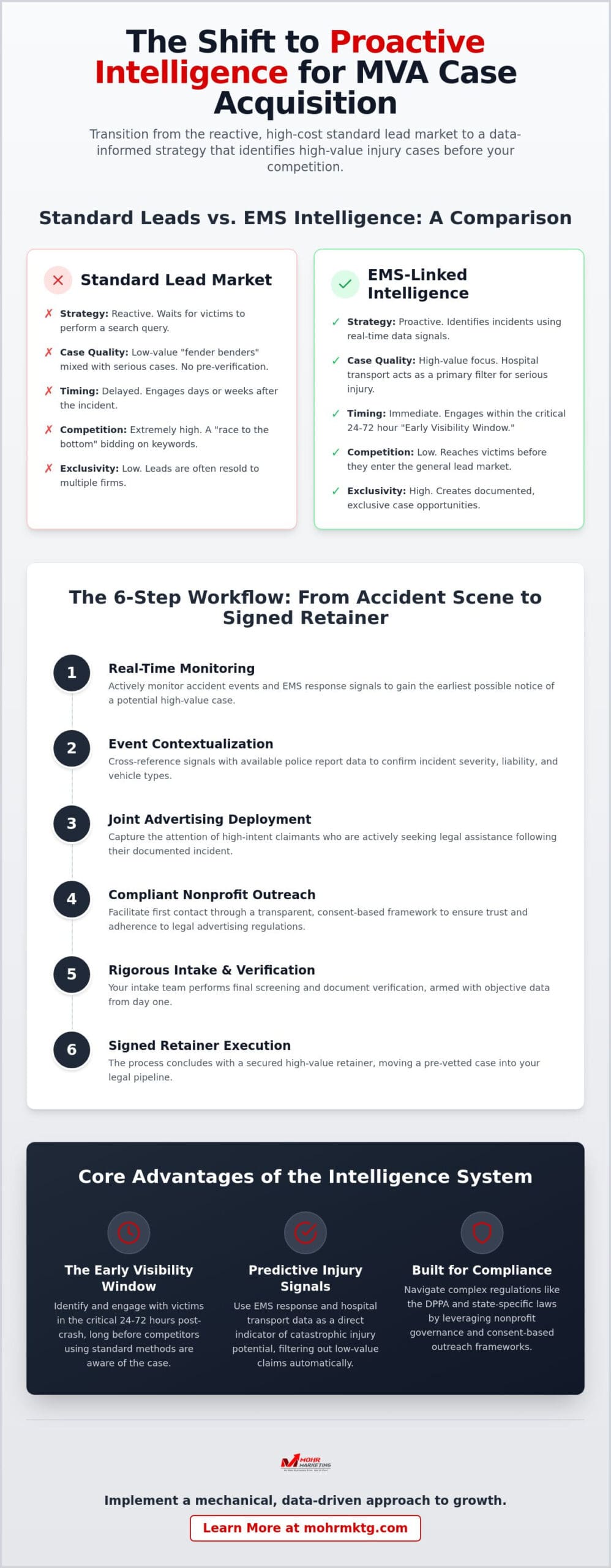
Standard MVA marketing is passive. You wait for a victim to search “car accident lawyer” on a mobile device. By that point, you’re competing with every firm in the zip code. EMS-linked accident intelligence is a data-informed advertising structure that flips the script. It identifies high-value incidents based on real-time signals rather than generic search queries. This system relies on three core pillars: emergency response alerts, medical transport data, and police-report-backed MVA cases.
Reactive marketing is a defensive strategy. You’re bidding on keywords alongside hundreds of other firms, which drives up costs and lowers margins. Proactive accident intelligence is an offensive move. It uses verifiable data to pinpoint where the legal need is greatest. Hospital transport serves as your primary filter for legal value. If an ambulance isn’t called, the case likely lacks the “serious injury” threshold required for a high ROI. By focusing on Emergency Medical Services (EMS) activity, you filter out property-damage-only claims before spending a single dollar on intake.
The Early Visibility Advantage
The “Early Visibility Window” is the critical period 24 to 72 hours after a crash. During this timeframe, victims are often overwhelmed and haven’t yet sought legal counsel. Competitors using standard lead generation won’t see these individuals until they enter the generic lead market days or weeks later. Leveraging https://www.mohrmktg.com/ems-linked-accident-intelligence-for-law-firms/ allows your firm to identify these events immediately. Speed-to-lead isn’t just about efficiency; it’s about preventing case poaching by rival firms. When you’re the first to offer a compliant, documented solution, your retainer conversion rates stay high.
Why EMS Signals Predict High-Value Damages
EMS response isn’t a random occurrence. It’s a direct indicator of catastrophic injury potential. When paramedics arrive, they document the severity of the trauma and the necessity of immediate hospital care. This documentation validates initial injury claims from day one. These EMS-linked signals also frequently flag truck accident signed cases where commercial vehicle involvement increases policy limits and case complexity. Proactive intelligence ensures you’re pursuing cases with the highest damage potential, not just the highest volume. It provides your intake team with the context they need to secure a retainer on the first call. This is a mechanical approach to growth that removes the friction of standard, unverified leads.
The 6-Step Workflow: From Accident Scene to Signed Retainer
Scaling case acquisition requires a disciplined, repeatable process. It isn’t enough to just see the data; you must act on it within a compliant framework. By integrating https://www.mohrmktg.com/ems-linked-accident-intelligence-for-law-firms/ into your daily operations, you move from speculative marketing to a mechanical workflow that prioritizes high-stakes injuries. This systematic approach ensures that your firm isn’t just busy, but is consistently securing high-value retainers.
The workflow begins with real-time monitoring of accident events and EMS response signals. This provides the earliest possible notice of a potential case. Once a signal is detected, the second step involves contextualizing the event with available police report data to confirm the severity and liability. Third, joint advertising is deployed to capture the interest of high-intent claimants who are already seeking help. The fourth step utilizes nonprofit outreach to facilitate compliant first contact, ensuring transparency and trust. Fifth, your team performs rigorous intake screening and document verification. Finally, the process concludes with the execution of a signed retainer, moving the case into your legal pipeline.
Integrating Police-Report-Backed MVA Cases
Police reports are the bedrock of liability verification. They confirm vehicle types, such as commercial trucks or passenger cars, and provide an objective narrative of the incident. These police report backed MVA cases reduce intake friction by providing objective, third-party verification of the incident before the first phone call occurs. This allows your intake team to speak with authority and confidence. When you lead with verified facts, the claimant’s trust in your firm increases immediately. If you’re interested in refining this process further, consider scheduling a consultation to see how this data integrates with your current CRM.
The Intake Screening and Verification Process
A “qualified” opportunity in an EMS-linked program must meet strict criteria. It’s not just about the accident; it’s about the medical transport and the subsequent treatment. Your intake team must verify transport details immediately to confirm the case meets the “serious injury” threshold. Administrative support plays a vital role here, gathering necessary records and preparing the file for attorney review. This staccato approach to verification ensures that only the most viable cases reach your desk. It eliminates the “fender bender” noise and focuses your resources on opportunities with the highest damage potential. Efficiency at this stage is what separates market leaders from firms that are simply overspending on low-quality leads.
Comparing EMS Intelligence vs. Standard MVA Lead Generation
Standard lead marketplaces operate on a resale model. Most aggregators sell the same contact data to three or more firms simultaneously. This creates a high-pressure race where quality is secondary to speed. It’s a system designed for the aggregator’s profit, not your firm’s growth. Blind leads often lack basic documentation, leaving your intake team to chase prospects who may not even have a viable case. You’re effectively paying to compete in a crowded market for unverified information.
Transitioning to https://www.mohrmktg.com/ems-linked-accident-intelligence-for-law-firms/ replaces this chaos with documented case opportunities. Instead of shared data, you utilize exclusive advertising dockets. Every inquiry is backed by real-time accident signals, meaning the victim has already been filtered for serious injury through hospital transport records. This context significantly lowers “no-contact” rates. When your team calls, they aren’t cold-calling a name from a list; they’re responding to a verified event with the documentation to prove it. This difference in approach transforms your intake department from a high-volume call center into a precision-focused acquisition unit.
Identifying Catastrophic Commercial Collisions
Commercial vehicle accidents demand immediate action. Policy limits are significantly higher, but the competition is fiercer. Utilizing a Premium Catastrophic Commercial Collision Traffic Report allows your firm to see these events as they happen. Speed is critical when dealing with commercial carriers who often deploy their own investigators to the scene within hours. Intelligence-backed signals ensure you’re pursuing truck accident signed cases with the necessary urgency. You don’t wait for the generic lead market to wake up. You move when the data is fresh and the liability is clear. This proactive stance is the only way to secure high-value commercial retainers consistently.
The Cost of Inefficient Intake
Wasted intake hours are a silent killer of law firm margins. When you buy raw, unverified data, your staff spends a majority of their time chasing “fender benders” or wrong numbers. This inefficiency increases overhead and burns out high-performing employees who want to work on meaningful cases. There’s a clear ROI advantage in paying for verified inquiries over raw data. By shifting your budget toward https://www.mohrmktg.com/ems-linked-accident-intelligence-for-law-firms/, you ensure your intake team focuses only on high-intent claimants. This mechanical approach to filtering ensures that every hour spent on the phone has a higher probability of resulting in a signed retainer. Efficiency isn’t just about saving time; it’s about maximizing the value of every advertising dollar through better case filtering and strategic resource allocation.
Navigating Compliance and Governance in Legal Advertising
Compliance is not merely a box to check; it is a strategic moat. In high-stakes MVA and mass tort litigation, the absence of a verifiable audit trail is a significant financial liability. Utilizing https://www.mohrmktg.com/ems-linked-accident-intelligence-for-law-firms/ provides a governance-driven framework that protects your firm from increasing regulatory scrutiny. State bar mandates are tightening nationwide. California Senate Bill 37, which became effective on January 1, 2026, allows for statutory damages up to $100,000 for advertising violations. A structured, transparent approach is the only way to scale case acquisition without risking your license or your capital.
Consent serves as the bedrock of any compliant outreach program. You cannot rely on implied interest or third-party lists without verification. Every interaction must be documented to satisfy the strict requirements of the Driver’s Privacy Protection Act (DPPA) and HIPAA. Under the DPPA, using personal information from motor vehicle records for marketing is prohibited; statutory penalties start at $2,500 per violation. Our model ensures that every claimant provides explicit, written authorization before any contact occurs. This mechanical approach to consent eliminates the risk of prohibited solicitation during state-mandated blackout periods, such as the 30-day window required in New York.
TrustedForm and Verification Standards
Verification requires objective, third-party proof. TrustedForm Certify documents the origin and intent of every inquiry by creating a unique digital certificate for each lead. Video playback of form-fills is essential for compliance because it provides a visual record of the claimant’s active consent. This level of documentation is critical for defending against class-action litigation or bar inquiries. It transforms a simple lead into a verified case opportunity with a clear, defensible history. This governance-driven model ensures your firm remains protected while you aggressively pursue market share.
Nonprofit Structure and Victim Support
The nonprofit component of our ecosystem creates a clear separation between public-interest outreach and direct legal solicitation. This structure provides victims with immediate support and resources, which is a significant ethical advantage over standard, aggressive lead generation. It aligns with state bar rules regarding lawyer referral services by maintaining total transparency in how cases are identified and distributed. Governance is the core of the Mohr Marketing, LLC ecosystem; it ensures every case on your docket was acquired through a rigorous, ethical process. If you are ready to secure high-value cases within a fully compliant framework, contact us to discuss your firm's expansion.
Integrating EMS Intelligence into Your Firm’s Growth Strategy
Firm growth requires a fundamental shift in mindset. You must stop treating case acquisition as a commodity purchase. Generic leads are often stale and resold; they don’t provide a foundation for scaling. Instead, you should fund dedicated advertising campaigns built on https://www.mohrmktg.com/ems-linked-accident-intelligence-for-law-firms/. This transition turns your marketing spend into a strategic asset. You aren’t just bidding on a name; you’re investing in an intelligence-driven pipeline that identifies catastrophic events in real time. Assess your intake capacity before you scale. High-intent opportunities require immediate action, not a delayed follow-up.
Scalability is the primary advantage of a national EMS-linked structure. Whether you’re targeting a single metro area or the entire country, the methodology behind https://www.mohrmktg.com/ems-linked-accident-intelligence-for-law-firms/ remains the same. You leverage verified transport signals to find serious injury cases that competitors miss. This allows for a predictable mix of MVA and mass tort acquisition. High-growth firms typically allocate between 4% and 8% of their revenue to marketing to maintain market leadership. To see a return on that investment, you need a system that filters out the noise and prioritizes documented trauma.
Optimizing Intake for Speed and Documentation
Intake teams must treat EMS-linked files with a different protocol than generic web inquiries. When transport is confirmed, the clock starts. Immediate follow-up is mandatory. Your staff should lead with the verified accident details to establish immediate authority. This isn’t just about intake; it’s about providing a solution to a victim in crisis. If your internal team lacks the bandwidth, evaluate personal injury lead generation companies that offer integrated intake support. Documentation must be gathered during the first call to secure the file and prevent the claimant from seeking other counsel.
Scaling Your MVA and Mass Tort Docket
The same intelligence used for MVA can be applied to broader practice areas. High-value damages are the common denominator for any successful litigation strategy. By focusing on catastrophic injury signals, you build a docket with higher settlement potential and lower risk. The “Signed Retainer” model is the ultimate risk-mitigation strategy. You pay for results, not possibilities. For firms that want to bypass the intake hurdle entirely, Mohr Marketing, LLC provides mass tort signed cases that are fully executed and ready for litigation. This allows you to scale your practice without adding administrative overhead. Success depends on moving faster and with better data than the generic market.
Dominate the MVA Market with Intelligence-Driven Acquisition
Case acquisition is no longer about buying volume; it’s about securing intelligence. By prioritizing EMS signals and police-report-backed data, you eliminate the waste associated with generic lead aggregators. You’ve learned how a 6-step workflow and a governance-driven model protect your firm from regulatory risk while maximizing damage potential. Success in 2026 requires moving beyond reactive search marketing to a proactive, documented strategy. Implementing https://www.mohrmktg.com/ems-linked-accident-intelligence-for-law-firms/ ensures your firm captures high-value opportunities before they reach the general market.
Mohr Marketing brings 30+ years of industry experience and a nonprofit-governed advertising structure to every campaign. We provide TrustedForm certified inquiries to ensure total transparency and compliance. This mechanical approach to growth removes the friction of standard, unverified leads and places your firm in a leadership position. Secure Your Firm’s Early Visibility Window with Mohr Marketing. Your firm’s expansion depends on better data and faster execution. Take the next step toward a predictable stream of serious injury cases today.
Frequently Asked Questions
What exactly is EMS-linked accident intelligence?
EMS-linked accident intelligence is a data-driven advertising structure that utilizes real-time emergency medical services signals to identify serious injury events. It moves beyond traditional keyword bidding by focusing on verifiable trauma signals like ambulance dispatch and hospital transport. This intelligence allows your firm to identify high-value opportunities before they reach generic marketplaces or aggregators.
Are police reports included in the EMS-linked program?
Yes, police reports are a critical component for contextualizing accident events and confirming liability. They provide objective verification of the incident narrative and the vehicle types involved. By integrating police data with EMS signals, the program ensures every case opportunity is backed by third-party documentation from the outset, which significantly reduces intake friction.
Is this service considered a lawyer referral service?
No, this is an advertising and intake service designed to generate exclusive case opportunities for your firm. It operates within a governance-driven framework that complies with state bar advertising rules. The nonprofit component helps maintain transparency and victim support while ensuring all outreach remains ethically compliant and avoids the pitfalls of direct solicitation.
How does hospital transport data affect case quality?
Hospital transport serves as the primary filter for legal value because it indicates a high probability of serious injury. If an ambulance is required at the scene, the case is more likely to meet the damage thresholds necessary for a high ROI. This signal helps your firm avoid low-value property damage claims and focus resources on catastrophic trauma cases.
Can this program be used for catastrophic commercial collisions?
Yes, the system is specifically designed to flag commercial vehicle involvement through real-time signals. Because commercial accidents often involve higher policy limits, early visibility is essential for securing these retainers. Using https://www.mohrmktg.com/ems-linked-accident-intelligence-for-law-firms/ allows your firm to act quickly on high-stakes truck and commercial carrier incidents before competitors even know they happened.
What role does the nonprofit component play in compliance?
The nonprofit structure separates outreach from direct legal solicitation by providing a transparent framework for victim support and public-interest objectives. This separation is critical for adhering to state bar mandates and ensuring that first contact is handled within a compliant environment. It creates an ethical buffer that protects your firm while maintaining advertising transparency.
How is this different from buying standard personal injury leads?
Standard leads are often resold multiple times and lack verifiable documentation at the point of intake. This program provides exclusive, documented case opportunities that aren’t shared with other firms. By using real-time intelligence, you eliminate the “resale” problem and lower no-contact rates by reaching victims during the critical Early Visibility Window with verified data.
What documentation do I receive with an EMS-linked case opportunity?
You receive a comprehensive file that includes verified transport details and available police report data. Every inquiry generated through https://www.mohrmktg.com/ems-linked-accident-intelligence-for-law-firms/ is also backed by a TrustedForm certificate to verify the origin and intent of the claimant. This documentation ensures your intake team has everything needed to execute a signed retainer with confidence and precision.

Recent Posts
- Signs You Need a New Lead Generation Partner: A Law Firm Guide
- How to Find Plaintiffs for Mass Tort Cases: A Practical Guide
- Ozempic Lawsuit Leads: A 2026 Guide for Law Firms
Categories
- AI and Lead Generation
- Business Financing
- Call Verified MVA Leads
- Car Accident Help
- Car Accident Settlements
- Claimant Funding
- Compliance Program
- EMS-EMT Reports
- Geotargeting
- Google Maps Ranking
- Healthcare Practice Growth
- Law Firm Growth
- Law Office Operations
- Lead Generation
- Lead Generation For Attorneys
- Lead Generation For Chiropractors
- Lead Generation For Criminal Attorneys
- Lead Generation For D&A Treatment Centers
- Lead Generation For DUI Attorneys
- Lead Generation For Eye Doctors
- Lead Generation For Family Law Practices
- Lead Generation For PI Law Firms
- Lead Generation For Plastic Surgeons
- Leads For Healthcare Professionals
- Leads For Insurance Industry
- Legal Leads
- Legal Marketing
- Legal Updates
- Mass Tort Leads
- Medicare and Medicaid Leads
- Merchant Funding Leads
- Mold Leads
- Online Marketing Strategies
- Pre-Settlement Funding
- Signed MVA Cases
- Tort Updates
- Truck Accident Leads and Signed Cases
- Truck Accident Settlements
- Web Design