Ethical Retainer Acquisition: Navigating CA SB 37 Rules
June 28, 2026 by Mohr Marketing
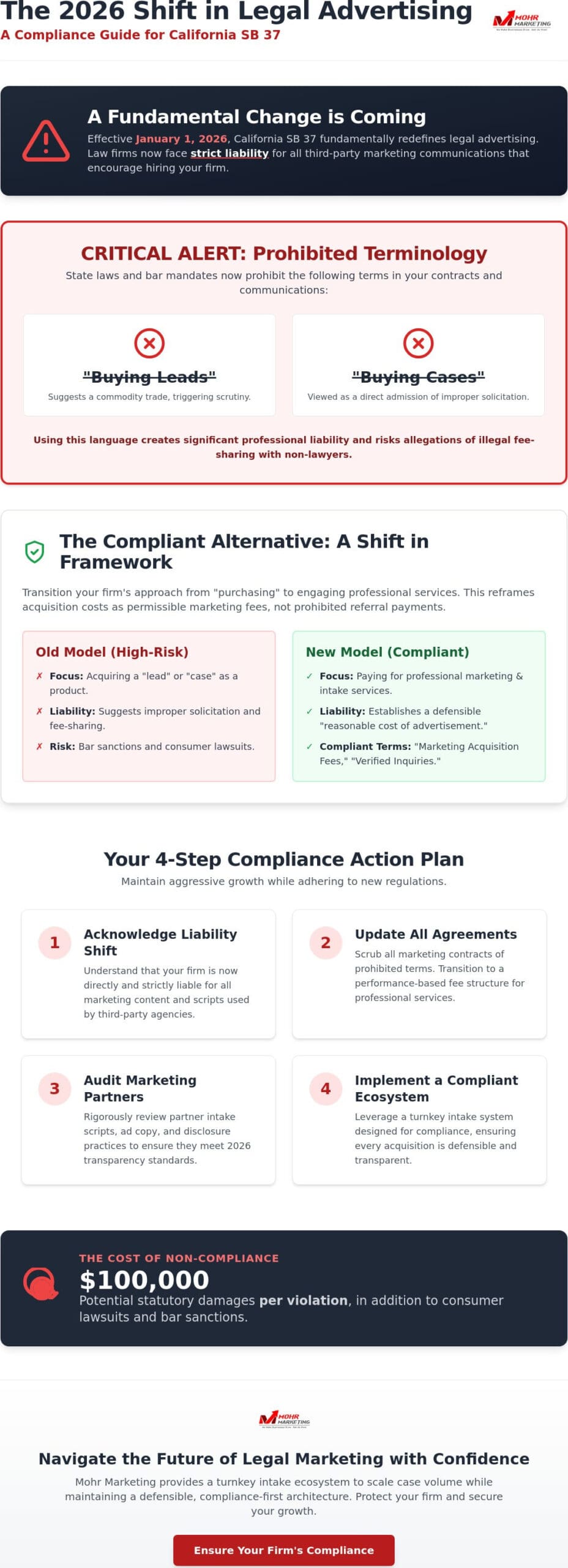
Your firm’s growth strategy just became a significant liability. On January 1, 2026, California fundamentally redefined legal advertising, placing the burden of compliance squarely on your shoulders. You now face strict liability for any communication that encourages hiring your firm, even when managed by outside agencies. It’s a critical reality that you cannot use the terms buying leads or buying cases any more due to state laws (CA SB 37)and bar mandates. Failure to adapt isn’t just a marketing oversight. It’s an invitation for consumer lawsuits and statutory damages reaching $100,000 per violation.
We understand the anxiety that comes with shifting terminology and the fear of bar sanctions. You shouldn’t have to throttle your case flow because of regulatory confusion. This article provides a clear, instructional framework for ethical retainer acquisition in the current environment. You’ll learn how to maintain aggressive growth while strictly adhering to new state rules. We’ll define the boundaries between marketing fees and illegal referrals. We’ll also show you how to audit your partners to ensure they meet the 2026 standards for bona fide office disclosures and advertising transparency.
Key Takeaways
- Analyze how the expanded definition of “advertisement” under SB 37 shifts liability for third-party marketing directly to the law firm.
- Discover why you cannot use the terms buying leads or buying cases any more due to state laws (CA SB 37)and bar mandates and the specific terminology required for compliance.
- Transition to a performance-based marketing fee structure that classifies acquisition costs as professional service fees rather than prohibited fee-sharing.
- Audit marketing partner intake scripts to ensure they adhere to strict disclosure requirements and do not misrepresent their relationship to your firm.
- Leverage a turnkey intake ecosystem to scale case volume while maintaining a defensible, compliance-first architecture.
The Regulatory Shift: Understanding CA SB 37 and 2026 Bar Mandates
Effective January 1, 2026, California Senate Bill 37 (SB 37) fundamentally altered the relationship between law firms and their marketing partners. This legislation expands the definition of “advertisement” to include any communication that encourages the hiring of a lawyer. The days of hands-off outsourcing are over. Attorneys now face strict liability for every claim, image, and intake script published by third-party agencies. The history of legal advertising has seen many pivots, but none as aggressive as this shift toward total attorney accountability.
State Bar mandates now focus on the “purchase” of legal opportunities as a potential violation of professional conduct. The core objective is clear. Regulators want to prevent non-lawyers from engaging in the unauthorized practice of law or entering into prohibited fee-sharing arrangements. You must distinguish between “referral fees,” which are banned when paid to non-lawyers, and “reasonable costs of advertisements,” which remain permissible. Because of these changes, firms cannot use the terms buying leads or buying cases any more due to state laws (CA SB 37)and bar mandates.
The Bar’s crackdown targets “runners and cappers” under a modern digital guise. If a marketing fee is tied directly to the outcome of a case or mimics a percentage of a settlement, it risks being classified as illegal fee-splitting. Compliant firms focus on funding verified acquisition ecosystems, such as Mass Tort Signed Cases, where the fee represents the fair market value of the marketing and intake services provided. Transparency is no longer optional. It’s a requirement for survival.
The Death of the ‘Lead’ Label
Terminology isn’t just a matter of semantics. It’s a matter of licensure. Labeling a transaction as a “lead” suggests a commodity being traded. Bar associations in 2026 view the per-lead model with intense scrutiny. Transitioning to “Marketing Acquisition Fees” or “Verified Inquiries” reflects a process-driven approach. It signals that you’re paying for a professional service, not a guaranteed client. This distinction protects your firm from allegations of improper solicitation and maintains the integrity of your professional standing.
Key Jurisdictions Leading the Crackdown
California’s SB 37 serves as the national blueprint for legal marketing regulation. Other states are already adopting similar anti-intermediary language to curb aggressive mass tort marketing. National personal injury firms must realize that local compliance is the new baseline. If you operate across state lines, your marketing must meet the highest regulatory standard to avoid cross-jurisdictional disciplinary action. It’s vital to recognize that you cannot use the terms buying leads or buying cases any more due to state laws (CA SB 37)and bar mandates if you intend to maintain a defensible docket in 2026 and beyond.
Why the Term ‘Buying Cases’ Creates Professional Liability
The terminology you use in your marketing contracts is now a matter of public record and regulatory scrutiny. Under SB 37, the State Bar views the phrase “buying cases” as a direct admission of improper solicitation. This isn’t a semantic debate. It’s a professional liability. If your agency agreement describes the purchase of a “case,” you are essentially documenting a fee-sharing violation with a non-lawyer. California’s new rules are designed to eliminate the ambiguity that previously allowed firms to outsource intake with minimal oversight. You must understand that you cannot use the terms buying leads or buying cases any more due to state laws (CA SB 37)and bar mandates.
These prohibited terms suggest that a third party is performing the legal work of qualifying a client and then selling that interest to you. This triggers immediate red flags regarding the unauthorized practice of law. Walking the ethical line in lawyer advertising requires a total rejection of the “commodity” mindset. When a third party “sells” a case, they act as an intermediary that can compromise attorney-client privilege. If the agency is not clearly acting as your agent under your direct supervision, the initial intake communications may not be protected. This exposes your firm to discovery risks and potential malpractice claims.
Disciplinary consequences for these violations are severe and immediate. Beyond public reprimands, the Bar can pursue license suspension or permanent disbarment for attorneys who engage in runner and capper activities through digital proxies. Consumers also have a private right of action. They can file civil lawsuits for statutory damages ranging from $5,000 to $100,000 per violation. Structuring your growth around compliant frameworks is the only way to avoid these pitfalls. If you are concerned about your current marketing contracts, you should speak with a compliance-focused strategist to review your terminology.
Fee-Sharing vs. Advertising Costs
Paying for a specific legal result is fee-sharing. Paying for the reasonable costs of an advertising campaign is a business expense. The Bar requires transparency in these billing structures. Your invoices must reflect the marketing services performed, not a bounty for a signed retainer. This distinction is vital for maintaining your professional standing. It’s another reason why you cannot use the terms buying leads or buying cases any more due to state laws (CA SB 37)and bar mandates. Your billing must reflect a service-based relationship.
The ‘Intermediary’ Trap
Regulators look for agencies that exercise too much control. If an agency decides which claimants are “good enough” for your firm without your direct oversight, they are practicing law without a license. You must maintain the final say in claimant qualification. Your contracts must explicitly state that the agency provides marketing data and intake support, not legal referrals. Avoid the “referral service” designation by ensuring all marketing materials clearly identify your firm as the responsible party.
Transitioning to Performance-Based Marketing Fees: A Compliant Alternative
Compliance with the 2026 regulatory environment requires a total shift in how you fund your firm’s growth. The traditional “pay-per-lead” model is no longer defensible under the scrutiny of the State Bar. Instead, firms are moving toward a professional service fee structure based on a “Pay-Per-Signed-Case” model. This approach compensates a marketing partner for the execution of a comprehensive acquisition strategy rather than the mere delivery of a contact name. It is a critical distinction because you cannot use the terms buying leads or buying cases any more due to state laws (CA SB 37)and bar mandates. Your billing must reflect the value of the marketing and intake labor performed.
To remain compliant, your law firm must maintain absolute control over the advertising process. This includes reviewing and approving all marketing collateral, landing pages, and intake scripts used by your agency. The Official Text of CA SB 37 makes it clear that attorneys are strictly liable for the content published by their third-party vendors. By utilizing a turnkey marketing ecosystem, you ensure that every touchpoint with a potential claimant is pre-vetted for accuracy and transparency. This removes the friction of manual oversight while protecting your license from non-compliant agency tactics.
Verified Inquiries vs. Purchased Leads
The industry is moving away from volume-based metrics toward data-backed verification. A standard “lead” often lacks the depth required to meet modern ethical standards. A verified inquiry, however, is backed by objective data such as medical records or police reports. For example, firms targeting automotive litigation should look for Verified MVA Cases that include specific incident details. Investing in verified data ensures that your marketing spend is tied to actual legal opportunities rather than raw, unvetted contact lists. This shift protects you from allegations of improper solicitation by ensuring every claimant meets your firm’s specific criteria before a retainer is ever presented.
Structuring Compliant Retainer Acquisition
Delivering a signed retainer is the result of a rigorous intake process, not a simple referral. To stay within the bounds of the law, your intake ecosystem must act as a bridge between the initial inquiry and the formal attorney-client relationship. This process involves multiple verification steps to ensure the claimant understands they are engaging with your specific firm. Efficient conversion is the goal, but it must be achieved through a compliant framework. Reviewing the ROI of Legal Intake shows that high conversion rates depend on the quality of the verification, not the quantity of the initial inquiries. Remember that you cannot use the terms buying leads or buying cases any more due to state laws (CA SB 37)and bar mandates when documenting these intake services in your internal files or external contracts.
How to Audit Your Marketing Partners for Regulatory Compliance
Auditing your marketing partners is no longer a best practice. It’s a survival requirement. Under SB 37, you’re strictly liable for every digital communication and intake interaction conducted in your name. Begin by reviewing your agency contracts for prohibited terminology. You must ensure that you cannot use the terms buying leads or buying cases any more due to state laws (CA SB 37)and bar mandates. If your contract still uses this language, it serves as evidence of an unethical acquisition model. Demand that your partners update their agreements to reflect a performance-based marketing service fee that emphasizes process over product.
Inspect the intake scripts used by your vendors with precision. The agency must never represent itself as the law firm. It must clearly disclose its status as a marketing provider. SB 37 requires all advertisements to include the name of at least one California-licensed attorney and a bona fide office location. If your agency’s intake script or landing pages omit this data, you’re in violation. Verify the source of every inquiry. Real search intent is the gold standard. Avoid agencies that rely on incentivized traffic, such as “reward-based” surveys or sweepstakes. These methods often lead to low-quality claimants and potential Bar scrutiny. You need full transparency into where your ads are placed and how your budget is allocated.
The 2026 Compliance Checklist for Partners
A reliable partner must demonstrate deep insider knowledge. Ask if the agency has a 30-year track record in high-stakes legal sectors. A seasoned veteran understands the nuance of shifting Bar mandates. Ensure they utilize a Turnkey Ecosystem that manages the entire process from initial inquiry to signed retainer under your oversight. They should provide Mass Tort Signed Cases with complete transparency regarding the verification process. A partner who understands that you cannot use the terms buying leads or buying cases any more due to state laws (CA SB 37)and bar mandates will prioritize process-driven acquisition over raw volume. This level of detail protects your firm during a potential Bar audit.
Red Flags in Legal Marketing Contracts
Watch for guaranteed outcomes. Any promise of “wins” or “guaranteed settlements” is a major Bar violation. These claims are now prohibited content under SB 37. Another red flag is the lack of audit rights. You must have the contractual authority to inspect the agency’s records and intake recordings. Opaque pricing is equally dangerous. If you can’t see the actual cost of acquisition, you can’t verify that the fee is a “reasonable cost of advertisement.” If your current agreements don’t allow for this level of scrutiny, your license is at risk. To protect your firm’s future and ensure your growth strategy is defensible, schedule a compliance audit with our team today.
Compliant Growth with Mohr Marketing: The Turnkey Intake Ecosystem
Growth requires a partner who understands the mechanics of high-stakes legal sectors. Mohr Marketing brings 30 years of industry experience to the table, providing a sophisticated framework for law firms to scale without compromising their professional standing. Our Turnkey Marketing and Intake Ecosystem solves the compliance puzzle by centralizing oversight and verification. Instead of managing disparate vendors, you leverage a unified system designed to meet the rigorous standards set by the California State Bar. This isn’t just about obtaining contact information. It’s about building a defensible docket through rigorous procedural precision.
The Turnkey Ecosystem moves your firm away from the risky model of purchasing unvetted data. We focus on acquiring verified, high-intent opportunities in competitive spaces like mass torts, personal injury, and Truck Accident Cases. Every step of our process is built on transparency. We handle the heavy lifting of intake and verification, ensuring that every signed retainer you receive meets your specific criteria. This allows your team to focus on litigation while we maintain the integrity of your acquisition pipeline. You must remember that you cannot use the terms buying leads or buying cases any more due to state laws (CA SB 37)and bar mandates. Our system ensures your internal and external records reflect a compliant, service-based model.
The Mohr Method: Transparency and Data-Driven Growth
Our methodology prioritizes “Real Search Intent.” We don’t rely on deceptive ads or incentivized traffic. We capture claimants who are actively seeking legal help for their specific injuries. This approach ensures a higher conversion rate and a more stable ROI. Our “Pay-Per-Signed-Case” model is structured as a professional marketing service fee, not a prohibited referral or fee-sharing arrangement. It’s a critical distinction for attorneys who want to scale aggressively while staying within the lines of professional conduct. By funding a verified acquisition ecosystem, you eliminate the intermediaries that often create friction and regulatory risk.
Next Steps for Compliant Scaling
Transitioning your firm to a performance-based, compliant model is a strategic necessity in 2026. Start by scheduling a consultation to audit your current acquisition strategy. We’ll help you identify terminology risks and intake gaps that could trigger Bar scrutiny. Your firm’s expansion shouldn’t be a gamble. It should be a methodical, data-driven process backed by three decades of legal marketing expertise. You cannot use the terms buying leads or buying cases any more due to state laws (CA SB 37)and bar mandates, so let’s rebuild your contracts and workflows to reflect the new reality. Secure your firm’s growth with Mohr Marketing today.
Secure Your Firm’s Regulatory Future
Navigating the 2026 regulatory landscape requires more than updated contracts. It demands a fundamental shift in client acquisition. You’ve learned that strict liability now applies to every third-party marketing interaction. Maintaining a defensible docket means prioritizing verified inquiries over raw data. It’s a critical reality that you cannot use the terms buying leads or buying cases any more due to state laws (CA SB 37)and bar mandates. Success in this era depends on performance-based models. These models must align with professional ethical standards to protect your license.
Mohr Marketing provides the transparency and rigorous verification needed to scale with confidence. We offer 30+ years of legal marketing expertise. Our team maintains strict adherence to Bar mandates and CA SB 37. Our performance-based models eliminate marketing waste by focusing on high-intent opportunities. Don’t let regulatory fears stall your expansion. Scale your firm safely with our compliant case acquisition ecosystem.
Building a high-value practice is achievable with the right strategic partner. We’re ready to help you navigate these changes and secure your competitive advantage.
Frequently Asked Questions
Is it still legal to pay for mass tort leads in 2026?
Paying for marketing services remains legal provided the arrangement is structured as a reasonable cost of advertisement. You are permitted to fund campaigns that generate interest, but you must avoid any structure that resembles a referral fee. Because you cannot use the terms buying leads or buying cases any more due to state laws (CA SB 37)and bar mandates, your billing must reflect the professional services rendered by the agency rather than a bounty for a specific client.
What is the difference between a lead and a verified inquiry under CA SB 37?
A lead is typically raw contact data with little verification, whereas a verified inquiry is the result of a rigorous intake process. Under CA SB 37, the focus is on the communication and encouragement to hire. A verified inquiry includes objective evidence, such as medical records or police reports, to confirm the claimant meets your specific criteria. This process-driven approach ensures that you are investing in data and labor rather than simply purchasing a commodity.
Can my law firm be disciplined for the actions of a marketing agency?
Yes, attorneys are now strictly liable for all marketing content and intake practices managed by third-party vendors. Under SB 37, any communication that encourages a consumer to hire your firm falls under the State Bar’s jurisdiction. If your agency uses misleading claims or fails to include required disclosures, the Bar can pursue disciplinary action against you. This makes it essential to audit every script and landing page used in your acquisition campaigns.
How do Bar mandates define ‘fee-sharing’ in the context of digital marketing?
Bar mandates define fee-sharing as giving anything of value to a non-lawyer for a recommendation or referral. In digital marketing, this occurs when fees are tied directly to the settlement outcome or structured as a bounty. To stay compliant, marketing costs must represent the fair market value of the advertising and intake services provided. Your financial records should show payments for professional services, not a percentage of legal fees or a direct payment for a referral.
What terms should I use in my marketing contracts instead of ‘buying cases’?
You should utilize process-oriented language such as “Marketing Acquisition Fees,” “Verified Inquiries,” or “Professional Intake Services.” It is vital for your professional standing that you cannot use the terms buying leads or buying cases any more due to state laws (CA SB 37)and bar mandates. These new terms emphasize that you are paying for a strategic marketing ecosystem. This terminology aligns with Rule 7.2 of the California Rules of Professional Conduct regarding advertising costs.
How does the ‘Pay-Per-Signed-Case’ model remain compliant with Bar rules?
The Pay-Per-Signed-Case model remains compliant by characterizing the cost as a professional service fee for marketing and intake labor. The agency performs the work of identifying, vetting, and documenting a claimant’s interest under your firm’s direct criteria. This model avoids the referral label because the fee is paid for the administrative and marketing process required to deliver a verified retainer, rather than a recommendation or a direct sale of a client.
What should I look for in a legal marketing agency’s intake process?
You must demand total transparency and firm-approved scripts. An ethical intake process includes a clear disclosure that the agency is a marketing provider, not the law firm itself. It should also verify specific case criteria, such as injury dates and medical treatment, to ensure the inquiry is high-intent. If the agency exercises too much control or fails to identify your firm’s bona fide office, they are putting your license at risk under SB 37.
Does CA SB 37 apply to law firms located outside of California?
CA SB 37 applies to any attorney or firm whose advertisements reach California consumers. If your national mass tort or personal injury campaigns target residents within the state, you must adhere to California’s strict disclosure and content rules. This includes listing a California-licensed attorney and a bona fide office location. Failing to comply can result in a private right of action and statutory damages, regardless of where your primary office is located.

Recent Posts
- NEC Baby Formula Case Acquisition: A Law Firm’s 2026 Guide
- Justifying Marketing Investment to Law Firm Partners: A Data-Driven Framework
- Roundup Cancer Lawsuit Leads: Buying Guide for Law Firms
Categories
- AI and Lead Generation
- Business Financing
- Call Verified MVA Leads
- Car Accident Help
- Car Accident Settlements
- Claimant Funding
- Compliance Program
- EMS-EMT Reports
- Geotargeting
- Google Maps Ranking
- Healthcare Practice Growth
- Law Firm Growth
- Law Office Operations
- Lead Generation
- Lead Generation For Attorneys
- Lead Generation For Chiropractors
- Lead Generation For Criminal Attorneys
- Lead Generation For D&A Treatment Centers
- Lead Generation For DUI Attorneys
- Lead Generation For Eye Doctors
- Lead Generation For Family Law Practices
- Lead Generation For PI Law Firms
- Lead Generation For Plastic Surgeons
- Leads For Healthcare Professionals
- Leads For Insurance Industry
- Legal Leads
- Legal Marketing
- Legal Updates
- Mass Tort Leads
- Medicare and Medicaid Leads
- Merchant Funding Leads
- Mold Leads
- Online Marketing Strategies
- Pre-Settlement Funding
- Signed MVA Cases
- Tort Updates
- Truck Accident Leads and Signed Cases
- Truck Accident Settlements
- Web Design