Law Firm Marketing Pricing: Strategic Guide for 2026
August 11, 2026 by Mohr Marketing
Why are you still paying for impressions when you should be buying signed cases? Most firms waste significant capital on unverified leads and opaque agency retainers that fail to deliver a measurable return. You’re likely tired of the guesswork involved in calculating your true cost per acquisition. This frustration is common among high-stakes professionals who value efficiency and tangible outcomes. Understanding the various law firm marketing pricing models is the first step toward reclaiming your budget and ensuring every dollar spent contributes directly to your bottom line.
This guide provides the financial mechanics you need to master legal lead acquisition. We’ll help you identify the most profitable model to fuel your firm’s growth. You’ll gain a clear framework for evaluating marketing costs, aligning agency incentives with your revenue, and scaling case volume without increasing your internal overhead. We’ll break down the critical shift from paying for “visibility” to paying for “verified outcomes” in the 2026 market. You’ll learn how to eliminate inefficient intermediaries and focus on high-intent inquiries that convert. By the end of this article, you’ll have a strategic roadmap to optimize your marketing spend and secure a competitive advantage in a crowded legal landscape.
Key Takeaways
- Identify why traditional pay-for-effort models fail and how to transition toward a strategy focused on verified outcomes.
- Master the financial mechanics of different law firm marketing pricing models to select a structure that aligns agency incentives with your firm’s growth.
- Calculate the true cost per signed case by auditing lead quality and intake efficiency rather than focusing on raw traffic volume.
- Match your practice area to the optimal acquisition model to scale Mass Tort or Personal Injury volume without increasing internal overhead.
- Leverage a turnkey intake ecosystem to ensure high-intent inquiries are converted into signed retainers with mechanical precision.
The Evolution of Law Firm Marketing Pricing in 2026
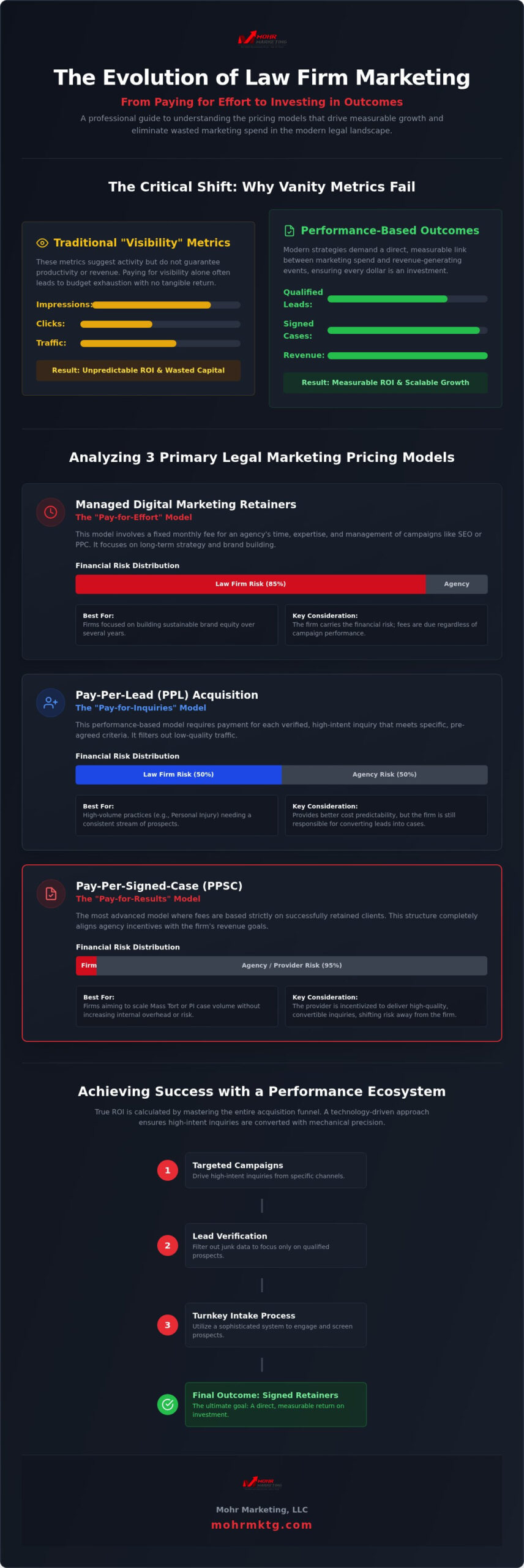
The legal marketing environment has reached a point of critical correction. For decades, firms accepted vague reports and high monthly fees as the standard cost of doing business. That era is over. In 2026, the focus has shifted from mere presence to measurable performance. You can’t afford to subsidize an agency’s learning curve with your capital. High-stakes firms now prioritize transparency and data-driven fee structures that ensure every dollar is an investment, not an expense. This evolution has solidified three dominant law firm marketing pricing models that define the current landscape:
- Managed Retainers: Monthly fees for ongoing strategy and campaign management.
- Pay-Per-Lead (PPL): Fixed costs for every inquiry generated by a marketing channel.
- Pay-Per-Signed-Case (PPSC): Fees based strictly on successfully retained clients, shifting the risk to the provider.
Understanding these mechanics is vital for scaling your practice area without inflating your overhead. The shift toward these structured models represents a move away from “pay-for-effort” toward “pay-for-results.”
Why Visibility Metrics No Longer Suffice
Impressions and clicks are vanity metrics. They suggest activity without guaranteeing productivity. If your agency highlights “increased traffic” while your case volume remains stagnant, there’s a fundamental misalignment. Paying for visibility in a saturated market like personal injury or mass torts is a recipe for budget exhaustion. You need outcomes, not digital footprints. Modern growth strategies require a direct link between marketing spend and signed cases. Firms that fail to pivot away from these superficial indicators find themselves outpaced by competitors who focus strictly on conversion and return on investment. The problem with traditional models is that agencies get paid regardless of your success.
The Role of Technology in Pricing Transparency
Advanced CRM integration and sophisticated intake tracking have removed the guesswork from marketing audits. You no longer have to wonder which campaigns are driving revenue. Real-time reporting allows for immediate assessment of lead quality and intake efficiency. This technological shift has forced agencies to be more accountable. It’s now possible to track a prospect from the initial click to the final signature with mechanical accuracy. Consequently, the most effective law firm marketing pricing models today are those that leverage this data to align agency incentives with firm revenue goals. You should demand a clear, unvarnished view of your acquisition costs at every stage of the funnel. This level of transparency eliminates inefficient intermediaries and focuses resources on high-intent inquiries.
Analyzing the 3 Primary Legal Marketing Pricing Models
Selecting the correct structure for your firm requires a deep understanding of how each model distributes risk and rewards. Most law firm marketing pricing models fall into three distinct categories. Each serves a different strategic purpose. Your choice depends on whether you value long-term brand equity or immediate, verified case volume. When comparing law firm marketing pricing models, your decision must hinge on the scalability of your practice and your tolerance for financial uncertainty.
Managed Digital Marketing Retainers
Managed retainers involve a fixed monthly professional fee. You pay for the agency’s time and expertise in managing SEO, PPC, or content strategy. This model focuses on strategic oversight and funnel execution. It’s excellent for building a sustainable brand over several years. However, the firm carries the financial risk. If the campaign underperforms, the retainer remains due. It’s a “pay-for-effort” approach that requires high trust in your partner’s ability to execute. This model is often less scalable for national practices because costs remain fixed regardless of lead fluctuations.
Pay-Per-Lead (PPL) Acquisition Fees
Pay-Per-Lead (PPL) acquisition fees pivot toward a performance-based approach. You pay for verified, high-intent inquiries rather than just traffic. This model separates raw inquiries from qualified legal leads, ensuring you don’t waste budget on junk data. It’s particularly effective for high-volume personal injury practices needing a constant stream of prospects. You only pay when a lead meets specific criteria, providing better cost predictability than a standard retainer. This structure allows for rapid scaling because you can tie your spend directly to inquiry volume. It’s a shared-risk model where the agency must deliver volume to get paid.
Pay-Per-Signed-Case (PPSC) Performance Fees
Pay-Per-Signed-Case (PPSC) represents the highest level of agency accountability. This is the ultimate performance model where you pay only for fully executed retainers. It eliminates the risk of poor intake conversion or low-quality leads. The agency assumes all the marketing and intake risk, ensuring their incentives are perfectly aligned with your revenue. You can learn more about Mass Tort Signed Cases to see how this model functions for high-stakes litigation. PPSC is the most scalable option for national firms because it bypasses the friction of internal intake bottlenecks. If you’re ready to shift toward a results-only framework, you should consult with a strategic partner to audit your current acquisition strategy.
Lead vs. Case: Calculating the Real ROI of Your Spend
Auditing the total cost of acquisition requires looking past the initial invoice. Many firms fall into the trap of purchasing high volumes of inexpensive leads without accounting for the back-end friction. To master law firm marketing pricing models, you must calculate the “all-in” cost of a signed case. This includes your marketing spend, the labor required for intake, and the opportunity cost of lost time. A “cheap” lead is often the most expensive asset your firm can buy if it fails to convert at a predictable rate.
Consider the math of a $200 unverified lead versus a $2,000 signed retainer. If your intake team must process 15 leads to secure one signature, your marketing cost per case is actually $3,000. You’ve also paid for the staff hours required to chase 14 people who never intended to hire you. In contrast, a $2,000 performance-based retainer offers a fixed acquisition cost with zero intake labor. When evaluating law firm marketing pricing models, the goal is to identify the structure that minimizes your cost-per-case while maximizing your team’s efficiency.
The Hidden Costs of Low-Quality Lead Volume
High-volume, low-intent leads drain your resources. Your intake staff spends hours filtering through inquiries that lack the necessary case criteria or have already signed with competitors. This creates a bottleneck that prevents your team from focusing on high-value litigation. Lead decay refers to the rapid decline in a prospect’s conversion probability as time passes or as they are contacted by competing firms, directly eroding the ROI of unverified inquiries. Every hour spent on a dead-end lead increases your overhead and reduces your firm’s overall profitability.
The Value of Verified High-Intent Inquiries
Search-intent-driven leads command a higher price because they represent active seekers. These individuals aren’t responding to a passive social media ad; they’re searching for specific legal remedies. This intent translates directly into higher conversion rates and lower intake friction. For example, Mesothelioma Leads Built on Real Search Intent ensure that your firm is connecting with claimants who meet rigorous medical and exposure criteria. Exclusivity is another critical factor. When you’re the only firm receiving a lead, you eliminate the race to the phone and preserve your margins. Paying a premium for verification and exclusivity is a strategic move that stabilizes your growth and simplifies your financial forecasting.
Choosing the Right Model for Your Practice Area
Selecting from various law firm marketing pricing models requires a clinical evaluation of your firm’s operational strengths and financial goals. Partners must first audit their internal intake capabilities. If your team cannot handle high-volume filtering, you should move toward performance-based structures. Next, analyze your practice area’s average settlement value against its acquisition cost. Finally, align your choice with your firm’s capital reserves. Smaller firms often require the certainty of PPSC, while larger firms might leverage PPL to lower their overall cost-per-case through internal efficiencies.
Mass Tort and High-Stakes Litigation
Mass tort litigation requires aggressive, national scaling that can quickly drain a firm’s liquidity. Pay-Per-Signed-Case (PPSC) has become the gold standard because it shifts the burden of multi-channel advertising and initial screening to the provider. You avoid massive upfront costs for media buys and only pay for verified claimants. This model is essential for firms looking to enter a competitive litigation without building a massive internal marketing department. It provides a predictable roadmap to growth by eliminating the risk of unverified inquiries. You can explore this strategy further through our guide on Mass Tort Lead Generation: A Roadmap to Scalable Growth.
Personal Injury and Motor Vehicle Accidents
In personal injury and motor vehicle accident law, consistency is vital. A PPL model offers a steady stream of local or national inquiries that keep your intake team active. This structure is ideal for firms that have refined their internal sales processes and can convert inquiries at a high rate. To further improve conversion, many firms are now Acquiring Police Report Backed MVA Cases to ensure they are dealing with verified incidents. This data-driven approach reduces the time spent on unverified claims and stabilizes your monthly acquisition costs. It’s a pragmatic way to scale without the unpredictability of a standard retainer.
Specialized Niche Cases (Trucking, Medical Malpractice)
Specialized niches like trucking and medical malpractice demand precision. These cases involve high-value litigation where a single signature represents significant revenue. Because the pool of potential claimants is smaller, the marketing cost per lead is naturally higher. You must demand strict case criteria to justify the spend. Utilizing Truck Accident Signed Cases and Verified Call Transfer Leads allows firms to bypass the noise of minor accidents and focus on catastrophic injury cases. This precision ensures your budget isn’t wasted on low-value inquiries that your staff will eventually reject anyway.
The Mohr Marketing Performance Ecosystem
Mohr Marketing operates on a fundamental principle: marketing is a liability until it produces a signed retainer. We’ve spent 30 years refining a system that eliminates the friction between lead generation and case acquisition. While other law firm marketing pricing models focus solely on the top of the funnel, our ecosystem integrates the entire journey. We don’t sell hope; we sell outcomes. This approach combines high-intent lead generation with a turnkey intake ecosystem. It ensures that your firm isn’t just busy, but profitable. Our philosophy is built on mechanical accuracy and strict compliance. We adhere to state bar mandates to protect your firm’s reputation. We prioritize transparency, providing you with the metrics that actually matter for your bottom line. You aren’t paying for an agency’s effort. You’re paying for a strategic partner who is aggressive in pursuing your expansion.
Eliminating Waste with a Turnkey Solution
A fragmented acquisition process is the primary cause of budget waste. When your lead provider and your intake team operate in silos, high-value opportunities slip through the cracks. Our turnkey solution bridges this gap. By managing both the acquisition and the initial verification, we ensure that every inquiry is maximized. You gain the benefit of a single partner responsible for the entire conversion path. This integration reduces lead decay and increases your overall ROI. You can learn more about how this efficiency drives growth by focusing on The ROI of Legal Intake Services. Streamlining these processes allows your firm to focus on litigation while we handle the mechanics of growth.
Secure Your Firm’s Growth in 2026
The legal market in 2026 demands a shift toward accountability. If you’re still locked into a traditional retainer that lacks transparency, your firm is at a competitive disadvantage. It’s time to audit your current agency agreement. Evaluate whether your provider’s incentives align with your revenue goals. Transitioning to performance-based law firm marketing pricing models allows you to scale without increasing your internal overhead. You can move from paying for visibility to paying for verified outcomes with immediate effect. Stop subsidizing inefficient marketing. Secure a more streamlined, direct path to success by choosing a model that rewards results. We’re ready to help you identify the most profitable structure for your specific practice area.
Secure Your Firm’s Competitive Advantage in 2026
Sustainable growth in 2026 requires a clinical focus on verified outcomes rather than vanity metrics. You must transition away from opaque fee structures that reward agency effort over firm results. Mastering the various law firm marketing pricing models allows you to mitigate financial risk while scaling your caseload with mechanical precision. Identifying a model that aligns agency incentives with your specific practice area is the most direct path to reducing internal overhead.
Mohr Marketing provides the transparency and expertise needed to navigate this complex transition. With over 30 years of industry experience, we offer a turnkey intake and signed case ecosystem designed specifically for high-stakes litigation and personal injury firms. We eliminate inefficient intermediaries and deliver verified, high-intent lead acquisition that protects your firm’s resources and ensures strict compliance with state bar mandates.
Take control of your acquisition costs and build a more resilient, profitable practice starting today. Your firm’s expansion depends on a strategy that prioritizes mechanical accuracy and strategic value.
Frequently Asked Questions
What is the average cost-per-lead for a personal injury law firm?
Average costs are determined by geographic market saturation and your specific practice area. Metropolitan markets with high competition naturally see higher acquisition costs than rural areas. Rather than focusing on a generic industry average, you should evaluate your firm’s specific cost-per-signed-case. This metric provides a more accurate reflection of your marketing efficiency and overall profitability without the distraction of unverified data points.
How does Pay-Per-Signed-Case pricing differ from traditional PPC management?
Pay-Per-Signed-Case (PPSC) shifts the financial risk from the law firm to the marketing provider. In traditional PPC management, you pay for clicks and impressions regardless of whether they convert into clients. PPSC ensures you only pay for successfully executed retainers. It is one of the most transparent law firm marketing pricing models available because it aligns agency incentives with your firm’s revenue goals.
Are performance-based marketing fees ethical under state bar rules?
Performance-based marketing fees are ethical when structured as payments for marketing services rather than prohibited fee-sharing. Your firm must ensure that any provider maintains strict compliance with state bar mandates regarding lawyer advertising and lead generation. We prioritize these regulatory requirements to protect our clients’ professional standing. It’s vital to work with a partner who understands the nuances of legal ethics and compliance.
What is the typical conversion rate from a high-intent lead to a signed case?
Conversion rates for high-intent inquiries are significantly higher than those for passive traffic. Industry professionals often report that firms with efficient intake processes see a substantial portion of these leads convert into signed cases. Your internal response time is the most critical variable in this equation. Passive inquiries from social media platforms typically require much more effort to convert than active search-intent leads.
Can a small law firm afford a performance-based marketing model?
Small law firms often find performance-based law firm marketing pricing models more affordable because they eliminate the need for large, unverified upfront media spends. This structure provides budget predictability and allows smaller practices to scale their caseload without hiring a full internal marketing department. It levels the playing field against larger competitors by ensuring every dollar spent results in a tangible outcome for the firm.
How do you verify the quality of a legal lead before charging a fee?
Lead quality is verified through a rigorous multi-step screening process that checks for specific case criteria and medical evidence. We utilize a turnkey intake ecosystem to audit every inquiry for high-intent indicators before they are passed to your firm. This mechanical accuracy ensures you don’t waste resources on unverified data. We focus on delivering prospects who meet your firm’s rigorous standards for litigation.
What happens if a lead generated through a PPL model does not sign a retainer?
Under a standard Pay-Per-Lead (PPL) model, the firm pays for the qualified inquiry regardless of the final signature. This underscores the necessity of having a robust internal intake process to maximize every opportunity you purchase. If your firm prefers to eliminate the risk of non-conversion, you should consider a Pay-Per-Signed-Case model. This shift ensures you only pay for results that contribute directly to your bottom line.
How does Mohr Marketing handle intake for signed case acquisition?
Our intake process utilizes a turnkey ecosystem that manages the entire prospect journey from initial contact to the signed retainer. This includes immediate follow-up and rigorous screening against your specific case criteria. We leverage 30 years of industry experience to ensure every inquiry is handled with mechanical accuracy. This integrated approach removes conversion friction and delivers fully verified outcomes directly to your firm.

Recent Posts
- NEC Baby Formula Case Acquisition: A Law Firm’s 2026 Guide
- Justifying Marketing Investment to Law Firm Partners: A Data-Driven Framework
- Roundup Cancer Lawsuit Leads: Buying Guide for Law Firms
Categories
- AI and Lead Generation
- Business Financing
- Call Verified MVA Leads
- Car Accident Help
- Car Accident Settlements
- Claimant Funding
- Compliance Program
- EMS-EMT Reports
- Geotargeting
- Google Maps Ranking
- Healthcare Practice Growth
- Law Firm Growth
- Law Office Operations
- Lead Generation
- Lead Generation For Attorneys
- Lead Generation For Chiropractors
- Lead Generation For Criminal Attorneys
- Lead Generation For D&A Treatment Centers
- Lead Generation For DUI Attorneys
- Lead Generation For Eye Doctors
- Lead Generation For Family Law Practices
- Lead Generation For PI Law Firms
- Lead Generation For Plastic Surgeons
- Leads For Healthcare Professionals
- Leads For Insurance Industry
- Legal Leads
- Legal Marketing
- Legal Updates
- Mass Tort Leads
- Medicare and Medicaid Leads
- Merchant Funding Leads
- Mold Leads
- Online Marketing Strategies
- Pre-Settlement Funding
- Signed MVA Cases
- Tort Updates
- Truck Accident Leads and Signed Cases
- Truck Accident Settlements
- Web Design