Data-Driven Mass Tort Client Acquisition: The 2026 Strategy for High-Value Case Growth
August 10, 2026 by Mohr Marketing
Mass tort marketing budgets are being liquidated by unqualified inquiries and opaque attribution. If your intake team spends more time disqualifying leads than processing retainers, your current strategy is failing. Scaling a practice in 2026 requires a shift from volume-based purchasing to data-driven mass tort client acquisition. This approach prioritizes behavioral intelligence over raw traffic; it ensures every dollar spent targets claimants with the highest intent and verifiable criteria.
You’ve likely experienced the volatility of traditional digital channels where ROI remains inconsistent and lead origin is a mystery. It’s a common pain point for high-stakes professionals who value efficiency and tangible outcomes. This article provides a clear roadmap to solve those inefficiencies. You’ll learn how to leverage integrated intake ecosystems to secure a predictable flow of signed cases. Drawing on 30+ years of industry experience, we’ll break down the mechanics of lowering your cost-per-acquisition through rigorous verification and the strategic move toward a performance-based model. By the end of this guide, you’ll understand how to achieve full transparency into the claimant journey and maintain a competitive advantage in a crowded market.
Key Takeaways
- Learn how to transition from basic demographic targeting to behavioral intelligence to capture claimants with genuine legal intent.
- Discover the mechanics of a responsive intake loop that uses real-time verification to eliminate unqualified inquiries instantly.
- Evaluate the strategic advantages of Pay-Per-Lead versus Pay-Per-Signed-Case models to optimize your data-driven mass tort client acquisition.
- Use our instructional guide to audit your acquisition funnel and identify critical data gaps in the claimant journey from click to retainer.
- Understand how a turnkey ecosystem backed by three decades of experience facilitates aggressive national scaling without operational friction.
The Shift to Data-Driven Mass Tort Client Acquisition in 2026
The mass tort landscape in 2026 is unforgiving for firms using legacy marketing models. Broad-spectrum targeting is no longer a viable strategy; it’s a liability. As Cost-Per-Click (CPC) rates on major search and social platforms reach record highs, precision is the only way to maintain a sustainable ROI. Firms must adopt data-driven mass tort client acquisition to survive this shift. This methodology moves beyond basic demographics like age or zip code. It focuses on granular behavioral intent and real-time verification to ensure every dollar spent targets a viable claimant.
Adopting a “Veracity-First” mindset is the first step toward scaling. This means prioritizing the quality and accuracy of claimant data at the point of capture rather than sorting through junk later. Instead of chasing raw lead numbers, successful firms now optimize for the truth of the claimant’s experience. This approach ensures that intake resources are dedicated to high-intent individuals who meet specific medical and legal criteria from the start. It’s about mechanical accuracy and strategic value, not just filling a CRM with names.
The Death of the Volume-Only Lead Model
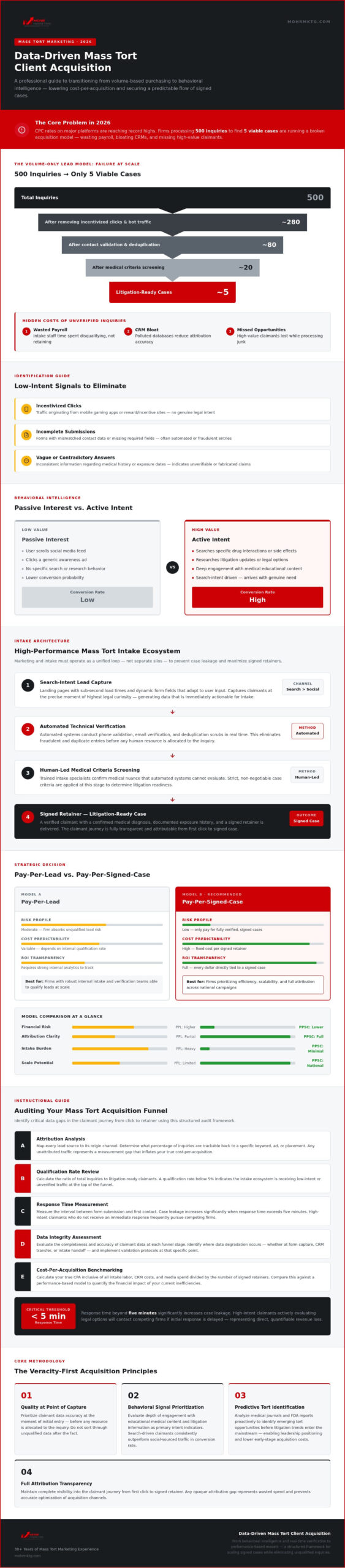
High inquiry counts are a vanity metric that can bankrupt a practice. If your intake team is processing 500 inquiries to find five viable cases, your acquisition model is broken. The hidden costs of processing unverified mass tort inquiries include wasted payroll, CRM bloat, and the opportunity cost of missing high-value claimants while distracted by “junk” traffic. You can identify low-intent signals by looking for:
- Incentivized clicks from mobile gaming apps or reward sites.
- Incomplete form submissions with mismatched contact data.
- Vague or contradictory answers regarding medical history or exposure dates.
Defining Behavioral Intent in Mass Tort Marketing
Effective data-driven mass tort client acquisition distinguishes between passive interest and active intent. A user scrolling social media who clicks a generic ad often has only passive interest. Conversely, a user searching for specific drug interactions or litigation updates demonstrates active intent. Real-time data signals, such as the depth of engagement with educational medical content, allow you to prioritize these high-value claimants. Predictive modeling also enables firms to identify emerging tort opportunities by analyzing medical journals and FDA reports before a litigation trend hits the mainstream. This proactive stance ensures you are capturing mass tort signed cases at the lowest possible cost-per-acquisition while maintaining a leadership position in the market.
Mechanics of a High-Performance Mass Tort Intake Ecosystem
Treating marketing and intake as separate silos is a strategic error that lead to wasted spend and lost opportunities. A high-performance ecosystem merges these functions into a singular, responsive loop. This integration is the backbone of data-driven mass tort client acquisition, as it prevents “case leakage” where qualified claimants fall through the cracks due to slow follow-up or poor data transfer. By synchronizing lead capture with immediate intake, you ensure that high-intent inquiries are processed while the claimant’s motivation is at its peak.
Search-Intent Driven Lead Capture
Social media platforms are effective for broad awareness, but high-value cases often originate in search. For example, mesothelioma leads built on real search intent consistently outperform social-only leads because the claimant is actively seeking specific legal or medical information. In 2026, technical requirements for landing pages have evolved; they must feature sub-second load times and dynamic form fields that adapt based on user input. This precision captures claimants at the moment of highest legal curiosity and ensures the data collected is actionable for your intake team.
Real-Time Verification and Case Qualification
Verification acts as the gatekeeper for your resources. An optimal balance utilizes automated systems for technical scrubs, such as phone and email validation, followed by human-led intake to confirm medical nuance. Strict case criteria are non-negotiable to ensure every inquiry is a viable investment. A claimant is considered litigation-ready when they possess a verified medical diagnosis, a documented link to the tort, and a signed retainer that satisfies all jurisdictional standards. This level of scrutiny ensures that your data-driven mass tort client acquisition strategy delivers cases, not just names.
The Feedback Loop: Intake Data Informing Ad Spend
The true power of an integrated ecosystem lies in the feedback loop. Intake data must flow back to the marketing team to dictate keyword bidding and creative shifts. If a specific ad set generates a high volume of inquiries but zero signed cases, that spend must be reallocated immediately. Granular conversion tracking allows you to scale winners based on actual retainer data rather than top-of-funnel clicks. This methodical approach eliminates spend on “junk” inquiries and maximizes your ROI. To see how this integrated model can streamline your operations, you should consult with an acquisition specialist today.
Comparing Pay-Per-Lead vs. Pay-Per-Signed-Case Models
Choosing between Pay-Per-Lead (PPL) and Pay-Per-Signed-Case (PPSC) isn’t merely a matter of preference; it’s a strategic decision based on your firm’s operational maturity. Both models play a role in data-driven mass tort client acquisition, but they carry different risk-reward profiles. PPL offers lower entry costs but requires a high-performance internal engine to convert inquiries. PPSC shifts the conversion risk to the provider, delivering a finished product that’s ready for litigation. You must evaluate your current intake capacity and growth targets to determine which path provides the most efficient route to scaling.
The PPL Model: Maximizing In-House Intake ROI
The PPL model is ideal for firms with an established, aggressive intake infrastructure. It allows you to leverage your existing team to mine raw data for high-value opportunities. However, the success of this model hinges on qualified legal lead generation. Without rigorous pre-qualification, your staff will quickly burn out while chasing unverified inquiries. To maximize ROI in a PPL framework, you must track two critical metrics: speed-to-lead and the inquiry-to-retainer rate. In mass torts, a lead’s value decays by the minute. If your team can’t respond to a high-intent inquiry within seconds, your acquisition cost will skyrocket.
The PPSC Model: Outsourcing the Conversion Burden
For firms focused on rapid national scaling, mass tort signed cases represent the cleanest path to ROI. This model eliminates the uncertainty of intake performance from your balance sheet. You don’t pay for “maybe” or “potential” claimants; you pay for verified retainers that meet your exact criteria. This is the most evolved form of data-driven mass tort client acquisition because it ensures your capital is tied directly to tangible assets. When utilizing PPSC, your focus shifts from managing a call center to ensuring compliance and quality in the signed documents you receive. It’s a results-oriented approach that removes the friction of the conversion process, allowing your legal team to focus on litigation rather than administrative hurdles.
The risk in PPL lies in the “junk” leads that inevitably slip through broad marketing filters. Conversely, the PPSC model carries a higher cost-per-unit but offers near-total transparency into the claimant journey. If you have the staff to handle high-volume sorting, PPL can offer a lower overall CPA. If you want a predictable, hands-off growth trajectory, PPSC is the superior strategic choice. Most successful firms eventually adopt a hybrid approach, using PPL for emerging torts and PPSC for established, high-competition litigations.
Instructional Guide: Auditing Your Mass Tort Acquisition Funnel
Strategic auditing is the difference between a scalable practice and a financial drain. If you don’t have a granular view of your funnel, you’re guessing with your firm’s capital. Executing a thorough audit is the only way to validate your data-driven mass tort client acquisition strategy and ensure your resources are spent on high-intent claimants rather than unverified inquiries.
Follow these five steps to evaluate your current operations:
- Step 1: Map the Journey. Track the claimant from the initial search query through the landing page to the final signed retainer. Identify every hand-off point between marketing and intake.
- Step 2: Identify Data Gaps. Locate where information is lost. If your marketing team can’t see which specific ad creative resulted in a signed case, your loop is broken.
- Step 3: Evaluate Lead Veracity. Audit a random sample of 100 inquiries. Cross-reference contact details against public records to check for “junk” data or incentivized clicks.
- Step 4: Implement Closed-Loop Reporting. Ensure your CRM feeds disposition data back to your ad platforms. This allows for real-time optimization based on actual revenue potential.
- Step 5: Stress-Test Intake. Measure your “speed-to-lead.” If your team takes longer than 90 seconds to respond to a web inquiry, your conversion rates will plummet.
Identifying and Plugging Case Leakage
Case leakage is the quantifiable loss of viable legal opportunities caused by fragmented data transfer or inefficient intake responses during the claimant journey. Common friction points include overly complex intake scripts and long wait times on transferred calls. To identify these leaks, you must “mystery shop” your own firm. Submit a test inquiry and evaluate the experience. Was the agent professional? Did they follow the criteria? If the experience is clunky, high-value claimants will simply move to the next firm in their search results.
Data Transparency and Vendor Accountability
Transparency is a non-negotiable requirement for data-driven mass tort client acquisition. You must demand full accountability from your marketing partners. If an agency cannot provide the exact URL where a lead was generated or the timestamp of the submission, they are likely hiding inefficient intermediaries. Look for red flags in your reports, such as identical IP addresses for multiple leads or a sudden surge in volume without a corresponding increase in signed cases. High-performing partners provide real-time access to inquiry data and origin tracking, ensuring you know exactly where your cases are coming from.
Scaling with the Mohr Marketing Turnkey Ecosystem
National expansion requires more than a marketing budget; it demands a battle-tested infrastructure. Mohr Marketing offers a 30 year legacy in the legal acquisition space, providing the stability and precision needed for aggressive growth. Our turnkey ecosystem is designed to remove the operational friction that typically stalls large scale campaigns. By integrating advanced behavioral targeting with a rigorous intake loop, we provide a direct path from high-intent inquiry to fully executed retainer. This model ensures your data-driven mass tort client acquisition strategy remains profitable as you scale into high-competition litigations.
Success in 2026 relies on the ability to pivot as dockets evolve. Our ecosystem handles the heavy lifting of lead capture, real-time verification, and retainer execution. This allows your firm to focus on the legal merits of the case rather than the logistics of the funnel. We provide the mechanical accuracy required to maintain a leadership position in the market, ensuring that every dollar of your budget is tied to a verified, high-intent opportunity.
A Strategic Partner, Not a Lead Vendor
Generic lead vendors often prioritize volume over validity, leaving your firm to deal with the fallout of poor data. We operate as a strategic partner, utilizing a consultative approach to customize criteria for high-value case acquisition. This partnership leverages three decades of insider knowledge to anticipate market shifts and regulatory changes. We protect your firm’s resources through aggressive verification processes that filter out non-qualified inquiries before they ever reach your desk. This commitment to transparency and procedural precision ensures that every case delivered is ready for your legal team to litigate.
Next Steps for National Practice Growth
Scaling your practice requires an honest evaluation of your current operational capacity. You must select torts that align with your firm’s specific litigation strengths and financial goals. Whether you’re targeting emerging environmental torts or established pharmaceutical litigations, your acquisition engine must be responsive and data-heavy. It’s time to move away from inefficient intermediaries and embrace a more streamlined path to success. Ready to optimize your acquisition? Contact Mohr Marketing for a strategy session to review your current funnel and identify opportunities for immediate improvement. Our team will help you implement a data-driven mass tort client acquisition framework that delivers predictable, high-intent results.
Secure Your Position in the 2026 Mass Tort Market
Success in high-stakes litigation requires a departure from legacy lead generation. You’ve learned that behavioral intent and real-time verification are the only defenses against rising acquisition costs. Implementing a data-driven mass tort client acquisition strategy ensures your firm’s resources target verified, high-intent claimants rather than unverified inquiries. By integrating your marketing and intake into a singular, responsive loop, you eliminate case leakage and maximize every dollar of your budget.
Mohr Marketing provides the mechanical accuracy and strategic stability needed for national scaling. With 30+ years of legal marketing experience, our turnkey ecosystem and performance-based signed case models remove the friction of growth. You now have the roadmap to audit your funnel and select the acquisition model that fits your operational maturity. It’s time to stop chasing raw volume and start securing high-value retainers with precision.
Your firm is ready to move beyond inefficient intermediaries and lead the market with a transparent, results-oriented approach.
Frequently Asked Questions
What defines a data-driven mass tort client acquisition strategy?
A data-driven mass tort client acquisition strategy uses behavioral intelligence to target high-intent claimants. It moves beyond demographics to focus on specific user actions and medical criteria. This approach ensures every marketing dollar targets verified inquiries that meet strict case requirements. It prioritizes mechanical accuracy and transparency throughout the claimant journey. By focusing on data rather than raw volume, firms achieve a more predictable growth trajectory.
How do you verify the intent of a mass tort lead?
Intent is verified through multi-layered screening that combines technical data with human-led intake. We analyze search queries to distinguish active seekers from passive observers. Real-time verification checks contact details, medical history, and exposure dates immediately. This process filters out unqualified inquiries and focuses on individuals ready to sign a retainer. Rigorous verification ensures your intake team doesn’t waste resources on low-intent traffic.
Is the Pay-Per-Signed-Case model compliant with state bar rules?
Compliance depends on how the model is structured regarding fee-sharing and advertising regulations. Most firms use these models as marketing cost arrangements rather than split legal fees. You should always have your compliance officer review specific contracts to ensure they meet your state’s bar requirements. Transparency in lead origin and verification is essential for maintaining professional standards and building trust with regulators.
What is the average cost per signed case in mass torts for 2026?
Costs vary significantly based on the specific tort and the level of competition in the market. Established litigations often have higher costs than emerging torts due to increased search engine bid prices. Firms should focus on their internal cost-per-acquisition (CPA) targets rather than industry averages. Accurate tracking of intake efficiency is the best way to manage these costs and ensure a sustainable ROI.
How does search intent data differ from social media interest in mass torts?
Search intent data captures users actively looking for solutions. Social media often captures passive interest. A user searching for specific contamination symptoms has higher legal intent than someone clicking a social ad out of curiosity. Data-driven mass tort client acquisition prioritizes search data to secure claimants who are further along in the decision-making process. This distinction is critical for lowering your cost-per-acquisition and increasing case quality.
Can you scale a mass tort campaign nationally without an internal intake team?
Yes, you can scale using a turnkey intake and marketing ecosystem. This model allows firms to outsource the conversion burden to specialized partners who handle high-volume inquiries and retainer execution. It eliminates the need for expensive internal infrastructure and allows you to pay for performance. This approach is ideal for firms focusing on rapid expansion without the operational friction of managing a large call center.
What are the common mistakes firms make in mass tort digital marketing?
The most common mistake is prioritizing lead volume over lead veracity. Firms often buy unverified inquiries that overwhelm their intake teams and waste resources. Other errors include failing to track granular conversion data and ignoring the “speed-to-lead” requirement. Without a closed-loop reporting system, it’s impossible to optimize ad spend based on actual signed cases. Success requires a focus on quality markers and procedural precision.
How long does it take to see ROI from a data-driven acquisition campaign?
ROI timelines depend on the litigation cycle and the efficiency of your intake process. While inquiries can be generated almost immediately, the conversion to signed retainers happens within days or weeks. Long-term profitability is realized as cases move through the courts. Using a performance-based model provides more immediate transparency into your acquisition costs and projected returns. Consistent data monitoring allows for faster adjustments to improve performance.

Recent Posts
- NEC Baby Formula Case Acquisition: A Law Firm’s 2026 Guide
- Justifying Marketing Investment to Law Firm Partners: A Data-Driven Framework
- Roundup Cancer Lawsuit Leads: Buying Guide for Law Firms
Categories
- AI and Lead Generation
- Business Financing
- Call Verified MVA Leads
- Car Accident Help
- Car Accident Settlements
- Claimant Funding
- Compliance Program
- EMS-EMT Reports
- Geotargeting
- Google Maps Ranking
- Healthcare Practice Growth
- Law Firm Growth
- Law Office Operations
- Lead Generation
- Lead Generation For Attorneys
- Lead Generation For Chiropractors
- Lead Generation For Criminal Attorneys
- Lead Generation For D&A Treatment Centers
- Lead Generation For DUI Attorneys
- Lead Generation For Eye Doctors
- Lead Generation For Family Law Practices
- Lead Generation For PI Law Firms
- Lead Generation For Plastic Surgeons
- Leads For Healthcare Professionals
- Leads For Insurance Industry
- Legal Leads
- Legal Marketing
- Legal Updates
- Mass Tort Leads
- Medicare and Medicaid Leads
- Merchant Funding Leads
- Mold Leads
- Online Marketing Strategies
- Pre-Settlement Funding
- Signed MVA Cases
- Tort Updates
- Truck Accident Leads and Signed Cases
- Truck Accident Settlements
- Web Design