Personal Injury Intake Services: A 2026 Guide to High-Conversion Case Acquisition
September 14, 2026 by Mohr Marketing
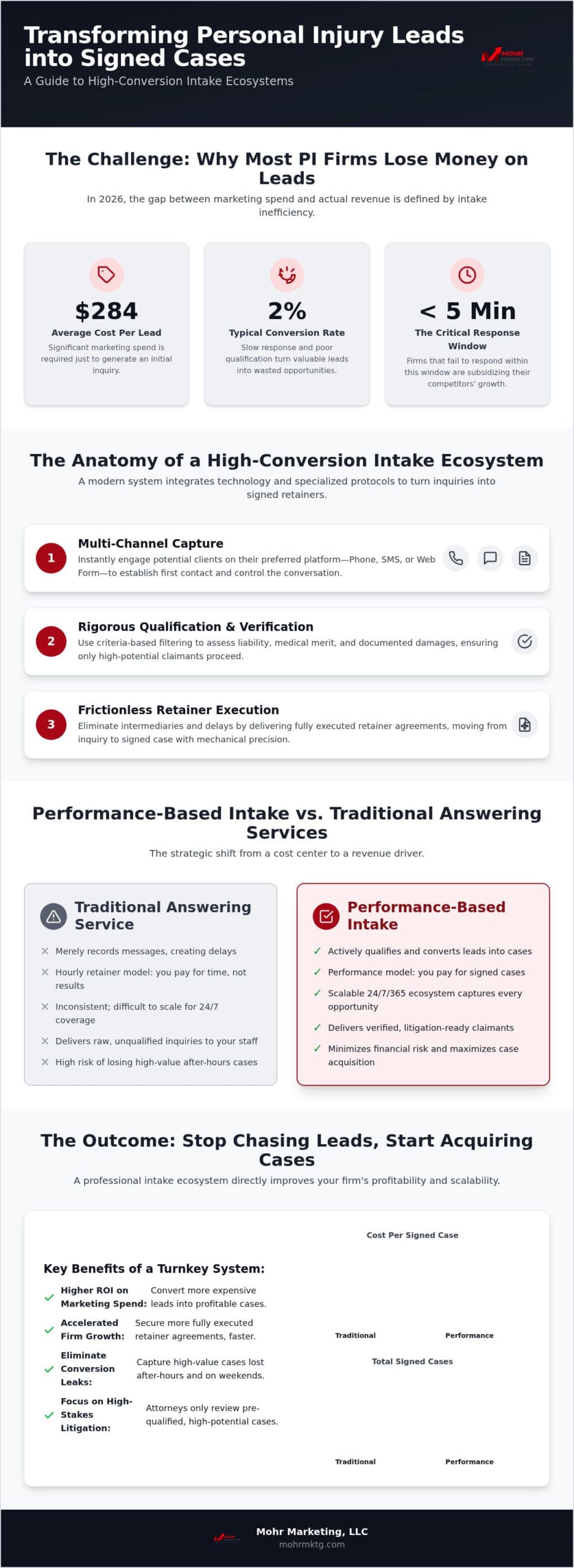
In 2026, the average personal injury firm pays approximately $284 per lead, yet many see conversion rates as low as 2% due to slow response times and poor qualification. You already know that a raw inquiry is worthless if it doesn’t result in a signed retainer. Professional personal injury intake services are the only bridge between expensive marketing spend and actual firm revenue. If your staff isn’t hitting the five minute response window, you’re essentially subsidizing your competitors’ growth.
We understand the frustration of missing high-value cases after hours or dealing with low-quality leads that never convert. This guide teaches you how to transform raw inquiries into verified, litigation-ready claimants through a rigorous, performance-driven intake ecosystem. We’ll examine the turnkey systems that deliver higher ROI on your digital marketing spend and provide a direct path to scaling your practice. You’ll learn how to eliminate inefficient intermediaries and secure fully executed retainer agreements with mechanical precision. It’s time to stop chasing leads and start acquiring cases.
Key Takeaways
- Distinguish between basic call answering and high-conversion personal injury intake services to ensure every inquiry is qualified for liability and medical merit.
- Implement a multi-channel ecosystem that uses SMS, web forms, and phone calls to capture and verify claimants across all entry points.
- Transition from inefficient hourly retainer models to performance-based acquisition to minimize financial risk and improve your cost per signed case.
- Audit your current intake funnel to identify conversion leaks during after-hours and weekends when high-value cases are most frequently lost.
- Utilize a turnkey ecosystem to receive fully executed retainer agreements, eliminating intermediaries and accelerating your firm’s national scaling efforts.
The Strategic Role of Personal Injury Intake Services in 2026
Personal injury intake services are no longer a luxury; they’re a strategic necessity for firms targeting aggressive growth. In 2026, the distinction between a “receptionist” and a “conversion specialist” determines the survival of a practice. Standard answering services merely record messages. High-performance intake identifies the specific medical and liability markers that turn a raw inquiry into a high-value signed case. Data shows that firms responding to a new lead within five minutes are significantly more likely to convert them. If your response time lags, you’re essentially funding your competitor’s marketing budget.
Lead vs. Case: Why Qualification Matters
Qualification is the filter that protects your firm’s most valuable resources: time and capital. Chasing every phone call is a financial drain that reduces your overall ROI. Effective intake uses criteria-based filtering to eliminate non-viable inquiries before they ever reach an attorney’s desk. This process requires a deep understanding of personal injury law to ensure that only claimants with clear liability and documented damages move forward. Establishing authority during that first interaction is critical. It’s the moment where a claimant decides whether to trust your firm or keep searching. For specialized areas such as police report-backed MVA cases, the intake protocols must be even more rigorous to verify the presence of an official record immediately.
The Evolving Landscape of Legal Intake
The legal market has shifted toward performance-based models where the focus is on signed retainers rather than raw lead volume. Many firms are moving away from in-house intake because it’s often inconsistent, difficult to manage, and expensive to scale for round-the-clock coverage. High-intent claimants don’t wait for business hours to seek help after a catastrophic event. Capturing these cases requires an ecosystem that is always active. Professional intake services provide this mechanical accuracy while maintaining the human empathy necessary to handle sensitive legal matters. By leveraging a turnkey ecosystem, you eliminate the friction of managing staff and focus exclusively on high-stakes litigation. This strategic shift ensures that your firm captures every viable case, regardless of when the inquiry arrives.
The Anatomy of a High-Conversion Intake Ecosystem
A high-performance intake ecosystem functions as a precision-engineered machine. It doesn’t rely on a single point of contact. Instead, it integrates phone, SMS, and web forms into a unified response layer. In 2026, personal injury intake services must accommodate the claimant’s preferred communication method instantly. If a potential client texts after an accident and doesn’t receive a reply within minutes, they’ve already moved to the next firm on Google. This “Speed to Lead” protocol is the baseline for modern case acquisition. You can’t afford to let inquiries sit in an inbox while your competitors are active.
The transition from an initial inquiry to a signed retainer should be frictionless. A successful system doesn’t just gather contact information; it initiates the legal journey. By the time a lead reaches your desk, they should already be qualified, verified, and ready to sign. This mechanical accuracy eliminates the traditional lag that kills high-value opportunities. Every step in the process must move the claimant closer to a formal agreement without unnecessary hurdles.
Verification Protocols for High-Value Cases
Qualification requires more than a simple checklist. It demands a deep dive into the narrative to identify “red flags” like prior injuries or lack of insurance coverage. For motor vehicle accidents, verifying the incident through police report-backed MVA cases ensures the firm isn’t wasting time on hearsay or unverified claims. When using non-lawyer staff for these tasks, firms must remain mindful of their ethical obligations regarding supervision and the unauthorized practice of law. Rigorous verification at the intake level means your attorneys only review cases with high settlement potential.
Data Integration and CRM Syncing
Precision requires transparency. Every inquiry must be tracked through a digital audit trail that syncs directly with your firm’s management software. Real-time data transfer prevents leads from falling through the cracks and allows for immediate follow-up. This integration also creates a vital feedback loop. When your intake team identifies a surge in specific case types, your marketing can pivot instantly to capitalize on the trend. If your current setup feels fragmented, it might be time to audit your intake ecosystem for potential leaks. A turnkey system removes these technical hurdles, allowing you to focus on litigation while the ecosystem handles the logistics of case acquisition.
Performance-Based Intake vs. Traditional Answering Services
Traditional answering services are cost centers. They charge for minutes spent on the phone, regardless of whether those minutes result in a client. In contrast, performance-based personal injury intake services function as profit centers. By shifting the focus from call volume to case acquisition, firms can mitigate the financial risk of marketing campaigns. If a provider only gets paid when a retainer is signed, their incentive to qualify aggressively and follow up relentlessly aligns with your firm’s growth objectives. This model transforms a variable expense into a predictable investment in firm expansion.
Evaluating a provider based solely on cost per lead is a tactical error. In 2026, the average personal injury firm pays approximately $284 per lead across all paid channels, but a lead is just an inquiry. A signed case is an asset. High-volume, low-quality lead generation often results in a high cost per acquisition because your staff spends hours filtering through spam. Transparency is the only remedy. You need to see exactly how inquiries are handled and why specific leads were rejected. Performance-based models demand this level of accountability, providing a clear audit trail from the initial click to the fully executed retainer.
The Pay-Per-Signed-Case Advantage
The pay-per-signed-case model eliminates the waste associated with unqualified inquiries. You aren’t paying for wrong numbers or individuals seeking legal advice for non-meritorious claims. This model is particularly effective for complex litigation, such as mass tort signed cases, where the qualification criteria are exceptionally high. It forces the intake ecosystem to prioritize the most viable claimants, ensuring that your capital is only deployed toward verified opportunities. This alignment of incentives turns your intake provider into a strategic partner rather than a mere vendor, focusing entirely on the mechanics of your growth.
Hidden Costs of Cheap Intake Solutions
Choosing the lowest-priced answering service often leads to the highest long-term costs. Missed calls are missed revenue. If a potential claimant has a poor initial experience, they won’t just hang up; they’ll go to a competitor and likely leave a negative review. Beyond reputation, there are significant liability risks. Non-compliant intake processes can lead to ethical violations or missed deadlines. A cheap service lacks the rigorous training required to handle sensitive medical or legal data with the precision your firm demands. When you calculate the value of a single lost high-stakes case, the savings from a budget answering service evaporate instantly. Quality intake is a protective measure for your firm’s brand and its bottom line.
Auditing Your Firm’s Intake Process for Maximum ROI
Auditing your intake process is the only way to stop wasting marketing capital. If you don’t know your exact numbers, you’re flying blind. A rigorous audit identifies where high-value cases are slipping through the cracks. In 2026, the margin for error is non-existent. Professional personal injury intake services provide the data necessary to evaluate your firm’s performance against industry benchmarks. Start with these five critical steps to reclaim your ROI.
- Calculate your inquiry-to-retainer rate: Determine how many raw inquiries actually result in a signed case. If your conversion rate for exclusive leads is below 15%, your qualification process is failing.
- Identify funnel leaks: Analyze your data for drops in conversion during after-hours and weekends. These are the peak times for catastrophic injury inquiries.
- Review qualification scripts: Vague questions lead to weak cases. Ensure your scripts target specific medical and liability markers for each practice area.
- Test multi-channel response speed: Measure the time it takes to reply to an SMS or web form. Any delay over five minutes significantly decreases your chances of a signed retainer.
- Evaluate the attorney review transition: Friction during the hand-off from intake to legal review allows claimants to keep searching for competitors. This transition must be instantaneous.
Optimizing for Specific Practice Areas
Generic intake scripts are a liability in complex litigation. Developing specific criteria for high-value mold case acquisition requires technical precision regarding exposure timelines and property damage. Your intake team must be trained to recognize the nuances of medical malpractice or truck accidents immediately. Customizing these interactions ensures you capture the specific data points required for a successful filing. Standard personal injury intake services often lack this level of practice-specific depth, resulting in missed opportunities for high-stakes torts.
Compliance and Ethical Standards in Intake
Compliance isn’t a suggestion; it’s a requirement for firm survival. Your intake ecosystem must adhere strictly to TCPA and HIPAA standards to protect sensitive claimant data. Furthermore, every interaction must align with state bar mandates regarding legal advertising and non-lawyer assistants. Transparency is the foundation of a performance-based partnership. You need a clear audit trail for every inquiry to ensure ethical standards are maintained while pursuing aggressive growth. This mechanical accuracy protects your firm’s reputation and its license to practice.
Scaling Case Acquisition with Mohr Marketing’s Turnkey Ecosystem
Mohr Marketing, LLC doesn’t offer just another answering service. We provide a turnkey ecosystem built on over 30 years of industry experience. Our focus is the elimination of inefficient intermediaries that drain your marketing budget. By integrating high-intent inquiries with rigorous verification, we deliver fully executed retainer agreements directly to your firm. This isn’t about generating noise; it’s about mechanical accuracy in case acquisition. We understand that personal injury intake services must be proactive and aggressive to secure high-stakes litigation in a competitive national market.
National scaling requires a partner who can handle the complexity of mass tort and high-volume personal injury practices across the entire country. We take the “straight-talk” approach to legal practice growth. We tell you exactly what’s working and where the market is shifting. Our ecosystem is designed to be a strategic extension of your firm, allowing you to scale without the overhead of a massive in-house intake department. We handle the friction of claimant verification so you can focus on the courtroom. This approach ensures you aren’t just buying data; you’re investing in a pipeline of litigation-ready files.
A Performance-Driven Partnership
A partnership with Mohr Marketing, LLC is defined by tangible outcomes. We don’t sell promises; we deliver signed retainers ready for litigation. This model reduces the administrative burden on your staff, allowing them to focus on case management rather than chasing unqualified leads. We handle the heavy lifting of claimant acquisition, from the initial digital touchpoint to the final signature. Whether you’re looking for truck accident signed cases or mesothelioma leads built on real search intent, our process remains consistent. We prioritize transparency and data-driven strategies to ensure your firm maintains a competitive advantage.
Getting Started with a Scalable Intake Strategy
The transition to a scalable model begins with an honest evaluation of your firm’s current capacity. National growth demands a robust infrastructure that can absorb a high volume of verified claimants without compromising quality. Onboarding with a performance-based agency like Mohr Marketing, LLC is a methodical process. We align our verification protocols with your specific case criteria to ensure every signed retainer meets your standards. This strategic alignment minimizes risk and maximizes your ROI. If your firm’s ready to stop managing leads and start litigating cases, the next step is clear.
Dominating the 2026 Personal Injury Market
Transitioning from raw inquiries to a high-volume signed case portfolio requires more than just marketing spend. It demands a rigorous ecosystem where every interaction is measured by its ability to secure a retainer. You’ve seen that traditional answering services fail because they lack the qualification depth necessary for high-stakes litigation. By contrast, specialized personal injury intake services focus on the mechanical accuracy of case acquisition, ensuring that only verified, high-intent opportunities reach your desk.
Mohr Marketing brings 30+ years of legal marketing experience to your firm’s expansion strategy. We eliminate inefficient intermediaries and deliver litigation-ready files through a performance-based signed case model. This approach protects your resources while positioning your practice for national scaling. It’s time to stop chasing leads and start executing on a turnkey growth plan.
Take control of your firm’s trajectory and build a more resilient, high-conversion practice today.
Frequently Asked Questions
What is the difference between a legal answering service and personal injury intake services?
Legal answering services focus on recording messages and routing calls. Personal injury intake services prioritize qualification and conversion. They use specific legal and medical criteria to verify a claimant’s eligibility before passing the data to the firm. This process transforms a raw inquiry into a high-intent opportunity. It requires a deep understanding of liability and damages rather than simple message taking. Professional intake ensures that your staff only reviews viable litigation files.
How do performance-based intake models like pay-per-signed-case work?
A pay-per-signed-case model shifts the financial risk from the law firm to the marketing partner. You don’t pay for raw leads or unqualified inquiries. Instead, fees are only triggered when a fully executed retainer agreement is delivered. This model ensures that the intake provider’s incentives align with your firm’s growth. It focuses on the quality of the litigation-ready file rather than the volume of the phone calls, providing a predictable investment.
Can outsourced intake services handle complex cases like mass torts or medical malpractice?
Specialized intake ecosystems are specifically designed to manage the high-stakes requirements of mass torts and medical malpractice. These systems utilize rigorous verification protocols to screen for specific exposure timelines and injury severity. By leveraging 30 years of industry experience, a professional provider ensures that complex criteria are met before the claimant is onboarded. This mechanical precision is essential for maintaining high settlement potential in national campaigns. It eliminates the risk of chasing non-meritorious claims.
What are the most common reasons personal injury leads fail to convert?
Speed to lead is the primary factor; delays longer than five minutes drastically reduce conversion rates. Other common leaks include inconsistent follow-up protocols and poor qualification scripts that fail to establish authority. Inefficient intake staff often miss the nuance of a claimant’s narrative, leading to lost opportunities. A turnkey ecosystem solves these issues by automating the response layer and utilizing trained conversion specialists who understand the urgency of every legal inquiry.
How does a legal intake service ensure compliance with state bar regulations?
Professional providers maintain strict compliance by adhering to state bar mandates regarding legal advertising and the supervision of non-lawyer assistants. Every interaction is documented through a transparent audit trail to ensure ethical standards are met. This includes following TCPA and HIPAA regulations for data privacy. Reliable partners prioritize this procedural precision to protect your firm’s reputation and license while pursuing aggressive national scaling strategies. Transparency is the foundation of these performance-based partnerships.
How quickly can a firm see ROI from professional intake services?
Firms often see a measurable increase in ROI within the first 30 to 60 days of implementation. By eliminating inefficient intermediaries and focusing on signed retainers, the cost per acquisition typically drops immediately. The shift from paying for raw leads to paying for litigation-ready cases provides instant clarity on marketing spend. This streamlined path to success allows practices to scale their national presence without the traditional lag of in-house training and management.
Is a 24/7 intake service necessary for a national personal injury practice?
Round-the-clock availability is mandatory for any firm pursuing national growth. High-intent claimants often search for legal help after hours or during weekends following an accident. If your firm isn’t active when the inquiry arrives, the case will go to a competitor who is. A 24/7 ecosystem ensures that you capture every viable opportunity regardless of the time zone. Using personal injury intake services ensures no high-value case is lost to a competitor.

Recent Posts
- Personal Injury Intake Services: A 2026 Guide to High-Conversion Case Acquisition
- Using EMS Reports to Find and Qualify Personal Injury Clients
- The Strategic Value of EMS-EMT Accident Reports in Car Accident Lawsuits
Categories
- AI and Lead Generation
- Business Financing
- Call Verified MVA Leads
- Car Accident Help
- Car Accident Settlements
- Claimant Funding
- Compliance Program
- EMS-EMT Reports
- Geotargeting
- Google Maps Ranking
- Healthcare Practice Growth
- Law Firm Growth
- Law Office Operations
- Lead Generation
- Lead Generation For Attorneys
- Lead Generation For Chiropractors
- Lead Generation For Criminal Attorneys
- Lead Generation For D&A Treatment Centers
- Lead Generation For DUI Attorneys
- Lead Generation For Eye Doctors
- Lead Generation For Family Law Practices
- Lead Generation For PI Law Firms
- Lead Generation For Plastic Surgeons
- Leads For Healthcare Professionals
- Leads For Insurance Industry
- Legal Leads
- Legal Marketing
- Legal Updates
- Mass Tort Leads
- Medicare and Medicaid Leads
- Merchant Funding Leads
- Online Marketing Strategies
- Pre-Settlement Funding
- Signed MVA Cases
- Tort Updates
- Truck Accident Leads and Signed Cases
- Truck Accident Settlements
- Web Design