Mass Tort Signed Retainers: The 2026 Strategic Guide to Case Acquisition
August 17, 2026 by Mohr Marketing
Buying leads in 2026 is a liability, not an asset. If your intake department is currently overwhelmed by no-contact leads while your marketing budget evaporates without a single guaranteed signature, you’re operating on an obsolete model. Most high-stakes firms accept this friction as the cost of doing business, but the industry’s elite have already pivoted. They’ve stopped gambling on raw data and started securing mass tort signed retainers through a performance-based supply chain.
You’re here because you need a predictable way to grow without adding massive in-house headcount. This guide provides the blueprint to transition from unpredictable lead-buying to a fixed-cost-per-case model that eliminates the intake bottleneck entirely. We’ll explore how to achieve rapid national scaling for emerging 2026 torts, including GLP-1 medications and PFAS environmental claims. You’ll learn the mechanics of a turnkey ecosystem that delivers fully executed agreements, allowing your firm to focus on litigation rather than administrative recovery.
Key Takeaways
- Identify the critical differences between raw contact data and legally binding agreements to stop wasting resources on unvetted leads.
- Shift financial risk away from your firm by adopting a performance-based model that eliminates the hidden costs of unqualified inquiries.
- Streamline your growth with a 5-step turnkey intake system designed to deliver verified mass tort signed retainers ready for immediate litigation.
- Scale national campaigns for high-impact 2026 torts like GLP-1 and PFAS without the burden of increasing your internal headcount.
- Leverage rigorous verification protocols that validate medical records and incident details before any case enters your pipeline.
Defining Mass Tort Signed Retainers vs. Raw Leads
A raw lead is a phone number. A signed retainer is a client. Law firms often conflate the two, leading to bloated intake departments and stagnant dockets. Raw leads represent unverified contact data that requires significant labor to convert. Conversely, mass tort signed retainers are legally binding, fully executed agreements between the claimant and your firm. By the time a retainer reaches your desk, the claimant has already committed to litigation. They aren’t just “interested” in a case; they’ve formally engaged your services.
As of August 2026, the market has shifted away from volume-based lead generation. Elite firms are moving toward performance-based acquisition models. This transition is driven by rising costs; the cost per qualified lead in mass tort advertising increased by 13% between April and August 2026. Paying for data that doesn’t convert is an unnecessary “marketing tax.” You shouldn’t gamble your capital on the hope of a conversion. You should only pay for results.
Understanding the distinction between a Class Action vs. Mass Tort is vital when building a docket. While class actions involve a representative plaintiff, mass torts require individual signatures for every claimant. This makes the acquisition of verified mass tort signed cases the most critical bottleneck in your firm’s growth strategy. If you don’t control the signature, you don’t control the asset.
The Functional Value of an Executed Agreement
Signed retainers eliminate the “ghosting” phase that plagues traditional marketing. When you buy raw leads, your intake team spends hours chasing people who never pick up the phone. A fully executed agreement means the claimant has already passed your specific screening criteria. They’ve verified their injury, usage, and intent. This allows your legal team to bypass administrative hurdles and begin litigation work immediately. It’s the difference between managing a call center and practicing law.
High-Intent Acquisition and Search Logic
Quality begins with how a claimant is found. Interruption ads on social media often catch people while they’re distracted. These users might click a button out of curiosity but lack the intent to sign a contract. Search-intent marketing is different. It captures claimants at the moment of peak interest when they’re actively searching for specific solutions, such as GLP-1 side effects or PFAS water contamination.
To optimize your pipeline, you must evaluate your current lead sources for intent-level markers. Ask your providers if they’re using broad-spectrum social ads or high-intent search queries. If your conversion rate from lead to retainer is below the 18% industry average, your source intent is likely the problem. Focus on acquisition channels that target specific, verifiable criteria to ensure your budget is spent on committed plaintiffs, not just digital footprints.
The Strategic Advantage of Performance-Based Case Acquisition
Traditional marketing models often impose a hidden “Marketing Tax” on your firm. You pay for every click and every raw lead, regardless of whether they ever answer the phone or sign a contract. This model forces law firms to gamble their capital on the efficiency of their intake departments. Performance-based acquisition shifts this financial burden. By purchasing mass tort signed retainers, you effectively outsource the risk of volatile media markets. The marketing provider absorbs the cost of low-intent clicks and uncontactable data, delivering only the final result: a committed claimant.
This shift has a profound impact on firm cash flow. Instead of budgeting for speculative lead volume, you budget for fixed-cost cases. This predictability allows for aggressive national expansion without the fear of a sudden spike in cost-per-lead. According to the legal definition of mass tort, these actions involve numerous plaintiffs with similar claims. Managing this scale requires a reliable supply chain of mass tort signed cases to ensure your litigation team stays productive. If you’re looking to stabilize your acquisition costs, consult with a strategic partner to evaluate your current pipeline.
Risk Mitigation for High-Volume Firms
Traditional PPC involves volatile costs and unpredictable conversion rates. For example, the cost per qualified lead in mass tort advertising increased by 13% between late April and mid-August 2026. Firms relying on raw leads saw their margins compress as acquisition became more expensive. Performance models provide a predictable supply chain. You eliminate the “dead lead” factor from your budget because you only pay for fully executed agreements. This allows for precise litigation planning and resource allocation based on known case counts rather than hopeful projections.
Operational Efficiency and Intake Reduction
Intake is a significant cost center that often functions as a bottleneck. A 24/7 intake ecosystem captures cases while your office is closed, ensuring no high-intent claimant is lost to a competitor. To understand the true value of this model, you must calculate your current cost of an in-house signature. This calculation should include:
- Direct labor costs for intake specialists and managers.
- CRM and lead-tracking software licensing fees.
- The “opportunity cost” of your legal team performing administrative follow-ups.
- Marketing spend wasted on leads that never convert.
Most firms find that their internal cost per signature is significantly higher than they realize. Outsourcing this process allows your team to focus on high-level legal work while maintaining a scalable, national presence in the mass tort landscape.
Comparing Case Acquisition Models: PPC vs. Signed Retainers
Direct media buying is a high-risk venture. In a Pay-Per-Click (PPC) model, you pay for the opportunity to speak with a potential claimant, not the claimant themselves. This volatility is a constant threat to firm margins. When you shift to mass tort signed retainers, you move the risk of audience fragmentation and bidding wars to the provider. You stop paying for impressions and start paying for legal assets. This model ensures that every dollar spent is tied to a verified, committed plaintiff.
Transparency is the primary driver of this shift. Traditional agencies often charge a management fee on top of media spend, which obscures your true acquisition cost. A performance-based model provides a single, all-in price. This clarity is essential for staying compliant with the ABA rules on lead generation, which mandate that lawyers remain responsible for the conduct of their marketing partners. By focusing on signed cases, you ensure the verification process is rigorous and ethical before the case ever enters your CRM. It’s a cleaner, more professional path to docket expansion.
Firms seeking high-value litigation are increasingly applying this performance model to specific niches. Securing police-report-backed MVA cases ensures that liability is already documented, reducing the time your staff spends on basic discovery. Similarly, the move toward truck accident signed cases allows firms to target higher policy limits with the same fixed-cost predictability found in mass tort campaigns. You don’t have to guess the value of your pipeline when the core evidence is already verified.
The Volatility of Traditional Digital Advertising
Algorithm updates in 2026 have made PPC bidding more complex. Rising competition from large-scale national firms has pushed costs for certain torts, like PFAS, into the $1,200 to $1,800 range per signed retainer. Traditional media buying lacks a safety net. If an algorithm shift drops your conversion rate, your cost per case skyrockets instantly. Performance models provide a buffer against these market shocks. You receive a litigation-ready asset regardless of how much the provider spent to acquire it.
Fixed-Cost Budgeting for 2026 Growth
Building a growth roadmap requires certainty. You can’t scale a firm on “maybe.” Use fixed-fee acquisition to bench-test new mass torts, such as those involving GLP-1 medications, without committing to a massive upfront media spend. This allows you to verify the viability of a tort before going all-in. It’s a strategic way to maintain a leadership position in emerging markets.
For optimal results, implement a 70/30 budget split. Allocate 70% of your acquisition capital to mass tort signed retainers to ensure a steady, predictable flow of cases. Use the remaining 30% for experimental PPC or niche media buying. This hybrid approach protects your firm’s cash flow while allowing you to stay aggressive in emerging litigation markets. It’s the most professional way to manage a high-growth docket in 2026.
Inside the Turnkey Intake and Verification Ecosystem
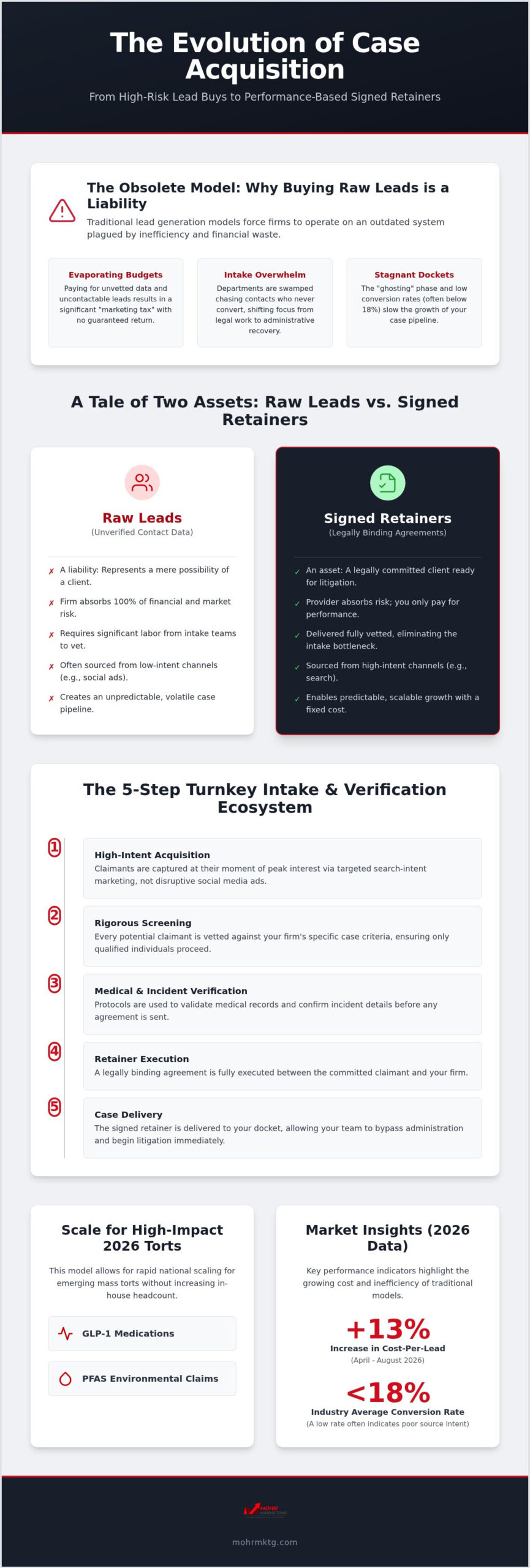
Transforming high-intent digital traffic into mass tort signed retainers requires more than a call center. It demands a rigorous, repeatable ecosystem that filters out noise and validates claims in real-time. Most firms struggle because their internal intake lacks the speed to catch claimants at the moment of peak interest. A turnkey ecosystem solves this by integrating marketing, qualification, and document execution into a single, seamless flow. This mechanical accuracy ensures that your firm receives a litigation-ready asset rather than a project.
Verification is the backbone of this process. We don’t just ask if a claimant was injured; we verify the incident details against objective standards. This includes securing medical records or confirming the existence of police reports. For example, in police-report-backed MVA cases, liability is documented before the retainer is ever sent. Secure e-signature technology then closes the gap, allowing claimants to execute agreements on their mobile devices within minutes of their initial inquiry.
The 5-Step Verification Protocol
Efficiency in mass tort acquisition is a function of procedural precision. Use this five-step framework to ensure your docket is built on verified data rather than speculation:
- Step 1: High-intent digital capture. Use custom-built legal funnels that attract claimants searching for specific remedies. This filters out the casual browsers common on social media.
- Step 2: Immediate live-agent qualification. Speed is the primary variable in conversion. Agents contact inquiries within seconds to qualify them against your firm’s specific criteria.
- Step 3: Verification of incident data. Validate the medical nexus or obtain accident reports. This step ensures the claimant meets the rigorous standards required for successful litigation.
- Step 4: Delivery of the firm-specific retainer. Deploy the agreement via a secure digital platform. Mobile-optimized documents ensure high completion rates.
- Step 5: Final audit and delivery. Perform a final audit of the case file to ensure all data points are accurate. The completed file is then delivered directly to your firm’s CRM.
Compliance and Ethics in Case Acquisition
Adherence to state bar mandates is not optional. As of 2026, advertising laws have become increasingly stringent regarding claimant privacy and data handling. A professional acquisition partner maintains transparency by providing full data-driven marketing logs and ensuring all communications respect the attorney-client relationship. You must audit your provider to ensure they don’t engage in prohibited solicitation. We prioritize rigorous verification to protect your firm’s reputation and ensure every case meets the highest ethical standards from the first touch.
Scaling National Litigation with Mohr Marketing
Mohr Marketing, LLC isn’t just a lead provider. We’re a strategic partner for firms ready to dominate the national stage. Scaling a litigation docket requires more than capital; it requires a supply chain that functions with mechanical precision. With over 30 years of industry experience, we eliminate the intermediaries that dilute your ROI. You deal directly with the source of high-intent inquiries. This ensures every one of your mass tort signed retainers meets rigorous standards before it enters your pipeline.
National Reach Without Local Friction
Expanding your reach shouldn’t mean opening regional satellite offices. Traditional expansion is slow, expensive, and operationally taxing. Our centralized intake ecosystem allows you to acquire cases across the United States from your current headquarters. You maintain brand consistency nationwide while we handle the heavy lifting of qualification and document execution. This model removes the geographic friction that typically limits a firm’s growth potential.
To start your 2026 growth plan, identify 2-3 emerging torts for a performance-based pilot program. Consider diversifying into high-value areas like mesothelioma leads or GLP-1 medications. A pilot program allows you to test market responsiveness and case quality without the risk of a massive upfront media spend. Once the pilot proves viable, you can scale your mass tort signed cases volume to meet your firm’s specific revenue targets. This methodical approach ensures your expansion is built on data, not guesswork.
The Mohr Advantage: Results-Oriented Precision
We operate as a straight-talker in an industry often filled with vague promises. Our focus is on procedural accuracy and financial performance. We’ve spent three decades refining a turnkey ecosystem that removes friction from the business of law. You don’t have to manage a call center, hire intake managers, or troubleshoot complex digital ad campaigns. You focus on practicing law. We focus on delivering the assets that make that practice profitable.
Integrating this model into your 2026 strategy provides the stability needed for long-term growth. Performance-based acquisition removes the financial volatility of traditional media buying. It turns your marketing spend into a predictable investment in case inventory. It’s time to stop gambling on raw data and start investing in verified mass tort signed retainers.
Transition to a High-Performance Acquisition Strategy
The 2026 legal landscape demands a shift from speculative lead generation to verified results. Firms that continue to waste resources chasing uncontactable data will struggle to maintain margins as acquisition costs rise. By prioritizing mass tort signed retainers, you eliminate the intake bottleneck and secure litigation-ready assets with fixed-cost predictability. This strategic pivot allows your team to focus on the practice of law rather than the mechanics of administrative recovery.
Mohr Marketing offers a direct path to national expansion. We leverage over 30 years of legal marketing expertise to provide a turnkey intake ecosystem that converts high-intent inquiries into fully executed agreements. Our performance-based model ensures that your capital is invested in committed claimants, not empty impressions. It’s time to stop gambling on volatile digital auctions and start building a scalable supply chain for your firm’s future.
Secure your firm’s position as a market leader in the mass tort space.
Frequently Asked Questions
What is the difference between a mass tort lead and a signed retainer?
A lead is raw contact data that requires your intake team to call and convert. Most leads never result in a signature. Conversely, mass tort signed retainers represent fully executed, legally binding agreements. By purchasing retainers, you bypass the “ghosting” phase. You receive a litigation-ready asset where the claimant has already committed to your firm. This distinction is critical for firm efficiency and predictable growth.
How does the Pay-Per-Signed-Case model reduce marketing risk?
This model shifts the financial burden of media buying to the marketing provider. You don’t pay for clicks, impressions, or no-contact leads. Instead, you pay a fixed cost for a final result. This protection is vital when costs fluctuate. For instance, the cost per qualified lead in mass tort advertising rose by 13% between April and August 2026. You eliminate speculative spending and only invest in verified signatures.
Are signed retainer agreements compliant with state bar ethics rules?
Yes, provided the provider adheres to specific solicitation rules. ABA Formal Opinion 501 clarifies that lawyers are responsible for the conduct of their marketing partners. Our ecosystem ensures transparency and follows strict bar mandates regarding claimant privacy and data handling. We avoid prohibited solicitation. We focus on high-intent search traffic where claimants actively seek legal remedies, ensuring ethical acquisition for every case in your docket.
What specific criteria are used to verify a personal injury or mass tort claimant?
Verification involves validating specific incident markers against objective data. For MVA cases, this means confirming the existence of a police report. For mass torts, we verify the medical nexus, such as usage of a specific drug or exposure to a contaminant like PFAS. We utilize live agents to screen inquiries against your firm’s exact criteria. This process ensures only high-value, qualified claimants receive a retainer for execution.
How quickly can my firm start receiving signed cases once we onboard?
Most firms begin receiving cases within 7 to 14 days of onboarding. This timeline allows us to calibrate our digital funnels to your firm’s specific criteria and integrate with your CRM. Because we utilize a turnkey intake ecosystem, there’s no need for you to hire or train internal staff. Once the pipeline is active, cases flow directly into your system for immediate litigation work, allowing for rapid national scaling.
What happens if a delivered signed case does not meet the agreed-upon criteria?
Every delivered case undergoes a final audit to ensure accuracy. If a delivered mass tort signed retainers file does not meet your pre-defined screening criteria, it’s typically subject to a replacement or credit policy. We prioritize procedural precision to prevent these discrepancies. Our goal is to maintain a high-quality supply chain where every signature represents a viable, high-intent case for your firm’s specific litigation needs.
Can my firm scale nationally using signed retainers without local offices?
You can scale across the United States without regional satellite offices. Our centralized intake ecosystem manages the qualification and document execution for claimants in any jurisdiction. This removes the geographic friction and overhead costs associated with traditional expansion. You can build a national presence from your primary office, leveraging our infrastructure to maintain brand consistency and operational efficiency across all 50 states without adding massive in-house headcount.
Why is high-intent search marketing better for generating retainers than social media?
Search marketing captures “pull” intent while social media relies on “push” interruption. A person searching for “GLP-1 side effects” is actively seeking a solution. They have higher intent to sign a retainer than someone scrolling through a social feed. Search-driven acquisition produces more committed claimants and fewer unqualified inquiries. This results in a higher conversion rate from inquiry to signed case, maximizing your firm’s return on investment.

Recent Posts
- Bar-Compliant Legal Marketing: 2026 Guide for Law Firms
- Auto Accident Lead Generation: Build a Verified Case Pipeline in 2026
- Car Accident Case Acquisition: Strategic Law Firm Guide
Categories
- AI and Lead Generation
- Business Financing
- Call Verified MVA Leads
- Car Accident Help
- Car Accident Settlements
- Claimant Funding
- Compliance Program
- EMS-EMT Reports
- Geotargeting
- Google Maps Ranking
- Healthcare Practice Growth
- Law Firm Growth
- Law Office Operations
- Lead Generation
- Lead Generation For Attorneys
- Lead Generation For Chiropractors
- Lead Generation For Criminal Attorneys
- Lead Generation For D&A Treatment Centers
- Lead Generation For DUI Attorneys
- Lead Generation For Eye Doctors
- Lead Generation For Family Law Practices
- Lead Generation For PI Law Firms
- Lead Generation For Plastic Surgeons
- Leads For Healthcare Professionals
- Leads For Insurance Industry
- Legal Leads
- Legal Marketing
- Legal Updates
- Mass Tort Leads
- Medicare and Medicaid Leads
- Merchant Funding Leads
- Mold Leads
- Online Marketing Strategies
- Pre-Settlement Funding
- Signed MVA Cases
- Tort Updates
- Truck Accident Leads and Signed Cases
- Truck Accident Settlements
- Web Design