Mass Tort Lead Generation Cost: The 2026 Strategic Pricing Guide
August 16, 2026 by Mohr Marketing
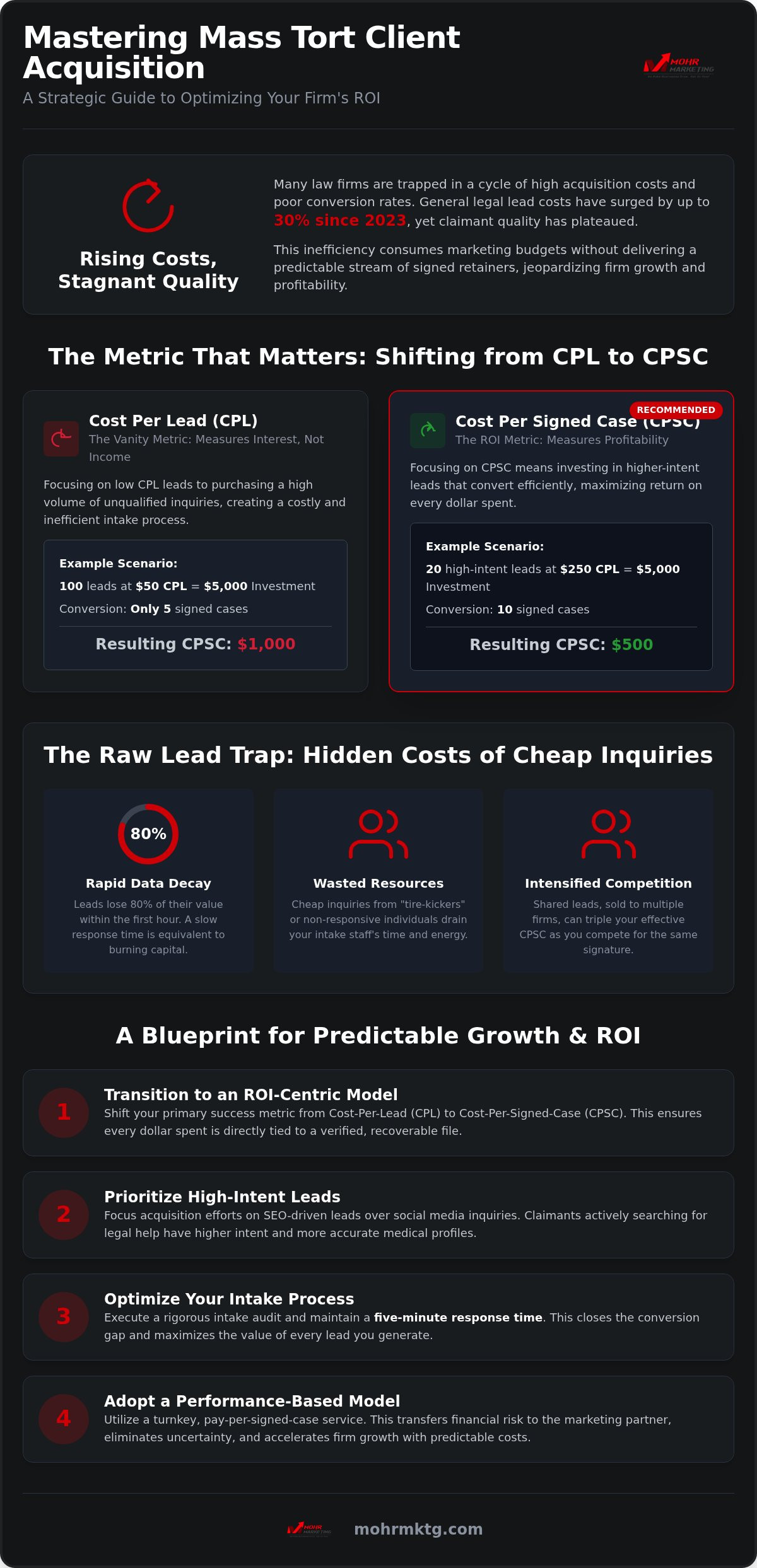
The cheapest lead on your balance sheet is often the most expensive mistake your firm will make this year. Competition for high-stakes litigation is at an all-time high. Many firms are currently trapped in a cycle of high acquisition costs and abysmal conversion rates. You’re likely seeing your mass tort lead generation cost climb while the quality of claimants plateaus. Industry data from GavelGrow indicates that general legal lead costs have surged by up to 30% since 2023. It’s frustrating to watch your marketing budget vanish into a black hole of unqualified inquiries and opaque vendor reporting. You need a strategy that prioritizes signed retainers over raw data.
We understand that predictability is the foundation of a successful mass tort practice. You deserve transparency and a clear path to a positive return on investment. This guide will help you master the economics of mass tort acquisition and learn how to optimize your firm’s cost-per-signed-case for maximum ROI. We’ll break down the 2026 market shifts, analyze why traditional lead buying is failing, and provide a blueprint for securing high-intent claimants who meet your strict criteria. It’s time to stop gambling on volume and start investing in verified results.
Key Takeaways
- Analyze how Multi-District Litigation volume and competition levels directly influence the mass tort lead generation cost in the current market.
- Transition from cost-per-lead metrics to cost-per-signed-case; this ensures every dollar spent results in a verified and recoverable file.
- Prioritize SEO-driven leads over social media inquiries to secure claimants with higher search intent and more accurate medical profiles.
- Execute a rigorous intake audit and maintain a five-minute response time to close the conversion gap in your marketing funnel.
- Adopt a turnkey and pay-per-signed-case model to eliminate the financial uncertainty of raw lead buying while accelerating firm growth.
Mass Tort Lead Generation Pricing: Understanding the 2026 Market
Mass tort lead generation cost represents the total investment required to identify, qualify, and convert a claimant into a viable case. It’s a comprehensive figure. It includes every dollar spent on media, technology, and human capital. In 2026, this cost is not static. It fluctuates based on the density of competition within specific Multi-District Litigation (MDL) proceedings. To understand the financial stakes, one must first grasp What is a mass tort? and how the legal aggregation process dictates market demand.
Pricing in 2026 is shifting. Firms are moving away from broad-spectrum television and social media “fishing” toward high-intent, search-based acquisition. This transition is a response to rising costs and declining lead quality. High-intent leads originate from users actively seeking legal remedies. These claimants are more likely to meet strict criteria, which justifies a higher upfront cost. This shift ensures your budget targets individuals with documented exposure rather than passive scrollers.
The Components of a Lead Generation Budget
A professional budget is split into three primary buckets. Media buying accounts for the largest share. This covers competitive auctions on Google, Meta, and emerging platforms. Management fees are second. These pay for the expertise of specialized legal marketing agencies that optimize your campaigns. Finally, intake and screening costs are the most overlooked. You must fund the labor and verification technology required to filter out unqualified inquiries before they reach your desk. Without rigorous screening, your mass tort lead generation cost will skyrocket due to wasted attorney time.
Market Volatility and the “Hot Tort” Premium
Litigation stage dictates pricing. Early discovery phases often feature lower costs as pioneer firms establish the initial market rate. However, as a tort gains national attention, prices escalate rapidly. Emerging “hot torts” frequently see cost spikes within the first 12 months. Competition intensifies. By the time a settlement phase is visible, the acquisition cost can double. Firms that wait for certainty often pay a premium for late entry. Many successful firms mitigate this volatility by securing mass tort signed cases rather than purchasing raw, unverified leads that may never convert.
Key Metrics: CPL vs. Cost-Per-Signed-Case (CPSC)
Cost per lead (CPL) is a vanity metric. It measures interest, not income. To truly evaluate your mass tort lead generation cost, you must shift focus to Cost-Per-Signed-Case (CPSC). A raw inquiry is merely a data point. A verified lead is a potential client who has passed a rigorous screening process. Understanding the legal framework behind these efforts is vital; Cornell Law School on legal advertising details how Supreme Court precedents allow firms to solicit clients through these targeted channels. You must focus on the end of the funnel, not the top.
Your true acquisition cost includes more than just the ad spend. You must factor in internal firm overhead. This includes the salaries of your intake team, the cost of your CRM, and the time attorneys spend reviewing files. If you buy 100 leads at $50 each ($5,000) but only sign 5 cases, your CPSC is $1,000. If you buy 20 high-intent leads at $250 each ($5,000) and sign 10, your CPSC drops to $500. The more expensive lead is actually the more profitable investment. To set a Target CPA, calculate your expected settlement value and subtract your desired profit margin and litigation expenses. The remaining figure is your maximum allowable acquisition cost.
The Raw Lead Trap: Hidden Costs of Cheap Inquiries
Cheap leads carry heavy baggage. They often consist of “tire-kickers” or non-responsive individuals who drain your staff’s energy. Data decay is a primary enemy. Industry standards show that leads lose 80% of their value within the first hour of submission. If your intake team isn’t ready to dial immediately, you’re burning capital. Shared leads exacerbate this problem. When a provider sells the same lead to multiple firms, your effective CPSC triples as you compete for the same signature.
The Signed Retainer Advantage
Successful firms bypass the lead-chase entirely. By purchasing fully executed retainer agreements, you eliminate the uncertainty of the intake funnel. Performance-based models like Pay-Per-Signed-Case transfer the financial risk from your firm to the marketing agency. You only pay for results. This creates absolute budget predictability. Instead of managing variable ad spend with unknown outcomes, you can forecast growth based on fixed case costs. To see how this model fits your current litigation goals, you should evaluate your target acquisition metrics with an expert.
Variables Influencing Mass Tort Lead Costs in 2026
Your mass tort lead generation cost isn’t a static market average. It’s a direct reflection of your firm’s specific case criteria and risk tolerance. In 2026, precision is the primary driver of pricing. If you demand a claimant with five years of documented exposure and a specific pathology, your costs will reflect that scarcity. Conversely, broader criteria allow for higher lead volume but require more intensive internal screening. You must decide where your firm’s bottleneck lies: at the acquisition stage or the intake stage.
Geographic and demographic targeting also play a significant role. Scaling your campaigns nationally is the most effective way to lower your average cost. Narrowing your focus to specific demographics or limited populations increases the cost per acquisition because it limits the pool of available claimants. National campaigns allow digital algorithms to find qualified individuals more efficiently. Additionally, compliance and ethics are non-negotiable cost factors. Ensuring “clean” lead acquisition that survives a court audit requires sophisticated verification technology. Cutting corners on compliance might save money today, but it creates massive liability for your firm during the settlement phase.
Criteria Strictness and Lead Volume
The “Inverse Relationship” rule dominates 2026 pricing. As your qualification criteria tighten, your costs rise exponentially. You’re no longer paying for a lead; you’re paying for the filter. Firms must balance the pursuit of “perfect” cases with the need for “workable” volume. For example, mesothelioma lead criteria are notoriously strict due to the high settlement values involved. These cases command a significant premium compared to broader personal injury torts where exposure is easier to prove. If your criteria are too rigid, you’ll starve your intake team of opportunities.
Platform Dynamics: Search vs. Social
Search intent is the most expensive commodity in legal marketing. Google Ads in 2026 remains a high-intent, high-competition environment. You’re bidding against the largest litigation groups in the country for users who are actively seeking a lawyer. This drives a high cost but results in faster conversions. Social media platforms like Meta and TikTok offer high volume and lower intent. These leads are often cheaper upfront but require a robust, 24/7 intake operation to qualify. Content-driven SEO remains the ultimate long-term play. By establishing authority through search-optimized content, you can achieve a lower-cost case acquisition over time that isn’t dependent on fluctuating ad auctions.
Maximizing ROI: Why Intake is the Silent Cost Driver
Your firm’s intake process is the filter through which your marketing budget passes. If that filter is clogged or leaking, your mass tort lead generation cost will never yield the expected return. You must audit your intake funnel for “leaks” by tracking the exact moment a lead enters your CRM to the first attempted contact. Industry data from August 2026 shows that the average lead-to-signed-case conversion rate hovers around 18% to 20%. If your firm falls below this benchmark, you aren’t suffering from a lead quality problem; you’re suffering from an intake deficiency.
Success requires a relentless “Speed to Lead” culture. The five-minute mark is your threshold. If you call a claimant after ten minutes, your chances of reaching them drop significantly. You must train your intake professionals to balance empathy with authority. They aren’t just checking boxes. They’re handling sensitive medical and legal inquiries from individuals who are often in distress. Beyond the initial call, leverage automated follow-up sequences. Text and email drip campaigns recover “lost” claimants who didn’t answer the first three attempts, effectively lowering your acquisition cost by maximizing the utility of every data point.
The Anatomy of a High-Conversion Intake Process
A high-performing script moves beyond a simple checklist. It establishes your firm as a leader while validating the claimant’s experience. You must integrate digital signature technology to close the loop instantly. A lead is only a lead until the retainer is signed. Delays in sending documents allow competing firms to intervene. For many firms, managing a 24/7 internal team is cost-prohibitive. Outsourcing to a specialized legal intake ecosystem is often more efficient. It provides the scale and procedural precision needed to handle high-volume campaigns without the overhead of internal hiring.
Verifying Lead Quality Post-Acquisition
Verification doesn’t end when the claimant says “yes.” You must implement a dual-verification step for high-value cases. This involves cross-referencing claimant statements with third-party data. Use police reports or medical records to validate claims as early as possible. This prevents your legal team from wasting months on a file that will eventually be dismissed. The “Cost of a Bad Case” is a silent profit killer. Taking the wrong lead is worse than taking no lead because it consumes your most valuable resource: attorney time. Rigorous post-acquisition vetting ensures your docket consists only of recoverable files and keeps your effective mass tort lead generation cost within a profitable range.
Performance-Based Acquisition: The Mohr Marketing Solution
Mohr Marketing provides a definitive end to the volatility of traditional lead buying. Instead of assuming the risk of unverified data, you can leverage a turnkey ecosystem that manages the entire lifecycle of a claimant. This process begins with high-intent search acquisition and concludes with a fully executed retainer. By focusing on the end result, you stabilize your mass tort lead generation cost and ensure that your marketing budget is an investment in your docket rather than a gamble on raw inquiries. We eliminate the uncertainty that plagues traditional legal marketing by delivering results, not just data points.
Our methodology is built on 30 years of industry experience. We maintain strict adherence to state bar mandates and advertising compliance. This protects your firm’s reputation while ensuring every case is legally sound and survives the scrutiny of a court audit. Strategic scaling becomes a reality when you remove the friction of in-house marketing. You can build a national docket without the massive overhead of a full-scale creative and media department. We handle the mechanics of growth so you can focus on the mechanics of litigation. This partnership allows your firm to remain lean while competing with the largest litigation groups in the country.
Signed Retainers vs. Managed Retainers
Choosing the right model depends on your firm’s current phase and litigation goals. The Pay-Per-Signed-Case model is the ultimate risk-mitigation strategy for immediate growth. It allows you to pay only for results, transferring the financial risk of advertising to us. Conversely, a Managed Digital Marketing Retainer is ideal for long-term brand building and establishing a permanent presence in specific torts. When comparing ROI across different case types, the metrics vary significantly. For instance, truck accidents often yield higher immediate settlements and require rapid intake response. In contrast, mold litigation requires a more targeted, intent-based approach to capture high-value claimants with specific exposure profiles. Both models benefit from our rigorous verification processes.
Getting Started: A Data-Driven Approach
Your first step is requesting a case-specific quote based on current 2026 market data. We don’t provide generic estimates. Every litigation has unique competitive pressures and search volumes that dictate pricing. During onboarding, we align on your specific case criteria and monthly volume requirements. This ensures the leads we capture fit your firm’s exact profile and litigation strategy. Our turnkey marketing and intake ecosystem then goes to work. You’ll receive transparent reporting on every dollar spent. It’s time to stop buying unverified leads and start acquiring cases through a proven, performance-based partner. This shift stabilizes your mass tort lead generation cost and provides a clear path to expansion.
Secure Your Firm’s Competitive Advantage in 2026
Dominating the 2026 mass tort market requires a clinical focus on conversion metrics over raw inquiry volume. You must transition your strategy from purchasing unverified data to acquiring fully executed retainers. This shift protects your firm’s resources and ensures that every dollar invested contributes directly to a recoverable docket. By optimizing your intake speed and focusing on high-intent search traffic, you can effectively control your mass tort lead generation cost and outpace the competition.
Mohr Marketing provides the procedural precision needed to achieve this growth. We utilize 30+ years of legal marketing expertise and a strict compliance-first approach to protect your firm’s reputation. Our performance-based models transfer the financial risk away from your firm, allowing you to scale national campaigns without the burden of in-house marketing overhead.
It’s time to stop gambling on unverified data and start investing in signed retainers. We’re ready to help you secure a leadership position in your target litigation.
Frequently Asked Questions
What is the average cost of a mass tort lead in 2026?
The average mass tort lead generation cost varies significantly by litigation type. Industry benchmarks from August 2026 indicate a blended cost of approximately $51.28 per qualified lead across active campaigns. However, high-competition torts often see ranges between $150 and $275 per lead. These figures reflect media spend and initial qualification. Your actual cost will fluctuate based on the specific medical criteria and the current volume of claimants entering the Multi-District Litigation.
Why are mass tort leads more expensive than personal injury leads?
Mass tort leads command a premium because they require extensive education and specialized targeting. Unlike a standard car accident where the victim knows they’re injured, mass tort claimants often don’t realize their medical condition is linked to a specific product or drug. This requires complex funnel marketing to identify and qualify individuals. Additionally, high potential settlement values in mass torts drive intense competition among firms, which inflates the auction prices for search intent.
How can my firm lower its cost-per-signed-case?
Lowering your cost-per-signed-case (CPSC) requires a dual focus on intake efficiency and lead quality. You must maintain a response time under five minutes to capture the claimant’s interest before they contact a competitor. Implementing automated follow-up sequences can also recover leads that would otherwise go cold. Finally, moving to a performance-based model eliminates wasted spend on unqualified inquiries. This ensures that every dollar in your mass tort lead generation cost is tied to a verified signature.
Is it better to buy exclusive leads or shared leads?
Exclusive leads are the only viable option for firms seeking a high return on investment. Shared leads are sold to multiple firms simultaneously, creating a race to the phone that often results in lower conversion rates and frustrated claimants. While shared leads appear cheaper upfront, they frequently result in a higher effective cost-per-signed-case. Exclusive leads provide the control and predictability necessary to manage a growing docket without the friction of competing for the same signature.
What are the risks of buying low-cost mass tort leads?
Low-cost leads often indicate poor screening or non-exclusive data. The primary risk is wasting your intake team’s time on “tire-kickers” or individuals who don’t meet basic medical criteria. Cheap leads may also lack proper compliance documentation, which can jeopardize your docket during a court audit. Taking a “bad” case is more expensive than taking no case at all. It consumes attorney time and firm resources that should be dedicated to recoverable files.
How do signed retainers differ from traditional legal leads?
A signed retainer is a fully executed legal agreement, whereas a traditional lead is merely a raw inquiry. When you purchase signed retainers, the marketing provider handles the entire qualification and intake process. This includes verifying exposure, checking medical history, and securing the claimant’s signature. This model transfers the conversion risk from your firm to the provider. It allows your attorneys to focus on litigation immediately rather than chasing non-responsive data points or managing a high-volume call center.
What role does intake play in the overall lead generation cost?
Intake is the primary driver of your effective acquisition cost. Even the highest quality leads will fail to convert if your intake process is slow or unprofessional. A leak in your funnel, such as a missed call or a delayed e-sign document, immediately inflates your cost-per-signed-case. Professional intake services ensure that every lead is handled with the necessary empathy and authority. This maximizes your conversion rate and ensures your marketing budget isn’t wasted on missed opportunities.
Are performance-based legal marketing models compliant with ethics rules?
Yes, performance-based models are compliant when executed within the framework of state bar mandates. These models must avoid prohibited fee-sharing arrangements while maintaining transparency in advertising. Mohr Marketing prioritizes a compliance-first approach, ensuring that all claimant acquisition strategies meet rigorous ethical standards. This includes proper disclosures and the use of verified inquiries. Firms should always verify that their marketing partners adhere to the specific rules governing legal advertising in the jurisdictions where they operate.

Recent Posts
- Bar-Compliant Legal Marketing: 2026 Guide for Law Firms
- Auto Accident Lead Generation: Build a Verified Case Pipeline in 2026
- Car Accident Case Acquisition: Strategic Law Firm Guide
Categories
- AI and Lead Generation
- Business Financing
- Call Verified MVA Leads
- Car Accident Help
- Car Accident Settlements
- Claimant Funding
- Compliance Program
- EMS-EMT Reports
- Geotargeting
- Google Maps Ranking
- Healthcare Practice Growth
- Law Firm Growth
- Law Office Operations
- Lead Generation
- Lead Generation For Attorneys
- Lead Generation For Chiropractors
- Lead Generation For Criminal Attorneys
- Lead Generation For D&A Treatment Centers
- Lead Generation For DUI Attorneys
- Lead Generation For Eye Doctors
- Lead Generation For Family Law Practices
- Lead Generation For PI Law Firms
- Lead Generation For Plastic Surgeons
- Leads For Healthcare Professionals
- Leads For Insurance Industry
- Legal Leads
- Legal Marketing
- Legal Updates
- Mass Tort Leads
- Medicare and Medicaid Leads
- Merchant Funding Leads
- Mold Leads
- Online Marketing Strategies
- Pre-Settlement Funding
- Signed MVA Cases
- Tort Updates
- Truck Accident Leads and Signed Cases
- Truck Accident Settlements
- Web Design