Exclusive Mass Tort Leads: A Strategic Guide to High-Intent Case Acquisition
July 19, 2026 by Mohr Marketing
Most lead generation models are designed to scale the vendor’s profit, not your firm’s caseload. You’ve likely dealt with the frustration of high-cost-per-lead rates only to find those prospects don’t meet strict MDL criteria or have already been contacted by multiple competitors. It’s an inefficient race to the bottom that drains your marketing budget without delivering signed retainers. You need a predictable flow of exclusive mass tort leads, not a list of shared phone numbers that fails to convert.
This guide helps you master the mechanics of high-intent case acquisition and identifies the specific triggers that actually result in qualified claimants. We’ll examine how a closed-loop intake ecosystem eliminates waste and provides the transparent reporting necessary to lower your cost-per-signed-case. You’ll learn to identify opportunities that prioritize real search intent over disruptive social media clicks. By the end of this article, you’ll understand how to shift from basic lead acquisition to a strategic, data-driven system that matches your specific case criteria and drives firm growth.
Key Takeaways
- Understand why law firms are shifting away from shared aggregators to eliminate lead dilution and internal intake friction.
- Learn to distinguish between disruptive social media clicks and high-intent, search-driven funnels that bake strict MDL criteria into the initial advertisement.
- Identify the performance metrics that allow exclusive mass tort leads to convert at significantly higher rates while reducing staff time spent chasing unresponsive contacts.
- Master the provider audit process by verifying the “Chain of Custody” and ensuring your partner utilizes proprietary funnels rather than third-party brokers.
- Discover how to transition from simply buying inquiries to acquiring signed retainers through a proven, turnkey intake ecosystem.
Defining Exclusive Mass Tort Leads in the 2026 Legal Market
Exclusive mass tort leads represent the definitive gold standard for modern legal marketing. In the simplest terms, an exclusive lead is an inquiry generated for one firm and one firm only. It’s never shared, never resold, and never recycled. This level of exclusivity is critical when managing cases involving complex litigation, such as understanding what is a mass tort and how to qualify claimants effectively. By 2026, high-performing law firms have recognized that shared leads are a liability. When you buy shared data, you’re buying a race. You’re competing against three or four other firms for the same individual’s attention. This dilution destroys your ROI and inflates your cost-per-signed-case (CPSC).
True exclusivity starts with real search intent. When a claimant proactively searches for legal help regarding a specific injury, they’re demonstrating a high level of motivation. Capturing that intent through a dedicated, closed-loop funnel ensures the lead belongs to you from the very first click. This approach eliminates the friction caused by third-party aggregators who prioritize volume over quality. It allows your firm to establish a direct line of communication with a high-intent prospect before they are overwhelmed by competing offers.
The Problem with Shared Lead Aggregators
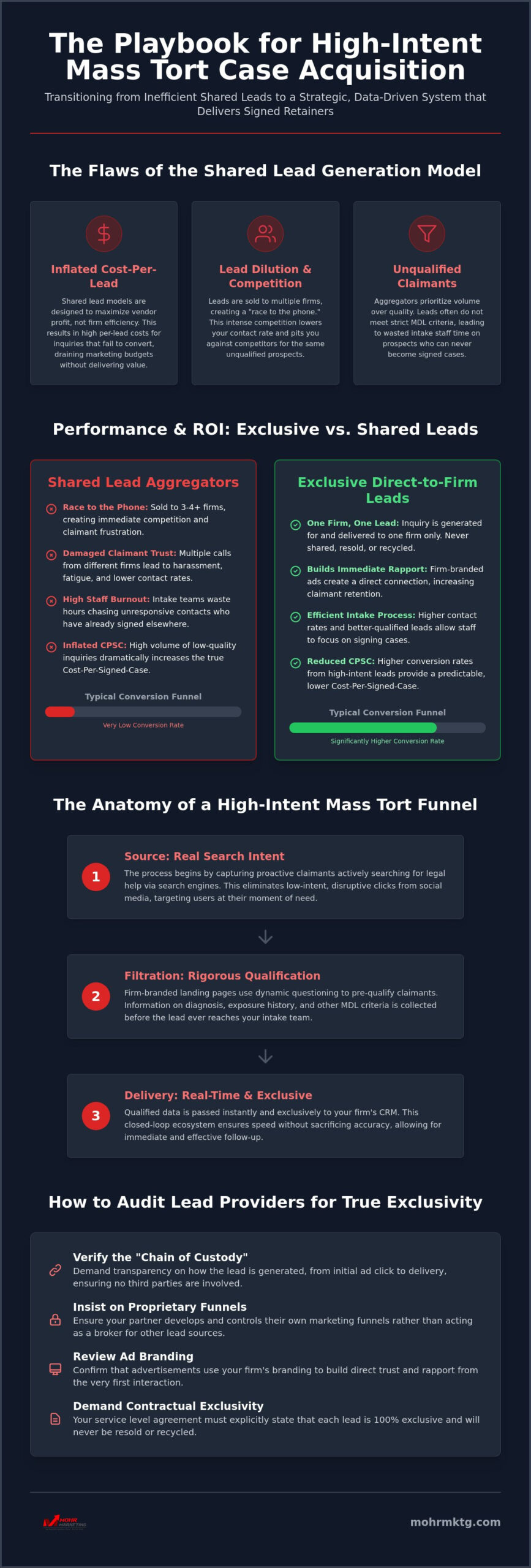
The aggregator model creates a “race to the phone” that actively damages claimant trust. When a potential plaintiff fills out a form and receives four phone calls in ten minutes, they feel harassed, not helped. This lead fatigue results in lower contact rates and higher staff burnout. Your intake team wastes hours chasing unresponsive contacts who have already signed elsewhere or have simply turned off their phones. The financial impact is clear. High lead volume doesn’t equate to high case volume. The inefficiency of shared leads often hides the true cost of acquisition. To see how the market is evolving toward better efficiency, review our guide on Mass Tort Lead Generation: A Roadmap to Scalable Growth in 2026.
Why 2026 Requires a Direct-to-Firm Acquisition Model
Modern claimants are more discerning. They want to know exactly who they’re talking to from the start. A direct-to-firm model uses your firm’s branding in the initial advertisement to build rapport immediately. Exclusive mass tort leads sourced through this method allow for a far more personalized intake experience. You aren’t just another voice in a crowd of callers. You’re the firm they recognized on their screen. This connection leads to higher claimant retention rates and fewer “no-shows” during the retainer phase. It also ensures that the intake process is focused on quality and strict criteria rather than speed. When you control the funnel, you control the outcome. This direct path is the only way to maintain a competitive advantage in a saturated market.
The Anatomy of a High-Intent Mass Tort Funnel
A high-performance funnel is more than a digital contact form. It’s a rigorous filtration system designed to isolate claimants who meet the authoritative definition of a mass tort. Unlike generic lead generation, exclusive mass tort leads require a funnel architecture that prioritizes intent over volume. This begins with the distinction between search-driven and disruptive lead generation. Search-driven leads come from users actively typing queries into search engines. These individuals are seeking immediate legal help. Disruptive leads from social media platforms often target broad demographics, catching users while they’re browsing unrelated content. The difference in intent is the difference between a signed retainer and a disconnected phone number.
Landing page architecture plays a critical role in this process. Effective pages don’t just ask for a name and number. They qualify the claimant through dynamic questioning. By the time a lead reaches your intake team, they should have already confirmed their diagnosis and exposure history. Real-time data passing ensures that this information hits your CRM the second the user clicks submit. Speed is vital, but accuracy is the priority. If you’re ready to refine your acquisition strategy, you can consult with our strategic partners to review your current funnel performance.
Leveraging Real Search Intent
High-intent keywords serve as the primary filter for case quality. Targeting broad terms often results in unqualified inquiries that drain your resources. Instead, focus on specific long-tail keywords that signal a readiness to litigate. For example, ensuring that mesothelioma criteria are explicitly mentioned in the ad copy prevents users with unrelated respiratory issues from entering the funnel. Search intent is the primary predictor of case compensability. By aligning your ad spend with specific legal remedies, you ensure that every dollar targets a high-probability claimant.
Multi-Stage Verification Processes
Exclusivity is only valuable if the lead is qualified. A multi-stage verification process acts as your first line of defense against non-qualified leads. This process should verify three pillars of mass tort litigation:
- Diagnosis: Confirmed medical condition related to the tort.
- Exposure: Documented contact with the harmful product or substance.
- Statute of Limitations: Ensuring the claim is still legally viable in the relevant jurisdiction.
Digital intake forms should dynamically adjust based on user input. If a user doesn’t meet the exposure criteria, the funnel should politely disqualify them before they ever speak to your intake team. This transition from digital submission to the initial call must be seamless. It preserves the claimant’s momentum while protecting your firm’s time.
Exclusive vs. Shared Leads: A Performance and ROI Comparison
Low-cost shared leads are a trap for your firm’s overhead. While the initial price per inquiry might appear attractive on a spreadsheet, the downstream costs are often catastrophic. Shared leads are diluted the moment they’re generated. When multiple firms receive the same data, the claimant is immediately bombarded with calls. This creates a hostile environment for your intake team and a poor experience for the potential plaintiff. In contrast, exclusive mass tort leads often convert at two to three times the rate of shared alternatives. You’re the only firm in the conversation. This exclusivity preserves the claimant’s trust and significantly increases the likelihood of securing a signed retainer.
Risk management is another area where exclusivity outperforms the aggregator model. When you buy shared data, you often lose visibility into the lead’s origin. Exclusive mass tort leads provide a clear chain of custody. You know exactly which ad the claimant saw and which criteria they met. This transparency is essential for maintaining compliance with state bar mandates and ensuring the long-term viability of your docket. Knowing the source allows you to optimize your spend based on actual case performance rather than raw lead volume.
Calculating the True Cost of Lead Dilution
To understand your true ROI, you must look beyond the initial invoice. Use this formula to calculate your actual acquisition cost: (Total Lead Spend + Intake Staff Labor Costs) / Total Signed Cases. Shared leads require massive labor resources to chase unresponsive prospects. This lead waste drastically inflates your real cost-per-signed-case. Investing in a higher upfront cost for exclusive leads typically results in a lower cost-per-settlement. It streamlines your entire operation by focusing your best intake talent on high-probability claimants. For a deeper dive into these efficiency mechanics, review The ROI of Legal Intake Services.
Case Velocity and Retention
Case velocity is a critical metric for scaling a mass tort practice. Exclusive leads move through your funnel faster because there’s no competition to distract or confuse the claimant. This speed reduces churn. Claimants don’t switch to other firms when they’ve had a seamless, non-competitive intake experience. This model was instrumental in scaling high-value mold case acquisition, where precision and speed were paramount. By eliminating the friction of the “race to the phone,” you create a professional environment that encourages claimants to stay committed to their legal journey with your firm.
How to Audit Mass Tort Lead Providers for True Exclusivity
Exclusivity is often used as a marketing buzzword rather than a technical standard. To protect your firm’s resources, you must move beyond verbal assurances and conduct a rigorous technical audit. True exclusive mass tort leads are defined by a verifiable chain of custody. This means you should have access to the IP address, timestamp, and the specific URL where the claimant’s journey began. If a provider cannot produce these data points, they’re likely reselling shared data or recycled inquiries. Demand transparency. Your CPSC depends on the integrity of your source.
Proprietary funnels are the only way to ensure exclusivity. Many providers act as mere brokers, buying traffic from other aggregators and adding a significant markup. This practice introduces lead dilution and increases the risk of non-compliance. When you audit a provider, ask to see the creative assets and landing pages. You need to know exactly what the claimant saw before they submitted their information. This level of detail ensures the lead hasn’t been “primed” with misleading promises that will cause them to drop out of your funnel later.
Identifying Red Flags in Lead Brokerage
Recycled leads are a major threat to your intake efficiency. Spot these by looking for “backlog” offers. If a provider claims to have a database of thousands of leads ready for immediate delivery, they’re selling stale data. These individuals have likely been contacted by dozens of firms already. Another red flag is lead arbitrage. Some providers buy cheap, low-intent social media traffic and attempt to resell it as high-intent exclusive mass tort leads. If the provider cannot show you the exact landing page used to capture the lead, walk away. They’re hiding a lack of quality and intent.
Compliance and Ethical Standards
Ethics and compliance are non-negotiable in 2026. Your provider must adhere to state-specific attorney advertising rules and TCPA mandates. Ensure every digital intake form includes clear, conspicuous opt-in language for phone and text communication. This protects your firm from costly litigation and bar complaints. The “Pay-Per-Signed-Case” model is the most transparent approach to acquisition. It aligns the provider’s incentives with your firm’s success. Because the provider only earns when a case meets your strict criteria, they’re naturally incentivized to maintain high ethical and quality standards throughout the funnel.
Scaling with the Mohr Marketing Intake Ecosystem
Scaling a mass tort docket requires more than just a steady supply of data. It demands a robust infrastructure capable of converting high-intent inquiries into active litigation. Many firms struggle to bridge the gap between receiving exclusive mass tort leads and securing signed retainers. This is where a turnkey ecosystem becomes essential. Mohr Marketing leverages over 30 years of industry experience to streamline this entire trajectory. We don’t just generate interest; we manage the mechanics of growth from the first click to the final signature. This direct path eliminates the friction of shared data and ensures your firm remains the sole point of contact for the claimant.
A true ecosystem integrates marketing, intake, and retainer execution into a single, seamless flow. This removes the inefficiencies that occur when handing off leads between disparate vendors. For firms targeting specific niches, this system allows for extreme procedural precision. You can customize criteria for specialized dockets, such as police-report backed MVA cases, ensuring every claimant meets your exact litigation requirements before they ever reach your desk. This level of customization is the only way to maintain a high-value docket in a competitive market.
The Pay-Per-Signed-Case Advantage
Performance-based models represent the ultimate evolution of legal lead generation. By shifting to a pay-per-signed-case structure, your firm eliminates the financial risk associated with lead waste and poor conversion. You’re no longer paying for attempts or potential. You’re paying for results. This model ensures that your marketing budget is directly tied to docket expansion. Fully executed retainers are the gold standard for sustainable growth. They provide the predictability needed to manage cash flow and staffing requirements effectively. To see how this model functions in practice, explore our options for Mass Tort Signed Cases.
Integrating Your Firm with a National Acquisition Strategy
Scaling from a regional practice to a national powerhouse requires a partner with national reach. Mohr Marketing provides the infrastructure to target claimants across all 50 states without increasing your internal overhead. Our professional intake specialists act as an extension of your firm. They maintain claimant interest throughout the signing process, preventing the churn that often plagues high-volume campaigns. This professional touch ensures that exclusive mass tort leads don’t just stay exclusive; they stay committed to your firm. The next step in your firm’s expansion is a technical evaluation of your goals. Request a custom funnel audit to identify the most efficient path for your specific practice area and start building a high-value docket today.
Dominate the 2026 Mass Tort Market with Strategic Acquisition
Transitioning your firm toward a performance-based growth model requires a departure from outdated aggregator practices. You’ve learned that prioritizing exclusive mass tort leads sourced through search-driven intent eliminates the friction of lead dilution and the hidden costs of staff burnout. Success in 2026 depends on a verified chain of custody and a closed-loop intake system that converts inquiries into signed retainers without delay.
Mohr Marketing provides the professional infrastructure necessary to execute this transition. With 30+ years of legal marketing expertise, we offer a turnkey intake and signing ecosystem that matches your firm’s specific litigation criteria. Our performance-based models ensure your resources focus on high-value outcomes rather than raw data volume. It’s time to stop competing for shared inquiries and start acquiring the cases that drive firm expansion.
Take the next step in scaling your docket with a strategic partner dedicated to your results.
Frequently Asked Questions
What is the difference between exclusive and shared mass tort leads?
Exclusive leads are generated for a single law firm and are never resold or shared with competitors. Shared leads are distributed to multiple firms simultaneously, triggering a race to the phone that often results in lead fatigue and lower contact rates. By using exclusive mass tort leads, you eliminate internal competition and preserve the claimant’s trust from the first interaction. This focus on exclusivity directly correlates with higher conversion rates and a more professional intake experience.
How do exclusive leads impact the cost-per-signed-case (CPSC)?
Exclusive leads typically lower the overall cost-per-signed-case by reducing labor waste and increasing conversion efficiency. While the upfront cost per lead is often higher than shared alternatives, the reduction in staff time spent chasing unresponsive prospects creates a more profitable acquisition model. You aren’t paying for the overhead of an inefficient intake department. Instead, your team focuses on high-intent claimants who haven’t been bombarded by competing firms.
Are mass tort leads compliant with state bar advertising rules?
Compliance depends on the provider’s adherence to state-specific attorney advertising mandates and TCPA regulations. Reputable providers include clear disclaimers and ensure all digital intake forms contain proper opt-in language for communication. It’s essential to audit your provider’s chain of custody to verify that all advertisements meet ethical standards. Performance-based models often provide built-in protections because the provider only earns when a case meets your firm’s strict legal criteria.
What is a “high-intent” lead in the context of mass tort litigation?
High-intent leads are generated when a claimant proactively searches for legal remedies for a specific injury or exposure. This search-driven behavior indicates a readiness to litigate that is absent in disruptive social media leads. By capturing real search intent, providers ensure the claimant is already motivated to speak with an attorney. This proactive engagement significantly reduces the churn often seen with leads captured through broad demographic targeting or passive browsing.
Can I buy exclusive leads for specific torts like Camp Lejeune or Ozempic?
You can acquire exclusive mass tort leads for specific, high-profile dockets like Camp Lejeune or Ozempic through customized acquisition funnels. These funnels are engineered to filter for strict criteria such as diagnosis, exposure dates, and statute of limitations. This precision ensures that your marketing spend is directed only toward claimants who meet the exact requirements of your current litigation strategy. Customization allows your firm to scale niche dockets with predictable efficiency.
How does the pay-per-signed-case model work with exclusive leads?
In a pay-per-signed-case model, the law firm only pays for fully executed retainers that meet pre-defined criteria. This model shifts the financial risk from the firm to the lead provider, ensuring that every dollar spent results in a tangible case. It’s the ultimate evolution of lead generation because it aligns the provider’s incentives with the firm’s growth. You receive a predictable flow of qualified claimants without the uncertainty associated with raw lead volume.
What should I ask a lead provider to verify exclusivity?
Demand to see the technical chain of custody for every inquiry, including the IP address, timestamp, and the specific URL where the lead was captured. Ask if the provider uses proprietary funnels or acts as a broker for other aggregators. You should also request to see the creative assets and landing pages used in the campaign. A transparent provider will have no issue sharing this data to prove that the lead hasn’t been shared or recycled.

Recent Posts
- Improving Law Firm Marketing ROI: A Practical Measurement Framework
- 4 Ways to Assess Unqualified Legal Leads and Their Costs
- Real-Time Legal Leads: How to Evaluate Speed, Quality, and Fit in 2026
Categories
- AI and Lead Generation
- Business Financing
- Call Verified MVA Leads
- Car Accident Help
- Car Accident Settlements
- Claimant Funding
- Compliance Program
- EMS-EMT Reports
- Geotargeting
- Google Maps Ranking
- Healthcare Practice Growth
- Law Firm Growth
- Law Office Operations
- Lead Generation
- Lead Generation For Attorneys
- Lead Generation For Chiropractors
- Lead Generation For Criminal Attorneys
- Lead Generation For D&A Treatment Centers
- Lead Generation For DUI Attorneys
- Lead Generation For Eye Doctors
- Lead Generation For Family Law Practices
- Lead Generation For PI Law Firms
- Lead Generation For Plastic Surgeons
- Leads For Healthcare Professionals
- Leads For Insurance Industry
- Legal Leads
- Legal Marketing
- Legal Updates
- Mass Tort Leads
- Medicare and Medicaid Leads
- Merchant Funding Leads
- Mold Leads
- Online Marketing Strategies
- Pre-Settlement Funding
- Signed MVA Cases
- Tort Updates
- Truck Accident Leads and Signed Cases
- Truck Accident Settlements
- Web Design