Mass Tort Case Acquisition Strategies: The 2026 Guide to Scalable Growth
July 7, 2026 by Mohr Marketing
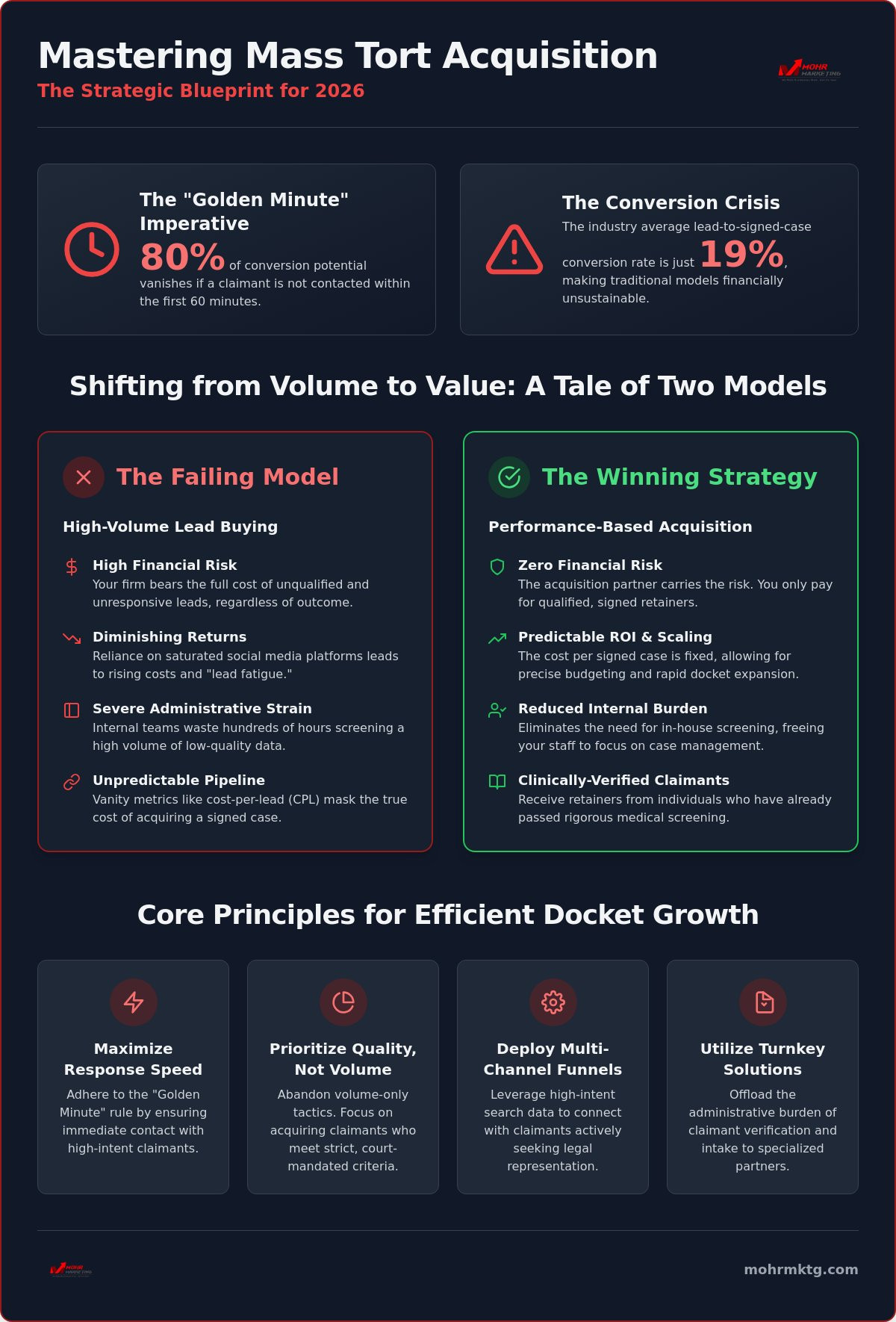
80% of your mass tort conversion potential vanishes if you don’t reach a claimant within the first sixty minutes. In a market where the average lead-to-signed case conversion rate sits at just 19%, traditional high-volume lead buying is no longer a viable path to growth. You’ve likely seen rising costs on social platforms and felt the administrative strain of chasing inconsistent intake data. Effective mass tort case acquisition strategies in 2026 require a shift from chasing raw numbers to securing high-intent, verified claimants through a performance-based ecosystem.
You know that unpredictable pipelines and slow response times are draining your firm’s resources. This guide provides the blueprint to master the transition from buying leads to acquiring signed retainers with clinical-level precision. We’ll examine the impact of California’s SB 37 on vendor liability, the rise of the GLP-1 MDL, and the mechanics of building a scalable, data-driven docket. You’ll learn how to reduce your internal administrative burden while maintaining total transparency over claimant verification.
Key Takeaways
- Abandon volume-only tactics to avoid lead fatigue and rising costs on saturated social media platforms.
- Transition to a performance-based model to secure signed retainers and eliminate the financial risk of unqualified leads.
- Deploy multi-channel mass tort case acquisition strategies that leverage high-intent search data to outpace competitors in 2026.
- Reduce intake friction by adhering to the “Golden Minute” rule and utilizing rigorous medical screening during the initial contact.
- Scale your firm’s docket efficiently by identifying turnkey solutions that handle the administrative burden of claimant verification.
The 2026 Mass Tort Landscape: Why Volume-Only Strategies Fail
The 2026 landscape for mass tort case acquisition strategies has shifted away from the “spray and pray” methods of the past decade. Social media feeds are congested with legal advertisements, leading to a phenomenon known as lead fatigue. Potential claimants have become skeptical of generic digital ads, often ignoring them entirely or providing false information to bypass intrusive forms. Firms that rely solely on broad-spectrum awareness campaigns now face diminishing returns and astronomical costs for data that rarely converts into a signed retainer.
Understanding what a mass tort is helps clarify why simple lead volume is insufficient. These are complex, multi-party litigations requiring specific medical and exposure evidence from the outset. 2026 requires a transition to high-precision targeting. Relying on vanity metrics, such as a low cost-per-lead (CPL), is a dangerous financial trap. If a lead doesn’t meet the evolving criteria of a Multi-District Litigation (MDL) court, it’s a liability, not an asset. High-volume, low-quality data creates a bottleneck in your intake department, forcing staff to chase dead-end leads while high-value opportunities grow cold.
The Move from Lead Volume to Case Quality
A “qualified claimant” in 2026 isn’t just someone who used a product. They must meet rigorous, court-mandated vetting standards that often include verified medical records and specific dates of exposure. Cheap leads are a primary cause of high overhead. When you purchase unfiltered data, your internal team spends hundreds of hours on manual screening. This labor cost, when added to the initial lead price, often exceeds the cost of a pre-verified signed case. Successful firms now prioritize acquisition strategies that deliver claimants who have already passed clinical-level screening questions.
High-Value Torts to Watch in 2026
GLP-1 (Ozempic/Wegovy) and PFAS “forever chemicals” litigation continue to dominate the docket this year. However, as these markets become crowded, the cost of acquisition on social media platforms is skyrocketing. To maintain a healthy ROI, firms are pivoting toward specialized cases that require deeper intent. For instance, Mesothelioma leads built on real search intent offer a more sustainable path than broad pharmaceutical plays. Identifying emerging environmental and pharmaceutical torts before they reach peak market saturation allows your firm to capture market share while acquisition costs remain manageable. Precision is the only way to scale in a mature litigation market.
Performance-Based Acquisition: Pay-Per-Lead vs. Pay-Per-Signed-Case
Law firms often mistake lead generation for business growth. In the current market, a lead is merely a data point, while a signed retainer is a secured asset. When evaluating mass tort case acquisition strategies, the most critical decision involves determining who carries the financial risk of non-conversion. Traditional lead buying puts that burden entirely on your firm. You pay for the inquiry regardless of whether the claimant ever answers the phone or meets the necessary criteria for your docket.
The performance-based model shifts this risk to the provider. Under a Pay-Per-Signed-Case (PPSC) structure, you only pay for executed retainers that meet your specific litigation requirements. This model provides total transparency and eliminates the “intake gap” where leads typically die in the pipeline due to slow follow-up or poor data quality. Understanding the legal definition of a mass tort is essential for recognizing why a signed case is far superior to a raw lead. These cases require specific evidence and documented injury; a signed retainer confirms that these hurdles have already been cleared by a professional intake team.
The ROI Advantage of the Pay-Per-Signed-Case (PPSC) Model
PPSC models allow for predictable budgeting and rapid scaling. You know the exact cost of every new client before they enter your CRM. This eliminates wasted spend on non-responsive or unqualified leads, which currently plague the industry. By utilizing mass tort signed cases, your firm can expand its docket without the need to increase in-house headcount for intake and screening. It’s a turnkey solution for firms that value efficiency over raw lead volume.
Evaluating Pay-Per-Lead (PPL) for Specific Torts
Pay-Per-Lead (PPL) still serves a purpose for high-volume, lower-threshold torts where the objective is broad market penetration. However, the success of this model depends on exclusivity. You must ensure you aren’t buying leads from shared aggregator pools where multiple firms are competing for the same claimant. If you choose the PPL route, ask your provider these specific questions:
- What is the exact source of the traffic?
- How many screening questions are asked before the data is delivered?
- What is the average response time from the moment the form is submitted?
If you’re ready to move away from uncertain lead quality, you can discuss your docket goals with a strategic partner to determine which model fits your firm’s risk profile.
Multi-Channel Digital Funnels: Capturing High-Intent Claimants
Capturing high-intent claimants requires a sophisticated multi-channel approach that prioritizes search visibility over passive social media exposure. While social platforms are effective for broad awareness, search-based mass tort case acquisition strategies target individuals at the exact moment they recognize a legal need. When a claimant utilizes a search engine to research a specific diagnosis or product failure, they demonstrate a level of intent that passive browsing cannot replicate. This active search behavior significantly improves the likelihood of a successful retainer execution. By positioning educational content directly in the path of these queries, firms can build authority and trust before the initial intake call even occurs.
Search Intent vs. Social Interruption
Google Search remains the primary driver for complex litigation because it captures users during the problem-solving phase of their journey. Rather than interrupting a user’s social experience with unsolicited ads, search funnels provide immediate solutions to specific medical or legal queries. Effective funnels utilize long-tail keywords focused on precise injuries, specific pharmaceutical side effects, or localized environmental contaminants to isolate qualified traffic. By refining keyword targeting for specific MDLs based on real-time search data, firms can bypass the high-volume noise of social platforms and engage with claimants who already meet established medical criteria. This precision reduces the cost-per-acquisition and ensures a more efficient intake process.
Compliance and Ethical Advertising Mandates
Advertising in 2026 demands absolute transparency to remain compliant with evolving state bar mandates and federal regulations. All digital assets must adhere to the non-misleading standards established by the American Bar Association, which prohibit deceptive claims regarding potential settlement values or legal outcomes. This includes clear firm identification, explicit disclaimers regarding the nature of the legal relationship, and adherence to new state-level AI disclosure laws. Understanding the ethical considerations in mass tort settlements is critical for maintaining a compliant acquisition funnel that survives court scrutiny. Mohr Marketing, LLC provides a turnkey marketing and intake ecosystem designed to navigate these regulatory complexities with clinical accuracy. This compliance-first approach protects your firm’s reputation while ensuring every claimant is handled with the professional rigor required by the court system.
The Intake Ecosystem: Eliminating Friction in the Retainer Process
Efficiency in the intake ecosystem is the final determinant of ROI for mass tort case acquisition strategies. While earlier sections detailed the importance of search-driven intent, that intent is perishable. Data from June 2026 confirms that conversion rates can decrease by as much as 80% if the initial contact occurs more than one hour after the inquiry. To maintain a competitive edge, firms must implement a sixty-second response window. This immediate engagement bridges the gap between a digital inquiry and a fully executed retainer. By integrating medical screening questions directly into the initial script, firms can verify eligibility before the claimant loses interest or seeks alternative representation.
The transition to a signed agreement must be instantaneous. Any delay in document delivery or HIPAA authorization collection provides an opportunity for claimant attrition. Utilizing technology for immediate e-signatures and secure document uploads ensures the retainer is executed while the claimant’s motivation is at its peak. This technical integration turns a raw inquiry into a secured asset, allowing the firm to scale without the administrative burden of manual follow-up. A seamless intake process is not just a convenience; it is a critical requirement for maintaining a high lead-to-retainer conversion rate in a mature litigation market.
Real-Time Verification and Medical Screening
General call centers often fail because they lack the specialized training required for complex litigation. A professional intake process requires a three-step verification: verifying contact accuracy, confirming injury through medical milestones, and establishing legal standing. This level of precision is mandatory for high-value case acquisition where criteria are exceptionally narrow. Mohr Marketing, LLC utilizes a clinical-level screening process to ensure that only qualified claimants proceed to the retainer stage. This rigor prevents legal staff from wasting time on cases that will ultimately be rejected by the court.
Automated vs. Human-Led Intake Strategies
Automation serves as a critical support tool for initial data collection, particularly during after-hours windows. AI-driven screening ensures that no inquiry remains unacknowledged, but human empathy remains essential for securing retainers in sensitive pharmaceutical or environmental torts. Reducing friction in the document collection phase through instant e-signatures is the most reliable path to a mass tort signed case. A seamless transition from the first call to a signed agreement prevents claimant attrition and solidifies the firm’s docket. You can audit your current intake process with Mohr Marketing, LLC to identify and resolve conversion bottlenecks.
Strategic Scaling: Implementing a Turnkey Mass Tort Solution
Scaling a litigation docket from 10 to 100 signed cases per month requires more than just increased ad spend. It demands a robust infrastructure capable of handling surge volume without compromising quality. Most firms eventually face the “Buy vs. Build” dilemma. Building an internal media department and a 24/7 specialized intake center is capital-intensive and time-consuming. Outsourcing to a partner like Mohr Marketing, LLC, with 30+ years of industry experience, allows you to leverage established mass tort case acquisition strategies immediately. This shift moves your firm from a labor-heavy operational model to a streamlined, results-oriented growth engine.
Audit your potential marketing partner with clinical precision. You must verify their intake and verification processes to ensure they align with the high-intent standards discussed in previous sections. A partner should provide transparent data on claimant verification, reducing the administrative burden on your in-house staff. Don’t settle for vague promises. Demand a partner that eliminates inefficient intermediaries and provides a direct path to verified, high-value claimants. This level of transparency is the only way to ensure your capital is protected during aggressive expansion.
Evaluating a Strategic Marketing Partner
Success is measured by three primary Key Performance Indicators (KPIs): Cost Per Acquisition (CPA), lead-to-signed conversion rate, and case retention. Transparency in reporting is non-negotiable. You need real-time access to data to track how your capital is performing across different torts. Strategic firms prioritize partners that offer signed retainers and verified leads. This model ensures that every dollar spent is tied to a tangible legal asset rather than a speculative inquiry. It’s the most efficient way to maintain a predictable pipeline of signed cases while minimizing financial risk.
Transitioning to an Outsourced Acquisition Model
Moving to an outsourced model requires clear expectations regarding case volume and quality thresholds. Integration is the final hurdle. Ensure your partner’s data can flow directly into your firm’s preferred case management software through secure API connections or standardized data imports. This eliminates manual data entry and prevents lead decay. Before launching a national mass tort acquisition campaign, use this final checklist:
- Verify the partner’s compliance with 2026 state bar advertising mandates and AI disclosure laws.
- Confirm the real-time transfer protocol for high-intent inquiries.
- Establish clear criteria for “qualified” cases to prevent intake bottlenecks.
- Test the CRM integration to ensure seamless document and signature collection.
Scaling is a mechanical process. When the right mass tort case acquisition strategies are paired with a veteran partner like Mohr Marketing, LLC, growth becomes a matter of precision, not luck.
Secure Your Competitive Advantage in the 2026 Litigation Market
Success in mass torts no longer depends on how many leads you can buy, but on how many verified retainers you can secure with clinical precision. High-intent search funnels and immediate, clinical-level intake are the only ways to navigate rising costs and stricter regulatory scrutiny. By prioritizing case quality over raw data volume, your firm can build a predictable, scalable docket without the administrative overhead of manual screening. This transition ensures your resources are spent on viable litigation assets rather than non-responsive data points.
Implementing advanced mass tort case acquisition strategies requires a shift toward performance-based models that align marketing spend with actual growth. Mohr Marketing provides a turnkey marketing and intake ecosystem backed by 30+ years of industry experience and data-driven results. We eliminate the friction between claimant inquiry and executed retainer, allowing you to focus on litigation while we manage the mechanics of acquisition. Don’t let inefficient intermediaries drain your capital; choose a partner that delivers verified results.
Secure your firm’s growth with Mohr Marketing’s Pay-Per-Signed-Case model. Build a sustainable path to success today.
Frequently Asked Questions
What is the difference between a mass tort lead and a signed case?
A mass tort lead is a raw inquiry from a potential claimant, whereas a signed case is a legally binding retainer agreement. Leads represent the initial stage of the funnel and require extensive screening to determine if they meet specific MDL criteria. Signed retainers are secured assets for your firm, having already passed medical and legal verification. Transitioning to signed cases eliminates the financial risk of paying for non-responsive data.
How much should a firm expect to pay for a mass tort signed retainer in 2026?
Blended costs for signed retainers in 2026 vary significantly based on the specific litigation and the complexity of the medical proof required. Industry benchmarks from early 2026 show a wide range, from under $400 for high-volume torts to over $11,000 for specialized pharmaceutical cases. Factors such as current MDL deadlines and the level of claimant vetting influence these figures. Firms should prioritize the total cost to acquire a viable case over raw lead prices.
Is it better to buy exclusive leads or shared leads for mass torts?
Exclusive leads are the only viable option for effective mass tort case acquisition strategies. Shared leads are sold to multiple firms simultaneously, creating a race that diminishes conversion rates and frustrates potential claimants. In a market where response speed is critical, competing with other firms for the same inquiry is a waste of capital. Exclusivity ensures your intake team has the first opportunity to secure the retainer while intent is highest.
How do you ensure mass tort marketing is compliant with state bar rules?
Compliance in 2026 requires strict adherence to transparency mandates and state-specific laws like California’s SB 37. All marketing communications must include a genuine office address and telephone number to avoid attorney liability for vendor content. Additionally, New York law now requires clear disclosure if AI-generated likenesses are used in advertisements. Firms must audit their partners to ensure all assets are non-misleading and clearly identify the responsible legal entity at all times.
What are the most profitable mass torts for law firms to pursue right now?
GLP-1 (Ozempic/Wegovy) and PFAS “forever chemicals” litigation are currently the most active and profitable torts for firms seeking scale. These cases offer high claimant volume and clear paths to MDL participation. Mesothelioma remains a high-value staple due to established settlement frameworks and search-driven intent. Identifying emerging pharmaceutical or environmental torts before they reach peak market saturation is essential for maintaining a competitive cost-per-acquisition and a healthy ROI.
How fast does the intake team need to respond to a mass tort inquiry?
Your intake team must respond to inquiries within 60 seconds to maximize sign-up rates and prevent lead decay. Data from June 2026 shows that a two-hour callback window can increase sign-ups by 15% to 25% compared to next-day follow-up. However, conversion rates drop by as much as 80% after the first hour of inactivity. In a high-stakes environment, being the first firm to reach a claimant often determines who secures the signed retainer.
Can I scale my mass tort acquisition without hiring more in-house staff?
You can scale your docket without increasing headcount by utilizing a turnkey acquisition and intake ecosystem. Outsourcing the screening and retainer process to a specialized partner allows your firm to focus entirely on litigation. This model shifts the administrative burden of claimant verification to external experts who operate 24/7. It provides a scalable infrastructure that can handle hundreds of inquiries monthly without the overhead or training requirements of a large internal call center.
What is a “verified inquiry” in the context of legal lead generation?
A verified inquiry is a lead that has passed a rigorous 3-step screening process: contact validation, injury confirmation, and legal standing. This process ensures the claimant has a documented injury related to the tort and isn’t already represented by counsel. Verified inquiries represent higher intent and a much higher probability of converting into a signed case. They serve as the foundation for modern mass tort case acquisition strategies that prioritize quality over raw data volume.

Recent Posts
- Commercial Vehicle Accident Client Acquisition: A Law Firm’s 2026 Guide
- Mass Tort Claimant Acquisition: A Practical Framework for Law Firms
- Signed Cases for Attorneys: A 2026 Evaluation Guide
Categories
- AI and Lead Generation
- Business Financing
- Call Verified MVA Leads
- Car Accident Help
- Car Accident Settlements
- Claimant Funding
- Compliance Program
- EMS-EMT Reports
- Geotargeting
- Google Maps Ranking
- Healthcare Practice Growth
- Law Firm Growth
- Law Office Operations
- Lead Generation
- Lead Generation For Attorneys
- Lead Generation For Chiropractors
- Lead Generation For Criminal Attorneys
- Lead Generation For D&A Treatment Centers
- Lead Generation For DUI Attorneys
- Lead Generation For Eye Doctors
- Lead Generation For Family Law Practices
- Lead Generation For PI Law Firms
- Lead Generation For Plastic Surgeons
- Leads For Healthcare Professionals
- Leads For Insurance Industry
- Legal Leads
- Legal Marketing
- Legal Updates
- Mass Tort Leads
- Medicare and Medicaid Leads
- Merchant Funding Leads
- Mold Leads
- Online Marketing Strategies
- Pre-Settlement Funding
- Signed MVA Cases
- Tort Updates
- Truck Accident Leads and Signed Cases
- Truck Accident Settlements
- Web Design