Data-Driven Marketing for Law Firms: A 2026 Strategic Guide
June 11, 2026 by Mohr Marketing
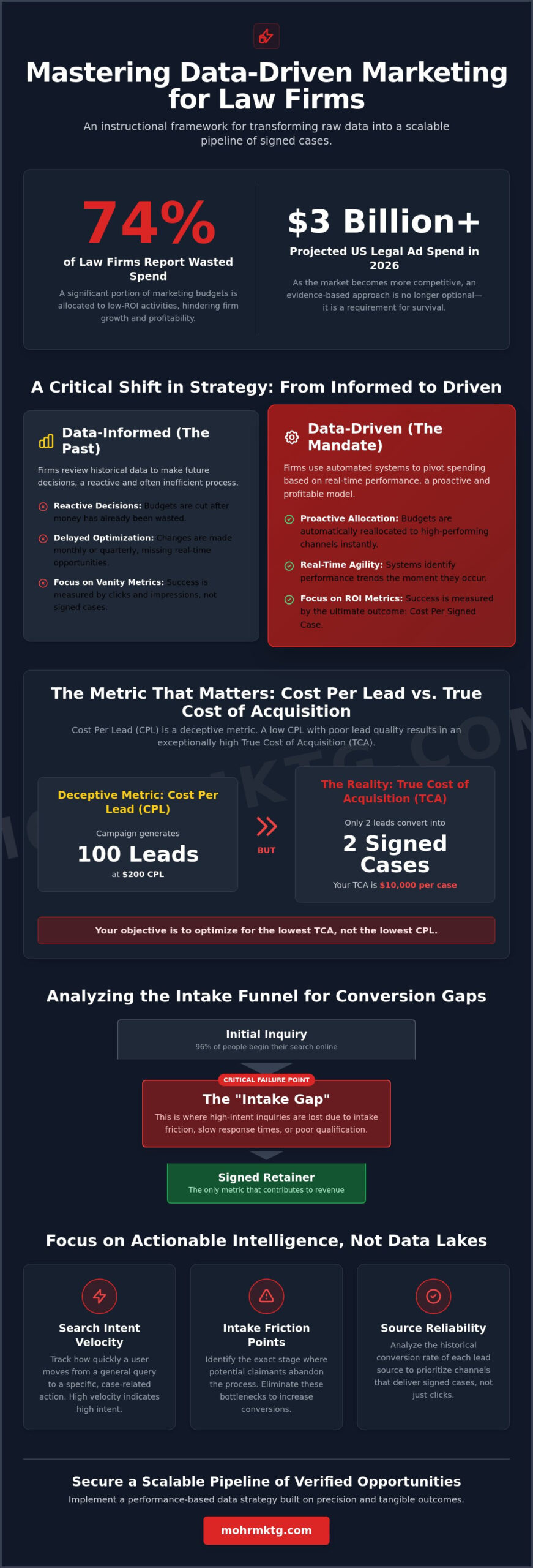
Research indicates that 74% of law firms report wasted spending on low-ROI marketing activities, a statistic that’s increasingly critical as US legal advertising spend is projected to exceed $3 billion in 2026. You likely agree that maintaining high cost-per-lead (CPL) metrics is a liability when those leads fail to convert into signed retainers. Managing growth in this environment requires a shift from intuitive spending to a rigorous, evidence-based approach. This guide provides the instructional framework to master the mechanics of high-conversion data-driven marketing for law firms by transforming raw data into a scalable pipeline of signed cases.
Mohr Marketing, LLC adopts the role of a strategic partner to help you navigate these complexities with precision. We’ll examine how to identify intake conversion gaps and deploy performance-based strategies that prioritize financial performance over vanity metrics. By following these procedures, your firm can eliminate inefficient intermediaries and secure a more streamlined path to expansion. This article serves as a manual for professionals who value mechanical accuracy and tangible outcomes in their business operations.
Key Takeaways
- Transition from intuitive spending to systematic, evidence-based resource allocation by leveraging claimant behavior and conversion data.
- Master data-driven marketing for law firms by prioritizing Lead-to-Retainer tracking over deceptive top-of-funnel metrics like Cost Per Lead.
- Identify and close the “Intake Gap” by auditing intake team performance to ensure high-intent inquiries successfully convert into signed cases.
- Deploy high-intent digital funnels by defining strict case criteria based on historical litigation success and specific keyword targeting.
- Secure a scalable pipeline of verified opportunities through a strategic partnership built on a 30-year track record of legal intake precision.
What is Data-Driven Marketing for Law Firms?
Data-driven marketing for law firms is the systematic use of claimant behavior and conversion data to drive acquisition. It isn’t a suggestion; it’s a requirement for survival. This approach represents a total shift from “gut-feeling” marketing to evidence-based resource allocation. While many firms are “data-informed”, meaning they look at charts after the money is spent, the top performers are “data-driven.” They use automated optimization to pivot spending based on real-time outcomes. Your core objective is simple. You must reduce the gap between an initial inquiry and a fully executed retainer. Every second of delay and every unverified data point increases your cost per signed case.
The distinction between being informed by data and being driven by it is mechanical. A data-informed firm might see that a campaign is underperforming and decide to cut it next month. A data-driven firm has systems that automatically reallocate that budget to high-converting keywords the moment the trend is identified. This level of agility is what separates profitable firms from those that merely “spend” on marketing. You’re no longer buying ads; you’re investing in a predictable outcome based on verified performance metrics.
The Evolution of Legal Lead Acquisition
The 2026 legal landscape demands higher precision than previous years. Broad-spectrum “brand awareness” is failing specialized firms. It’s too expensive and too slow. Since 96% of people seeking legal advice begin their research on a search engine, your presence must be surgical. Transparency in lead sourcing is now a non-negotiable requirement. With legal advertising spend projected to exceed $3 billion this year, there’s no room for error. Regulations like California’s SB 37 mean you’re liable for every claim made in your name. Precision isn’t just about ROI; it’s about protecting your license and your capital.
Moving Beyond the “Data Lake”
Raw data is a liability without a structured intake ecosystem. You don’t need a “data lake” filled with useless metrics that look good on a slide deck. You need actionable intelligence. This means identifying which data points actually correlate with high-value cases. For example, when acquiring mass tort signed cases, the data must immediately validate specific exposure and injury criteria before a lead is ever passed to your team.
To turn raw information into a signed retainer, you must track these specific indicators:
- Search Intent Velocity: How quickly a user moves from a general query to a specific case-related action.
- Intake Friction Points: The exact stage where potential claimants drop out of your digital funnel.
- Source Reliability: The historical conversion rate of specific lead aggregators versus direct search traffic.
Stop collecting data for the sake of having it. Start using it to eliminate the inefficient intermediaries that dilute your margins.
Core Metrics for High-Volume Practice Areas
Efficiency in legal acquisition requires a strict hierarchy of data points. While many firms monitor impressions and click-through rates, these top-of-funnel metrics are insufficient for predicting revenue. Cost Per Lead (CPL) is often deceptive because it doesn’t account for lead quality or retainer conversion. Within a strategy for data-driven marketing for law firms, you must prioritize the cost per signed case. This shift ensures that your capital is allocated based on the final outcome rather than initial engagement.
To calculate the True Cost of Acquisition (TCA), you must divide your total marketing spend by the number of fully executed retainers within a specific period. For example, if a campaign generates 100 leads at $200 each but only signs two cases, your TCA is $10,000 per case, not the $200 CPL. High-intent signals, such as specific queries regarding litigation timelines or injury-specific contaminants, provide the data necessary to optimize this ratio. Focusing on these indicators allows you to stop paying for volume and start paying for performance.
Personal Injury and MVA KPIs
Success in motor vehicle accident litigation depends on immediate verification and response speed. You should track inquiries that are already police report-backed MVA cases to ensure case viability before committing intake resources. Speed-to-lead data is a critical variable. Research shows that call conversions in the legal industry are often driven by the first firm to respond. If your team doesn’t connect with a claimant within minutes, the data shows a sharp decline in conversion probability.
Mass Tort and Complex Litigation Metrics
Mass tort acquisition requires monitoring case criteria adherence with surgical precision. Identifying “hidden-gem” topics through search intent data allows firms to capture high-value opportunities before the market becomes saturated. For example, scaling mesothelioma leads for law firms requires verifying exposure dates and medical diagnoses in real time. If you want to refine these metrics for your practice, you can consult with an acquisition specialist at Mohr Marketing, LLC to eliminate non-qualifying inquiries.
Analyzing the Intake Funnel for Conversion Gaps
The Intake Gap is a primary point of failure where high-intent inquiries fail to transition into signed retainers. In the framework of data-driven marketing for law firms, the intake department must be treated as a data-generating unit. If your signed case volume doesn’t match your qualified lead volume, a systematic audit of your intake protocols is required. You can’t improve conversion without identifying the specific stage where potential claimants exit the funnel.
To conduct a formal audit of your intake team, follow this sequence to extract actionable performance data:
- Review call recordings: Ensure staff strictly adheres to your firm’s verification protocols and legal compliance standards.
- Analyze response latency: Measure the exact number of seconds between the initial digital inquiry and the first outbound contact attempt.
- Categorize disqualification reasons: Document why leads are rejected to determine if your marketing filters require technical adjustment.
- Benchmark staff conversion rates: Compare individual performance to identify training deficiencies or procedural bottlenecks.
Scaling national operations requires a 24/7 turnkey intake ecosystem. High-value inquiries often occur outside of standard business hours, making immediate availability essential. Many data-driven firms now utilize Verified Call Transfers to minimize lead waste. This process ensures your legal team only engages with claimants who have already passed a rigorous initial screening, effectively removing the administrative burden from your internal staff.
The Mechanics of High-Conversion Intake
Speed remains the most significant variable in conversion data. If your firm doesn’t initiate contact within the first few minutes of an inquiry, the probability of signing that case decreases significantly. You must implement rigorous verification protocols that filter out unqualified claimants immediately. The Mohr Marketing, LLC Method utilizes a turnkey ecosystem that manages this entire workflow. We handle the initial friction, ensuring your internal resources are reserved for litigation rather than administrative filtering.
Turning Data into Signed Retainers
Performance-based models offer a superior alternative to traditional lead buys because they align the marketer’s incentives with your firm’s growth. For instance, acquiring mass tort signed cases provides a predictable ROI by removing the uncertainty of the intake phase. You should map the claimant journey from the initial search query to the final digital signature. This mapping allows you to visualize exactly where friction exists. By removing these hurdles, you transform raw data into a consistent, scalable pipeline of revenue.
Implementing a Performance-Based Data Strategy
Success in data-driven marketing for law firms requires a transition from passive observation to active control of your acquisition costs. You must treat your marketing budget as a capital investment that demands a predictable return. To achieve this, follow a structured, four-step implementation framework designed for the 2026 legal landscape.
First, define strict case criteria based on your historical litigation success. Analyze which variables, such as specific medical diagnoses or accident severity, consistently lead to high-value settlements. Second, deploy high-intent digital funnels that target granular keywords. Instead of bidding on broad terms like “personal injury lawyer,” focus on specific contaminants or accident types that signal a high likelihood of a viable claim. Third, integrate a real-time intake and verification layer. Every inquiry must be vetted against your criteria before it reaches your team. Finally, shift your budget toward Pay-Per-Signed-Case or Pay-Per-Lead models to minimize financial risk. This ensures you only pay for performance, not potential.
Auditing Your Current Marketing Spend
You must identify and eliminate “zombie” campaigns. These are digital initiatives that generate high click volume and impressions but fail to produce a single signed case. They drain your capital while providing a false sense of activity. Audit your lead providers based on their transparency and verification standards. In 2026, ethical compliance is a mechanical requirement. Ensure all data-driven funnels adhere to state bar rules and regulations like California’s SB 37, which requires clear disclosures and attorney-of-record identification. If a provider cannot show you exactly where their data originates, they’re a liability to your firm.
Scaling for National Growth
Scaling from local markets to a national presence is an engineering problem. Use the data from your high-performing local campaigns to identify demographic patterns and then replicate that success across wider jurisdictions. This is where mass tort lead generation becomes essential for rapid expansion. It allows your firm to tap into high-volume claimant pools with surgical precision. Managing the data flow for complex litigation, such as truck accident signed cases, requires a robust verification layer to handle increased volume without sacrificing the quality of the retainers. If your current strategy lacks this level of precision, contact our team for a performance audit to secure your firm’s growth.
Securing the Business Strategy with Mohr Marketing
A successful strategy requires more than just a dashboard; it requires precise execution. Mohr Marketing serves as your strategic partner for data-driven marketing for law firms, providing the infrastructure necessary to turn high-intent traffic into revenue. We bring a 30-year track record of delivering verified opportunities to the table. Our focus remains on the mechanics of your expansion, ensuring that every dollar spent is tied to a tangible outcome. Stop managing data and start managing growth. Your firm’s time is better spent in the courtroom than in the weeds of lead verification.
Our Pay-Per-Signed-Case model is designed to optimize your firm’s cash flow. Unlike traditional agencies that charge for clicks or unverified impressions, this model shifts the financial risk away from your firm. You pay for results, not promises. This approach allows you to scale your operations aggressively without the unpredictability of fluctuating lead quality. By utilizing data-driven marketing for law firms, we align our success entirely with yours. We don’t just provide data; we provide the signed retainers that build your case inventory.
The Turnkey Advantage
Our turnkey ecosystem handles the entire lifecycle of a claimant, from the initial search query to the fully executed retainer. We eliminate inefficient intermediaries through direct sourcing, which ensures higher margins for your firm. This direct-to-consumer approach provides 100% transparency in your lead-to-case pipeline. You’ll have clear visibility into every stage of the process, allowing you to audit performance with surgical precision. We remove the friction of administrative filtering, delivering only those cases that meet your specific litigation criteria.
Next Steps for Performance-Driven Firms
Transitioning to a performance-based acquisition model is a straightforward process. It begins with a consultation to define your specific case criteria and volume requirements. We then build custom marketing funnels tailored to your firm’s high-volume practice areas. You must prepare your internal team for a high-volume influx of qualified claimants. Our systems ensure a steady flow of verified opportunities, allowing your staff to focus on case management rather than lead chasing. To secure your firm’s position in the 2026 market, Scale your firm with Mohr Marketing today.
Engineer Your Firm’s Expansion with Performance-Based Data
The 2026 legal market leaves no room for reactive spending. To maintain a competitive advantage, you must transition from broad brand awareness to a surgical acquisition model. Success depends on your ability to audit intake conversion gaps and prioritize Lead-to-Retainer ratios over simple lead counts. Mastering data-driven marketing for law firms is the only way to ensure your capital is protected and your pipeline remains scalable.
Mohr Marketing provides the infrastructure to execute this strategy with mechanical accuracy. With over 30 years of industry-leading expertise, we offer a turnkey intake ecosystem that enforces strict case criteria and rigorous verification. Our transparent, performance-based models, including Pay-Per-Signed-Case, remove the financial uncertainty of traditional lead buys. It’s time to stop managing fragmented data and start managing the growth of your practice. Secure high-intent signed cases for your firm today and build a predictable engine for long-term success.
Frequently Asked Questions
What is the difference between a lead and a signed case in data-driven marketing?
A lead is merely an unverified inquiry or contact record, whereas a signed case is a fully executed retainer from a claimant who meets specific litigation criteria. In data-driven marketing for law firms, the distinction is critical for measuring ROI. Raw leads often include unqualified contacts that drain intake resources. Signed cases represent a verified outcome where the claimant has passed all screening protocols and committed to legal representation.
How does data-driven marketing ensure compliance with legal ethics and bar mandates?
Data-driven systems enforce compliance by automating the inclusion of required disclosures, such as those mandated by California’s SB 37. These systems ensure every landing page and advertisement identifies the attorney of record and their bona fide office location. By tracking the origin of every inquiry, firms maintain a clear audit trail. This transparency protects the firm from liability associated with misleading third-party claims or prohibited actor portrayals in testimonials.
Why do most law firms fail to see a high ROI from their digital marketing data?
Most firms fail because they optimize for Cost Per Lead (CPL) rather than Cost Per Signed Case. They focus on vanity metrics like clicks and impressions while ignoring the “Intake Gap” where high-intent inquiries drop off. Without integrating intake data back into the marketing engine, firms continue to spend on keywords that produce volume but no revenue. Success requires a mechanical connection between search intent and the final executed contract.
What are the most important KPIs for a personal injury firm to track in 2026?
Personal injury firms must track speed-to-lead latency, contact rates for high-intent inquiries, and the percentage of leads backed by police reports. In 2026, the most critical KPI is the Lead-to-Retainer conversion rate within the first 300 seconds of inquiry. Tracking these metrics allows firms to identify exactly where friction exists in the intake funnel. Monitoring the cost per signed case remains the final arbiter of campaign success and financial viability.
Can data-driven marketing help my firm scale into national mass tort litigation?
Data-driven marketing for law firms allows you to identify high-performing demographic and keyword patterns in local markets and replicate them nationally. Scaling requires a robust verification layer to handle the increased volume of mass tort inquiries without diluting quality. By utilizing performance-based models, firms can expand into national litigation with a predictable cost structure. This prevents the capital drain often associated with broad, unoptimized national advertising campaigns.
How does a turnkey intake ecosystem improve the conversion of digital inquiries?
A turnkey intake ecosystem improves conversion by providing immediate, 24/7 responsiveness to every inquiry. It utilizes standardized screening scripts and automated verification protocols to ensure only qualified claimants reach your legal team. This eliminates the delay that leads to claimant churn. By handling the initial friction of filtering and follow-up, the system allows your firm to focus its internal resources on litigation rather than administrative lead chasing.
Is a Pay-Per-Signed-Case model more cost-effective than managing a digital marketing retainer?
The Pay-Per-Signed-Case model is generally more cost-effective because the firm only pays for verified outcomes. Traditional marketing retainers often involve significant upfront costs with no guarantee of case volume. In contrast, performance-based models align the marketer’s incentives with the firm’s growth. This structure protects firm cash flow by ensuring that every marketing dollar spent results in a fully executed retainer that meets your specific litigation criteria.
How long does it typically take to see results from a data-driven legal marketing strategy?
Results vary depending on the acquisition channel. Performance-based models like Pay-Per-Signed-Case provide immediate volume once the criteria are established and the funnels are deployed. Organic strategies such as SEO typically require three to six months to achieve a dominant search position. However, once a data-driven engine is integrated with your intake process, you should see measurable improvements in your Lead-to-Retainer conversion rates within the first thirty days of operation.

Recent Posts
- Exclusive vs Shared Legal Leads: Compare Costs and Competition
- Attorney Search Engine Marketing: Do It Yourself or Hire Help
- Improving Law Firm Marketing ROI: A Practical Measurement Framework
Categories
- AI and Lead Generation
- Business Financing
- Call Verified MVA Leads
- Car Accident Help
- Car Accident Settlements
- Claimant Funding
- Compliance Program
- EMS-EMT Reports
- Geotargeting
- Google Maps Ranking
- Healthcare Practice Growth
- Law Firm Growth
- Law Office Operations
- Lead Generation
- Lead Generation For Attorneys
- Lead Generation For Chiropractors
- Lead Generation For Criminal Attorneys
- Lead Generation For D&A Treatment Centers
- Lead Generation For DUI Attorneys
- Lead Generation For Eye Doctors
- Lead Generation For Family Law Practices
- Lead Generation For PI Law Firms
- Lead Generation For Plastic Surgeons
- Leads For Healthcare Professionals
- Leads For Insurance Industry
- Legal Leads
- Legal Marketing
- Legal Updates
- Mass Tort Leads
- Medicare and Medicaid Leads
- Merchant Funding Leads
- Mold Leads
- Online Marketing Strategies
- Pre-Settlement Funding
- Signed MVA Cases
- Tort Updates
- Truck Accident Leads and Signed Cases
- Truck Accident Settlements
- Web Design