Tampon Heavy Metal Lawsuit: Eligibility & Legal Rights
July 23, 2026 by Mohr Marketing
The July 2026 FDA report hasn’t ended the tampon heavy metal contamination lawsuit; it has simply raised the threshold for medical causation. Law firms entering this space face a difficult reality. High acquisition costs and the challenge of verifying decades of product usage make standard lead generation a liability. You need more than just inquiries. You need claimants who can withstand the scrutiny of defense counsel in a shifting regulatory environment.
Mohr Marketing, LLC understands that investing in an unproven tort requires strategic precision. It’s difficult to scale when you’re fighting inconsistent intake quality and unverified data. This analysis provides an authoritative roadmap for navigating the current litigation landscape and securing high-intent signed cases. We’ll examine the legal implications of the UC Berkeley findings, the impact of California’s SB 754, and the specific framework for qualifying high-value claimants. You’ll gain a clear strategy for acquiring signed retainers that prioritize scientific rigor and long-term usage history.
Key Takeaways
- Analyze the scientific foundation of current litigation, focusing on the UC Berkeley study’s findings regarding heavy metal absorption through vaginal tissue.
- Navigate complex liability theories, including failure to warn and deceptive advertising, to strengthen your position in the tampon heavy metal contamination lawsuit landscape.
- Establish rigorous qualification criteria for claimants by prioritizing documented long-term product usage and specific reproductive health complications.
- Optimize your intake ecosystem with a speed-to-lead framework designed to convert high-intent inquiries into fully executed signed retainers.
- Scale your mass tort practice efficiently by utilizing a turnkey acquisition model that bypasses inefficient intermediaries and focuses on verified case quality.
Understanding the 2024 Tampon Toxic Metal Study
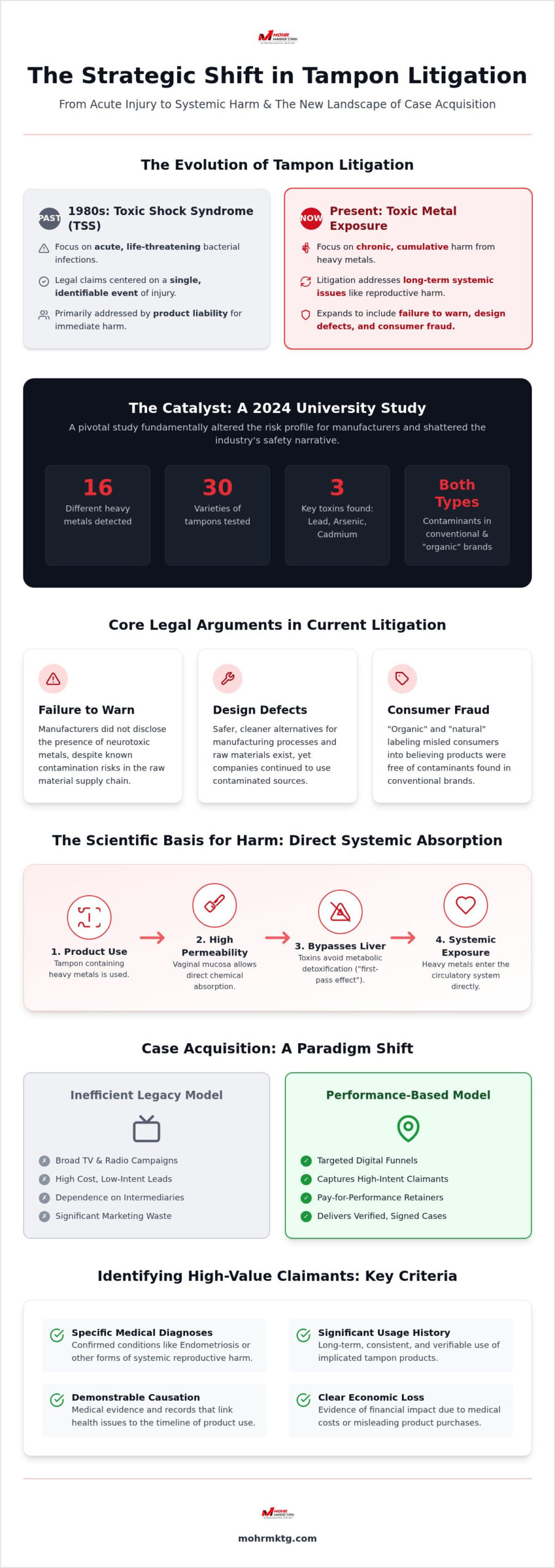
The July 2024 University of California, Berkeley study published in Environment International fundamentally shifted the liability landscape for menstrual products. This research provided the first comprehensive evidence that heavy metals are present across a wide range of tampon brands sold in the United States and Europe. For law firms, this study serves as the primary scientific pillar for the current tampon heavy metal contamination lawsuit wave. It moves the conversation from anecdotal health concerns to measurable, peer-reviewed data.
Manufacturers have historically operated with minimal oversight regarding internal contaminant testing. Looking back at the history of tampon litigation, we see a recurring pattern where systemic risks are ignored until legal action forces transparency. The 2024 study tested 30 products from 14 different brands, identifying 16 different metals, including lead, arsenic, and cadmium. These findings suggest that contamination is not an isolated manufacturing glitch but a systemic issue within the global supply chain.
Key Contaminants Identified
The study’s findings challenged the industry’s “clean” marketing narratives. Researchers found that metal concentrations varied significantly based on whether the products were organic or non-organic. This distinction is vital for legal teams when identifying potential defendants and refining class definitions.
- Lead: Detected in 100% of the samples tested. Concentrations were significantly higher in non-organic tampons, likely due to whitening agents or pigments used during manufacturing.
- Arsenic: Identified more frequently and in higher concentrations within organic tampon brands. This suggests that soil contamination in organic cotton farming plays a major role in the final product’s toxicity.
- Cadmium and Cobalt: These toxic metalloids were also present, contributing to a “cocktail effect” of cumulative chemical exposure.
Vaginal Absorption and Health Implications
The legal strength of a tampon heavy metal contamination lawsuit relies on the unique physiology of the vaginal canal. Unlike the skin, which acts as a barrier, the vaginal wall consists of highly permeable mucous membranes. This environment is designed for efficient absorption, which is why it’s often used for systemic drug delivery. When heavy metals are present, they have a direct pathway into the bloodstream.
Toxins absorbed through this route bypass the liver’s first-pass metabolism. In standard ingestion, the liver filters a significant portion of toxins before they circulate. Vaginal absorption allows these metals to reach vital organs without this initial filtration. Because the average user may use thousands of tampons over their lifetime, the risk of cumulative systemic exposure is high. This long-term usage history is a critical factor in establishing medical causation for reproductive and systemic health complications.
Liability and Legal Theories in Tampon Litigation
The legal framework for a tampon heavy metal contamination lawsuit rests on the manufacturer’s fundamental duty to ensure consumer safety. Because the FDA regulation of tampons classifies these products as Class II medical devices, manufacturers must adhere to specific safety, testing, and labeling requirements. When these products contain undisclosed reproductive toxins like lead or arsenic, it opens a multi-front path for litigation based on product liability and consumer protection statutes.
Primary liability often stems from a failure to warn. Plaintiffs argue that manufacturers knew, or should have known through standard quality control, that their supply chains introduced heavy metals into the final product. By failing to disclose these risks, they deprived consumers of the ability to make informed health decisions. Deceptive advertising serves as a secondary but equally potent theory. Many defendants marketed their products as “pure,” “natural,” or “organic” to command a price premium. If these products contain detectable levels of cadmium or cobalt, those marketing claims may constitute a breach of express warranty and a violation of state consumer fraud acts.
Major Defendants and Current Class Actions
Litigation is currently concentrated against industry leaders. Barton v. The Procter & Gamble Company (Case No. 3:24-cv-01332-GPC-SBC) in the Southern District of California is a significant bellwether, with a class certification motion deadline set for March 13, 2026. Other filings, such as Otkina et al. v. The Procter & Gamble Company in the Northern District of Illinois, signal a nationwide expansion. California’s Proposition 65 also plays a critical role, as it establishes strict maximum allowable dose levels for reproductive toxins, providing a clear statutory benchmark for what constitutes an “unsafe” concentration.
Establishing Medical Causation
Medical causation is the most complex hurdle in this litigation. The defense will likely rely on the July 2026 FDA study, which concluded that trace metal amounts in tampons are too small to cause significant harm. To counter this, plaintiffs must utilize expert testimony from toxicologists and gynecologists to demonstrate how the “cocktail effect” of multiple metals, combined with high vaginal permeability, leads to systemic health issues. Proving that these contaminants—rather than “ubiquitous” environmental exposure—caused specific reproductive complications is essential. Success in these cases requires a rigorous intake process that identifies claimants with the strongest medical documentation. To ensure your firm is targeting the right demographic, consult with a strategic partner who specializes in high-intent case acquisition.
Evaluating Claimant Criteria and Health Complications
Identifying a viable plaintiff for a tampon heavy metal contamination lawsuit requires a methodical approach to medical history and usage patterns. General inquiries rarely translate into high-value cases without rigorous vetting. Your firm must establish a clear nexus between the defendant’s product and the claimant’s specific pathology. This process begins with an instructional focus on three pillars: duration of exposure, medical documentation, and the exclusion of alternative causes.
Establishing a consistent history of brand usage is the primary hurdle. Claimants must demonstrate long-term exposure, typically spanning several years, to the specific brands identified as contaminated in recent research. Because heavy metals accumulate in the body over time, sporadic use is difficult to litigate. Medical record availability is non-negotiable. You need documented proof of diagnosis and treatment history to correlate the onset of symptoms with the period of product use. The NIH Study on Heavy Metals in Tampons provides the scientific framework for these systemic risks, but your intake team must prove individual causation for every retainer signed.
Excluding confounding factors is equally critical. Defense counsel will aggressively pursue alternative exposure sources, such as lead-based paint in older homes or occupational hazards in industrial settings. A high-intent claimant is one whose medical history is relatively “clean” of these variables, leaving the contaminated tampons as the most probable delivery vehicle for the toxins. This level of scrutiny during the intake phase prevents your firm from wasting resources on cases that will likely fail during the discovery process.
Primary Health Complications in Litigation
Litigation currently focuses on outcomes where heavy metal toxicity is a known or suspected contributing factor. Infertility and significant reproductive system damage are primary drivers for these claims. Endocrine disruption, which leads to severe hormonal imbalances and metabolic issues, also qualifies many claimants. Additionally, legal teams are evaluating cases involving increased risks of ovarian or uterine cancers, particularly when medical records show elevated levels of cadmium or arsenic in the patient’s system.
Case Qualification Checklist
Use the following criteria to screen for high-value claimants and ensure your tampon heavy metal contamination lawsuit filings are built on a solid foundation:
- Brand Consistency: Documented usage of major brands like Tampax, Kotex, or Playtex for a minimum of five years.
- Clinical Diagnosis: Proof of heavy metal toxicity, primary infertility, or reproductive-tract cancers.
- Exposure Timeline: Symptoms or diagnosis must align with the period of consistent tampon usage.
- Discovery Rule: The claimant had no prior knowledge of the contamination risks before the July 2024 study release.
- Source Exclusion: No significant history of occupational exposure to lead, arsenic, or cadmium.
By following this framework, your firm can distinguish between general inquiries and the high-intent cases necessary for national scaling. This disciplined approach to intake ensures that every signed retainer represents a legitimate opportunity for recovery.
Strategic Case Acquisition and Intake Optimization
Scientific causation alone won’t build a successful docket. The transition from identifying a legal opportunity to securing a signed retainer requires operational precision. In the competitive landscape of a tampon heavy metal contamination lawsuit, speed to lead is the primary differentiator. High-intent inquiries are volatile. If your firm doesn’t respond within minutes of the initial contact, the claimant will move to a competitor. Success depends on a turnkey marketing and intake ecosystem that prioritizes immediate engagement and rigorous screening.
Filtering out unqualified inquiries early protects your resources. Many individuals may have used the products but lack the necessary medical documentation or usage duration to withstand discovery. By implementing a standardized vetting process, you ensure that your marketing spend translates into high-value assets. Review our offerings for mass tort signed cases to understand how a fully executed retainer eliminates the financial risk of unverified inquiries.
The Mechanics of Mass Tort Intake
National claimant acquisition requires a 24/7 intake ecosystem. Claimants often research health concerns outside of standard business hours; therefore, your intake team must be available to qualify and sign cases around the clock. Identifying high-intent search patterns is equally vital. Instead of broad feminine hygiene terms, focus on specific search intent such as “toxic tampons” or “heavy metals in Tampax.” This precision reduces the acquisition cost by targeting individuals already aware of the litigation. Read about The ROI of Legal Intake Services to see how conversion efficiency directly impacts your firm’s growth.
- Instant Response: Automated SMS and immediate outbound dialing for every new inquiry.
- Dynamic Scripting: Intake flows that adjust based on the claimant’s brand usage and medical history.
- Digital Retainers: Sending electronic signature documents while the claimant is still on the phone.
Verifying Claimant Information
Validating brand usage history is a significant challenge in a tampon heavy metal contamination lawsuit. Most consumers don’t retain physical receipts for years of hygiene product purchases. Your intake process must utilize alternative validation techniques. This includes reviewing credit card statements, retail loyalty program data, or pharmacy records. Compliance with state bar mandates is also critical during this phase. Every interaction must be documented to ensure the acquisition process remains transparent and legally sound. Medical-record-verified inquiries provide the strongest foundation for a successful claim, as they correlate product usage with clinical outcomes directly.
Scaling Your Tampon Litigation Practice with Mohr Marketing, LLC
Success in a tampon heavy metal contamination lawsuit docket requires a shift from passive lead acquisition to active case conversion. Mohr Marketing, LLC provides a turnkey ecosystem that transforms raw inquiries into fully executed signed retainers. We eliminate the systemic inefficiencies of standard lead generation by managing the entire intake and verification process. This allows your firm to focus on the legal merits of the case while we manage the mechanics of national growth.
Our pay-per-signed-case model serves as a powerful financial risk mitigation strategy. Traditional lead aggregators often charge for unverified inquiries that never reach the retainer stage. We reject this model. Instead, we only deliver cases that meet your firm’s specific medical and usage criteria. This approach ensures your capital is invested in high-intent assets rather than speculative data points. With 30 years of industry experience, we possess the institutional knowledge to navigate the complex compliance and bar mandate requirements inherent in mass torts. We act as your strategic partner, protecting your resources while aggressively pursuing docket expansion.
The Mohr Marketing, LLC Advantage
The difference between a raw lead and a high-intent opportunity lies in the source. We build our acquisition strategies on real search intent, targeting individuals who are proactively researching the health risks of toxic tampons. We avoid the social media fluff that typically results in high volume but low conversion. Our transparent, data-driven approach provides your firm with direct access to claimants who have already identified their exposure and are seeking legal representation. This precision is essential for competing in the tampon heavy metal contamination lawsuit space, where timing and claimant quality determine the ultimate ROI.
Next Steps for Law Firms
Scaling your mass tort practice requires a disciplined approach to capacity and case management. If your firm’s ready to move beyond unverified leads, follow this instructional framework for expansion:
- Analyze Capacity: Determine the exact volume of signed retainers your legal team can process and file within a 30-day window.
- Define Standards: Work with our team to align your firm’s specific qualification standards with our rigorous vetting protocols.
- Schedule a Consultation: Contact Mohr Marketing, LLC to verify current signed case availability and discuss national scaling opportunities.
Expansion in a new tort requires a reliable partner who understands the mechanics of conversion. Explore our Mass Tort Lead Generation roadmap for national scaling to see how we help firms achieve sustainable growth. We provide the infrastructure necessary to secure a leadership position in emerging litigation.
Dominating the Tampon Litigation Market
The 2024 scientific findings have set the stage for a complex legal battle. Success in the tampon heavy metal contamination lawsuit landscape depends on your firm’s ability to filter out noise and focus on medical causation. You need a strategy that prioritizes high-intent claimants with documented long-term brand usage and clinical diagnoses. General marketing efforts won’t suffice in a tort where scientific rigor is the primary barrier to entry.
Mohr Marketing, LLC provides the infrastructure to scale your docket with precision. We leverage over 30 years of lead generation expertise to deliver performance-based signed case models. Our turnkey ecosystem ensures strict adherence to legal advertising compliance while eliminating the financial risk of unverified inquiries. You don’t have to manage the friction of raw intake. We provide a direct path to high-value retainers.
Position your firm at the forefront of this emerging litigation. We’re ready to help you build a high-quality docket today.
Frequently Asked Questions
Which tampon brands are involved in the heavy metal lawsuit?
Procter & Gamble is the primary defendant in high-profile litigation, specifically regarding Tampax Pearl products in cases like Barton v. The Procter & Gamble Company. The 2024 UC Berkeley study identified contaminants across 14 different brands, including major names like Kotex and Playtex. Lawsuits focus on both organic and non-organic products where lead, arsenic, or cadmium were detected.
What health problems are linked to lead and arsenic in tampons?
Lead and arsenic exposure through vaginal absorption is linked to severe reproductive health issues and endocrine disruption. Documented complications include primary infertility, hormonal imbalances, and increased risks of uterine or ovarian cancers. Because these metals bypass first-pass metabolism, they can accumulate in systemic tissues over years of consistent product usage.
How do I qualify a claimant for a tampon contamination case?
Qualifying a claimant requires proving consistent usage of a contaminated brand for a significant period, typically five years or more. You must also secure medical records confirming a diagnosis of reproductive injury or heavy metal toxicity. A successful tampon heavy metal contamination lawsuit filing also depends on excluding other environmental exposure sources, such as lead paint or industrial hazards.
What is the statute of limitations for tampon heavy metal claims?
The statute of limitations varies by state, but in California, the deadline is generally two years from the date of injury according to CCP 335.1. Some jurisdictions apply the discovery rule, which starts the clock when the claimant first learns of the link between the product and their illness. You must verify the specific statutes in the claimant’s home state to ensure timely filing.
How does a pay-per-signed-case model work for mass torts?
In this model, your firm only pays for fully executed retainers that meet your pre-defined medical and usage criteria. This eliminates the financial risk associated with raw leads that fail to convert or lack necessary documentation. It’s a performance-based acquisition strategy that ensures your marketing budget is spent only on verified, high-intent opportunities.
Is the UC Berkeley study enough to establish legal causation?
The 2024 UC Berkeley study provides foundational evidence of the presence of metals, but it’s not enough to win a case on its own. The July 2026 FDA study concluded that trace amounts are too small to cause harm, creating a significant hurdle for plaintiffs. Legal causation now requires expert testimony and individual medical proof that the metals were actually released and absorbed at toxic levels.
Can menopausal women file a claim for past tampon usage?
Yes, menopausal women can file a claim if they used the contaminated products during their reproductive years and now suffer from health issues linked to cumulative exposure. The key is establishing a timeline that connects their past usage to current medical diagnoses. You’ll need to document their brand history and secure medical records that support a theory of long-term systemic toxicity.
What are the average acquisition costs for tampon litigation leads?
Acquisition costs vary based on the level of vetting and the specific health complications your firm targets. Inquiries for high-intent cases with verified medical records are more expensive than raw leads but offer a much higher ROI. Focusing on the cost per signed case is more effective for scaling than tracking the cost of unverified inquiries that often lack merit.

Recent Posts
- Tampon Heavy Metal Lawsuit: Eligibility & Legal Rights
- Tampon Lawsuit Litigation: Key Updates and Case Trends
- How to Get More Motor Vehicle Accident Clients: A 2026 Performance-Based Strategy
Categories
- AI and Lead Generation
- Business Financing
- Call Verified MVA Leads
- Car Accident Help
- Car Accident Settlements
- Claimant Funding
- Compliance Program
- EMS-EMT Reports
- Geotargeting
- Google Maps Ranking
- Healthcare Practice Growth
- Law Firm Growth
- Law Office Operations
- Lead Generation
- Lead Generation For Attorneys
- Lead Generation For Chiropractors
- Lead Generation For Criminal Attorneys
- Lead Generation For D&A Treatment Centers
- Lead Generation For DUI Attorneys
- Lead Generation For Eye Doctors
- Lead Generation For Family Law Practices
- Lead Generation For PI Law Firms
- Lead Generation For Plastic Surgeons
- Leads For Healthcare Professionals
- Leads For Insurance Industry
- Legal Leads
- Legal Marketing
- Legal Updates
- Mass Tort Leads
- Medicare and Medicaid Leads
- Merchant Funding Leads
- Online Marketing Strategies
- Pre-Settlement Funding
- Signed MVA Cases
- Tort Updates
- Truck Accident Leads and Signed Cases
- Truck Accident Settlements
- Web Design